How Timeframe Defines Your Entire Trading Lifestyle
The timeframe you trade on decides more about your results than almost any strategy choice you will ever make. It is not a display setting. It determines when you work, how many decisions you make each week, how wide your stops sit, and what your life looks like outside the market.

You have already read the lessons on scalping, day trading, swing trading, and position trading. Those lessons described the styles. This one explains the mechanism underneath them: why the chart interval you choose quietly controls everything else.
It Is Not Just a Chart Setting
Open the same stock on a 5-minute chart and a daily chart. You are looking at the same company, the same price history, the same volume. But you are looking at two different jobs.
The 5-minute chart demands attention during the session. It produces dozens of signals a day, most of them noise, and it punishes anyone who looks away. The daily chart produces one bar per day. It asks for a few minutes of analysis after the close and patience the rest of the time.
Picking a timeframe is picking a shift schedule; the 5-minute chart books you the morning rush, the daily chart books you the evening quiet.
Most beginners treat the timeframe dropdown like a zoom control. It is not. It is a commitment to a working pattern, and the market will hold you to it whether you planned for it or not.
Your Timeframe Dictates Your Day
A scalper working the 1-minute chart lives at the desk during the open. The first hour of the session holds most of the opportunity, so the scalper's morning belongs to the market. Miss the open, miss the day.
A swing trader working the daily chart has the opposite life. The bar closes after the session ends. Analysis happens in the evening, orders get placed for the next day, and the market cannot demand anything during working hours because nothing actionable happens until the close.
The chart sets your calendar, not the other way around.
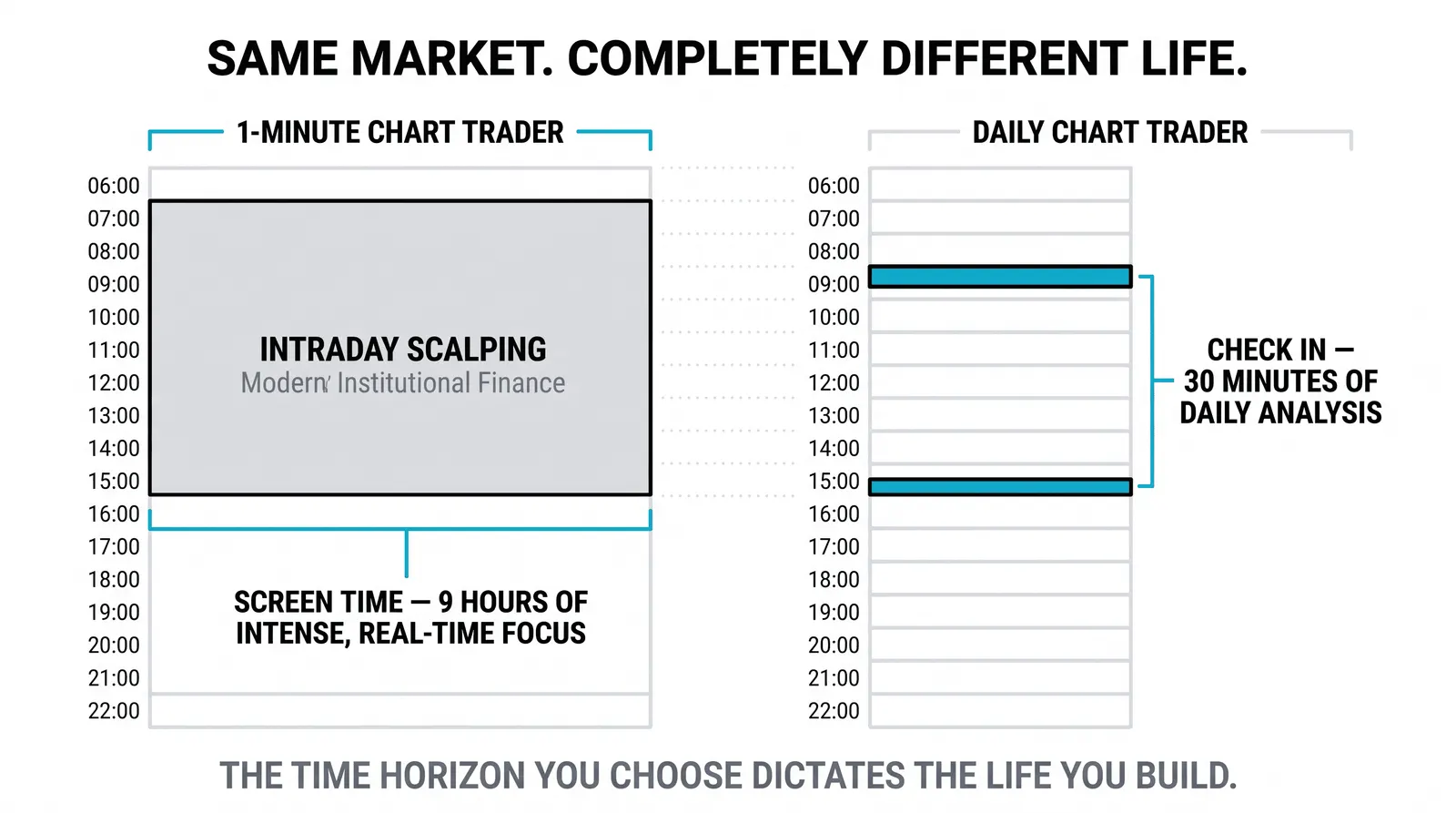
This is the part new traders skip. They pick a style because it sounds exciting, then discover the style requires them to stare at a screen at 9:30 in the morning while their employer expects them in a meeting. The strategy was fine. The schedule was impossible.
Your Timeframe Dictates Your Decisions
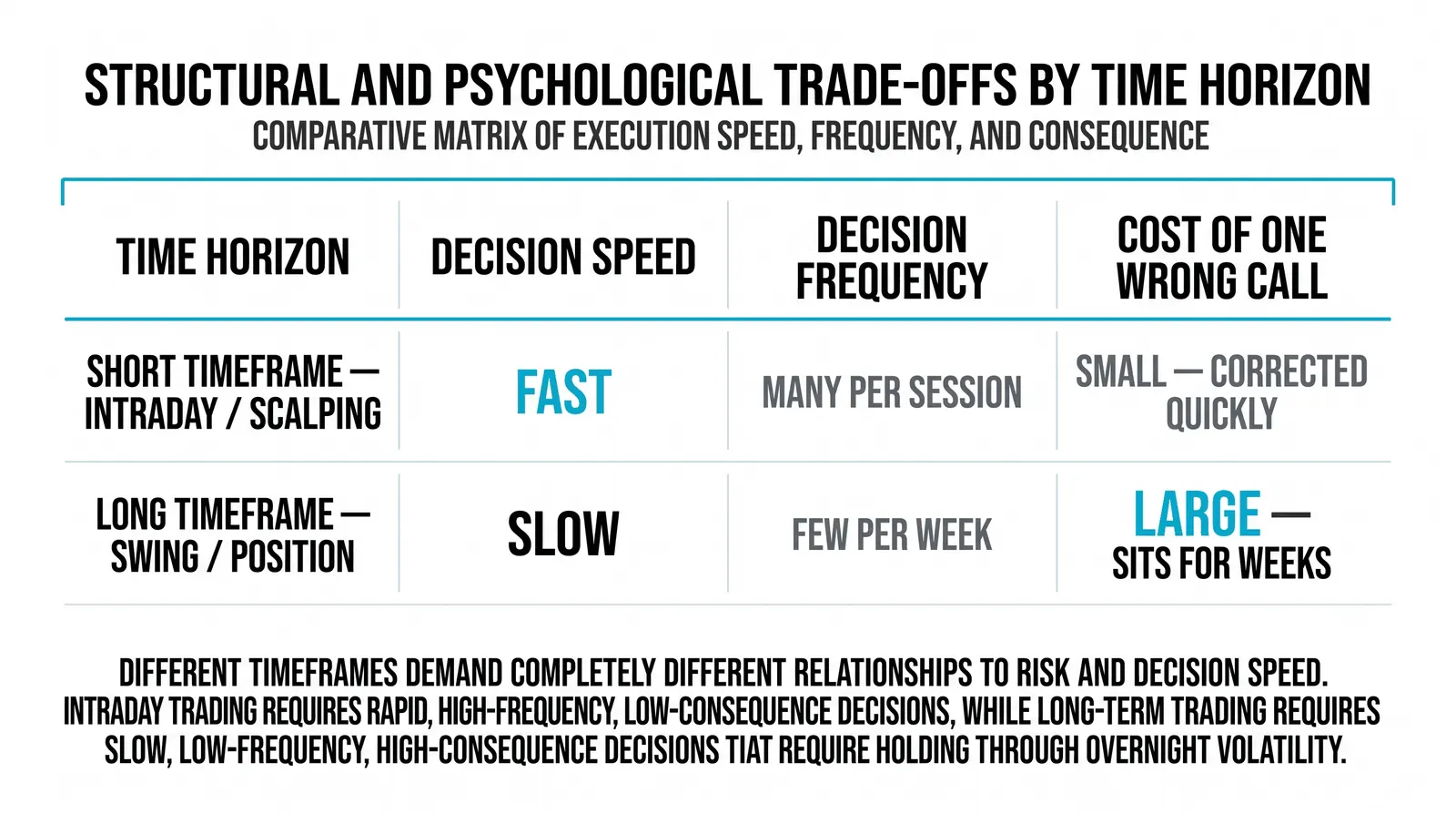
Count the bars. A 5-minute chart during a full session produces roughly 78 bars a day, close to 390 a week. A daily chart produces five bars a week. Each bar is a potential decision point, and each decision carries a cost.
More decisions mean more commissions and spreads paid, more chances to be wrong, and more emotional wear. A scalper might make twenty decisions before lunch. Each one is small, but the total cognitive load is heavy, and fatigue degrades judgment by the afternoon.
Slower charts flip the trade-off. Fewer decisions, but each one matters more. Stops sit wider because daily ranges are wider than five-minute ranges. Wider stops mean smaller position sizes to keep risk constant. A swing trader might hold a position for two weeks and make one decision the entire time.
Neither is better. They are different distributions of effort, cost, and stress. Faster charts concentrate your work into intense hours. Slower charts spread it thin and demand patience instead of reflexes.
The Mismatch Problem
The most common and expensive error among new traders is not a bad strategy. It is a mismatch between the timeframe and the life around it.
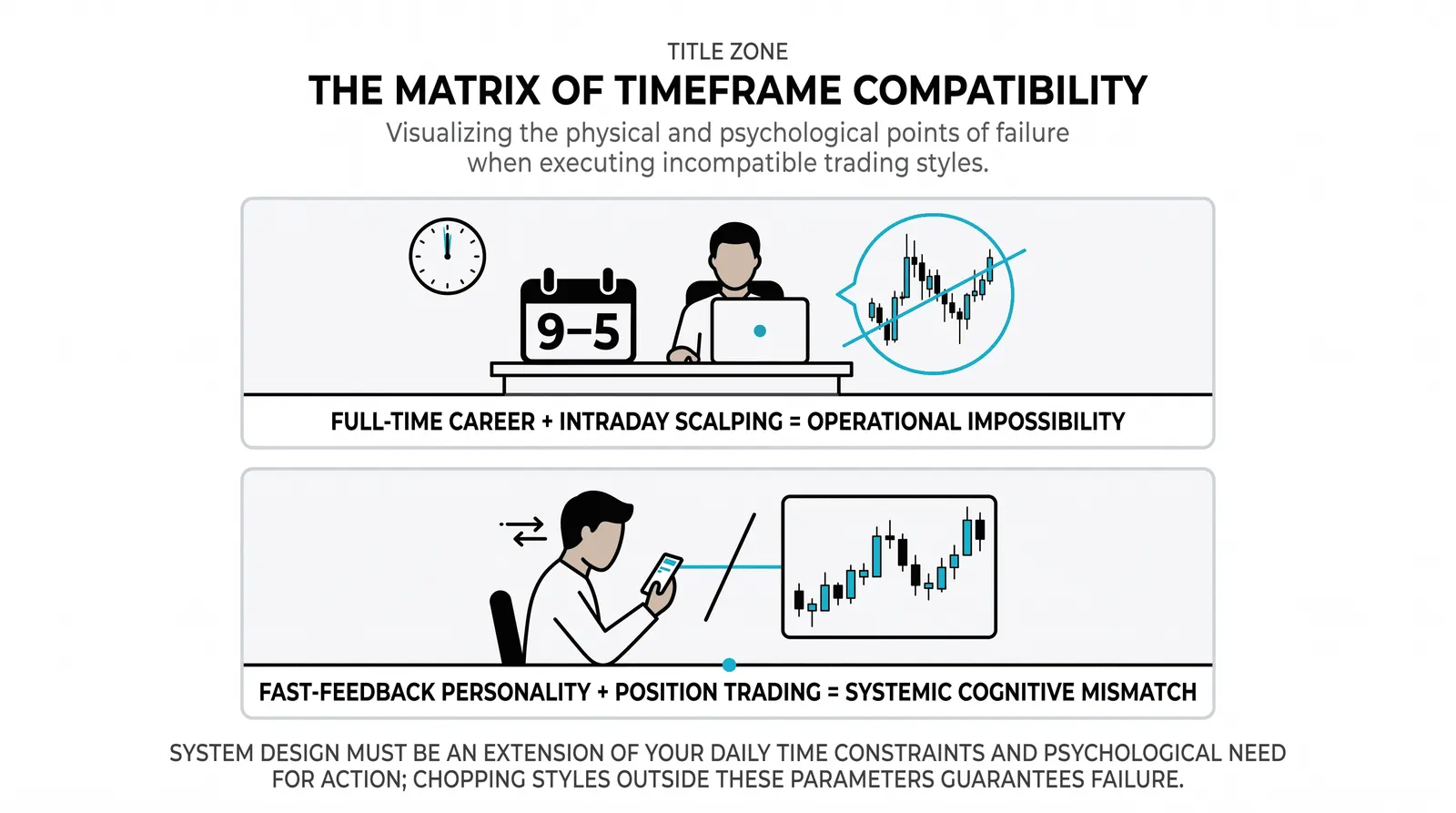
Two versions show up constantly. The first: a trader with a full-time job tries to trade 5-minute charts. They check their phone between meetings, enter late, exit in a panic, and blame their analysis. The analysis was irrelevant. They were never present for the job they signed up for.
The second: a restless trader on daily or weekly charts. The setup is fine, the position is working, but nothing happens for days and they get bored. They tinker, tighten the stop for no reason, or close a good trade early just to feel active. The style fails because the temperament fails.
Both failures look like trading problems. Both are actually scheduling problems. The market did not beat these traders. Their calendars did.
A Worked Example
Consider a hypothetical. Two traders, same $10,000 account, same stock, same month.
Trader A watches the 5-minute chart during work hours, phone on silent, glancing at it between tasks. Over the month they take three rushed mobile entries. Each entry is late because they saw the move minutes after it started. Two get stopped out for $150 each. One wins $100. Net result: minus $200, plus a month of distraction and low-grade anxiety.
Trader B checks the daily chart for twenty minutes after dinner. They spot one clean setup, plan the entry, the stop, and the target in advance, and place the order. The trade takes eight days to play out and nets $300. Total time invested: about three hours across the month.
Same account. Same market. Trader B did not out-analyze Trader A. Trader B picked a timeframe their life could actually serve, and Trader A picked one their life could not. The results had nothing to do with skill and everything to do with fit.
Choosing Before You Trade
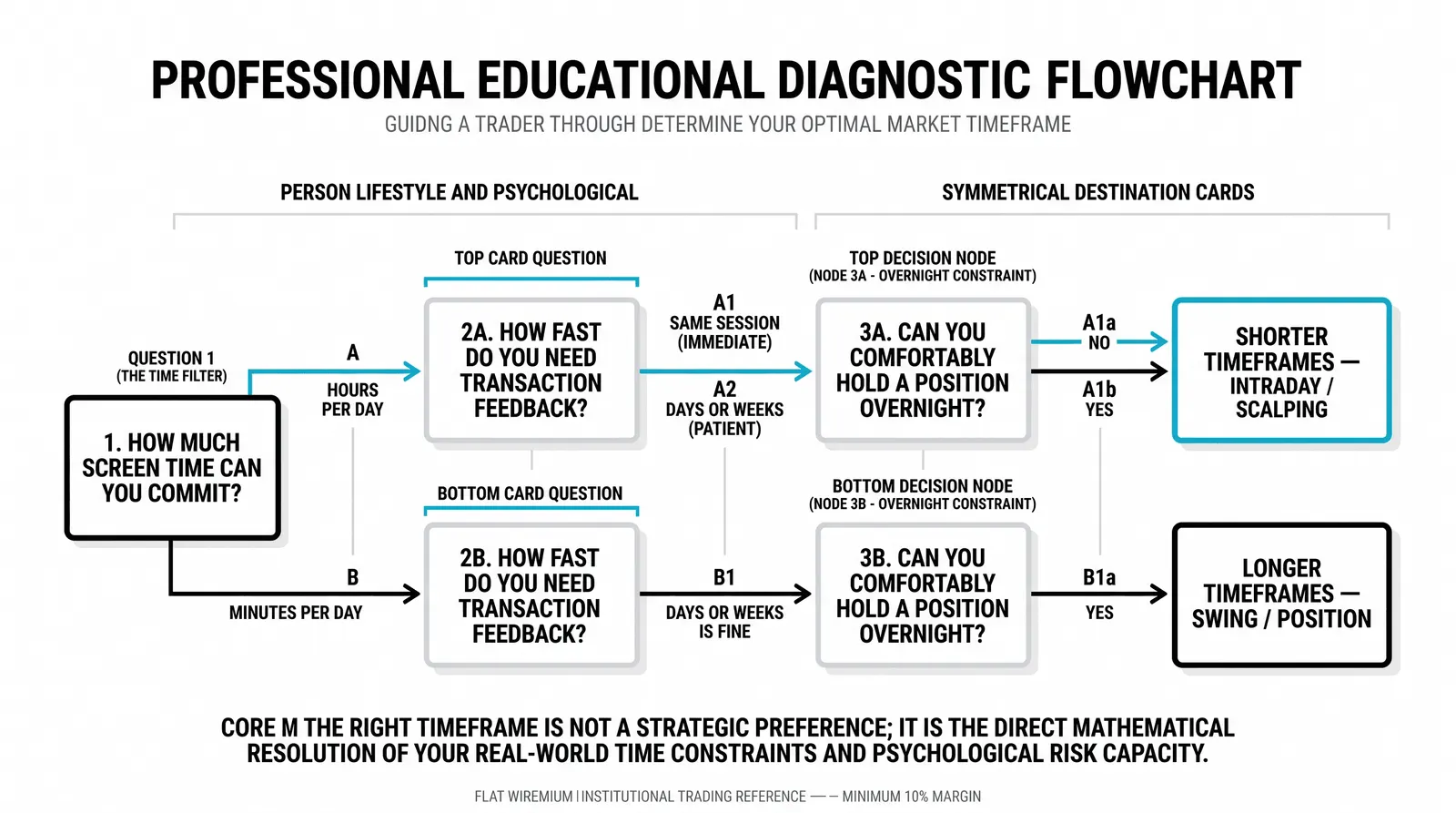
The correct order of operations runs opposite to what most beginners do. Do not pick a strategy and then try to squeeze your life around it. Audit your schedule first, pick the timeframe that schedule can serve, then find a strategy that lives on that timeframe.
- Write down your real availability. Not your hoped-for availability. Which hours can you actually watch a screen, and which hours are blocked by work, family, or sleep?
- Match the timeframe to the free hours. Free mornings near the open can support intraday charts. Only evenings free means daily charts. Only weekends free means weekly charts and position trading.
- Check your temperament honestly. If waiting two weeks for a trade sounds unbearable, slower charts will break you even if your schedule allows them. If rapid decisions under pressure sound miserable, faster charts will break you even if your mornings are free.
- Then choose the strategy. Only after the timeframe is fixed does the strategy question make sense.
Here is how the main options compare side by side.
| Timeframe | When You Actually Work | Decisions per Week | Who It Fits |
|---|---|---|---|
| 1 to 5 minute | Full attention during the session, especially the open | 50 to 200+ | Full-time traders with free mornings and fast temperaments |
| 15 to 60 minute | Several check-ins during the session | 15 to 50 | Day traders with flexible daytime schedules |
| 4 hour | Two or three check-ins per day | 5 to 15 | Traders with partial daytime availability |
| Daily | 20 to 30 minutes after the close | 1 to 5 | People with full-time jobs and patient temperaments |
| Weekly | An hour or two on the weekend | 1 or fewer | Position traders and long-term investors |
Notice what the table does not contain: profit potential. Every row can make money and every row can lose it. The difference between them is the life they require, not the returns they promise.
Questions About Timeframes
Can I trade a faster timeframe part-time?
Not reliably. Fast timeframes demand presence during specific hours, usually the session open, and the market does not wait for your lunch break. If you cannot guarantee those hours, the faster chart will punish you with late entries and distracted exits. Trade the timeframe your hours can actually cover.
Does the timeframe change my risk?
Yes, in both directions. Faster charts allow tighter stops and larger position sizes per trade, but they multiply the number of trades, so costs and small losses accumulate quickly. Slower charts require wider stops and smaller positions, but you make far fewer decisions. Risk per trade can be identical; the distribution of that risk across time is what changes.
Should I match my timeframe to my job?
Yes, before anything else. If your job blocks the market open, intraday charts are off the table no matter how appealing they look. Daily and weekly charts exist precisely for people whose working hours belong to someone else. Build your trading around your life, not the reverse.
Can I change timeframes later?
Yes, and many traders do as their circumstances change. A new job, a new child, or more free capital can all justify a shift. Treat it as starting over in one respect: paper trade the new timeframe first, because the pace, the stop placement, and the emotional rhythm are genuinely different skills.
Once you have an honest answer on schedule and temperament, the next step is matching that timeframe to a concrete strategy with defined entries, exits, and risk rules. That is where the styles you studied earlier stop being descriptions and start being plans.