How to Match Your Temperament to a Trading Style
Your trading style is the way you participate in markets that fits the hours you actually have, the patience you actually have, and how you behave when money is moving. That fit matters more than the style's theoretical edge. Mismatches between temperament and style sink more beginners than bad analysis does, because a style you cannot live with gets abandoned at exactly the wrong moment.

Choosing a trading style without checking your temperament is buying a suit without trying it on: it looks right on the hanger and splits the first time you move.
Why Temperament Is Not Optional
Every style looks good on paper. The question is whether you can execute it on a bad Tuesday.
You will abandon a style you cannot live with. That is not a prediction about weak people. It is what happens to almost everyone who picks a style for its profit stories instead of its daily demands.
And the abandonment always comes at the worst moment. The swing trader who cannot stomach watching a position drop closes the trade at the low, days before the setup plays out. The day trader who cannot sit still overtrades the quiet midday hours and gives back the morning's gains.
The market does not punish your analysis in these moments. It punishes the mismatch.
The Four Traits That Actually Matter
Forget vague labels like "aggressive" or "conservative." Rate yourself honestly, one to five, on four specific traits.
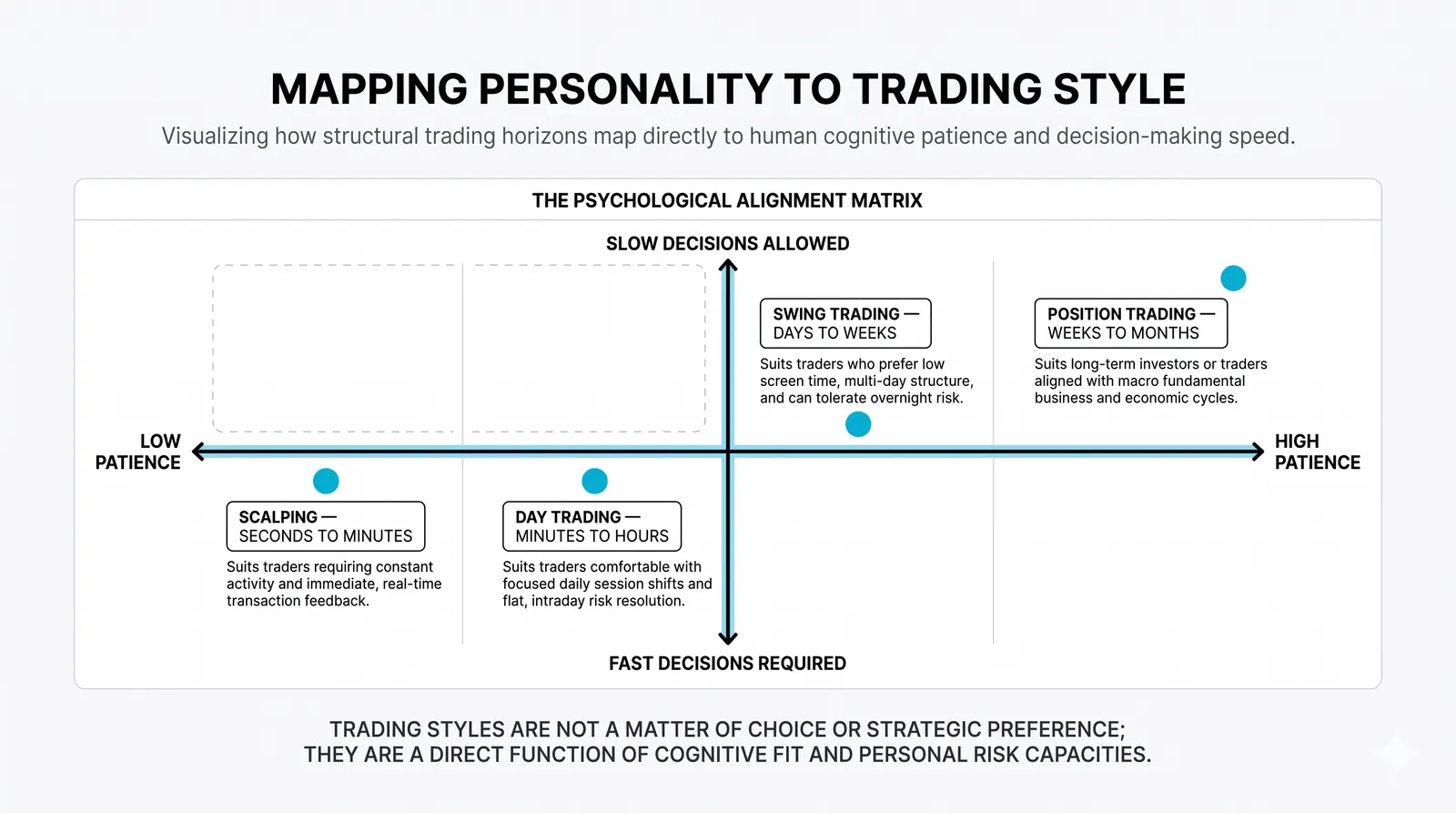
- Patience for waiting. Can you watch a chart do nothing for days without forcing a trade? High scores point toward swing and position trading. Low scores point toward day trading or scalping.
- Decisiveness under time pressure. Can you act in seconds without freezing or second-guessing? High scores suit scalping and day trading. Low scores suit slower styles where decisions happen after the close.
- Tolerance for drawdown. Can you watch an open position move against you without touching it? High scores fit swing and position trading, where heat on a trade is normal. Low scores fit fast styles with tight stops.
- Need for action. Do you feel restless when you are not in a trade? High scores push you toward active styles, or toward trouble. Low scores make waiting painless.
Be honest with the numbers. Nobody sees them but you, and lying here costs real money later.
Audit Your Actual Schedule
Traits are half the equation. The other half is the clock.
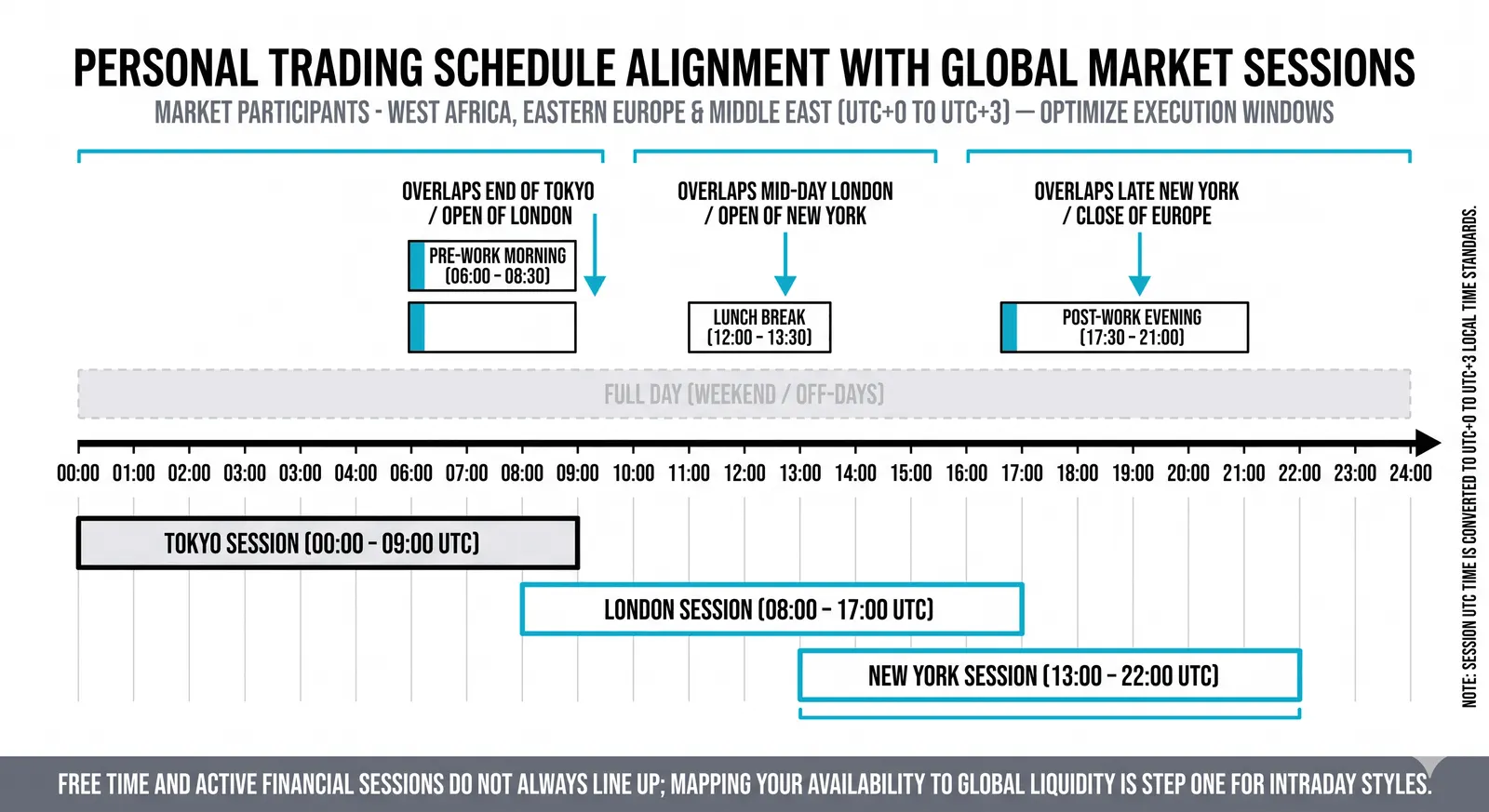
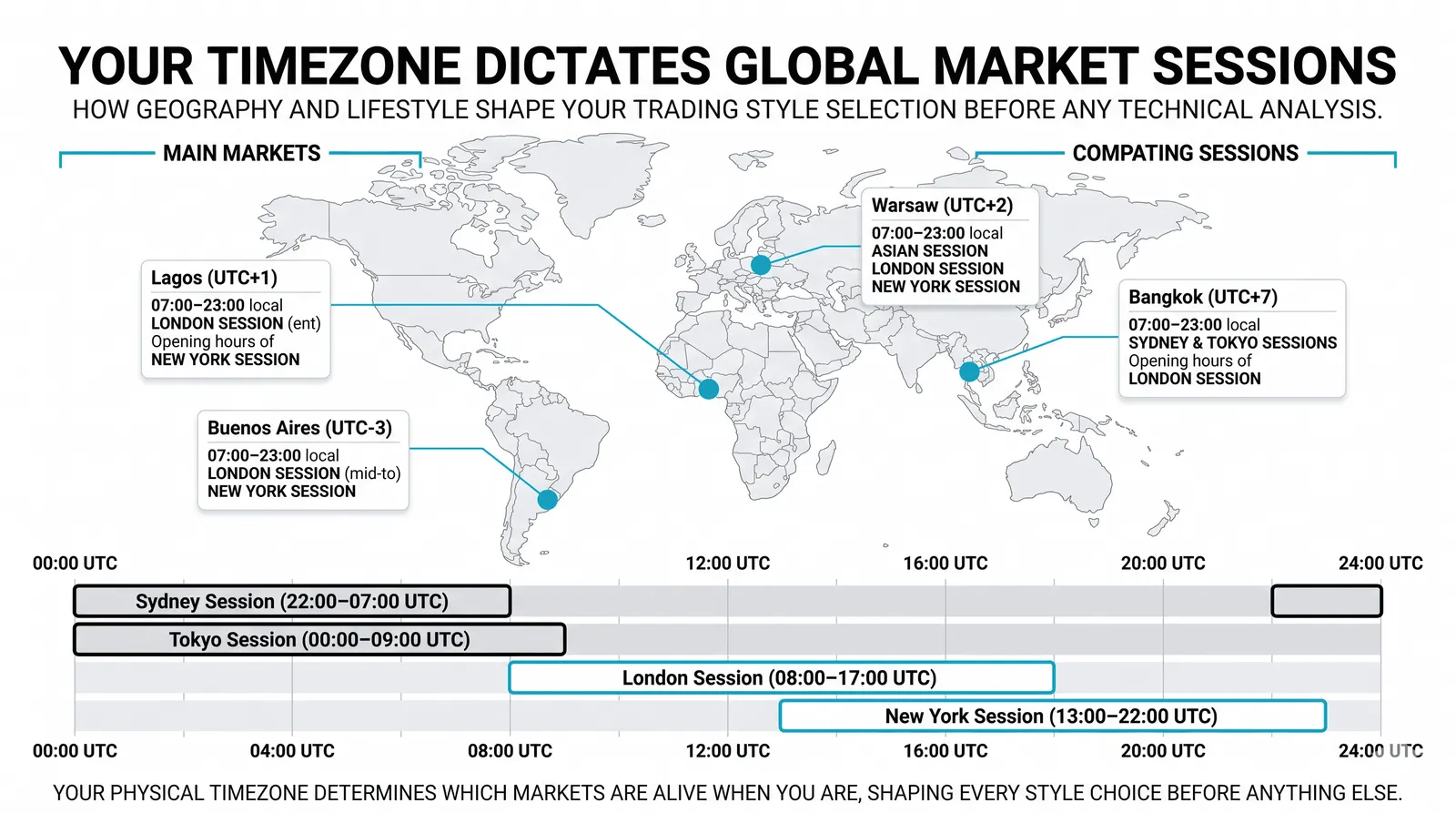
Write down which market hours you can genuinely cover. Not the hours you wish you had. The ones you have after work, sleep, family, and the meetings you cannot skip.
Include the messy parts. The week you travel. The school run. The deadline months at your job. A style has to survive your worst week, not your best one.
If your honest answer is thirty minutes in the evening, day trading is closed to you. That is not a limitation to fix. It is a fact to build around, and end-of-day swing trading exists precisely for that life.
First Job or Second Job
Now the harder conversation. What is trading to you right now?
Three numbers define the answer: capital you can afford to risk, hours you can commit, and stress you can carry home without it leaking into the rest of your life.
If trading is a second job squeezed around a first one, any style that needs your daytime focus is closed until your life changes. No indicator fixes a schedule. No alert app turns a commute into a trading desk.
This is not defeatism. Position trading and swing trading were built for people with careers. Plenty of consistent traders check charts once a day and beat the hyperactive majority precisely because they are not forcing trades.
Pick the style your life can fund with time and attention. Upgrade later if the life changes.
Same System, Two Traders, Opposite Results
Here is a hypothetical with round numbers. Two traders run the identical breakout system on the same stock.
Trader A is patient and schedule-bound. They take the daily-chart version: five setups in a month, each risking $200. They win three of five at a two-to-one reward: three wins of $400 and two losses of $200, a net of $800 and a calm month.
Trader B is action-hungry. They run the same system but cannot wait for daily setups, forcing eight extra intraday entries the system never generated. Six of them lose $100 each, and fees eat another $100. Their five legitimate trades make the same $800 as Trader A, but the impulse trades cost $700.
Same system. Same stock. Same month. Trader A finishes up $800. Trader B finishes up $100 and exhausted.
The difference was never the method. It was the fit between the method and the person running it.
Matching Traits to Styles
Use this table as a starting filter, not a verdict.
| Temperament Trait | Styles That Fit | Styles to Avoid |
|---|---|---|
| High patience, low need for action | Position trading, swing trading | Scalping |
| Fast decisions, calm under pressure | Scalping, day trading | Position trading |
| High tolerance for drawdown | Swing trading, position trading | Scalping |
| High need for action | Day trading (with strict rules) | Position trading |
| Low stress capacity, limited hours | Position trading, long-term investing | Day trading, scalping |
Notice that every trait closes some doors and opens others. There is no best row. There is only your row.
Questions About Trading Style
Can my temperament change over time?
Yes, slowly. Screen time builds tolerance for drawdown, and boredom with overtrading often cures the need for action. But plan for the temperament you have today, not the one you hope to have in three years.
What if I am impatient by nature?
Then pick a faster style with strict rules, or add structure that protects you from yourself. Hard limits on trades per day turn impatience from an account killer into a manageable trait.
Does my capital decide my style?
Partly. Small accounts struggle with position trading because returns feel trivial, and large accounts make scalping pointless. But capital narrows the options; temperament makes the final call.
Can I train myself into a style that does not fit?
Rarely, and the cost of trying is usually paid in losses. Discipline can stretch you one notch in either direction. It cannot turn a restless trader into a patient one, and forcing it delays finding the style where you would have thrived.
Once you have a shortlist that fits your traits and your calendar, the next step is testing it properly. Paper trading a style for a month will tell you more about the fit than any self-assessment, and how to test an approach before committing to it is where we go next.