Investing vs Trading
Investing vs trading comes down to one question: are you buying the thing, or are you buying the move? Investing means buying a stake in something to own its results over years. Trading means buying and selling the price movement itself, over minutes to months. The instrument can be identical. Your relationship to time and to ownership is not.

This lesson is not about how to read a market. Another lesson covered technical versus fundamental analysis, which are two ways of forming an opinion. This one is about participation: what you do after you have an opinion, and what the clock does to every decision you make.
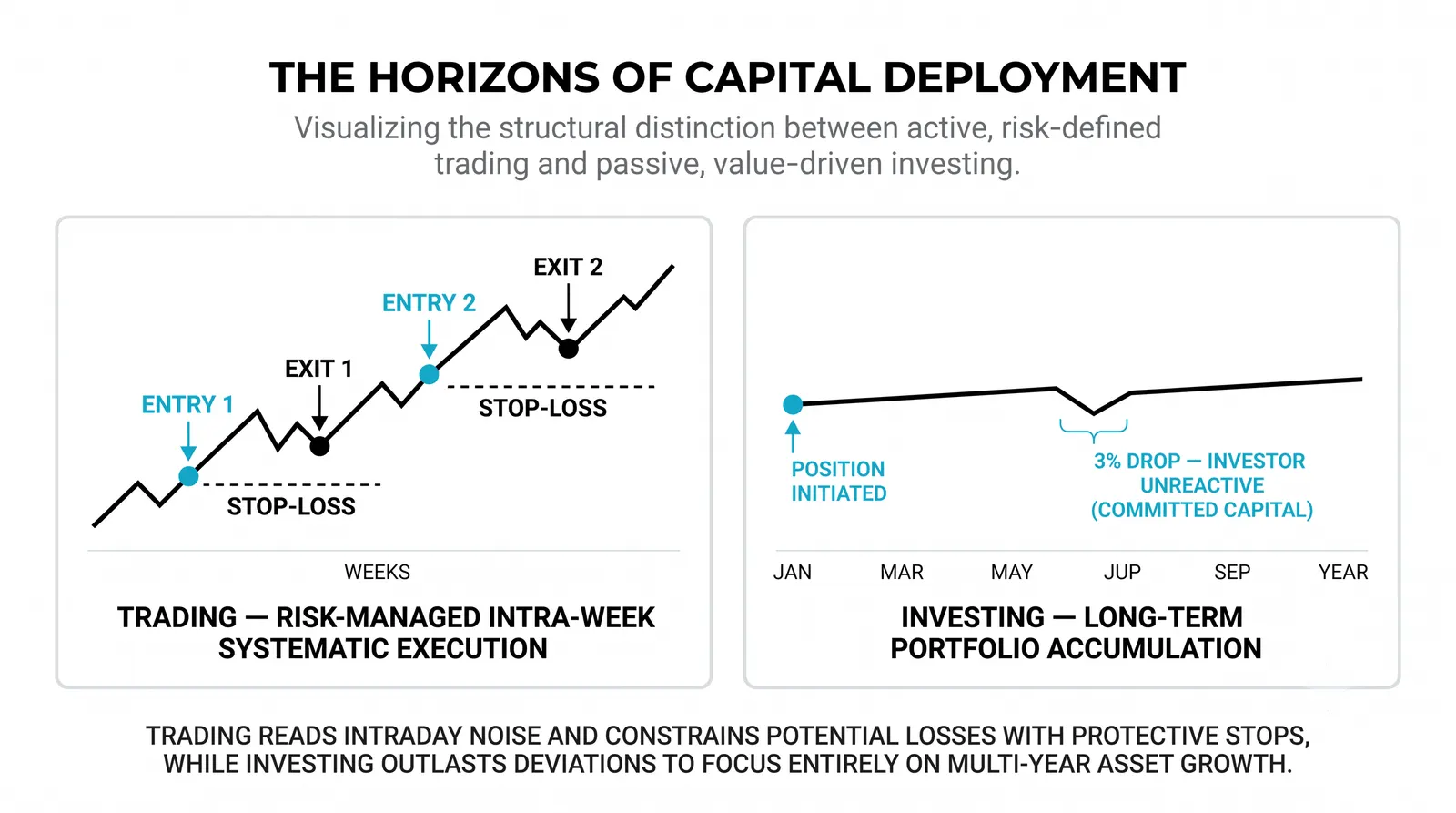
What Actually Separates Them
Start with purpose. An investor wants the business or asset's future. They buy a share of a company because they believe its earnings, products, or assets will be worth more in five or ten years. A trader wants the move between two prices. They buy at 40 because they expect to sell at 44, and the company's five-year plan is mostly irrelevant.
Then look at evidence. The investor's evidence is business results: revenue, margins, debt, competitive position. The trader's evidence is price behavior: trend, levels, volume, momentum. Each can ignore the other's evidence entirely and still be doing their job correctly.
Finally, time. Investing is measured in years. Trading runs from minutes to months. That gap in the clock is not a detail. It changes what every piece of information means, which is the next section.
Think of it like a landlord versus a house flipper. Same building, completely different job.
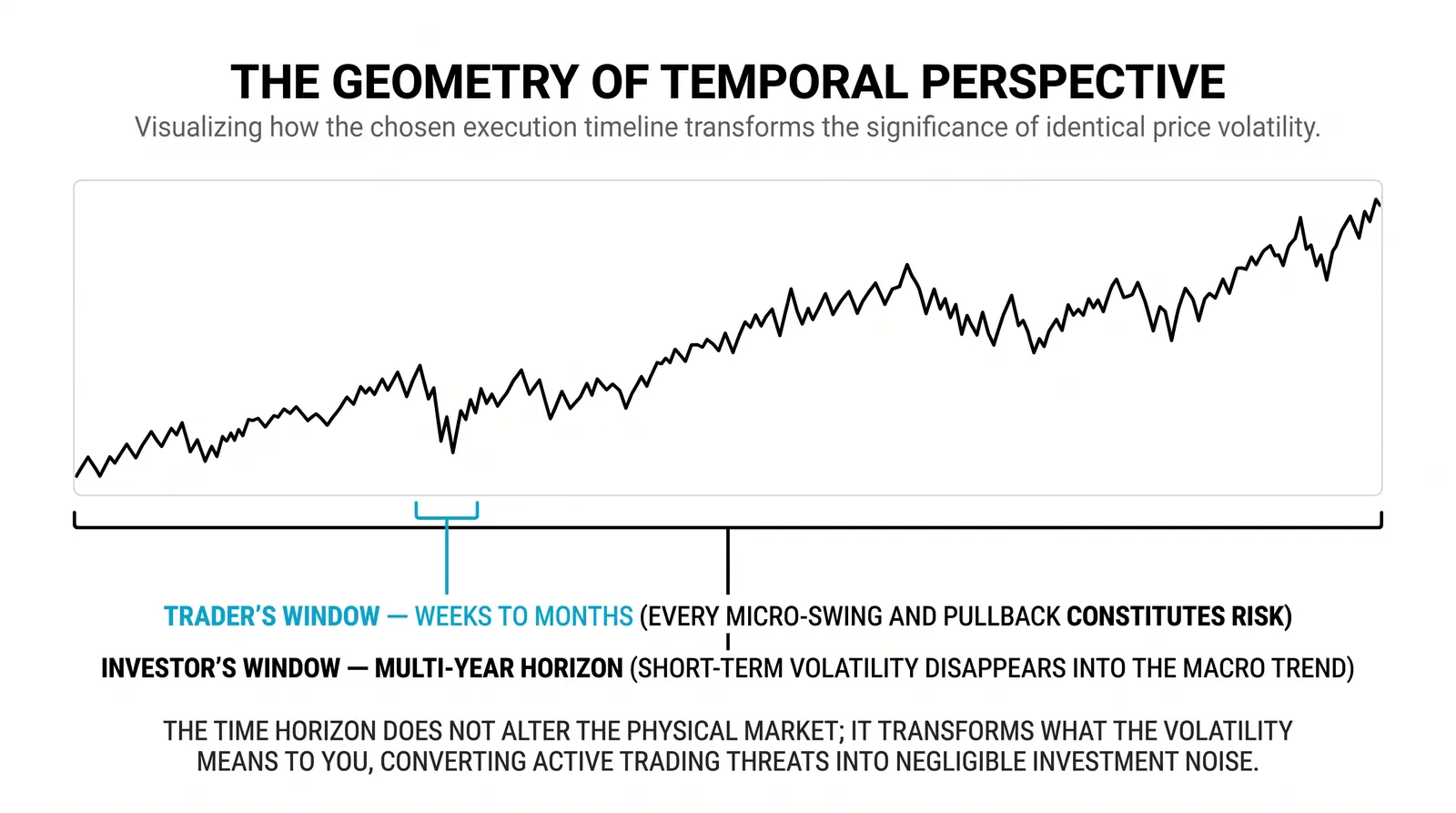
How the Clock Changes Every Decision
Take a 20 percent drop in a stock. To an investor who has rechecked the business and found it intact, that drop is a discount. The same asset costs less. To a trader, that same drop is a stop-out. His reason for entering was a price pattern, the pattern failed, and the position is closed. Neither reaction is emotional. Both are mechanical consequences of the job.
Headlines work the same way. A quarterly earnings miss is noise to an investor whose thesis spans a decade. To a trader holding a two-week position, that headline is a trigger. Same words on the screen, opposite instructions.
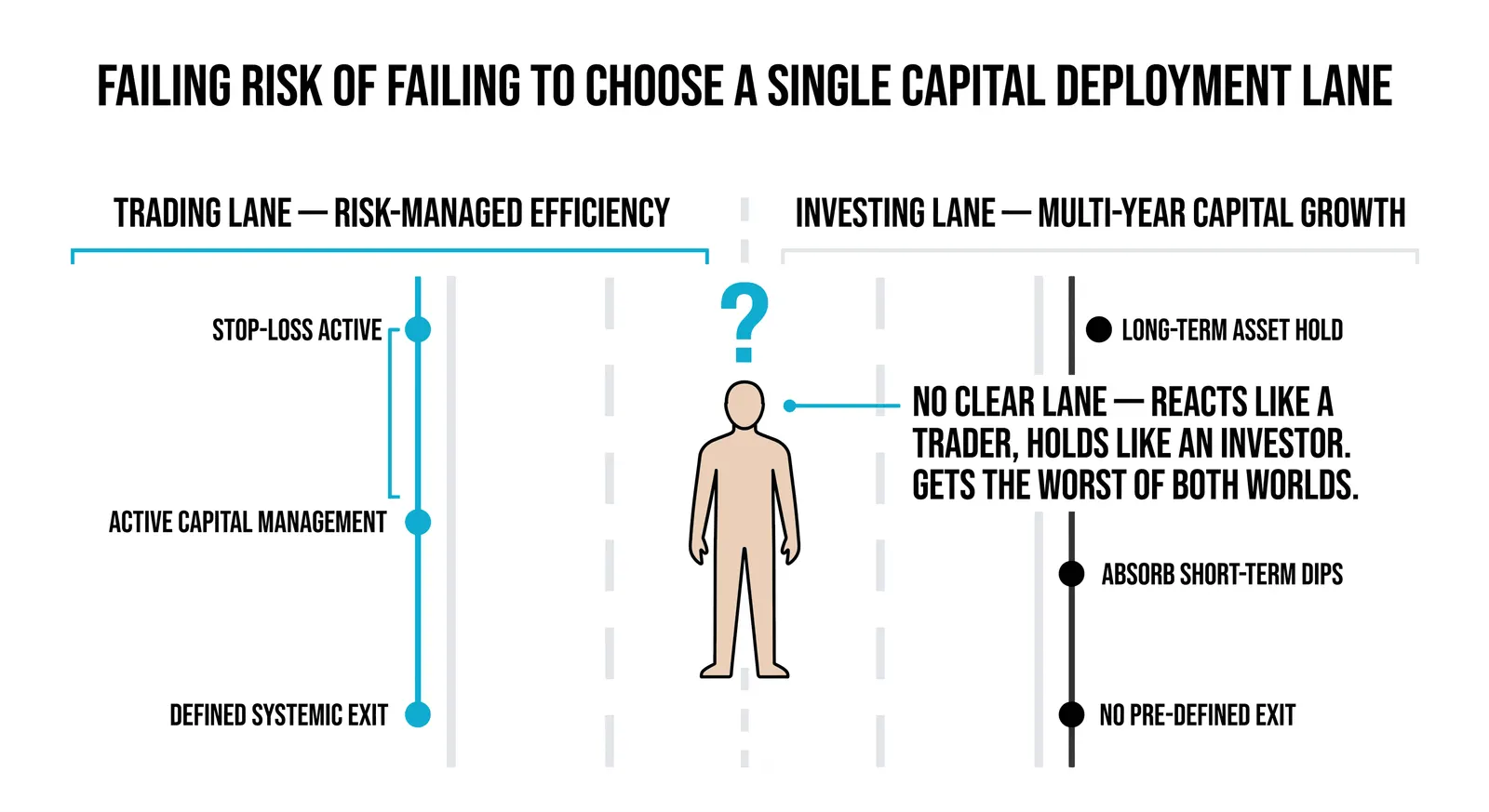
Confusing the two jobs is where accounts get hurt. The classic failure: someone enters a trade, the trade goes against them, and they suddenly become an "investor" to avoid taking the loss. The reverse happens too. Someone buys a solid long-term stake, watches it dip 8 percent, and panic-sells like a trader whose stop was hit. They switched jobs mid-loss, in the direction that felt better, and that direction is usually wrong.
Decide your job before you enter. Write it down if you have to.
Where Position Trading Sits
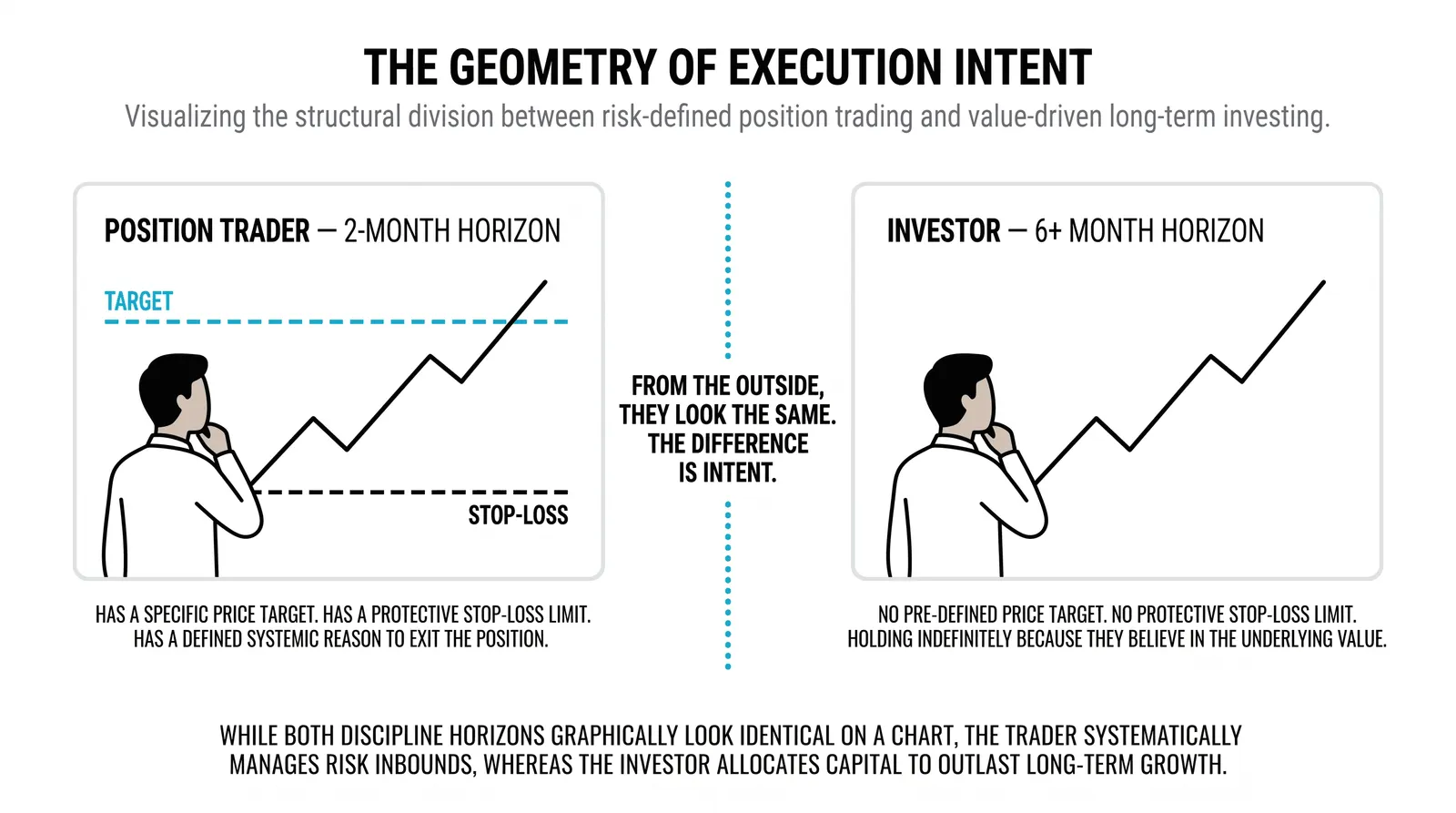
Position trading is the bridge between the two. A position trader holds for weeks to months, sometimes longer. That holding period demands the patience of investing: you sit through pullbacks, you ignore daily noise, you let a thesis develop.
But it is still trading. The evidence is price behavior, not business results. There is a plan with an entry, an exit, and a point where the idea is wrong. A position trader does not fall in love with the asset. When the move is done or the setup breaks, the position closes, no matter how good the company's story sounds.
This style suits people who cannot watch a screen all day but want more activity than buy-and-hold. It is slower decisions with a trader's discipline.
A Worked Example
Here is a hypothetical with round numbers. A broad market selloff drags a stock from 50 down to 40 over several weeks.
The investor owns shares from 45. They recheck the business: revenue steady, debt manageable, nothing about the company changed, only the market's mood did. They buy more at 40, lowering the average cost. Their job is to own results, and the results are intact.
The trader bought at 48 on a breakout setup with a stop at 46. They were stopped out weeks ago for a small, planned loss, and watch the drop to 40 from the sidelines, unbothered, waiting for the next setup. Their job was the move, and the move failed.
Both acted correctly. Now flip it. If the investor had panic-sold at 41 because the chart looked scary, they abandoned the job. If the trader had moved the stop down and "held for the long term" at 40, they abandoned theirs. The falling knife that hurts people is usually a trade they refused to exit. The panic-sold stake that hurts people is usually an investment they never gave time to work.
Costs and Behavior
Frequency multiplies costs. A trader who enters and exits fifty times a year pays spreads, commissions, and slippage fifty times. Each trade starts slightly underwater. Trading must overcome that friction before it earns anything, which is one reason most short-term traders underperform their own ideas.
Infrequency multiplies temptation. An investor who acts twice a year spends the other 363 days watching prices wiggle and resisting the itch to do something. Boredom is the investor's main opponent. Overtrading is the trader's.
Neither cost shows up on a chart. Both are real, and both compound.
Three Styles Side by Side
| Investing | Position Trading | Day Trading | |
|---|---|---|---|
| What you actually own during the hold | A stake in a business or asset | A price position with a plan | A price position, closed by day's end |
| Main evidence | Business results | Price behavior on higher timeframes | Price behavior on intraday timeframes |
| Typical holding period | Years | Weeks to months | Minutes to hours |
| How often you decide | A few times a year | A few times a month | Many times a day |
None of these is morally better. They are different jobs with different costs, different skills, and different demands on your attention and temperament.
Questions About Investing vs Trading
Can I invest and trade at the same time?
Yes, and many people do, but keep the two in separate accounts or at least separate records. Mixing them in one pot is how a losing trade quietly becomes a "long-term hold." Give each job its own money, its own rules, and its own scorecard.
Which one makes more money?
Neither has a guaranteed edge; outcomes depend on skill, discipline, and costs. Trading offers more opportunities per year but charges more friction and punishes mistakes faster. Investing is slower and more forgiving of timing errors but demands patience through deep drawdowns. Anyone promising you a specific return from either is selling something.
Does investing need charts at all?
Not for the core decision, which rests on the business or asset itself. Some investors glance at a chart to avoid buying during obvious manias or to stagger entries, but a chart is a tool for timing, not a substitute for knowing what you own.
Which fits a total beginner?
Investing is the gentler starting point because mistakes unfold slowly and costs stay low. If trading appeals to you, start with position trading on a small size or a practice account. Day trading has the steepest learning curve and the fastest feedback, which makes it the most expensive classroom.
Once you know which job you want, the next step is learning how to size a position so no single decision can sink you. That is where risk management comes in, and it applies to every style on the table above.