Swing Trading
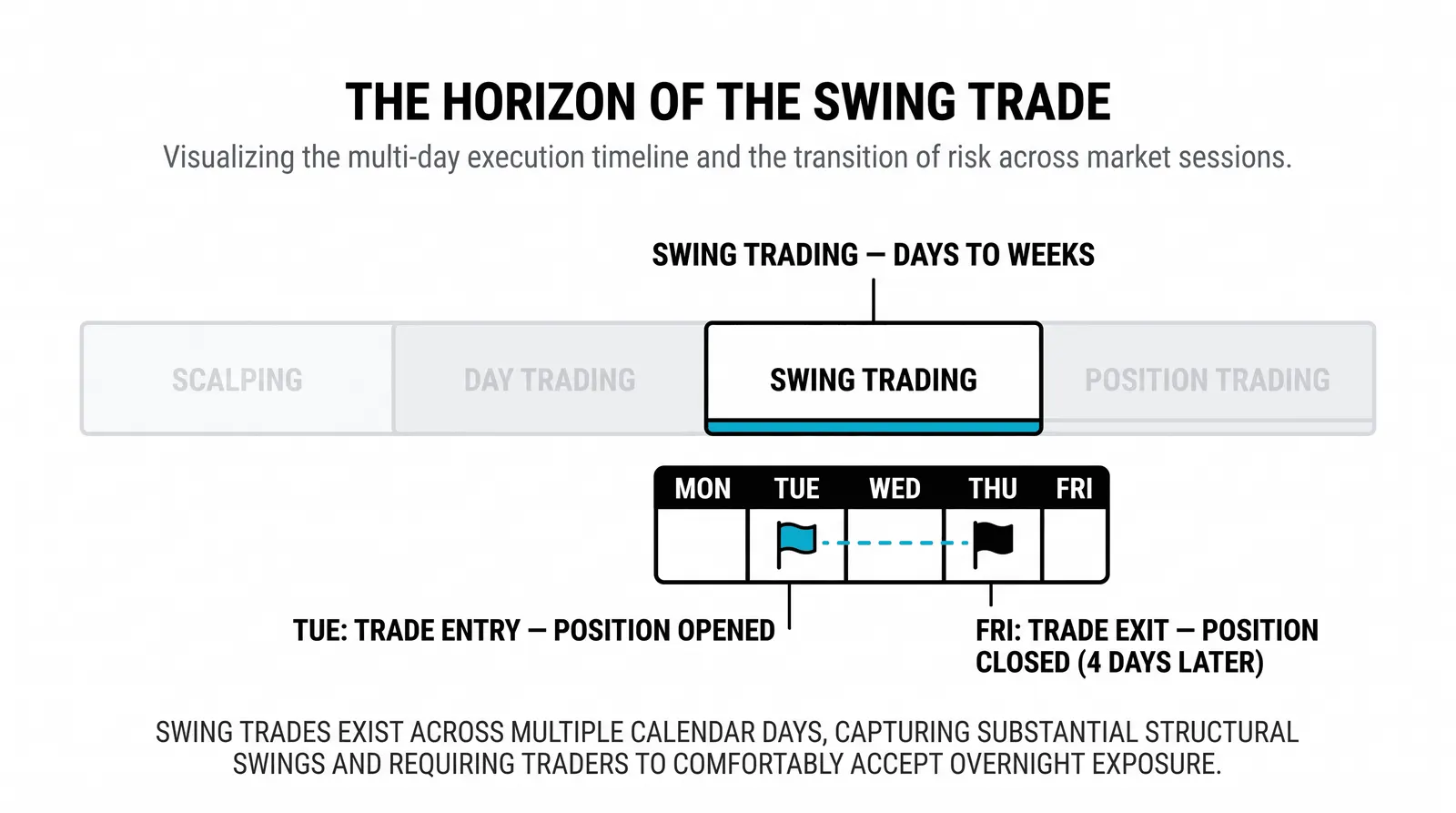
Swing trading means holding positions for days to weeks, aiming to capture one swing of the market: the move from one turning point to the next, not every wiggle inside it. You are not trying to catch the open, the lunch dip, and the afternoon rally. You are trying to catch the one meaningful leg in between.

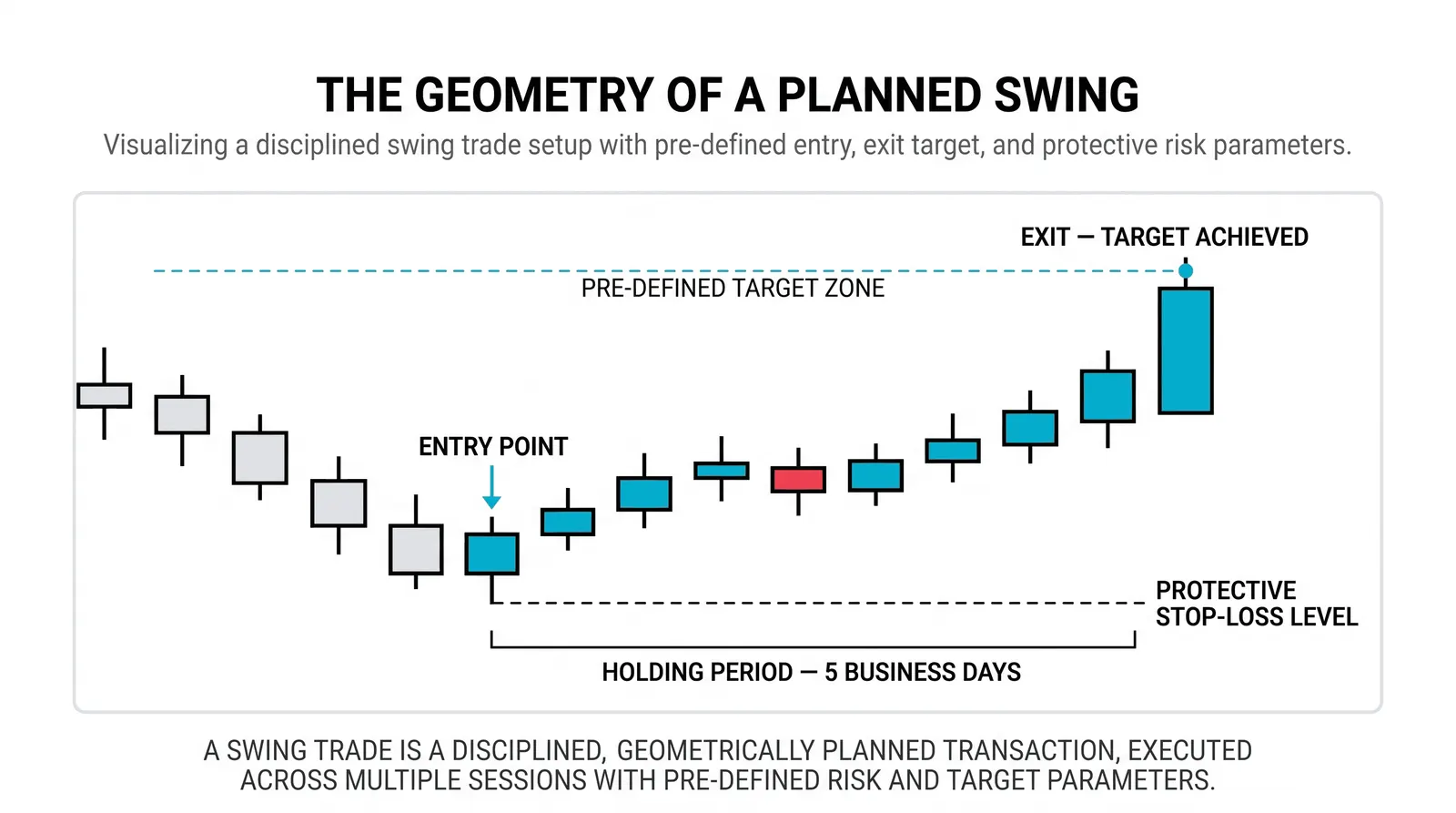
A swing trader rides the wave, not each ripple on top of it. That single idea shapes everything else about the style: how often you decide, where your stops sit, and how much of your day the market gets to claim.
What a Swing Actually Is
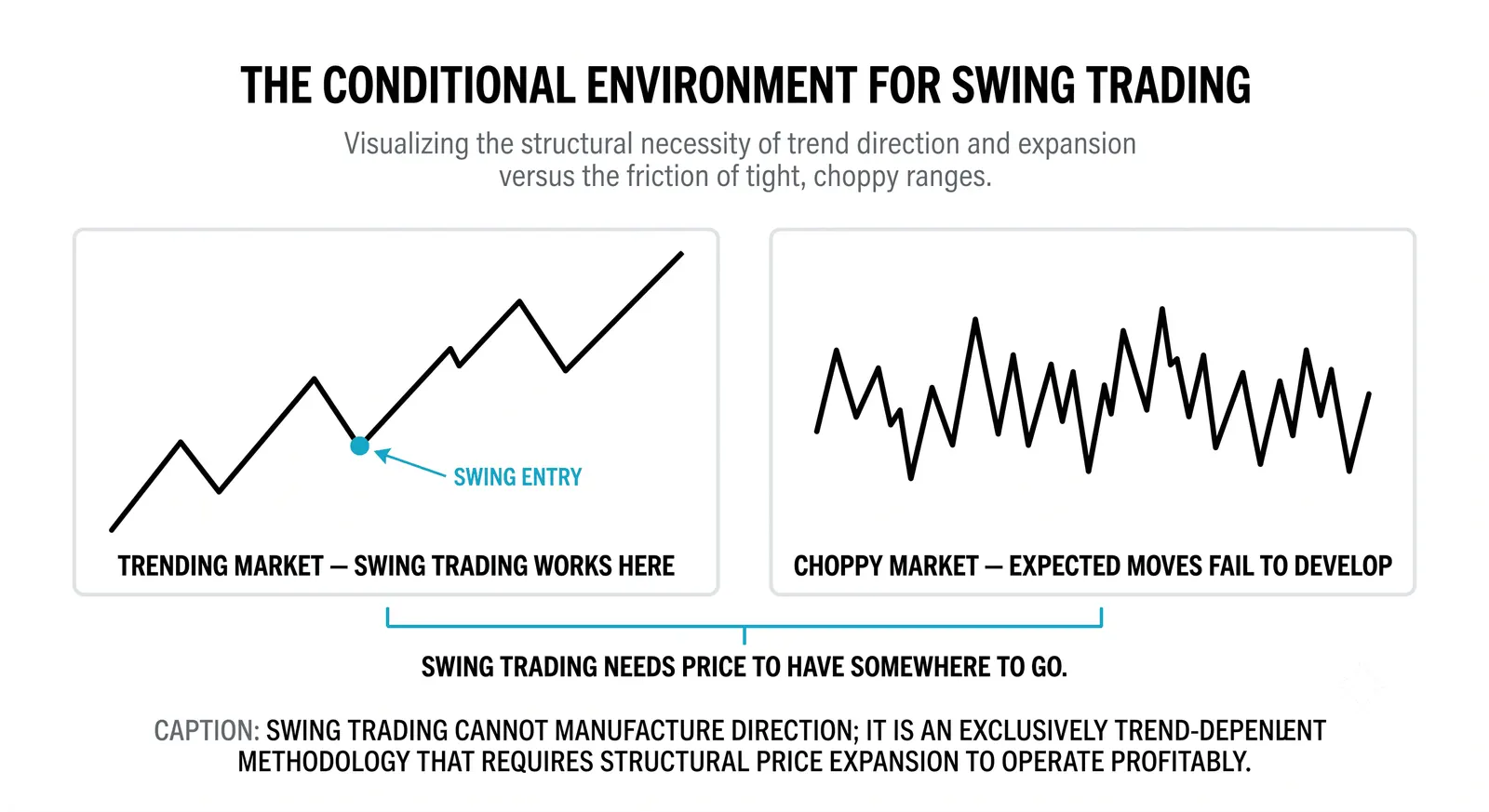
A swing is one directional leg. An advance off a low is a swing up. A decline off a high is a swing down. Price rarely moves in a straight line, so trends are really chains of these legs, separated by pullbacks and pauses; market structure is the map of them.
The swing trader's job is to own one of those legs. You enter after the turn is underway, once there is evidence the new direction has started. You exit before the next counter-move matures, handing the position off to someone else.
This means you deliberately give up both edges of the move. You will not buy the exact low, and you will not sell the exact top. Traders who cannot accept that end up turning a three-day hold into a three-week ordeal.
The Pace of Decisions
Swing trading runs on a weekly rhythm, not a minute-by-minute one. Most swing traders carry a handful of positions at a time, often three to eight. The daily chart is home base, with the weekly chart for context and the hourly chart only for fine-tuning entries.
Decisions are measured per week, not per hour. A typical evening routine is twenty to forty minutes: review open positions, scan for new setups, place or adjust orders. Then you close the platform.
Most of the job is waiting. You wait for the setup, then you wait for the trade to work. Beginners often find this harder than any chart reading, because doing nothing feels like doing something wrong. It is not. Boredom is part of the style's price; plan around it instead of treating it as a malfunction.
Holding Through Noise
Nobody warns you about this: your position will spend days underwater. A trade that eventually wins might sit red for three of its nine days. Any given Wednesday, your open P&L may look like a mistake.
The plan has to survive a pullback that would shake out a day trader. A normal retracement inside an uptrend is not a failed trade. It is the cost of admission for holding the swing.
This is why swing stops sit wider and position sizes sit smaller. A wide stop with full size is just a big loss waiting for a date. The math has to work together:
- Wider stop, because the trade needs room to breathe through normal pullbacks.
- Smaller position, so the wider stop still risks the same fixed amount of money.
- Fewer positions, so correlated pullbacks do not hit everything at once.
Risk per trade stays constant. Only the share count changes.
A Worked Example
Here is a hypothetical trade with round numbers, to show how few decisions a swing actually requires.
A stock in an uptrend bases around $40 for several weeks. It then breaks out and trades up to $43. The swing trader does not chase the breakout candle and waits for the break to confirm, then enters near $41.50 on the first orderly pullback that holds.
The stop goes under the last higher low, at $38.50. That is $3.00 of risk per share. The target is the $48 area, where the last rally stalled. That is roughly $6.50 of potential reward, a bit better than two-to-one.
The trade runs nine days. It dips to $40.80 on day four, which feels terrible and changes nothing. Price reaches the target zone, momentum stalls, and the trade closes at $47.20.
Total decisions: three. Entry, stop placement, exit. Nine days of market noise, three actual choices. That ratio is the whole point of the style.
Swing Trading vs Day Trading vs Position Trading
These three styles differ mostly in time horizon, and everything else follows from that. None is superior. They suit different schedules and temperaments.
| Day Trading | Swing Trading | Position Trading | |
|---|---|---|---|
| Typical holding period | Minutes to hours, flat by the close | Days to weeks | Weeks to months |
| Decisions per month | Dozens to hundreds | Roughly 5 to 20 | A handful |
| Screen time | Hours during the session | 20 to 60 minutes daily | Weekly check-ins |
| Overnight exposure | None | Yes, every position | Yes, through earnings and cycles |
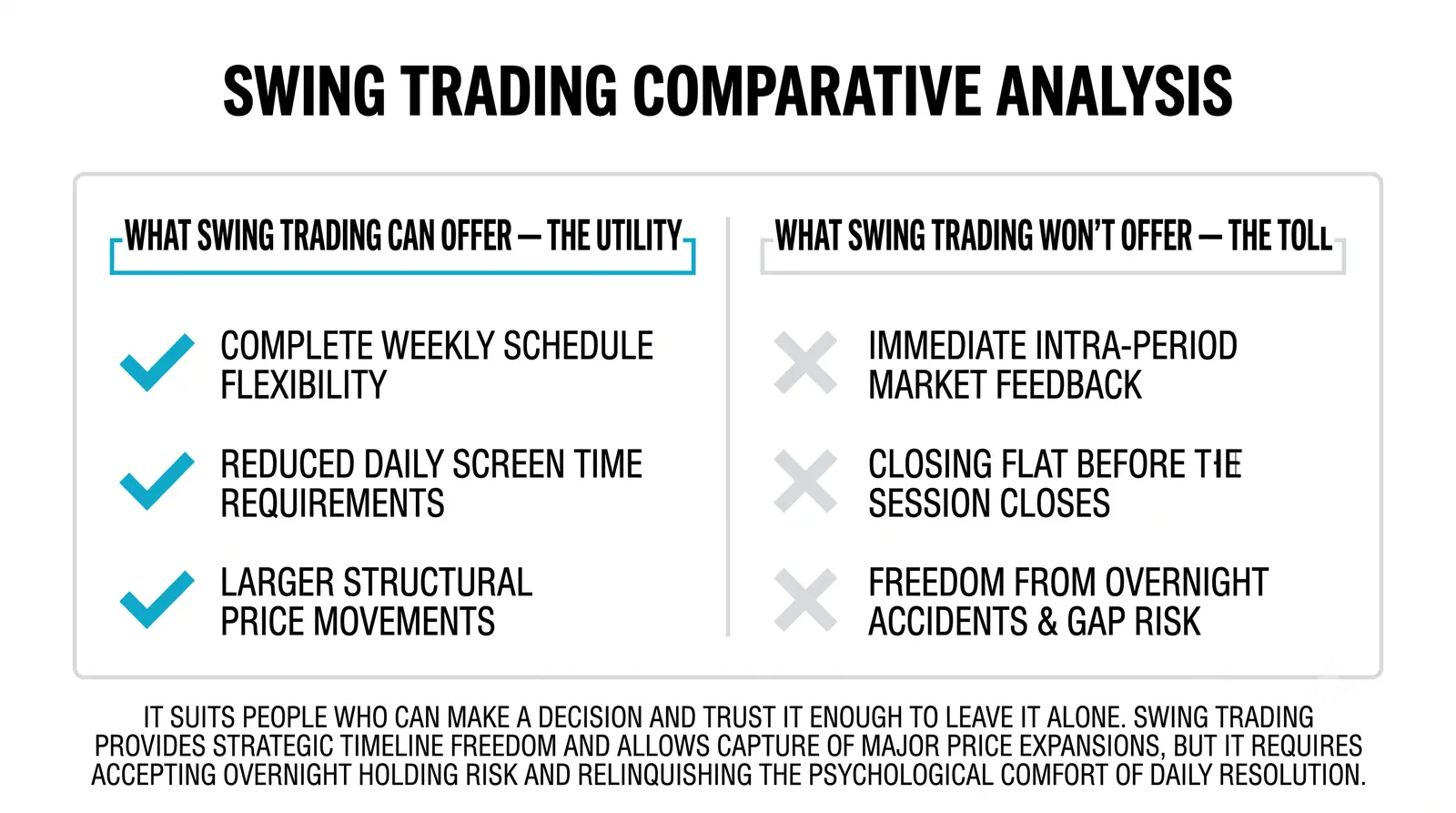
Notice the trade-off in the last row. Day traders avoid overnight risk by paying with their attention all day. Swing traders accept overnight risk in exchange for getting their days back.
Who Swing Trading Fits
Swing trading suits people with jobs, families, and lives. The analysis happens in the evening. Orders are placed in advance: entries, stops, and targets can all rest with the broker, so nothing needs babysitting at 10:15 in the morning.
Weekends are genuinely off. Your positions are either within their planned risk or they are not, and no amount of Saturday worrying changes Monday's open.
It also suits people who think better slowly. If you make your worst decisions under time pressure, a style that gives you hours to consider each trade removes your biggest weakness. If you crave constant action, though, swing trading will frustrate you, and a frustrated trader manufactures trades that were never there.
Be honest about which person you are before choosing.
Questions About Swing Trading
What about overnight gap risk?
Gap risk is real and it is the price of the style. A stock can open well past your stop, turning a planned $300 loss into a $600 one. You manage this with smaller position sizes, by avoiding holding through scheduled events like earnings, and by accepting that an occasional gap-through is a known business cost, not a system failure.
How long should a swing trade last?
Most swings last a few days to a few weeks, and the market decides, not you. The trade is done when it hits your target, hits your stop, or the reason you entered clearly breaks down. A trade that goes nowhere for three weeks has also told you something: your money is parked in a dead stock while other setups move.
Where do swing stops go?
Swing stops belong beyond the structure that would prove the trade wrong, usually under the most recent higher low in an uptrend or above the most recent lower high in a downtrend. If price reaches that level, the swing you bought no longer exists, so there is nothing left to hold. Stops placed at random round numbers or fixed percentages get hit by ordinary noise.
Can I swing trade with a full-time job?
Yes, and it is arguably the only active style that fits one cleanly. Your analysis happens outside market hours, your orders rest with the broker during the day, and a quick check at lunch is optional rather than required. What it does not survive is constant phone-checking, which adds stress without adding information.
Once you understand the rhythm of holding one swing at a time, the natural next question is where those swings come from. That leads directly to trend structure and how to read higher highs and higher lows as a roadmap rather than a Rorschach test, which is where we go next.