What Moves Markets: The Macro Framework
What moves markets, at the largest scale, is money deciding whether to reach for risk or hide from it. That decision is driven by a short list of forces: rates, growth, risk appetite, and the plumbing that carries them, liquidity and policy. Every big move is an answer to one question: which way is the money flowing. The framework below is how you answer it.

Think of a market the way a town lives off one river. Everything downstream depends on which way the water is running today, toward risk or away from it. Your job at this level is not to predict the rain. It is to read the current.
Money Moving Toward or Away From Risk
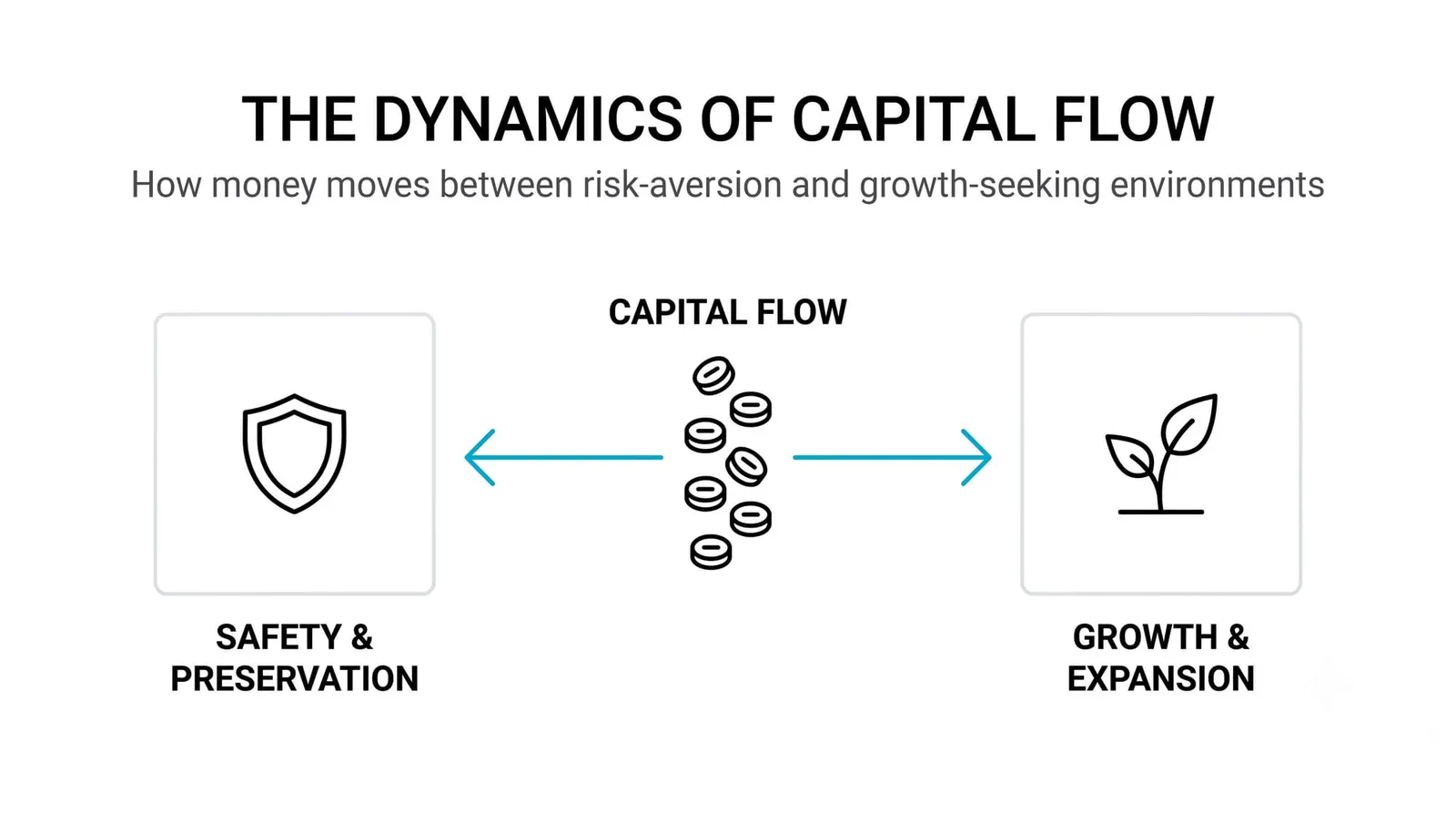
When confidence is high and money is cheap, capital reaches. It flows into stocks, crypto, small companies, emerging markets, anything with a story and upside. You already know this posture as risk-on.
When fear rises or money gets expensive, capital retreats. It moves into government bonds, cash, and the safest corners of the system. That is risk-off, and you met it in the intermarket lesson.
Watch the flow, not the ticker. A single stock can fall on bad news while the whole market rises on a wave of fresh money. The tide is the flow; the ticker is one boat on it. Traders who stare at boats miss tides.
This is why two assets with nothing in common can move together for weeks. They are both answering the same question about the same river. Once you see that, a lot of confusing price action stops being confusing.
The Short List of Forces That Matter Most
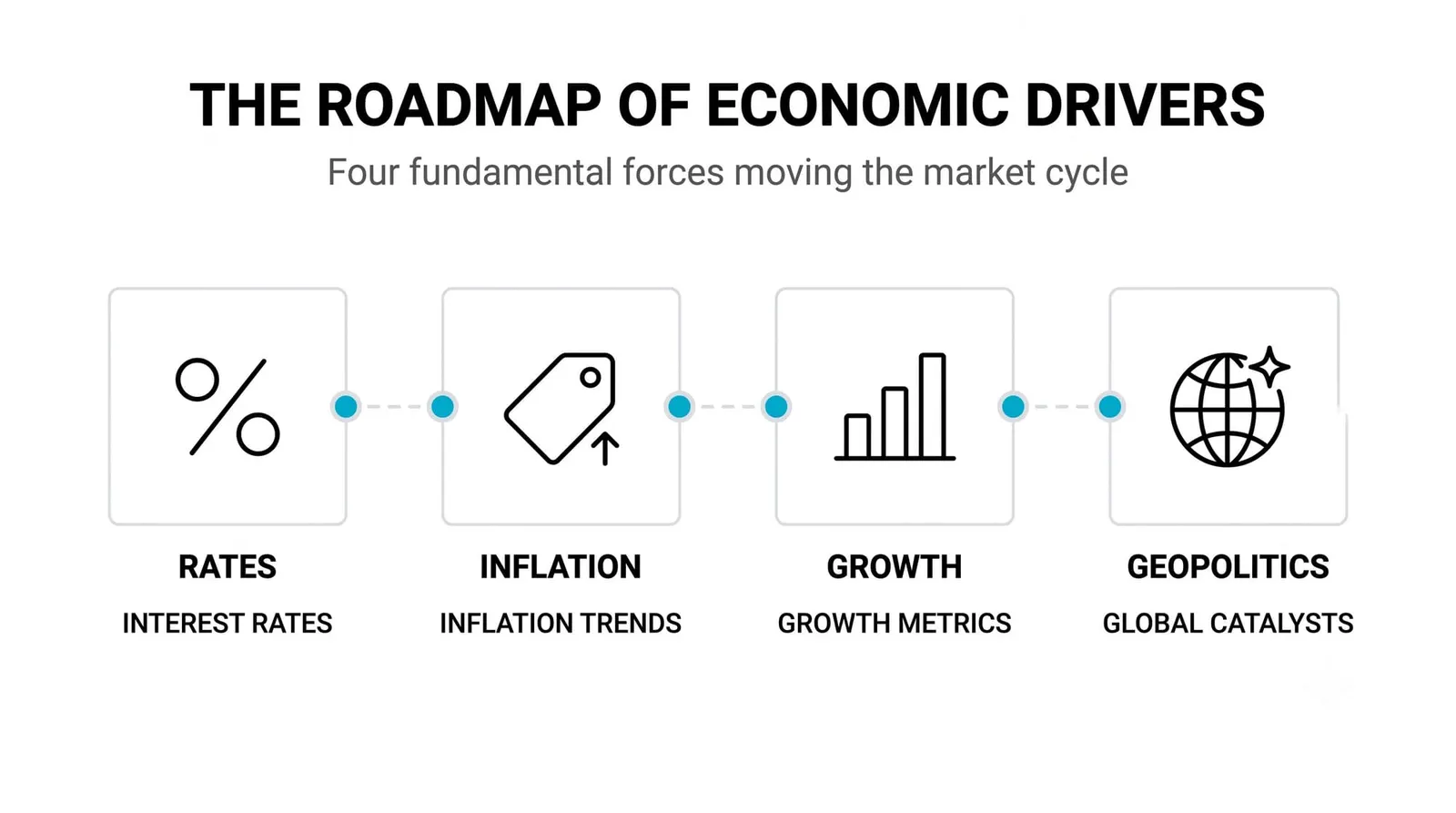
Four forces do most of the work. You met the first three in the first lesson of this level, so here is the one-line version of each, plus the fourth that carries them all.
- Rates: the price of money. Higher rates make borrowing expensive and saving attractive; lower rates do the reverse. Rates set the hurdle every risky asset must clear.
- Growth expectations: the promise of future earnings. Markets pay for tomorrow, so what matters is whether the economy looks like it will expand or shrink from here.
- Risk appetite: the crowd's tolerance for uncertainty. The same news produces different reactions depending on whether participants feel brave or bruised.
- Liquidity and policy: how much money exists and how easily it moves. Central banks and governments control the supply and the plumbing. Abundant, easy money lifts almost everything; scarce, restricted money weighs on almost everything.
Each force has one job. Rates price money, growth prices the future, risk appetite prices fear, and liquidity decides how much fuel the other three get to burn.
Two of these get their own lessons right after this one. Inflation and interest rates are deep enough to deserve separate treatment, so for now hold them at this level of detail.
Why No Single Driver Works Alone
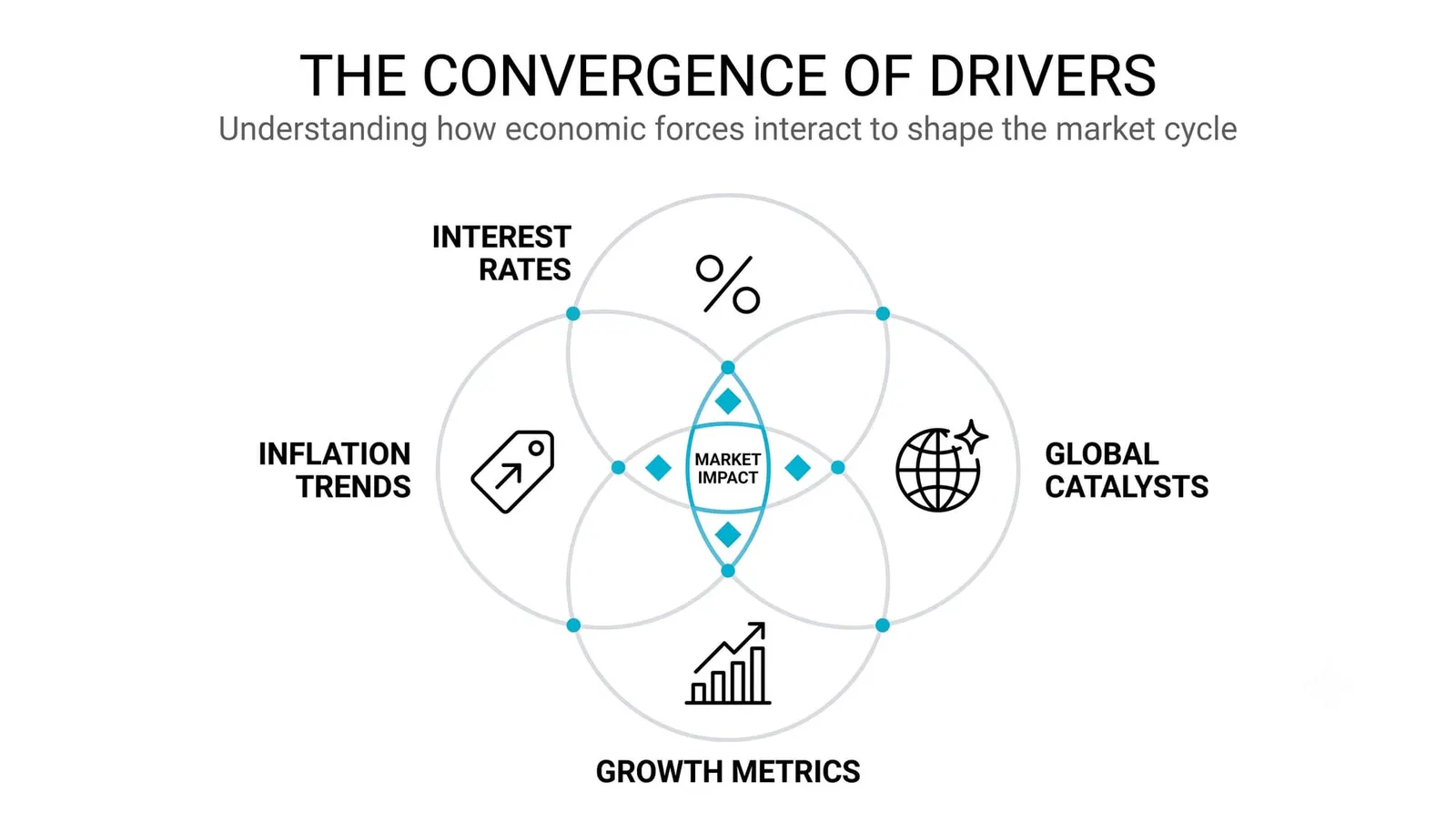
Drivers overlap, and they argue with each other. Take a rate cut. It is bullish for borrowers, because debt gets cheaper. It is often bearish for the currency, because lower yields give foreign money less reason to park there. And it can be a warning, because central banks usually cut when the economy needs help.
One event, three messages. Which message wins depends on what the crowd was expecting and which force is loudest that week.
This is why single-cause storytelling fails. "The market rose because of the rate cut" sounds clean and is usually wrong. The market rose because the cut landed on a crowd that was already positioned a certain way, with growth data pointing one direction and liquidity pointing another.
Use the framework for weighing, not for storytelling. List the forces, mark which way each one leans, and accept that the answer is a balance, not a verdict. Some weeks the balance is obvious. Most weeks it is a genuine argument, and honest traders say so.
One Week, Five Headlines
Here is a hypothetical week with round, invented numbers. Nothing here refers to any real market or date.
Monday: A central bank official hints that rate cuts are possible this year, maybe from an invented 5% down toward 4%. That headline maps to rates. Cheaper money on the horizon is supportive for risk assets.
Tuesday: A monthly jobs report shows the economy added 50,000 jobs when 200,000 were expected. That maps to growth. Weak hiring pulls future earnings expectations down. But notice the argument it starts: weak growth also makes the hinted rate cuts more likely. One headline, two forces pulling opposite directions.
Wednesday: Two large companies report earnings of $2.10 and $1.75 per share against expectations of $1.80 and $1.50. That maps to single-asset fundamentals, not a macro force. Those stocks can rally on their own news even in a nervous market. Company results live one level below the tide.
Thursday: A trade dispute flares between two large economies, with talk of 25% tariffs. That maps to risk appetite. Nothing about rates or growth changed overnight, but the crowd's tolerance for uncertainty just dropped.
Friday: You weigh the week. Rates lean supportive. Growth leans negative but feeds back into easier policy. Risk appetite took a hit. Liquidity is unchanged. Three forces lean supportive or neutral, one injects real fear.
The net read: the week is a tug between easing money and nervous nerves. That is a normal week. Markets spend most of their time in exactly this kind of mixed state, which is why the framework beats any single headline.
| Force | Question it answers | What it pushes | Signals you watch |
|---|---|---|---|
| Rates | What does money cost? | Borrowing, valuations, currencies | Central bank statements, bond yields |
| Growth | Will earnings expand? | Stocks, commodities, hiring-sensitive assets | Jobs reports, output data, surveys |
| Risk appetite | How brave is the crowd? | Speculative assets versus safe havens | Volatility measures, safe-haven flows |
| Liquidity and policy | How much money exists and moves? | Everything, all at once | Central bank balance sheets, government spending |
What Moves Markets, Answered
Is one driver always in charge?
No. Leadership rotates. Some months rates dominate every conversation; other months a growth scare or a shock to risk appetite takes over. The framework stays the same even when the loudest force changes, which is the point of having a framework.
Do the same forces move crypto?
Yes, the same four forces apply. Crypto sits far out on the risk curve, so it tends to amplify whatever the flow is doing: it rises hard when money reaches for risk and falls hard when money hides. Liquidity and risk appetite matter even more there than in older markets.
How fast do macro forces show up in prices?
Expectations move prices before events do. Markets price what participants think will happen, so a widely expected rate cut can move assets for weeks before it arrives and barely move them on the day. Surprises move prices fast; confirmed expectations often do not.
Can I trade the framework without reading every headline?
Yes. You need the scheduled, structural releases, central bank decisions, jobs and growth data, and a general sense of the crowd's mood, not a constant news feed. A weekly check of which way each force leans is enough for most position and swing traders.
Next in this level, the framework gets its first deep dive: inflation, what it actually measures, and why it sits behind almost every rate decision you will ever read about.