The Economic Cycle, Explained
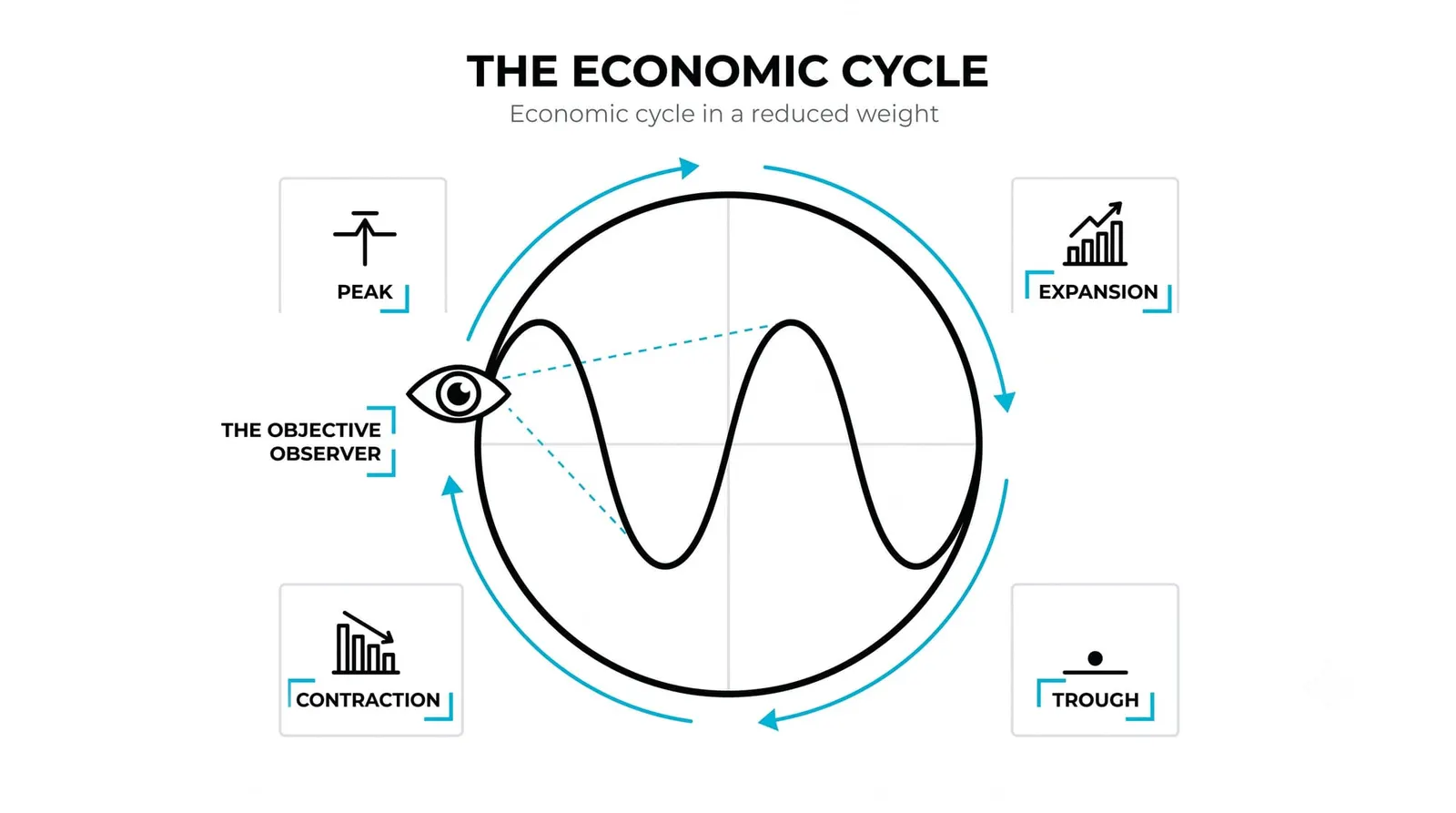
The economic cycle is the repeating loop of growth and slowdown that every economy moves through, in four stages: expansion, peak, contraction, and trough. Each stage pushes different assets in different directions. The loop never repeats on schedule, but it always repeats.

Economies have an appetite like a person at a long buffet: hunger, a full plate, the sluggish hour after, and the hunger that always comes back. That rhythm is not a flaw in the system. It is the system. Once you accept that growth and slowdown take turns, you stop being surprised by either one, and you start reading markets as stages of a loop instead of random noise.
The Economic Cycle: One Loop, Four Stages
Four stages make up the loop, and each has one job:
- Expansion: activity and hiring rise.
- Peak: the economy runs hot and strains.
- Contraction: activity falls.
- Trough: the low point where the next expansion seeds.
Two forces run inside every stage: interest rates and inflation. They get their own lessons later in this level, so for now treat them as the pressure and the thermostat of the loop. Rates are the main tool policymakers use to cool a hot economy or warm a cold one. Inflation is the heat reading they watch while they do it.
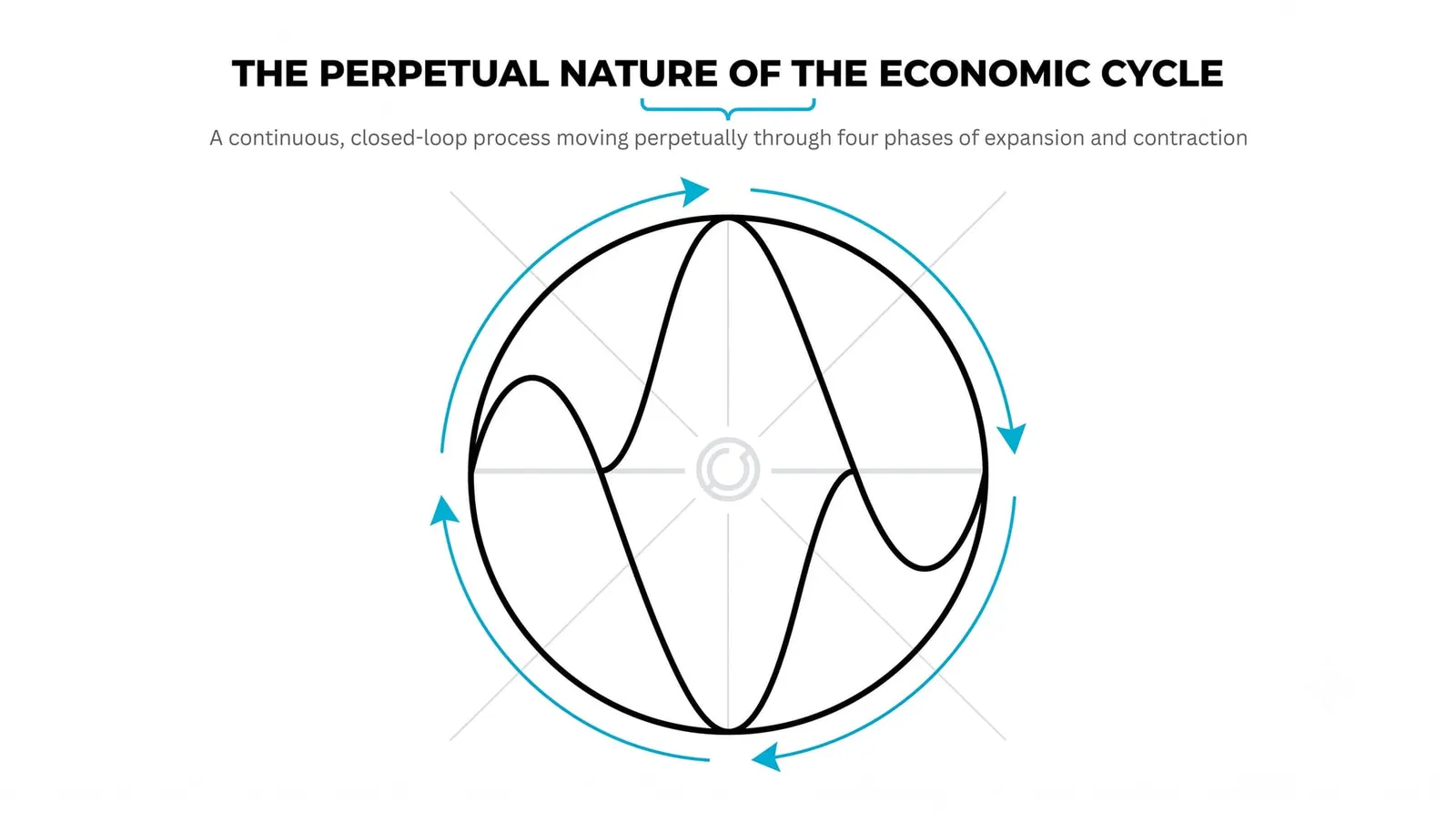
One warning before we walk the stages: they blend at the edges. Nobody rings a bell at the top or the bottom. Economists usually confirm a peak or a trough months after it happened, by looking backward at the data. You will trade through these transitions in real time, without a label. Expect that.
Expansion and Peak: When Things Are Going Well
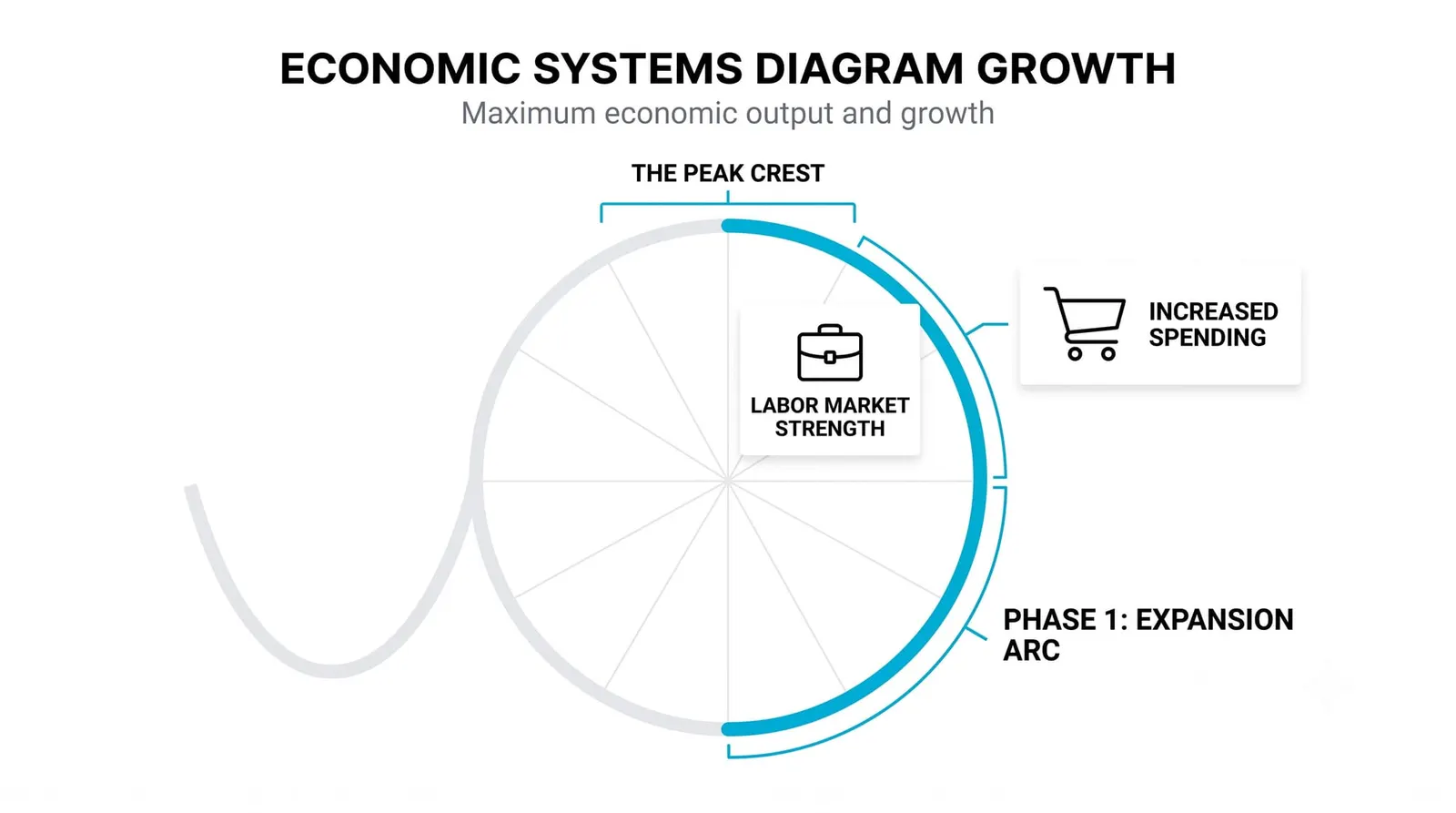
Expansion is the stage you can see on the street. Employment rises as firms hire. Output grows as factories and offices produce more. Lending increases because banks feel confident and borrowers feel capable. Wages drift up, spending follows, and the whole thing feeds itself for a while.
Expansions tend to be the longest stage of the four. They can run for years. Most of the time you spend as a trader, you will be trading inside one.
The peak is what happens when the good times run too far. Capacity strains: firms cannot find workers, suppliers cannot keep up, and shortages appear. Prices accelerate because demand outruns supply. Policy tightens in response, meaning the central bank raises rates to cool things down. Borrowing gets expensive. The easy money that fed the expansion starts to dry up.
The part that catches new traders: the strongest headlines arrive closest to the turn. Record employment, record profits, record confidence. Those are late-cycle readings, not early ones. By the time the news is uniformly great, the expansion has usually done most of its work. Euphoria is a stage, not a signal to buy.
Contraction and Trough: When Things Slow Down
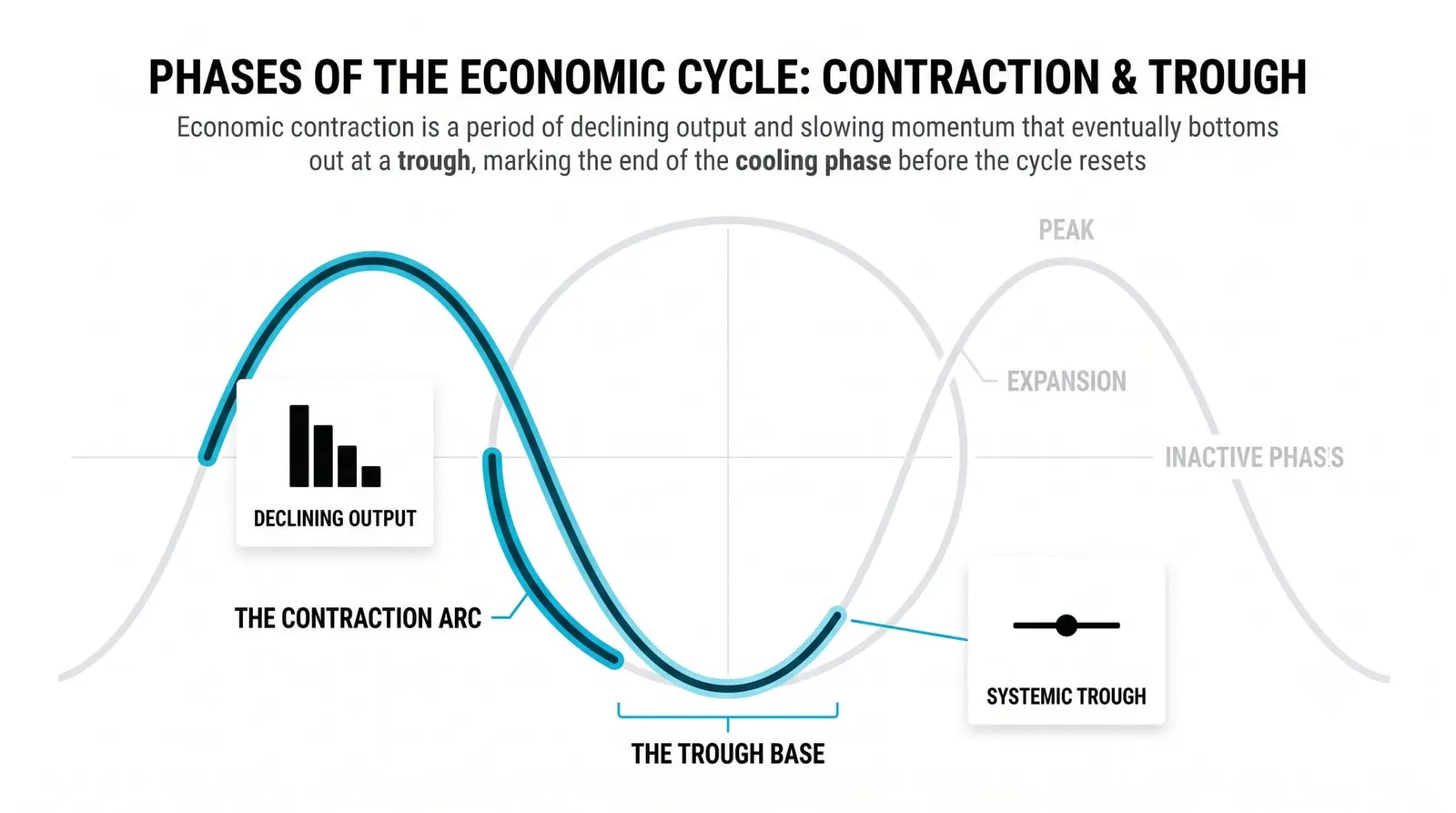
Contraction is expansion in reverse. Output falls as demand weakens. Unemployment rises as firms cut costs. Credit pulls back because lenders turn cautious and borrowers turn defensive. Spending shrinks, which shrinks revenue, which causes more cuts. The loop feeds itself going down just as it did going up.
Contractions are usually shorter than expansions, but they feel longer. Prices fall faster than they rose. Fear is a faster emotion than confidence.
The trough is the low point. Activity stops falling. Policy eases, meaning rates come down to stimulate borrowing. Cheap funding returns. Somewhere in that gloom, the seeds of the next expansion are planted: weak firms have failed, costs have reset, and survivors can borrow cheaply to grow.
Be blunt about this stage: the trough is where the bravest long-term money gets made, and it feels worst there. Every headline is bad. Everyone you know is cautious. Buying at the trough means buying when your instincts scream at you not to. Most people cannot do it, which is exactly why the opportunity exists.
Why This Cycle Repeats and Why It Matters to You
The mechanism is simple and it never changes. Expansion breeds the excesses that cause the contraction: too much borrowing, too much hiring, too much optimism, until the strain forces a break. Then the contraction creates the cheap conditions that seed the next expansion: low rates, low prices, low competition for workers and assets. Each stage manufactures the next one. That is why the loop repeats, and why no policy has ever abolished it.
For a trader, the stage you are in changes which assets have a tailwind. Equities tend to thrive in expansion and suffer in contraction. Bonds tend to rally when contraction forces rates down. Commodities often run hottest near the peak, when demand strains supply. This is also why professionals rotate between sectors as the cycle turns, a topic that gets its own lesson in this level.
Zoom all the way out and the point gets bigger. The cycle is the widest context any trade can have. A beautiful chart pattern inside the wrong stage of the cycle is fighting the wider context. The same pattern inside the right stage has the whole economy behind it.
One Loop in Numbers
Here is a full loop with invented round numbers, purely as an illustration of how the stages connect.
Expansion. An economy grows for six straight quarters. Unemployment falls from 6 percent to 4 percent as hiring runs strong. Demand heats up, so the central bank lifts its policy rate from 3 percent to 5 percent to keep things from boiling over. Equities climb through most of this stretch, because earnings grow and confidence is high.
Peak. Inflation is running at 5 percent, capacity is strained, and the central bank holds rates high to squeeze the heat out. Stocks stop making progress and start to wobble. The headlines are still glowing. The smart money is already nervous.
Contraction. Activity shrinks for three quarters. Unemployment climbs back to 5.5 percent. Asset prices sag, and equities fall as earnings shrink. But notice what happens in the bond market: with growth weakening and rate cuts coming, bonds rally. Falling rates push existing bond prices up. One asset's bad stage is another asset's good one.
Trough. The central bank cuts rates to 3.5 percent. Lending thaws. The news is still grim, but activity stops falling. Quietly, with nobody celebrating, the next equity cycle is born. Traders who bought into that gloom own the recovery before it has a name.
| Stage | What rises | What falls | What a trader watches |
|---|---|---|---|
| Expansion | Employment, output, lending, equities | Unemployment | Earnings growth, hiring data, rate path |
| Peak | Inflation, rates, commodity prices | Stock momentum, credit quality | Euphoric headlines, tightening policy |
| Contraction | Unemployment, bond prices | Output, equities, lending | Rate cuts, credit stress, earnings misses |
| Trough | Policy stimulus, early equity recovery | Rates, pessimism | Stabilizing data, thawing credit |
The Economic Cycle, Answered
How long does one full cycle take?
There is no fixed length. Full cycles have historically run anywhere from a few years to over a decade, with expansions usually much longer than contractions. Anyone who tells you the cycle runs on a schedule is selling something. Treat the stages as a sequence, not a calendar.
Can I time trades to the cycle?
You can position for stages, but you cannot call exact turns, and neither can professionals. The practical approach is to read which stage you are likely in from employment, lending, and policy data, then tilt accordingly. Betting everything on a precise top or bottom is gambling, not cycle awareness.
Do all countries cycle together?
No. Major economies often move in loose sync because trade and finance link them, but each country has its own policy, its own industries, and its own timing. One economy can be contracting while another is mid-expansion. That difference is itself a trading input when you look at foreign markets or currencies.
Which asset does best in every stage?
None. No single asset wins all four stages, which is the entire reason the cycle matters. Equities favor expansion, bonds favor contraction, commodities often shine near the peak, and cash preserves options at the trough. Matching the asset to the stage is the skill.
Next in this level, we pull apart the two forces you met inside every stage here: interest rates and inflation. Understanding how they are built and how they move will turn the cycle from a story you recognize into a machine you can read.