Inflation: What It Is and Why Markets Care
Inflation is a sustained rise in the general level of prices, which is the same thing as a steady fall in what money buys. One price going up is not inflation. A broad, persistent rise across the whole economy is. That distinction matters because inflation sits at the center of macro trading. It pushes interest rates, erodes fixed payments, and forces every market to reprice.

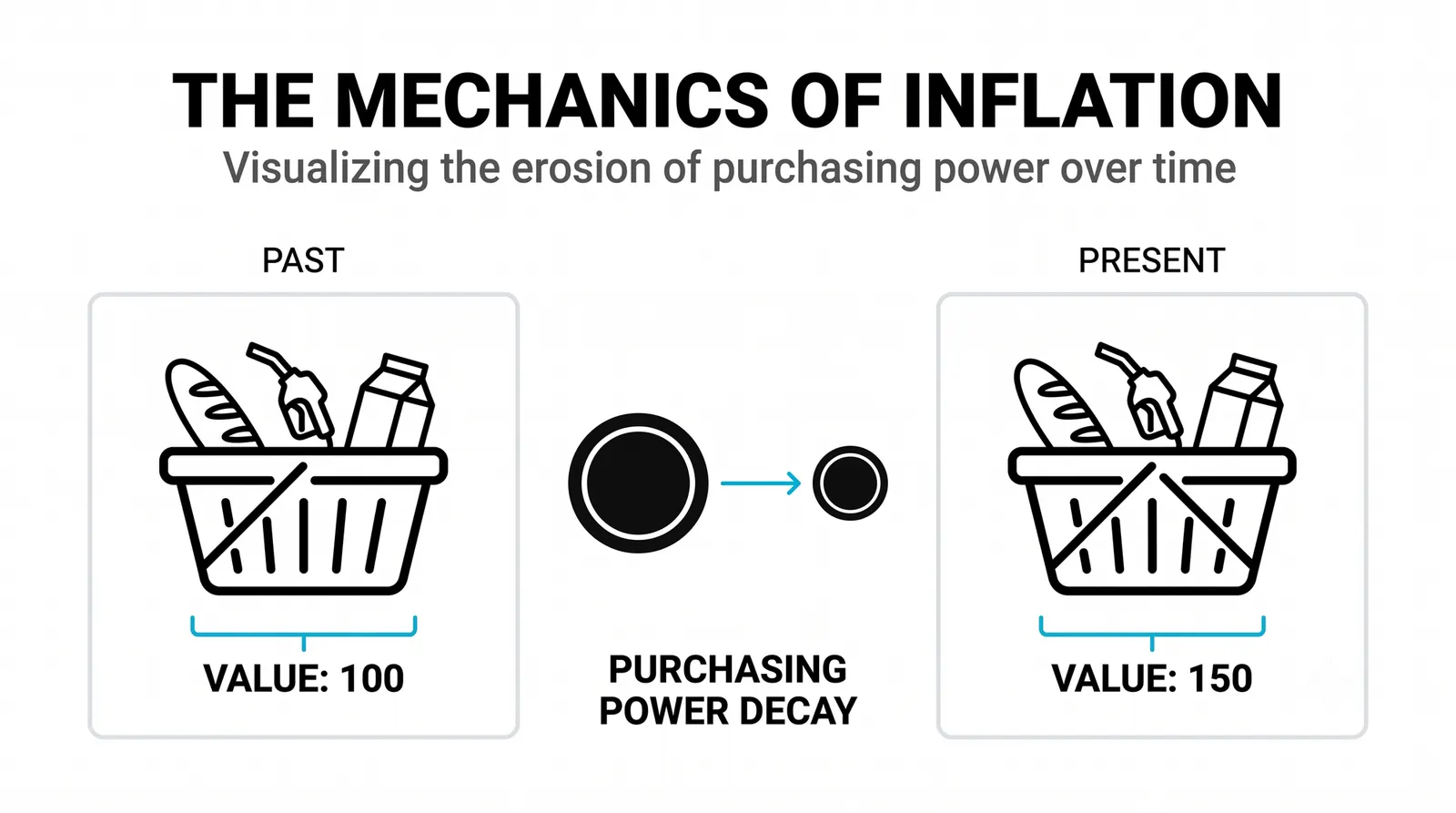
The concept has two sides, and beginners usually only see one. Prices rising is the visible side. Purchasing power falling is the side that actually bites. When inflation runs, each unit of currency buys less bread, less fuel, less rent. Inflation works like a tax nobody voted on; prices do the collecting. Nobody sends you a bill. Your money just quietly does less work than it did last year.
What Inflation Actually Is
The old phrase still does the job: inflation is too much money chasing too few goods. Unpack it slowly. "Too much money" means demand is running hot, either because people and governments are spending freely or because credit is cheap and easy. "Too few goods" means supply cannot keep up, whether because of shortages, bottlenecks, or weak production. When the two meet, sellers raise prices because they can.
This connects directly to the macro seesaw from the previous lesson. Demand and supply sit on opposite ends, and prices are the pivot point. Tip demand up or supply down, and the price level rises. Inflation is what that tilt looks like when it persists across the whole economy instead of one market.
Economists split the causes into two families. Demand-pull inflation happens when buyers want more than the economy can produce, so spending pulls prices upward. Cost-push inflation happens when production inputs like energy, labor, or raw materials get more expensive, and producers pass those costs along. In practice the two tangle together, but the labels help you read why prices are moving.
How Inflation Gets Measured
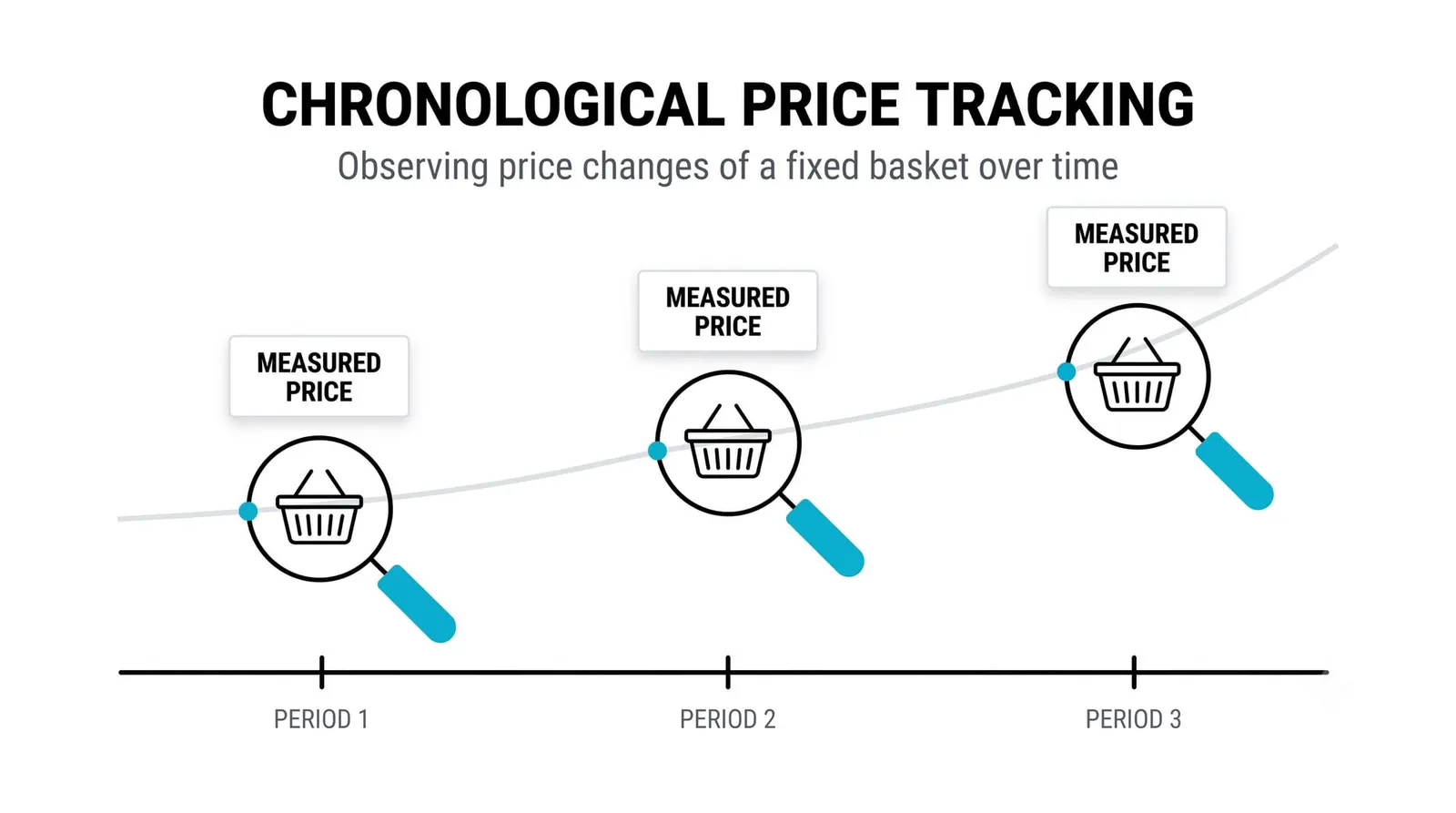
Statisticians measure inflation with a fixed basket of goods and services meant to represent what a typical household buys. Food, housing, transport, clothing, medical care, and so on, each weighted by its rough share of household spending. Every month, prices for that basket get collected and compared to the same month a year earlier. The annual percentage change is the number headlines carry.
The headline gauge in most economies is the consumer price index, and it gets its own deep-dive lesson later in this level, so we will leave the report mechanics there. For now, hold one idea: the CPI is a model of a household, and models can be argued with. Your spending pattern is not the average household's spending pattern. A renter in a city experiences a different inflation rate than a homeowner in the countryside, even though both live under the same published number.
You will also hear about core inflation, which strips out food and energy. The reason is simple: those two categories swing hard on weather, harvests, and geopolitics, and the swings often reverse. Removing them gives a steadier read on the underlying trend. Neither version is the "true" one. They answer different questions, and markets watch both.
Why Markets Care So Much About Inflation
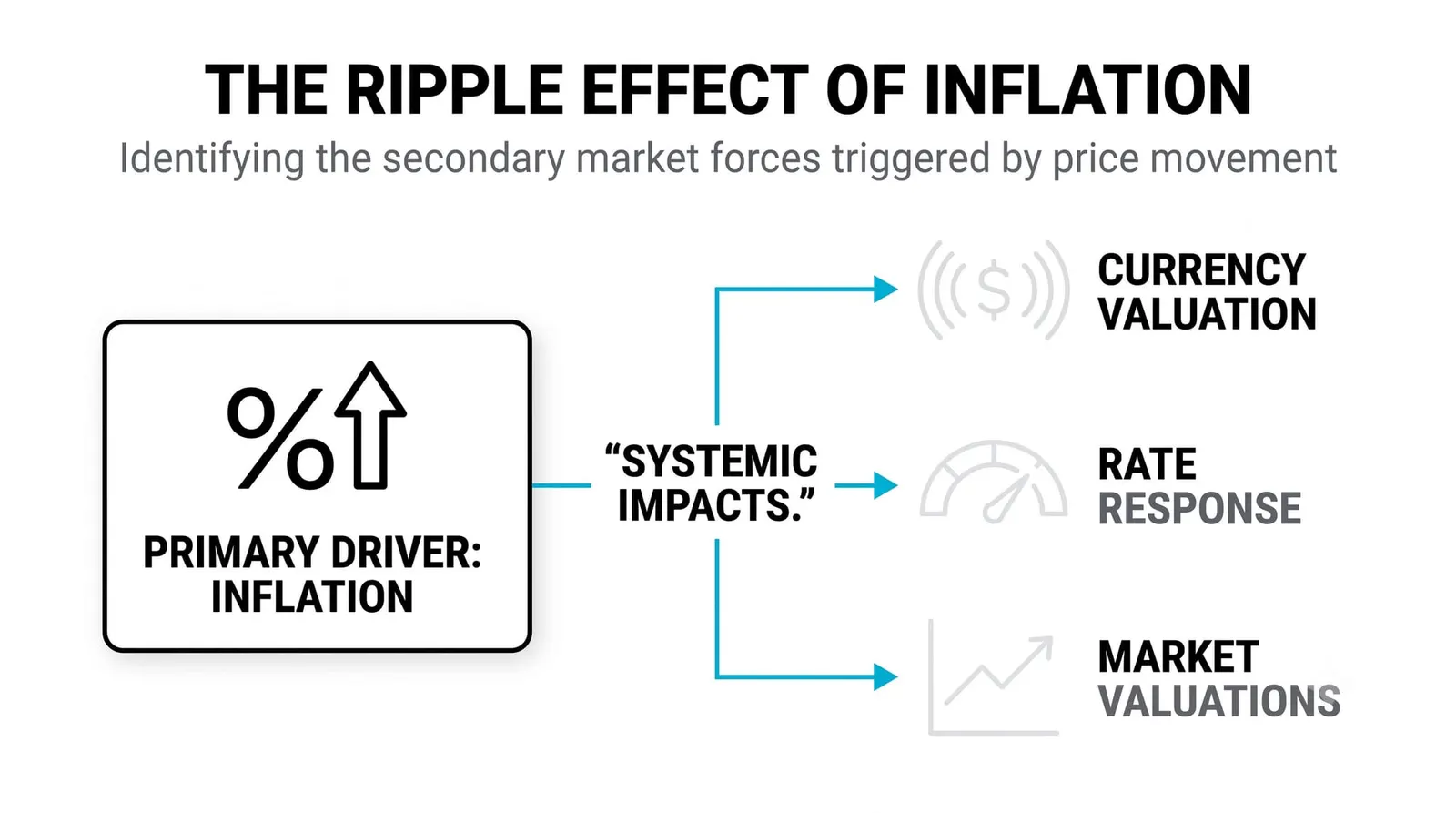
Three channels carry inflation into every price you trade. The first is the central bank. When inflation runs above target, central banks raise interest rates to cool demand, and that single move reprices every asset class, because rates are the discount rate underneath all valuation. The full mechanics of that link get their own lesson in this level. For now, remember the chain: inflation up, rates up, asset prices under pressure.
The second channel is bonds. A bond pays fixed amounts of money on fixed dates. Inflation eats the real value of every one of those payments. A bond paying a fixed stream of cash is worth less in a world where that cash buys less each year, so bond prices fall when inflation expectations rise. Bondholders are the most direct losers in an inflationary surprise.
The third channel is quieter but just as real: inflation distorts the signals everyone plans around. When prices move fast and unevenly, a business cannot tell whether rising revenue means growing demand or just rising prices. A trader cannot tell whether a company's earnings beat reflects strength or shrinkage of the currency. Planning horizons shrink. Uncertainty itself becomes a cost, and markets charge for it.
Two Percent Versus Eight Percent
Here is a purely hypothetical illustration with round numbers. Imagine two identical economies. In one, inflation runs at 2 percent a year. In the other, it runs at 8 percent. Same workers, same factories, same currency on paper. Completely different pressure underneath.
Start with the 2 percent world. A rough doubling rule says prices double in about 72 divided by the inflation rate, so at 2 percent, prices double in roughly 36 years. Over a single decade, a unit of money keeps about four fifths of its purchasing power. A saver holding cash loses ground slowly, almost politely. A borrower with a fixed-rate loan barely notices the help. The central bank sleeps well, because 2 percent is the neighborhood of most official targets.
Now the 8 percent world. The same doubling rule says prices double in about 9 years. Over a decade, that same unit of money keeps barely half its purchasing power. The saver holding cash watches half the value evaporate in ten years and feels pressure to move money anywhere that might keep pace. The borrower with a fixed-rate loan wins clearly, repaying in cheaper and cheaper money. And the central bank is no longer calm. It is raising rates, accepting economic pain on purpose, because letting 8 percent run risks something worse.
Same arithmetic, different temperature. That gap is why a few percentage points of inflation dominates headlines, central bank speeches, and your charts.
| Group | High inflation does this | Low stable inflation does this |
|---|---|---|
| Savers | Cash and fixed deposits lose real value fast; pressure to take risk just to stand still | Purchasing power erodes slowly and predictably; planning is easy |
| Borrowers | Fixed-rate debts shrink in real terms; repayment gets cheaper each year | Debts keep most of their real weight; no hidden discount |
| Stock investors | Input costs and discount rates both rise; valuations compress and uncertainty widens | Steady pricing lets earnings and valuations be judged on merit |
| Bond investors | Fixed payments lose real value and prices fall as yields adjust upward | Fixed payments hold their worth; bonds behave as designed |
Inflation, Answered
Is some inflation actually good?
Yes, a small amount is generally considered healthy. Most major central banks target around 2 percent, because mild inflation greases the economy: it encourages spending over hoarding, gives wages room to adjust, and keeps a buffer against deflation, which is harder to escape. Zero sounds tidy but leaves no margin for error.
Who wins and who loses when inflation rises?
Borrowers with fixed-rate debts win, because they repay in cheaper money, and governments with large fixed-rate debts win for the same reason. Savers holding cash, lenders, bondholders, and anyone on a fixed income lose, because the money coming to them buys less. The transfer is silent, but it is a transfer.
Why do markets react to the expectation more than the number?
Because prices already reflect what traders expected before the release. A 4 percent inflation print that everyone forecast changes little; a 4 percent print when 3 percent was expected moves everything, because positions were built on the wrong assumption. Markets trade the surprise, not the statistic.
Can inflation fall without a recession?
Yes, it has happened, though history says it is the harder path. Cooling demand usually costs jobs and output, which is why disinflation and recession often travel together. Sometimes supply heals on its own, or demand cools gently enough, and inflation falls while growth survives. Traders call that a soft landing, and they price the odds of one constantly.
Later in this level, we open the consumer price index itself: how the report is built, what each line means, and how to read the release without getting whipped around by the first headline.