Interest Rates: The Macro Driver
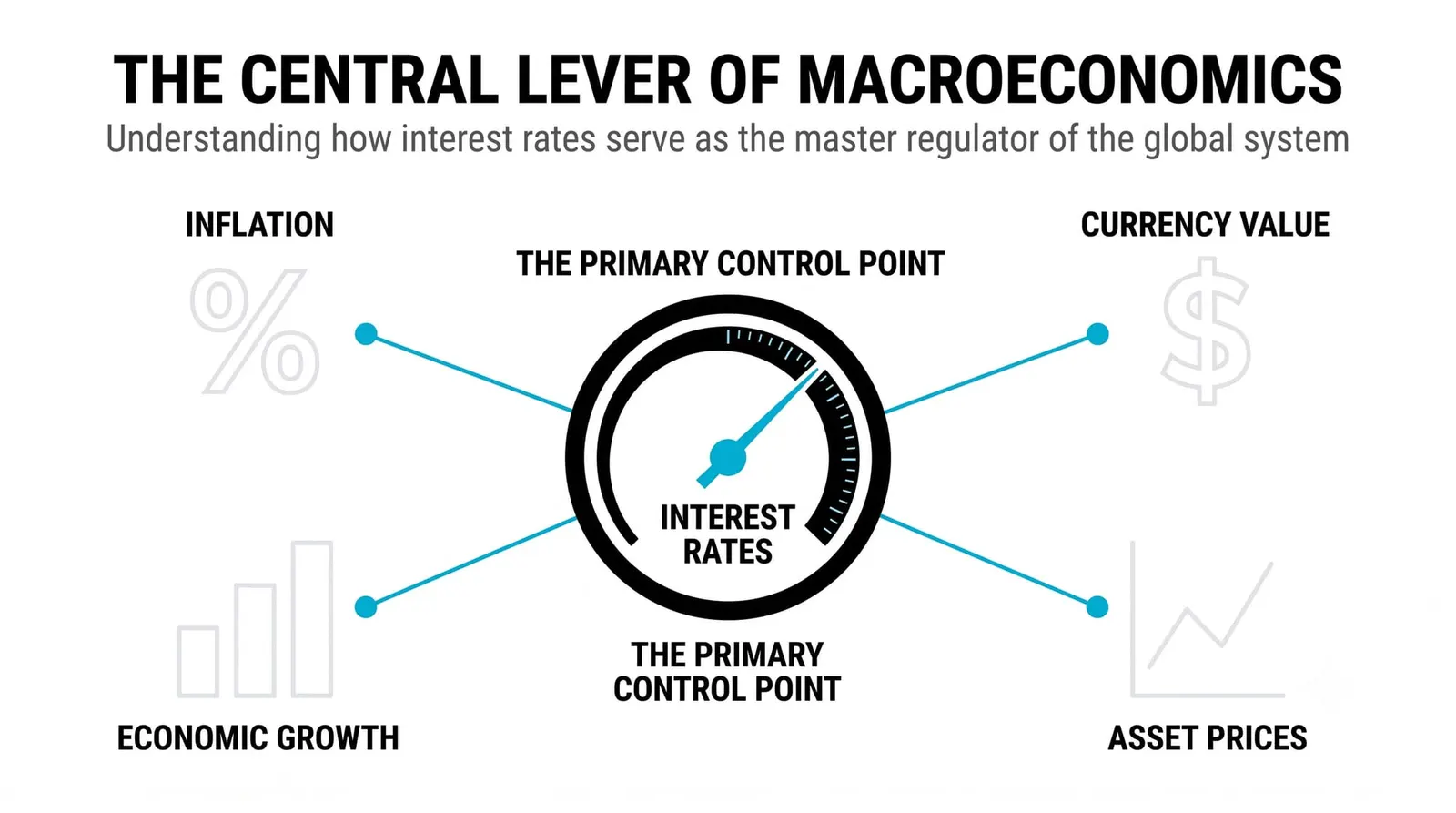
Interest rates are the price of money, the rent paid for using someone else's, and because every asset, loan, and business plan depends on that price, the rate set at the top of the financial system ripples into everything else. That makes it the single most powerful macro driver you will study at this level. When you hear traders say "rates are everything," they are not exaggerating for effect. They are describing a mechanical chain that runs from one committee's decision to a mortgage payment, a hiring plan, and a stock's valuation.

An interest rate is the price of time: using tomorrow's money today carries a sticker, and the sticker moves everything. When the sticker gets expensive, people wait. When it gets cheap, they pull the future forward. That single behavior, repeated millions of times, is the economy responding to one number.
What an Interest Rate Actually Is
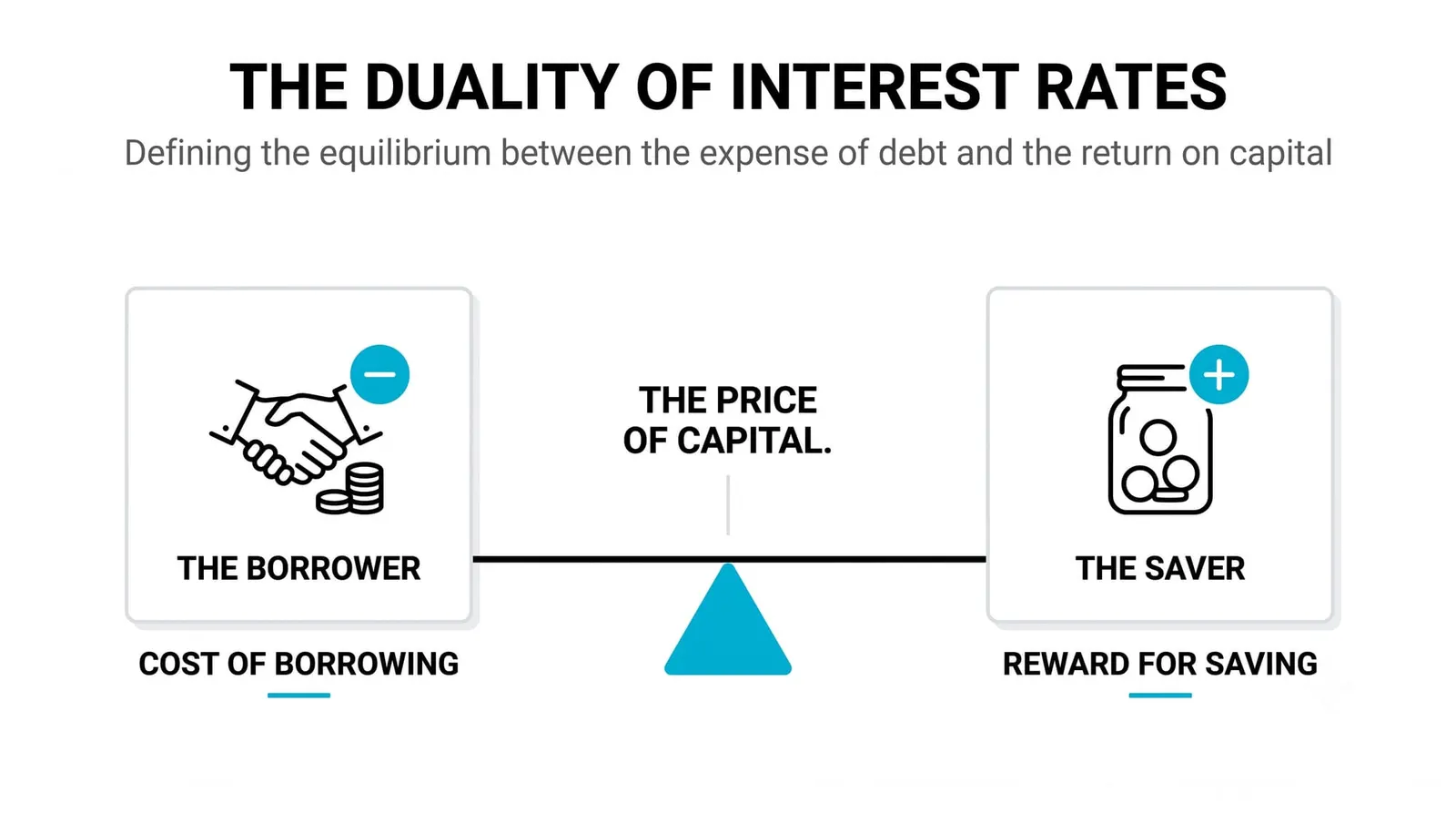
Strip away the jargon and a rate is compensation. A lender gives up the use of money today and takes on the chance of never getting it back. The interest rate pays for both: the waiting and the risk. Wait longer, charge more. Trust the borrower less, charge more. Every loan you will ever see is built from those two ingredients.
At the top of the system sits a base rate, set by a country's central bank. In the United States that is the Federal Reserve; other countries have their own equivalents. Who sits on those committees and how they vote gets its own lessons later in this level. For now, hold one fact: the central bank sets the rate at which the core of the banking system lends and borrows, and that number is the foundation under everything else.
Every other rate is stacked on top of it. A mortgage is the base rate plus a margin for the borrower's risk and the lender's profit. A business loan is the base rate plus a margin sized to that business. A savings account pays the base rate minus whatever the bank keeps for itself. Credit cards, car loans, corporate bonds: same structure, different margins.
This stacking is why one number moves a whole economy. The central bank never touches your mortgage directly. It moves the foundation, and every floor above it shifts by roughly the same amount.
How Rates Ripple Through the Whole Economy
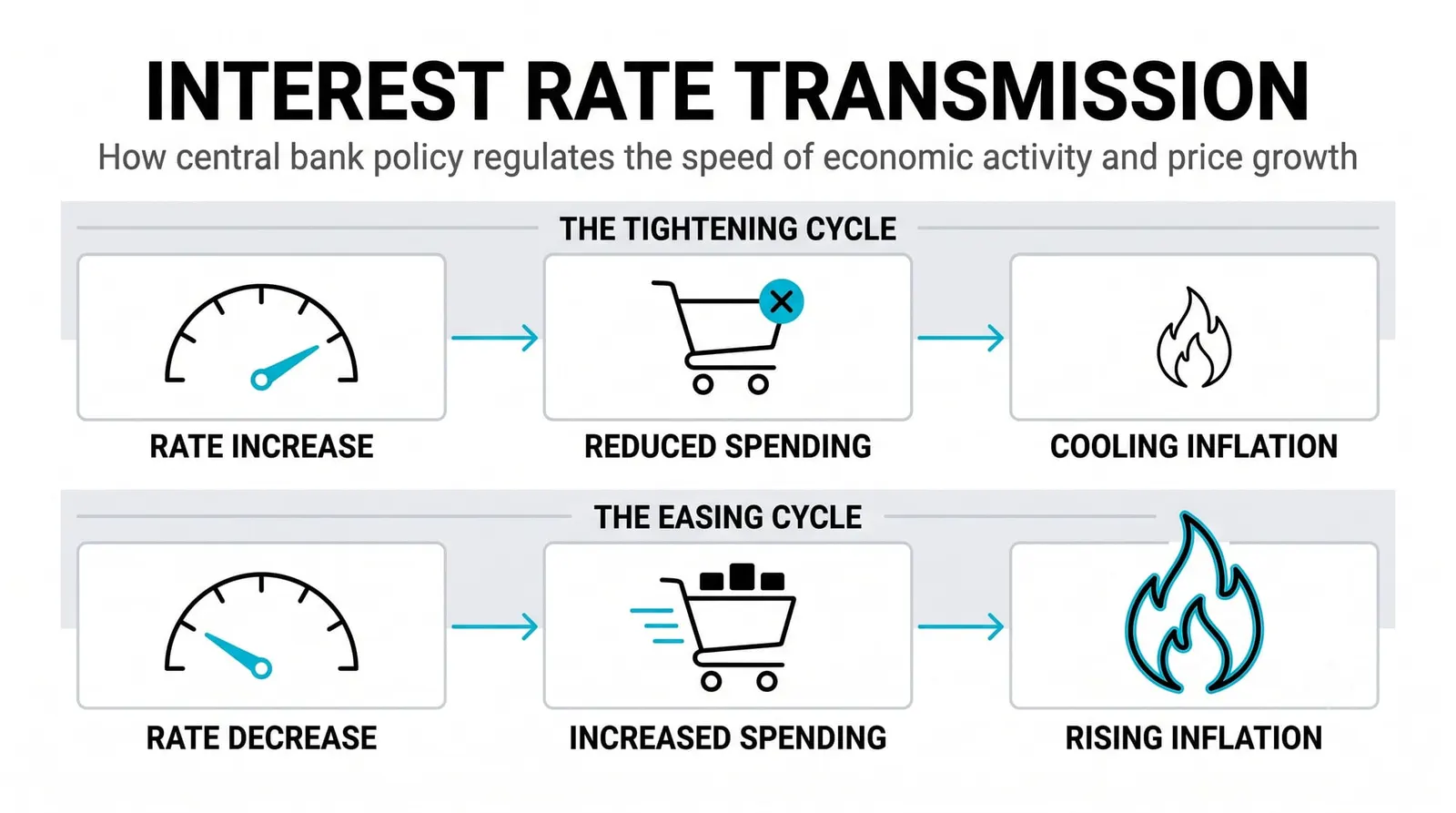
Start with the borrower. When rates rise, the cost of carrying debt rises with them. A household that was comfortable borrowing at one price reconsiders at a higher one. A company that planned to expand on borrowed money runs the numbers again and finds the project no longer clears its own bar. Spending and expansion get deferred, and deferred plans mean fewer orders, fewer hires, and slower growth.
Asset valuations compress too, for a simple reason. A business is worth the cash it will produce in the future, translated back into today's money. That translation uses interest rates as the exchange rate between future and present. Higher rates shrink the present value of distant cash, so the same company with the same prospects is priced lower. Nothing about the business changed. The measuring stick did.
Lower rates run the same machine in reverse, with force. Borrowing gets cheaper, shelved projects come off the shelf, hiring resumes, and future cash is worth more in present terms. This is why central banks cut rates when economies stall and raise them when spending runs too hot.
Now the part that frustrates everyone, including policymakers: the lag. A rate change does not land the day it is announced. Mortgages reset on their own schedules. Business plans take quarters to revise. Hiring decisions lag investment decisions. The full effect of a single move can take many months to work through the economy, which is why policy always feels slow and why central banks are always steering toward where they think the economy will be, not where it is.
Why Markets Watch Rate Expectations More Than Rates Themselves
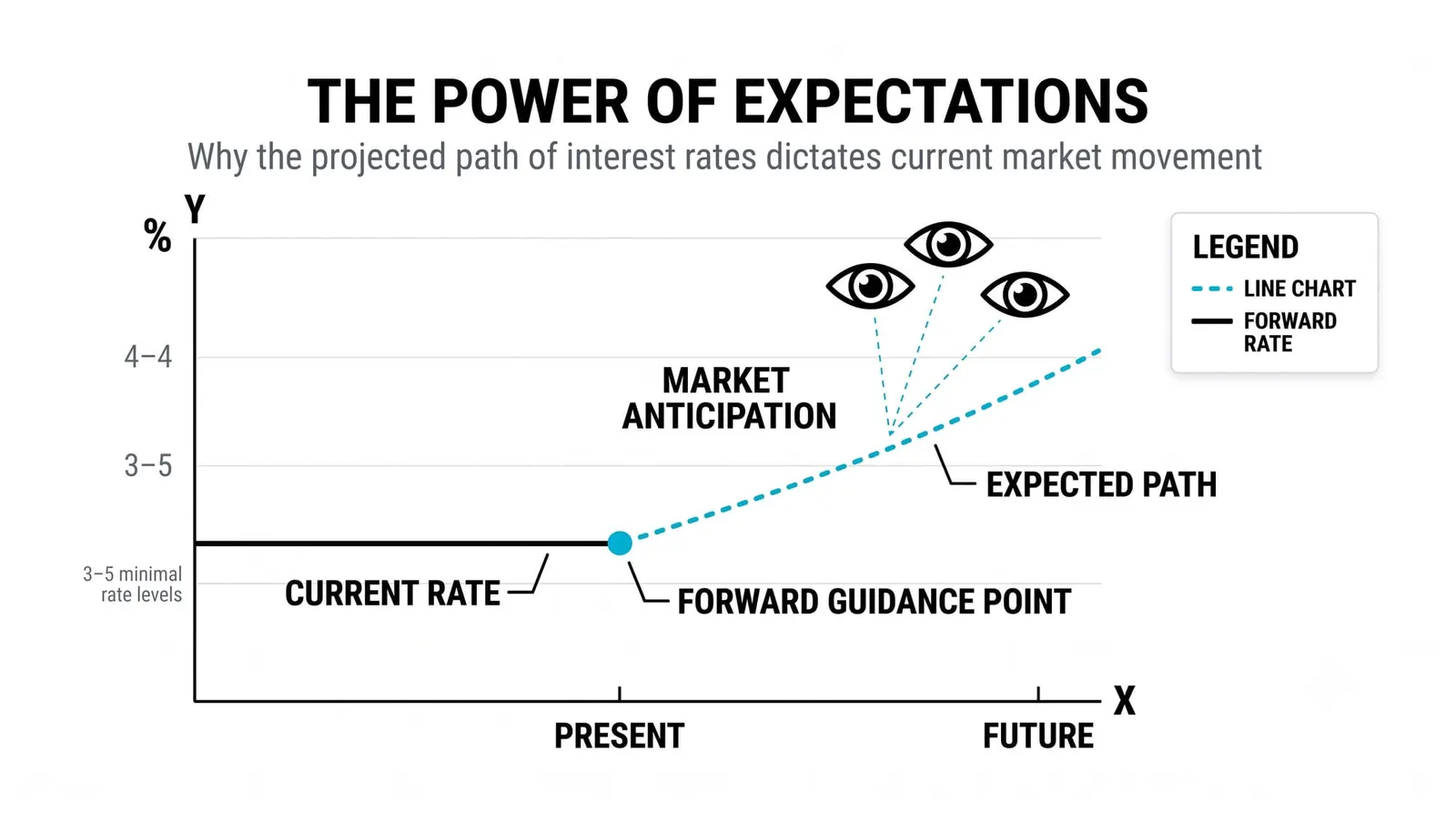
Prices are set on the future, not the present. A market price is the crowd's collective bet on what comes next, and that bet includes what rates will do. By the time a decision is announced, the expected part of it is already inside the price.
Walk through the logic. Suppose everyone in the market expects a rate cut on Monday. Traders position for it the week before. Prices drift to where they would sit after the cut. Monday arrives, the cut is announced, and nothing happens, because the news was old before it was official. The only thing that moves a price is the surprise: the gap between what was expected and what was delivered.
This explains a pattern that confuses new traders every time. A meeting ends with exactly the decision everyone forecast, and the market still moves hard. The decision was priced. The language was not. If the statement hints that the next move will come sooner than expected, or later, or not at all, that hint is new information, and new information is the only thing prices have left to chew on.
So when you watch a rate decision, you are really watching two things: the number, which is usually telegraphed, and the words around it, which are not. Experienced macro traders spend more time on the statement and the press conference than on the headline figure. The figure tells you what happened. The words tell you what the crowd got wrong.
One Percent, Followed Through
Make this concrete with round, hypothetical numbers. Imagine the base rate falls from 5 percent to 4 percent. One percentage point. Watch it travel.
Ripple one: the mortgage. A hypothetical 30-year loan of 300,000 at a rate consistent with the old environment costs about 1,610 a month. At the new, lower rate, the same loan costs about 1,430 a month. That is roughly 180 a month back in the household's pocket. Multiply that across millions of homeowners and you see why refinancing applications surge the moment rates drop. Lower rates put spendable cash into the economy without anyone writing a check.
Ripple two: the business decision. A company has been weighing a new factory. At the old borrowing cost, the project's expected return barely cleared the interest expense, so the board shelved it. At the new rate, the math flips. The factory gets approved, contractors get hired, and orders go out for equipment. One percentage point just turned a "no" into a "yes."
Ripple three: the saver. Money sitting in safe, yield-bearing accounts now earns less. Some savers accept the lower return. Others go hunting for yield and move money toward riskier assets: stocks, corporate bonds, anything that pays more than the shrinking safe rate. This push out of safety and into risk is one of the main channels through which rate cuts lift asset prices.
Ripple four: the currency. Foreign capital chases return. When a country's rates fall, holding that country's currency and bonds pays less, so some international money leaves for better yields elsewhere. Selling pressure softens the currency. A softer currency then makes exports cheaper abroad, which is yet another way a rate cut stimulates the home economy.
One percentage point, four ripples: the mortgage, the factory, the saver, the currency. None of them required anyone to change their mind about anything. The price of time changed, and behavior followed.
| Group | What lower rates do | What higher rates do |
|---|---|---|
| Borrowers | Cheaper payments, easier refinancing, more willingness to take on debt | Costlier payments, refinancing dries up, borrowing plans get postponed |
| Savers | Lower returns on safe accounts, push toward riskier assets for yield | Better returns on safe accounts, less pressure to take risk |
| Businesses | Cheaper financing, shelved projects get approved, hiring expands | Expensive financing, projects deferred, hiring and expansion slow |
| Asset markets | Future cash worth more today, valuations tend to rise | Future cash worth less today, valuations tend to compress |
Interest Rates, Answered
Who actually decides the rate?
The country's central bank sets the base rate, through a committee that meets on a fixed schedule. Everything else in the economy is priced as a margin on top of that decision. The committee's membership, tools, and decision process are covered in dedicated lessons later in this level, so for now just anchor the chain: central bank at the top, every other rate stacked beneath.
Why does one meeting matter so much?
Because the meeting is where expectations get confirmed or broken. The decision itself is usually anticipated, but the statement and press conference can shift what the market expects for the next several meetings, and that repricing hits every asset class at once. One afternoon of language can move bonds, stocks, and currencies simultaneously, which is why the calendar is circled months in advance.
Do rates affect crypto the same way?
The same channels apply, mostly through liquidity and risk appetite. Lower rates push yield-hungry money toward riskier assets, and crypto sits near the far end of the risk spectrum, so it tends to feel rate shifts strongly. Higher rates pull in the opposite direction as safe yields become competitive again. The mechanism is the same as for stocks; the amplitude is usually larger.
How long until a rate change reaches the real economy?
Months, not days. Financial markets react within seconds because they trade on expectations, but mortgages reset on schedules, business plans take quarters to revise, and hiring follows investment with a delay. A single move can take the better part of a year to fully work through spending and employment. This lag is why policy is judged on where the economy is heading, not where it stands.
You now own the rate itself: what it is, who sets it, and how one number travels through mortgages, factories, savers, and currencies. The next lesson takes the same rate change and walks it asset by asset, showing how stocks, bonds, currencies, and commodities each respond in their own way. Bring this lesson's core habit with you: when a rate decision lands, ask what was expected first, because the surprise is where the movement lives.