What Is a Trading Approach and Why It Matters
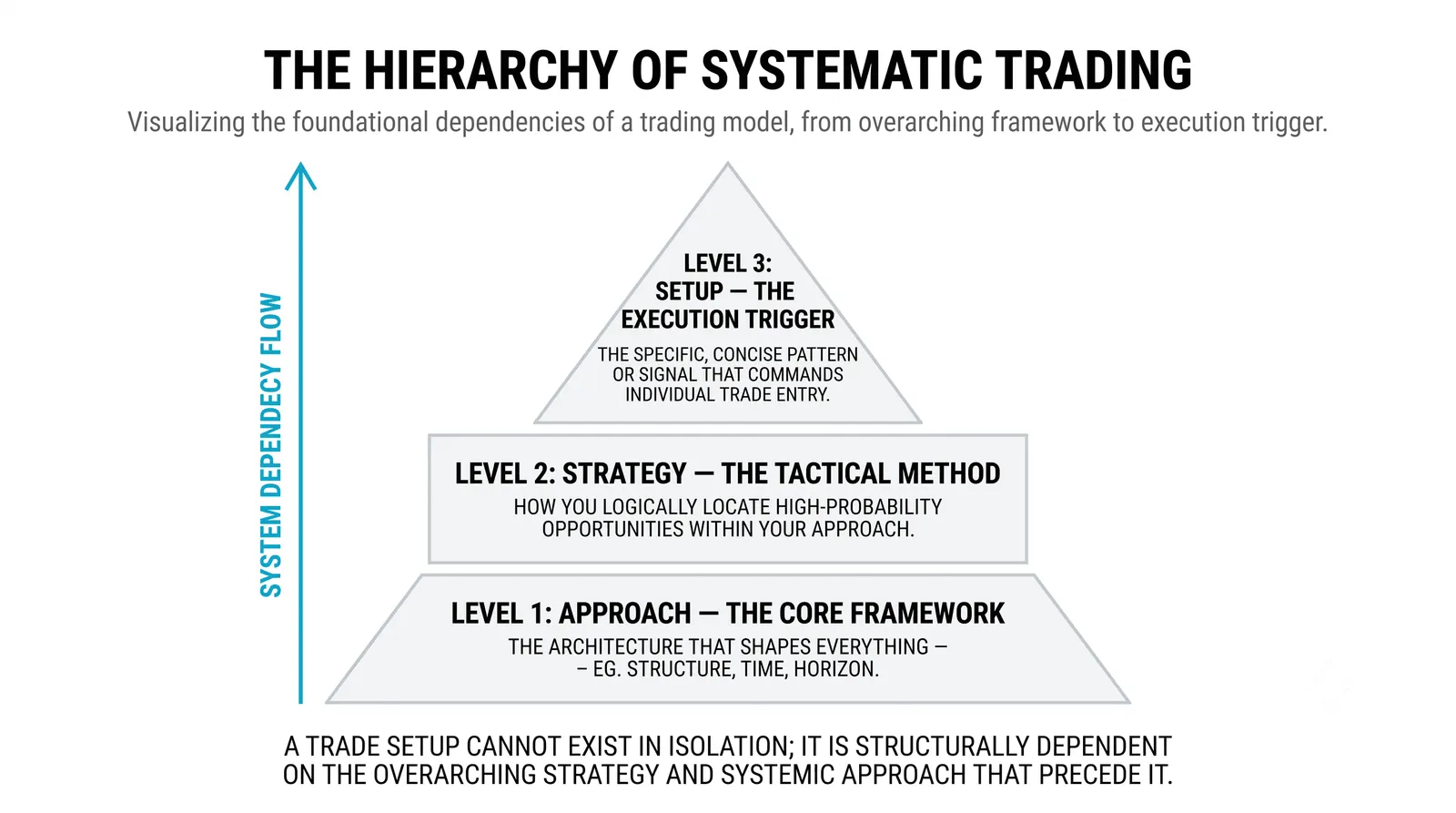
Your trading approach is the overall way you participate in markets: your time horizon, how often you trade, what evidence you act on, and how long you hold. It sits above any individual strategy. Before you pick setups, indicators, or entry tricks, you need this frame, because every later decision hangs off it.

Choosing an approach is like choosing a sport before you train for one; the drills that build a marathon runner are not the drills that build a sprinter. Most new traders skip this step entirely. They jump straight to entries and wonder why nothing sticks.
What an Approach Actually Defines
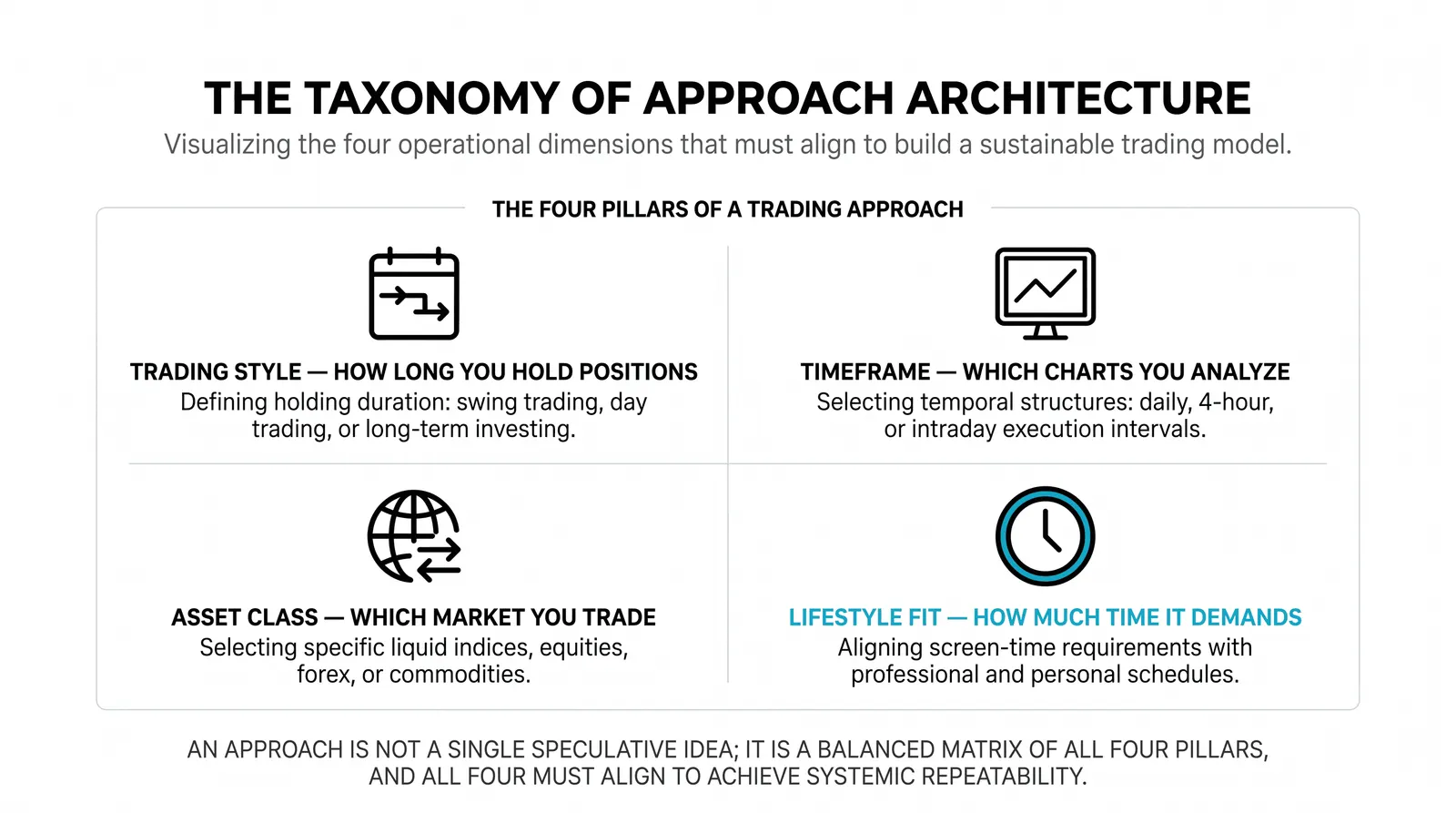
An approach answers four questions. Get clear on these and most of your later choices make themselves.
- How long you hold. Seconds, hours, days, or months. This single choice drives almost everything else.
- How often you decide. A scalper makes dozens of decisions a day. A position trader might make a handful a month.
- What evidence triggers you. Fast styles lean on order flow and one-minute structure. Slow styles lean on daily trends, earnings, and macro context.
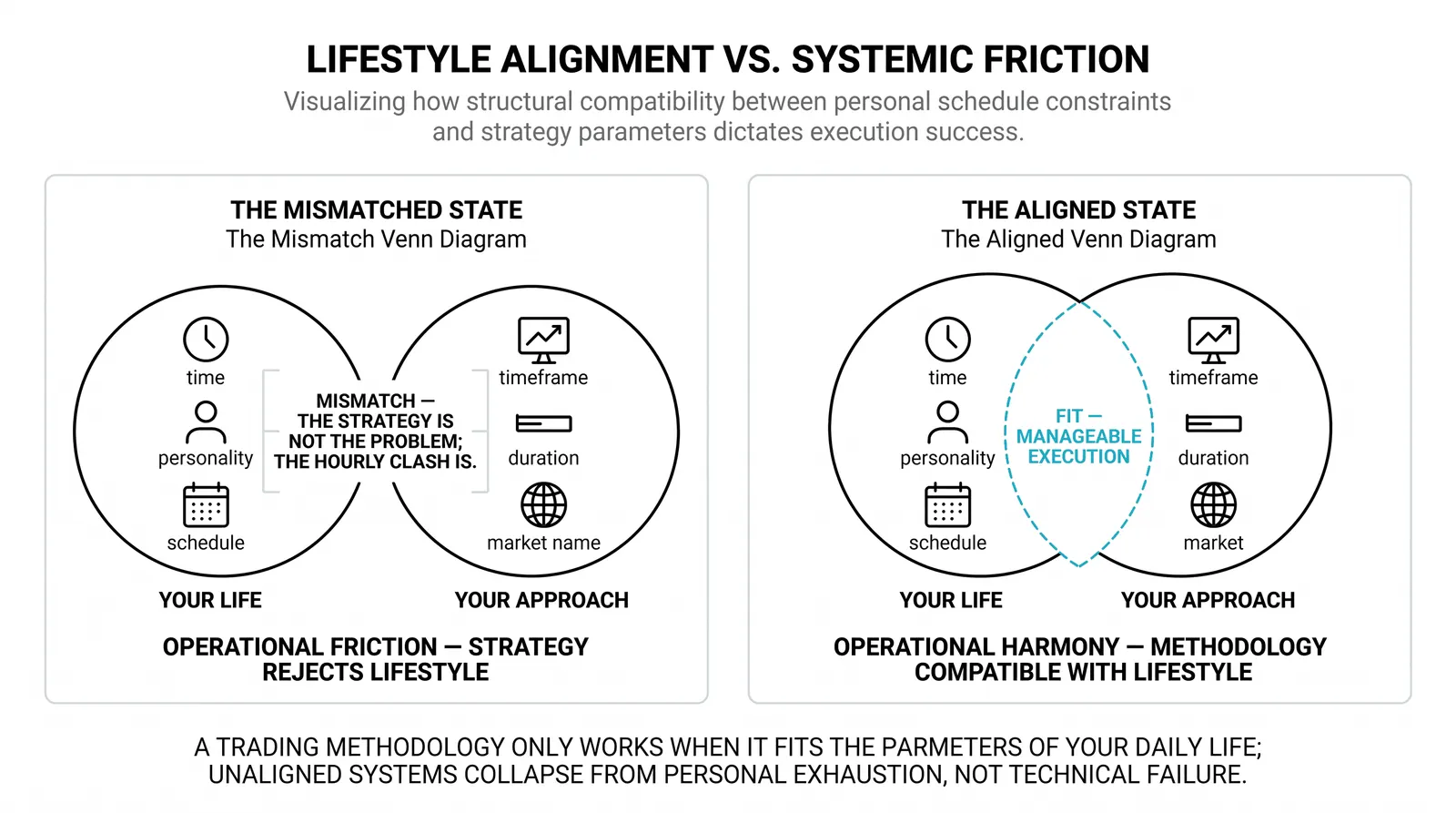
- How much screen time the style demands. Some approaches require you at the desk during market hours. Others need twenty minutes in the evening.
Notice what is missing from that list: indicators, patterns, and entry tricks. Those are tactics. The approach is the container they live in.
The Cost of Skipping This Decision
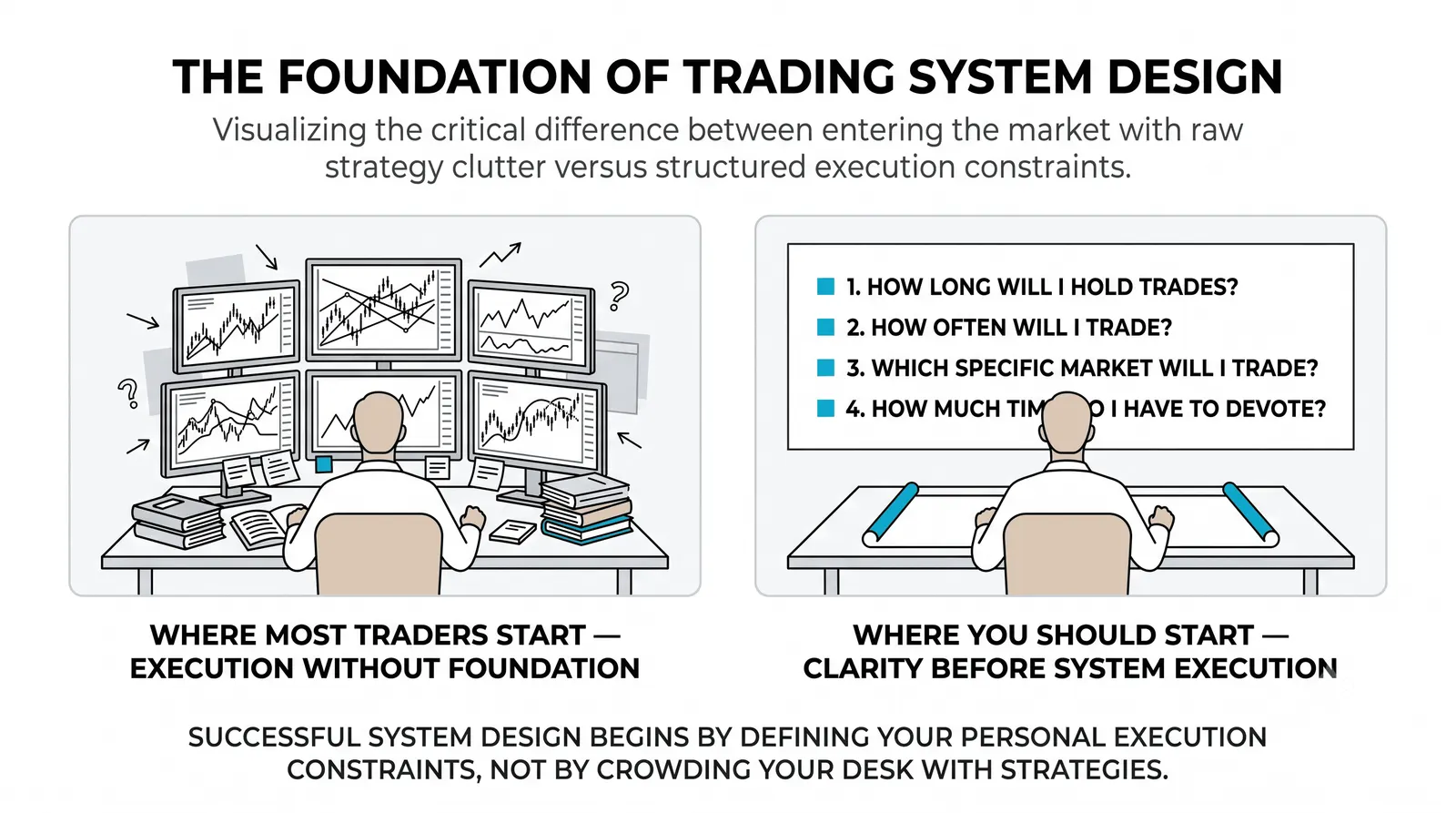
Beginners who never pick an approach become drifters. They scalp on Monday because a video made it look exciting. They swing trade on Wednesday because a position went against them and they refused to exit. By Friday they are "investing for the long term" in a trade that was supposed to last an hour.
The drifter pays the costs of all three styles and collects the benefits of none. Scalping demands fast execution and tight discipline. Swing trading demands patience through overnight risk. Position trading demands conviction through deep pullbacks. Each skill takes months to build. Switching weekly means none of them ever develop.
Worse, drifting hides your mistakes. A losing scalp becomes a "swing trade," so you never review it as the bad scalp it was. Your journal, if you keep one, records three different jobs under one name. You cannot improve what you refuse to define.
The Main Approaches at a Glance
Four broad approaches cover most of what retail traders do. Each has a dedicated lesson on this site, so this is only the map, not the territory.
- Scalping. Holding for seconds to minutes, taking many small moves, demanding full attention and fast execution.
- Day trading. Holding minutes to hours, always flat by the close, no overnight risk but a full working day at the screen.
- Swing trading. Holding days to weeks, capturing one leg of a move, workable alongside a job.
- Position trading. Holding weeks to months, riding major trends, closest to investing but still technically driven.
None of these is superior. They are different jobs with different pay structures, different stresses, and different failure modes.
How the Approach Shapes Everything Downstream
Pick a holding period and a chain of consequences follows. Your charts change: a scalper lives on the one-minute, a swing trader on the daily. Your news filter changes: a position trader cares about earnings and rate decisions, a scalper cares about the next economic release at 8:30. Your stops change: tight and mechanical at fast speeds, wide and structural at slow ones.
Even the definition of a good week changes. A scalper wants dozens of clean executions with small edges adding up. A swing trader might take three trades and call it a strong week. A position trader can do nothing for a month and be performing exactly as planned.
This is why comparing yourself to other traders is usually meaningless. You are often watching someone play a different sport.
One Move, Three Jobs
Here is a hypothetical with round numbers. A stock trades at 50 and, over the course of a week, bounces to 53 before settling back. Same chart, same move, three traders.
The scalper works the intraday swings inside that bounce. Four trades, about 0.50 each, roughly 2 points captured in pieces, minus costs on four round trips. The swing trader enters at 50.50 on Monday and exits at 52.50 on Thursday, capturing 2 points in one trade with one set of costs. The position trader, holding for a move from 50 toward 65 over months, does not act at all. A 3-point wiggle inside a week is noise on their timeframe.
All three handled the same market correctly. The scalper was paid for speed and attention. The swing trader was paid for patience over days. The position trader was paid for ignoring it. If any of them had tried to do the other's job with their own tools, the week would have gone badly.
The Approaches Side by Side
| Approach | Typical Hold | Decisions per Week | Screen Time Demanded |
|---|---|---|---|
| Scalping | Seconds to minutes | 50 to 200+ | Full sessions, total focus |
| Day trading | Minutes to hours | 10 to 50 | Most of the trading day |
| Swing trading | Days to weeks | 2 to 10 | 30 to 60 minutes daily |
| Position trading | Weeks to months | 0 to 3 | A few hours per week |
Read the right-hand column honestly. Screen time is the constraint most beginners ignore, and it eliminates more approaches than any preference does. If you have a full-time job, scalping is not a style choice, it is a scheduling impossibility.
Questions About Trading Approaches
Can I change my approach later?
Yes, and most traders do at least once. Changing deliberately is fine; drifting without deciding is the problem. When you switch, treat it as starting a new job: size down, journal separately, and give it months, not days.
Which approach is best for beginners?
Swing trading suits most beginners because it is slow enough to think, cheap enough on costs, and compatible with a normal life. Fast styles punish hesitation and amplify fees. Slow styles forgive both while you build skill.
Does the approach change my risk?
Yes, in both directions. Faster styles take more trades with smaller stops but stack up costs and execution errors. Slower styles take fewer trades with wider stops but carry overnight and weekend risk. Total risk is a dial you set within any approach, not a property of the approach itself.
Can I run two approaches at once?
You can, but not yet. Two approaches means two skill sets, two journals, and two sets of rules competing for the same attention. Master one first, then add a second only if your schedule and capital genuinely support it.
Your next step is to look at each approach on its own terms. The lessons on scalping, day trading, swing trading, and position trading walk through what each job actually involves day to day, so you can choose with your eyes open rather than default into whatever you saw first.