When Fundamentals Meet Technicals
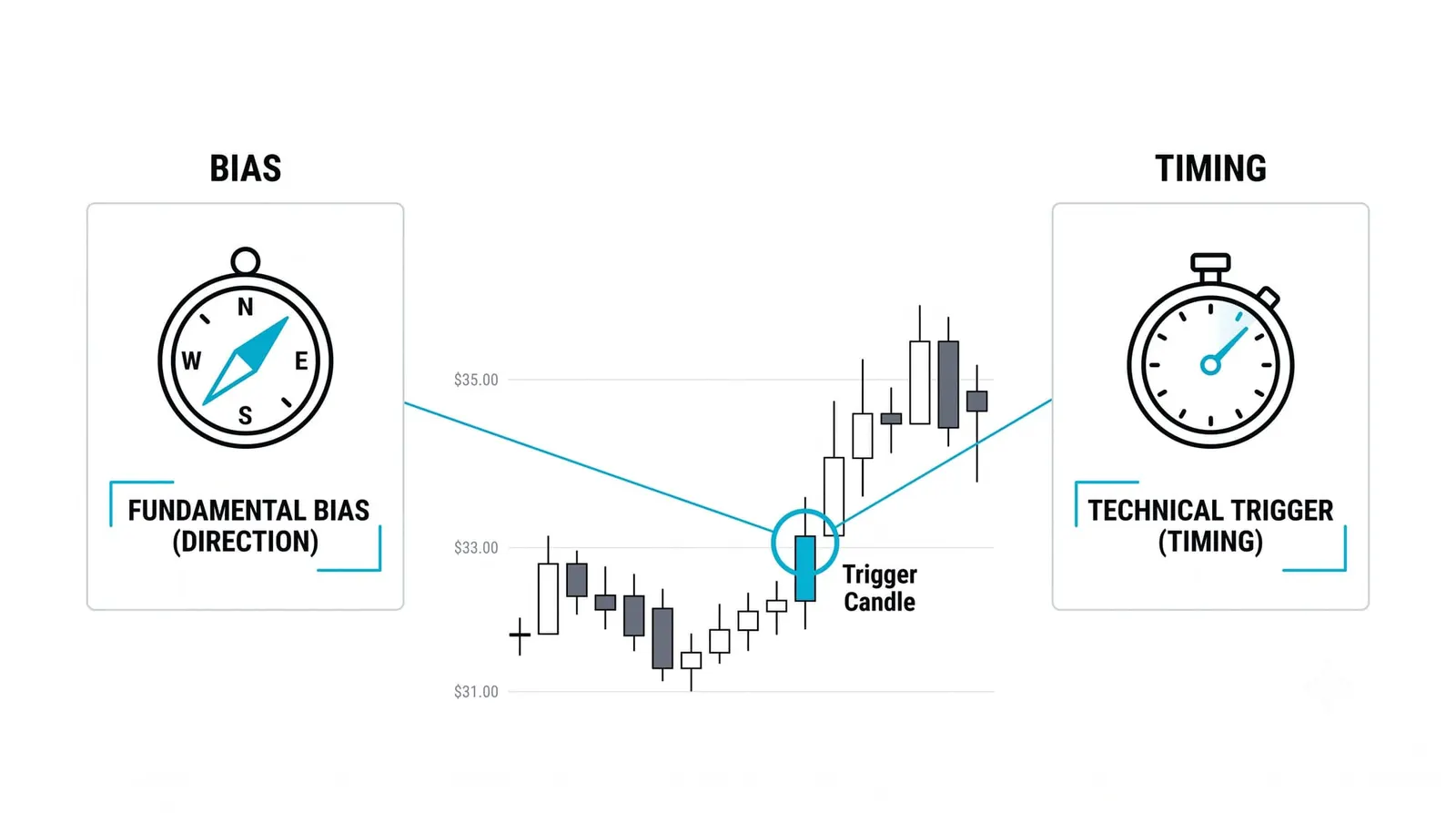
Technicals and fundamentals work together by splitting the job: fundamentals set the bias, which side of a market you want to be on and how big the opportunity is, while technicals set the trigger, the specific price and moment to act. The old head-to-head debate between the two schools was settled long ago in favor of traders who use both, and an earlier level covered that comparison in detail, so we will not re-litigate it here.
Think of fundamentals as the wind and technicals as the sail trim: the wind decides whether the boat moves, the trim decides whether you catch it. A trader who only reads the wind never leaves the dock efficiently. A trader who only trims sails sits becalmed in perfect rigging. You need both layers doing their own job.
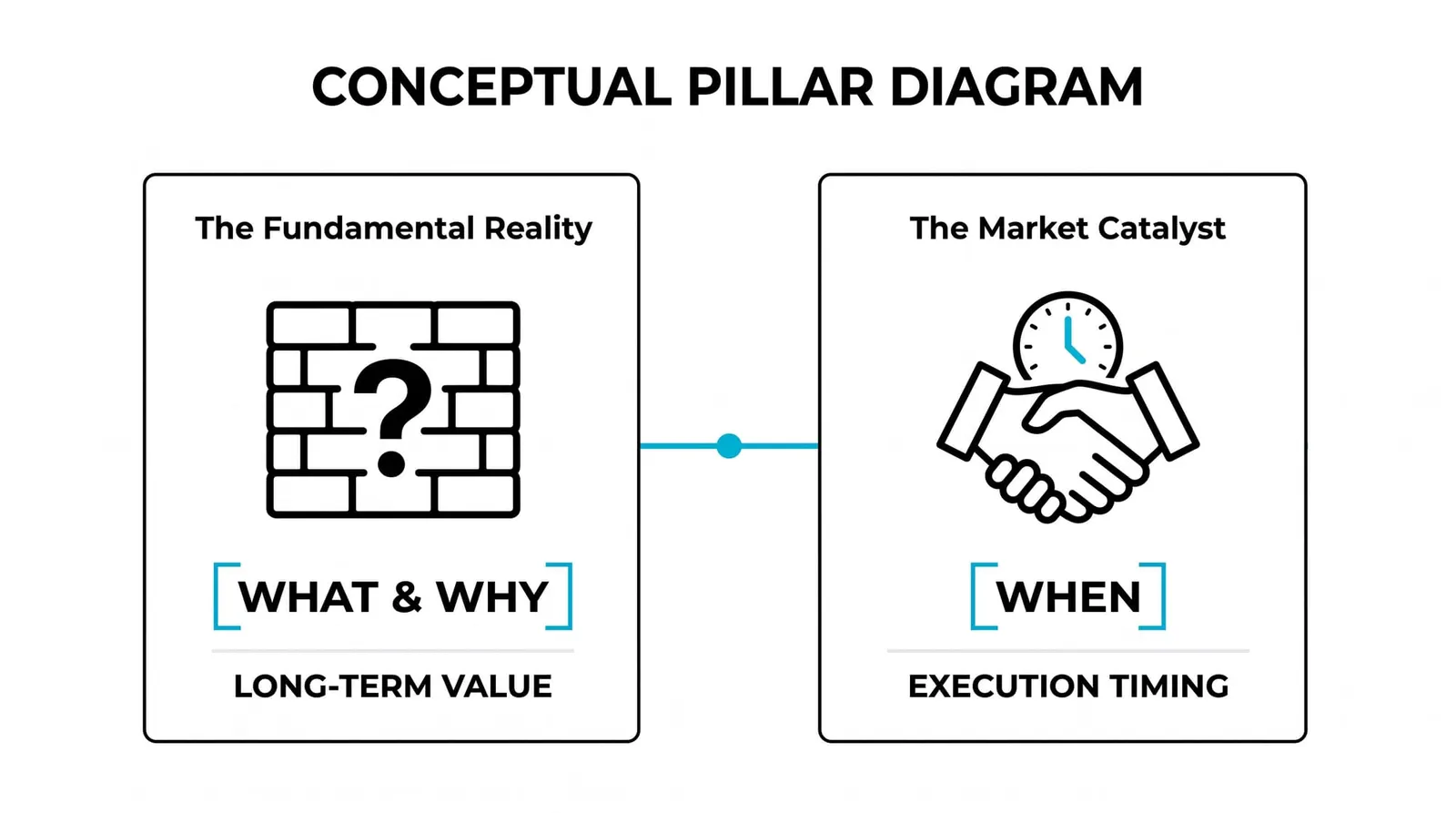
Fundamentals Set the Bias, Technicals Set the Trigger
The bias answers two questions: which direction has a reason underneath it, and how strong that reason is. Reasons come from the fundamental layer. Earnings growth, industry demand, interest rate direction, input costs, competitive position. These are slow-moving forces, and they tell you whether a market deserves your money at all.
Building that bias from the top down, from the economy to the sector to the individual name, was covered on the technical track, so treat that process as already in your toolkit. What matters here is the output: a directional opinion with a conviction level attached.
The trigger is a different animal. It is the level, the signal, the moment. A support zone with a history of holding. A breakout through a well-watched resistance. A candlestick pattern at a price that has mattered before. The trigger tells you where to enter, where you are wrong, and where to take profit.
A bias without a trigger has no entry. You can be completely right about an industry and still lose money buying at the wrong price. A trigger without a bias has no reason. You can nail an entry on a chart pattern in a company with deteriorating fundamentals and get run over by the next earnings report. Each layer covers the other's blind spot.
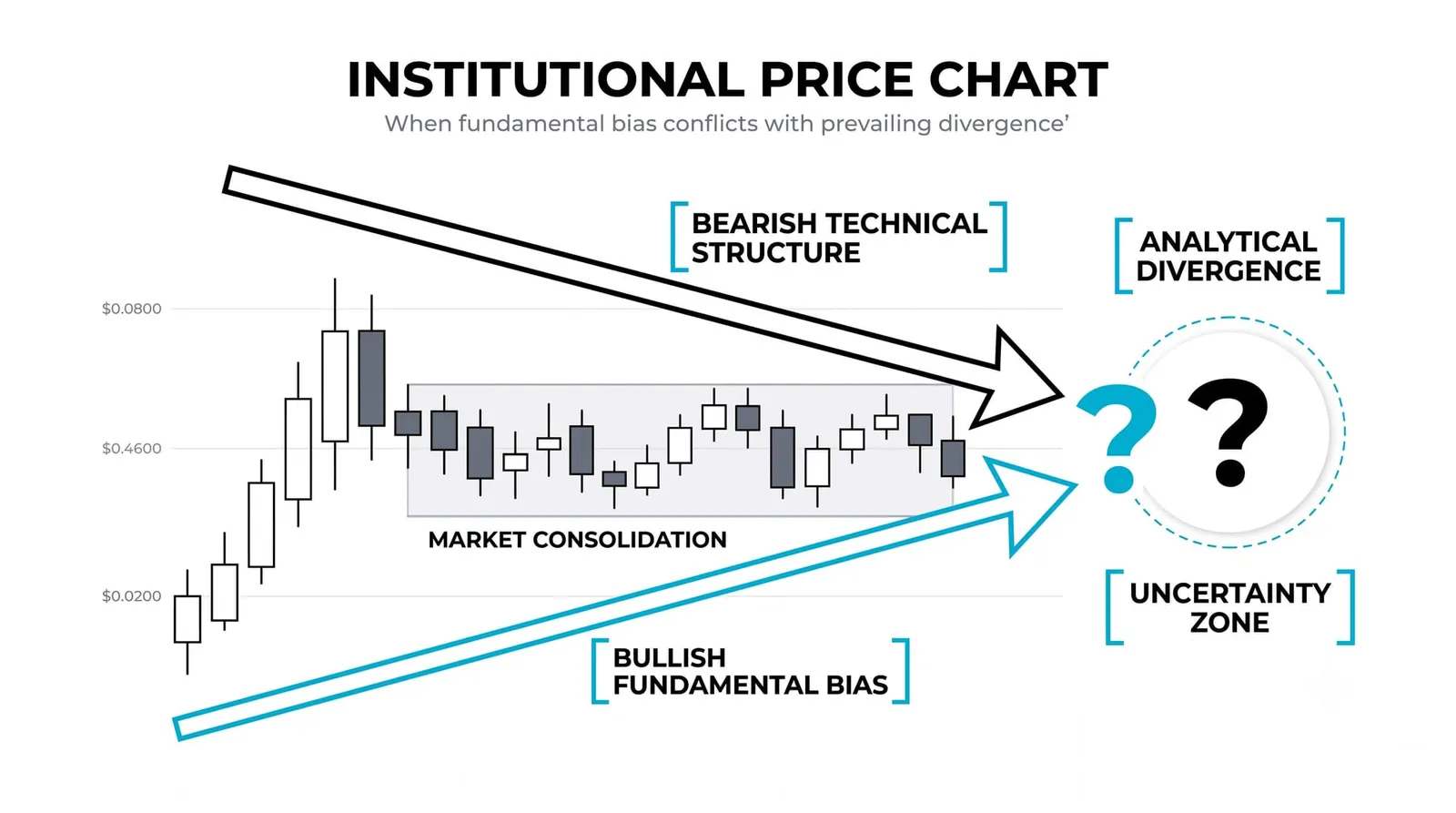
What Happens When They Disagree
Disagreement between the layers is common, and it comes in two flavors. Sometimes the technicals improve while the fundamentals sour: the chart builds a base and breaks out while the company's revenue quietly shrinks. Sometimes the reverse: the fundamentals are excellent and the chart keeps making lower lows.
You have three honest options when this happens. Skip the trade entirely. Shrink the size. Or shorten the horizon, treating the trade as a quick technical play rather than a position you intend to hold. There is no fourth option where you pretend the disagreement away.
Disagreement is information about risk. When the two layers conflict, the market is telling you that something is unresolved, and unresolved situations deserve less capital. That is the logic in full.
One rule keeps you honest: the layer you cannot verify is the layer that should set the size. If you understand the chart but cannot confirm the fundamental story, trade small. If you trust the fundamentals but the chart makes no sense to you, trade small. Confidence you cannot check should never get full size.
Bringing Both Into One Trade Decision
Use a fixed order of questions, and do not let the order slide. Fundamentals first, for direction. Technicals second, for location and timing. Size last, after both layers have spoken.
The order exists to protect you from yourself. If you look at the chart first and fall in love with a setup, you will go hunting for a fundamental story to justify it. If you size the trade before you have a trigger, you will invent a trigger to fit the size. Each layer is fully capable of rationalizing the other's conclusions, and the fixed sequence is what stops that.
In practice the sequence looks like this:
- Direction: does the fundamental picture give this market a reason to rise or fall over my holding period?
- Location: where on the chart is the low-risk entry, and where is the price that proves me wrong?
- Timing: is the trigger present now, or am I early?
- Size: given how well the two layers agree, how much of my risk budget does this trade deserve?
Write the answers down before entering. If any answer is missing, the trade is not ready.
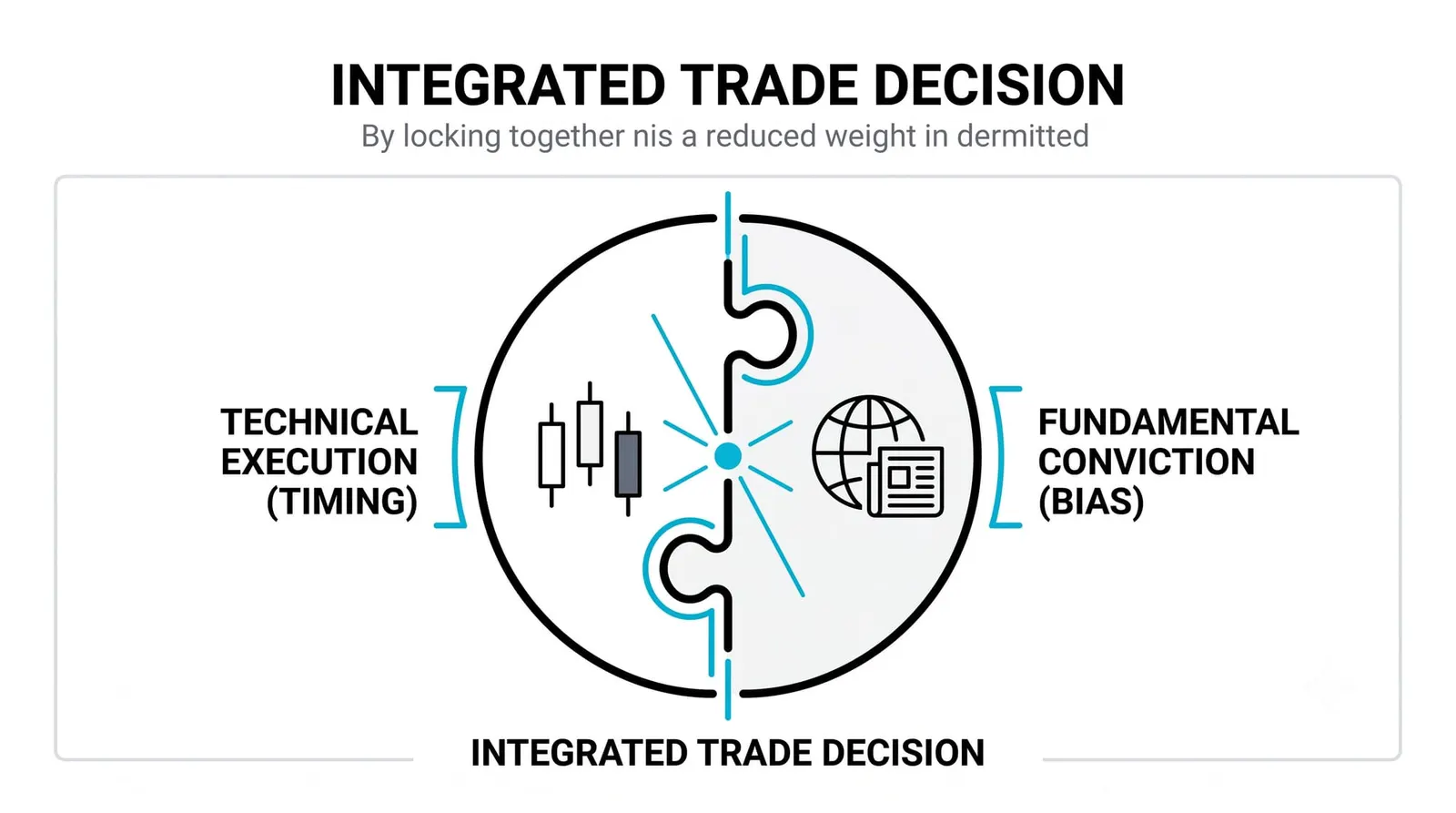
One Decision, Both Layers
Here is a hypothetical with round numbers, purely as an illustration. A stock trades at 44 in a long uptrend. The fundamental layer is clean: demand in its industry is growing, and interest rates are falling, which historically supports valuations in that sector. Your bias is long, with solid conviction.
The technical layer offers the trigger. There is support at 42 with a three-touch history, meaning price has dropped to that zone three times and buyers have appeared each time. The plan: enter near 42.50 on a pullback into support, stop at 40.90 just below the zone, first target at the prior high of 48.
The risk is about 1.60 per share against a potential reward of about 5.50. Both layers agree, so the trade earns full size within your normal risk limits.
Now the disagree case. Same chart, same 42 support, same three touches. But the company has just lost a lawsuit that will cost roughly 10 percent of its revenue. The trigger has not moved at all. The bias has flipped from supportive to hostile.
The verdict changes even though the entry does not. You either cut the size in half, acknowledging that the chart says go while the story says caution, or you pass entirely. The trigger never changed. The bias did. And the bias is what sized the trade.
| Layer | What it answers | What it sets | What happens on conflict |
|---|---|---|---|
| Fundamentals | Which direction has a reason, and how strong | Bias and conviction | The weaker or unverifiable layer caps the size |
| Technicals | Where to enter, where you are wrong, when | Entry, stop, target | |
| Both agreeing | Direction and location point the same way | Full normal size | No conflict to resolve |
| Both disagreeing | Story and chart point apart | Reduced size, shorter horizon, or no trade | Skip, shrink, or shorten |
Fundamentals and Technicals, Answered
Can I trade technicals alone and add fundamentals later?
Yes, and many traders do exactly that, but understand what you are trading without. Without a fundamental layer you have no independent read on direction, so every trigger looks equally valid and sizing becomes guesswork. Adding the bias layer later usually means fewer trades and better ones.
Which layer sets the stop-loss?
The technical layer sets the stop, always. A stop belongs at the price that proves the trade idea wrong, and that is a chart question: below support, below the pattern, beyond the level that should have held. Fundamentals can tell you the trade is attractive, but they cannot tell you where the market has refuted your entry.
Do both layers ever fully align?
Yes, though less often than you would like. Full alignment means a strong fundamental reason, a clean chart, and a trigger at a well-defined level, all at once. These are the trades that deserve your largest standard size, and they are worth waiting for rather than forcing.
What if my fundamental view is right but the trigger never comes?
Then there is no trade, and that is a correct outcome. A bias without a trigger has no entry, by definition. Being right about direction without ever getting a price you can act on costs you nothing, while forcing an entry without a trigger costs real money.
Next in this level, you will start building the fundamental layer itself: the economic releases that move markets, how to read them, and how to fold them into the bias you now know how to use.