Interest Rates and Asset Prices
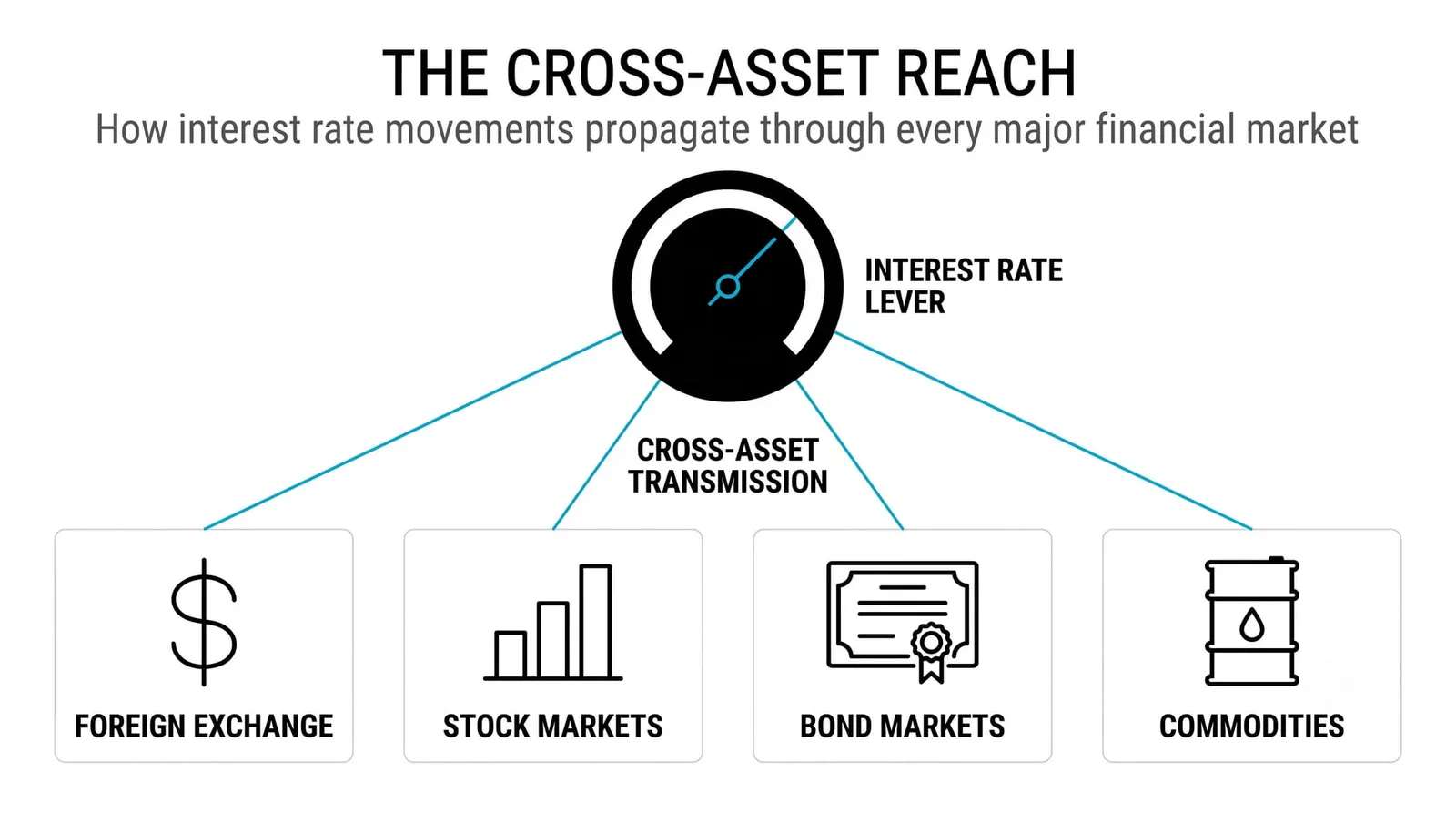
Interest rates and asset prices are linked through two forces: discounting, which shrinks the present value of every future payment when rates rise, and competition, because a higher safe yield gives investors a reason to demand more from everything risky. When rates climb, stocks, bonds, currencies, and commodities all reprice, but each does it through its own mechanism.

Rates act like gravity in finance; the stronger the pull, the harder it is for anything to float. That single image explains the direction, but it does not explain the details. A currency does not respond to a rate hike the way a bond does, and a bond does not respond the way a growth stock does. One driver, four separate transmissions. If you treat them as one trade, you will be right about the rate call and wrong about the position.
A previous lesson covered what a policy rate is and how it ripples through the real economy. This one owns the next step: how each asset class actually feels the change, and why the timing often surprises people.
Rates and Currencies
Capital chases yield. When a country offers higher interest rates than its peers, foreign investors need that country's currency to buy its bonds and deposits, which is one engine behind currency strength. Demand for the currency rises, and the exchange rate tends to firm.
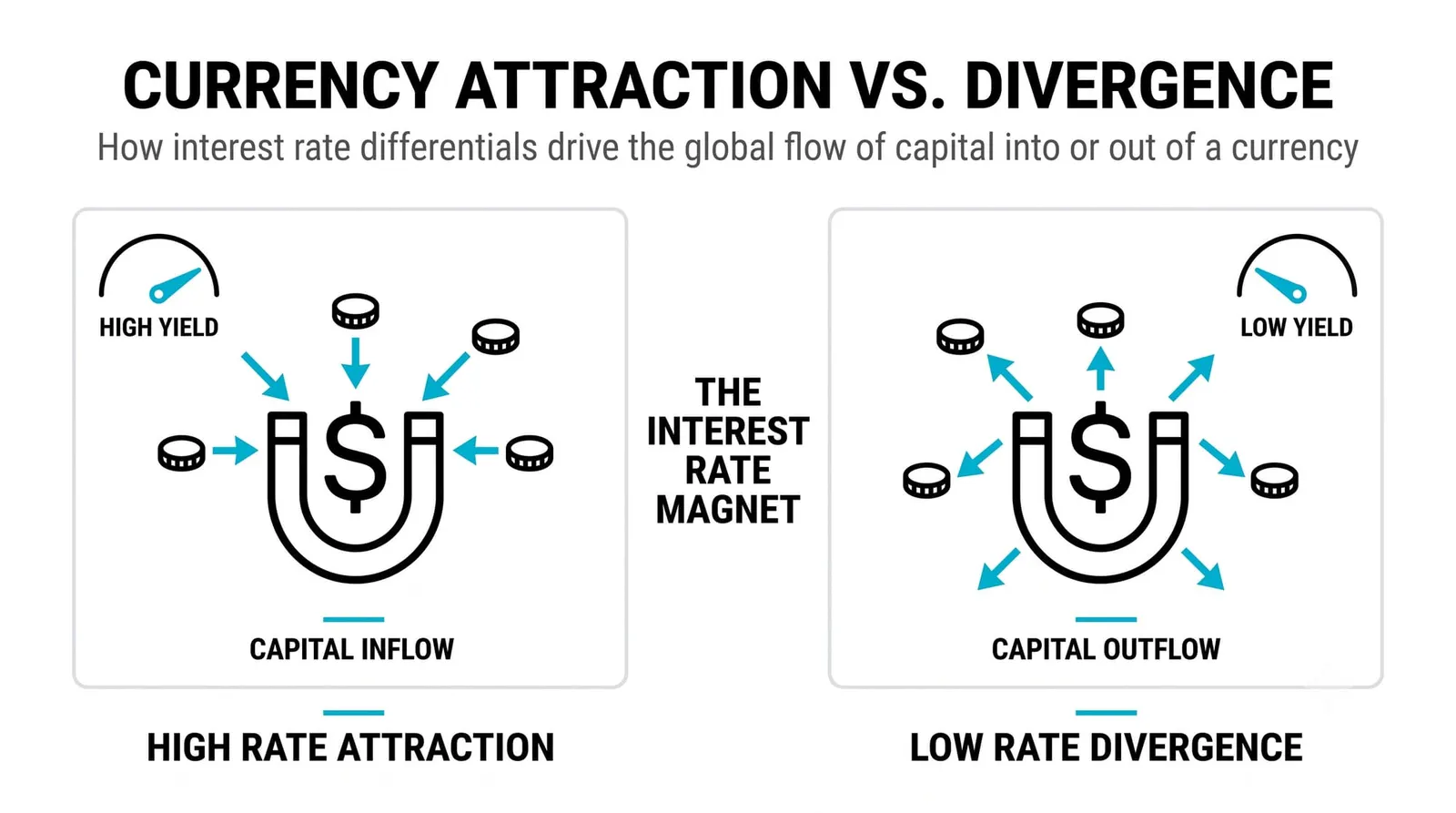
The catch is that currency markets trade on expectations, not announcements. Traders spend weeks positioning for a hike they see coming. By the time the central bank actually moves, the buying has often already happened.
This produces a pattern that confuses beginners: the currency strengthens for weeks ahead of a hike, then sells off on the day of the announcement. Nothing went wrong. The news was priced in, and late buyers took profits. The opposite happens with cuts. A widely expected cut can leave the currency flat or even higher if the central bank sounds less worried than feared.
So the currency question is never just "did they hike?" It is "what did the market already assume, and what changed?"
Rates and Stocks
Stocks feel rates through three channels, and they do not all hit at the same speed.
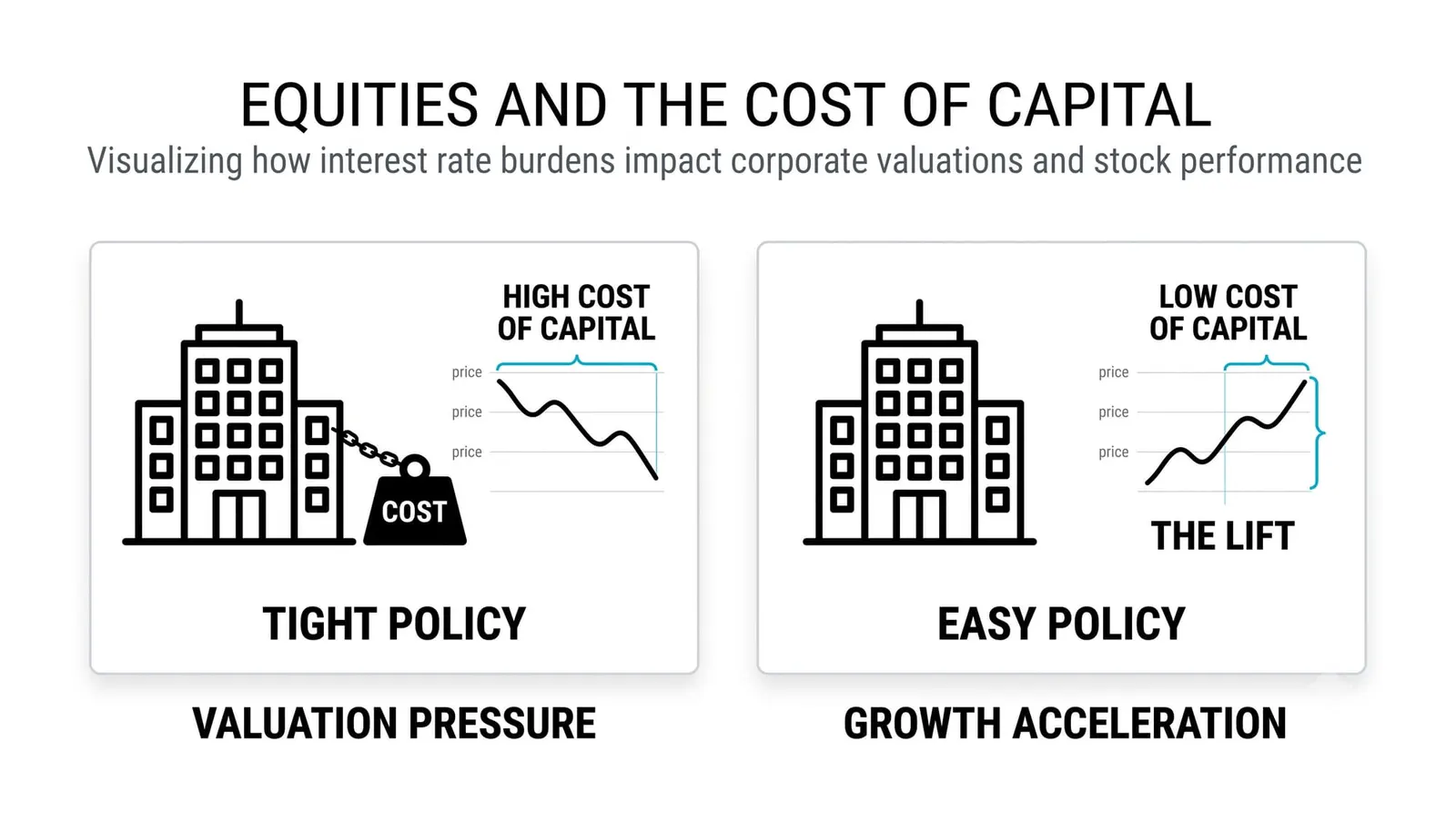
The first is the discount channel. A share is a claim on future profits, and those profits are worth less in present money when the discount rate rises. This hits growth companies hardest. A mature firm paying steady dividends has most of its value in near-term cash flows. A young company promising big profits ten years out has most of its value far in the future, exactly where higher discount rates bite deepest. That is why rate hikes tend to punish expensive, long-dated growth stocks more than cheap, cash-generating ones.
The second is the cost channel. Companies borrow to operate and expand. Higher rates mean higher interest expense, thinner margins, and postponed projects. This shows up in earnings quarters later, not on the day of the decision.
The third is the competition channel. If a safe government bond pays 5 percent, an investor holding a risky stock asks a harder question: why accept volatility for an expected return that barely clears 5 percent? Money rotates toward the safe yield, and stock valuations compress to stay attractive. When safe yields are near zero, almost any expected return wins the comparison. When they are not, stocks have to earn their place.
None of this means every stock falls when rates rise. Banks can earn wider lending margins. Companies with no debt and strong pricing power shrug off the cost channel. The average effect is a headwind, not a law.
Rates and Bonds and Commodities
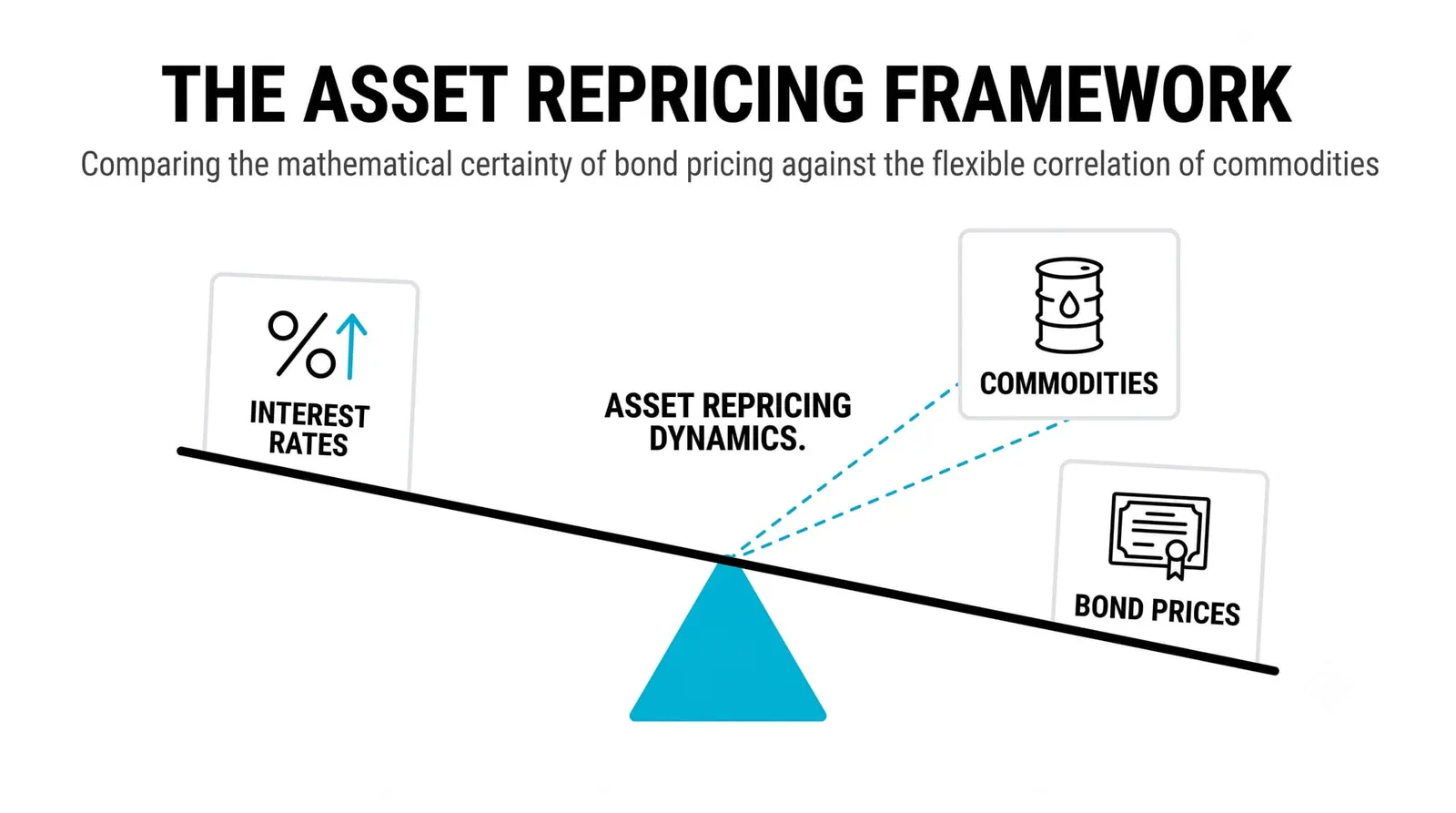
Bonds carry the most direct inverse relationship in finance. A bond pays fixed amounts on fixed dates. When new bonds are issued at higher rates, the old bond paying less is strictly worse, so its price falls until its yield matches the new reality. When rates fall, the old bond paying more becomes valuable, and its price rises.
The arithmetic is mechanical. A bond paying 4 percent when the market demands 5 percent must be marked down until its buyer effectively earns 5 percent. There is no opinion involved, only math. Longer-dated bonds move more, because the inferior payments stretch further into the future.
Commodities get squeezed through two doors at once. Most are priced in dollars, so when higher rates firm up the dollar, commodities become more expensive for the rest of the world and demand softens, the dollar effect again. At the same time, holding commodities costs money: storage, insurance, and financing. Higher rates raise that carrying cost and raise the return on simply holding cash instead. Gold feels this acutely because it pays nothing. Its appeal rises when the opportunity cost of holding it falls, and fades when safe yields climb.
The Same Cut, Four Markets
Here is a purely hypothetical illustration with invented round numbers. A central bank cuts its policy rate by a quarter point, from 5.00 percent to 4.75 percent. Watch one decision travel four different routes.
Currencies. Yield seekers who parked money for the 5.00 percent return now see less reason to stay. Some capital leaves, demand for the currency dips, and the exchange rate softens. If the cut was fully expected, most of that softening already happened in the weeks before.
Stocks. The first reaction is often a wobble, not a rally. A cut can signal that the central bank sees weakness ahead, and traders sell on the worry. Then the discount math takes over: future profits are now discounted at a lower rate, borrowing gets cheaper, and the safe alternative pays less. Stocks firm up. Two forces, opposite directions, minutes apart.
Bonds. Existing bonds paying the old, higher coupons now beat anything newly issued. Buyers bid them up. This is the cleanest reaction of the four, because it is arithmetic rather than sentiment.
Commodities. Gold lifts. The dollar softens, making it cheaper for foreign buyers, and the lower rate reduces the opportunity cost of holding an asset that pays nothing. Both doors swing the same way.
One decision, four mechanisms, four different speeds. The table below compresses it.
| Asset class | Channel rates push through | Direction when rates fall | The catch |
|---|---|---|---|
| Currencies | Capital flows chasing yield | Tends to soften | Moves on expectations, often before the decision |
| Stocks | Discounting, borrowing costs, bond competition | Tends to rise | May dip first if the cut signals economic trouble |
| Bonds | Fixed payments repriced against new yields | Prices rise, mechanically | Longer maturities swing harder |
| Commodities | Dollar pricing plus carrying cost | Tends to lift | Two channels, and they do not always agree |
Rates and Asset Prices, Answered
Do all stocks fall when rates rise?
No. The average effect is a headwind, but individual businesses differ. Banks may earn more from wider lending margins, debt-free companies with strong pricing power barely feel the cost channel, and cheap value stocks hold up better than expensive growth stocks because less of their value sits in the distant future.
Why did the currency move before the rate did?
Because currency markets trade expectations. Traders position for a likely hike or cut weeks in advance, so the exchange rate adjusts before the announcement. The decision itself often confirms what was already priced in, which is why currencies can reverse on the actual news.
Do rate cuts always lift gold?
No. Cuts help gold through a softer dollar and a lower opportunity cost of holding it, but other forces can dominate. If the dollar strengthens for separate reasons, or if inflation expectations collapse, gold can fall even while rates drop. The rate channel is a tailwind, not a guarantee.
Which asset class reacts fastest?
Currencies and short-dated bonds usually move within seconds of a decision, because they price the rate itself most directly. Stocks react fast too but can reverse as traders digest what the decision implies about the economy. Commodities and long-dated effects, like corporate borrowing costs, unfold over weeks and quarters.
Once you can trace one rate decision through four markets, the next step is learning where those rates come from: how central banks set policy, what they watch, and why their meeting calendars belong on yours.