Wyckoff Spring: The Shakeout Before Markup
A spring is a probe below range support that closes back above it almost immediately on low volume, and it is widely treated as the strongest single buy signal in the Wyckoff method. It is the shakeout: the fake breakdown that catches weak holders at the worst prices of the whole campaign and hands their shares to professional buyers.

On the chart it looks like the cruelest wick you will ever see. Price breaks the floor everyone was watching, triggers panic, and then recovers within a bar or two as if nothing happened. The traders who sold into that wick sold the low. The traders who recognized it bought the low. Same bar, opposite outcomes.
Think of it as a fencing feint: the attack draws the parry, and the opponent's reaction is the real information. The poke below support is the feint. What the market does in response, who sells and how much supply actually appears, tells the professional buyer whether the path upward is clear.
The previous lessons in this block walked through the phase A event sequence and the full schematic, so this lesson picks up inside phase C, after the range has been built and the trading range has a readable floor and ceiling. The spring is the sharpest event in that phase, and it deserves its own treatment.
Why Price Pokes Below the Floor
Stops cluster in predictable places. When a stock has bounced off the same support level three or four times, traders who bought near that floor place their protective stops just below it. That is textbook practice, and everyone who has read the same books does it the same way.
Professional buyers know exactly where those stops sit. A quick push through the floor triggers them in a cascade, and each triggered stop becomes a market sell order. Those sell orders arrive in a burst, at prices below the level where the professional buyer was already willing to accumulate.
That burst of forced selling is inventory. The buyer who wanted a large position without paying up for it now gets filled at a discount, supplied by the very traders who were shaken out. The floor everyone watches is the floor worth attacking once, because that is where the liquidity lives.
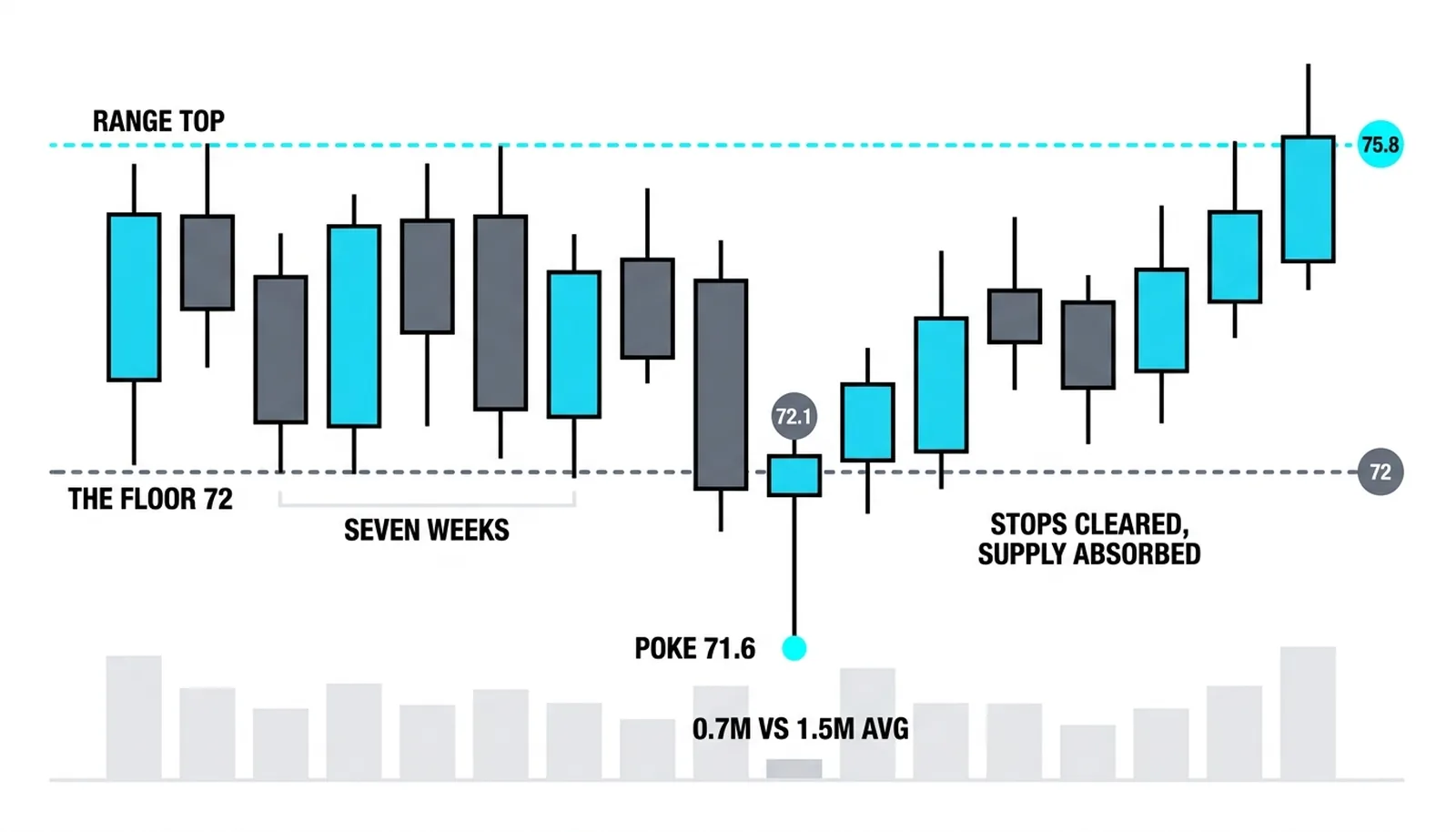
This is why the poke is brief. The purpose is to harvest the stops, not to break the range. If the buyers doing the pushing wanted lower prices to hold, they would press the advantage. Instead they step back the moment the stops are cleared, and price recovers because the supply that drove it down just got absorbed.
The Volume Verdict
The shape alone proves nothing. A poke below support can be a spring or it can be a genuine breakdown, and the two paths look identical for the first few hours. Volume and follow-through are what separate them.
Path one: the poke prints on low volume, the bar closes back above the floor quickly, and the next one to three bars refuse to fall. Low volume on the break says very few sellers actually participated. The fast recovery says buyers stepped in immediately. The quiet bars afterward say no fresh supply is arriving. That combination is the spring.
Path two: the break closes below the floor on heavy volume, and the following bars keep falling. Heavy volume says real supply hit the market beyond the triggered stops. Continued weakness says that supply was not absorbed. That is a genuine breakdown, and treating it as a spring is how accounts get hurt.
Same shape, opposite verdicts. The tell is what the next one to three bars refuse to do. If they refuse to follow the breakdown lower, the breakdown failed. Location plus volume decide, which is the location principle from earlier in this level doing its job: a bar means what its address and its participation say it means.
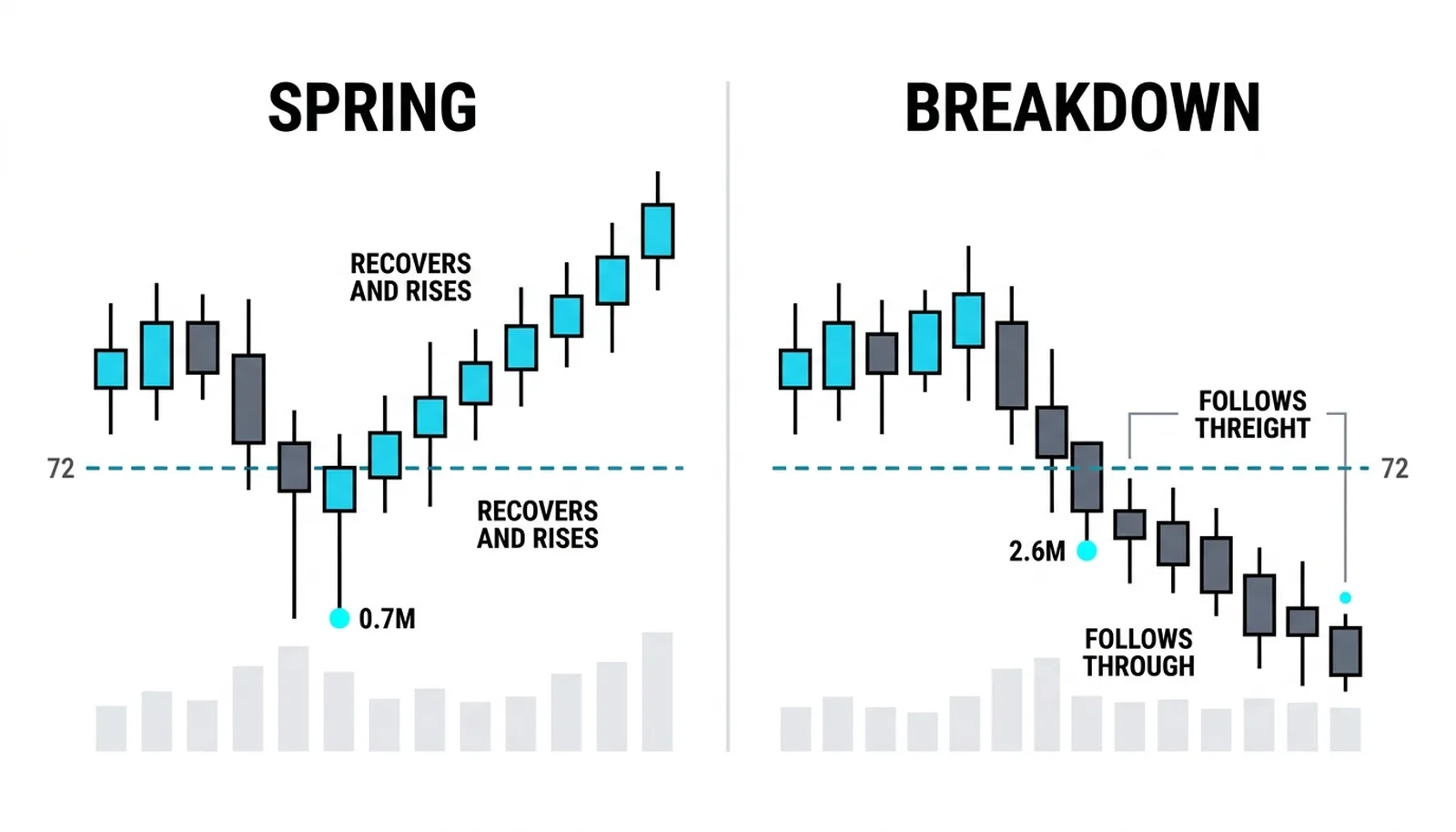
Be honest about the story here. The narrative that an operator engineered the poke is a model of intent, and you cannot see anyone filling. What you can see is the poke, the recovery, the volume, and the absence of follow-through. The measurements do the proving, not the story.
The mirror image exists at tops. The upthrust after distribution is the same device pointed upward, a probe above resistance that fails, and the pseudo upthrust lesson already showed how one bar shape changes its meaning with its address.
Trading the Spring
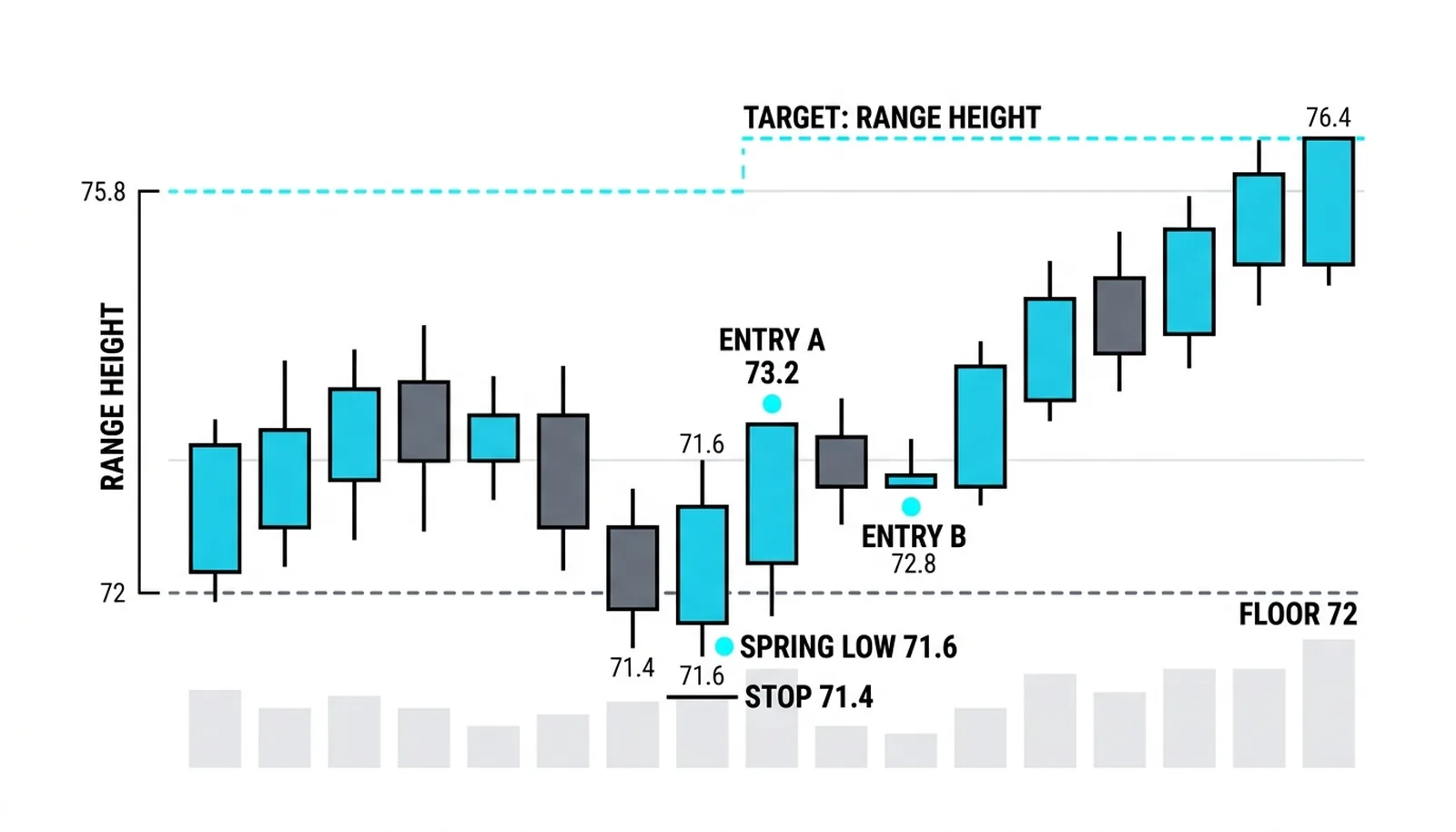
Two entries are standard. The aggressive entry buys the close back above support on the spring bar itself. You get the best possible price, but you accept the risk that the recovery fails and the breakdown turns real.
The conservative entry waits for the first pullback after the spring and buys it only if that pullback holds above the floor. You pay a slightly higher price in exchange for confirmation that the recovery has legs. Both entries are legitimate; the choice is about which risk you prefer to carry.
The stop goes just below the spring low. This is one of the cleanest invalidation points in all of technical analysis. If price trades under the low of the bar that was supposed to be the shakeout, the shakeout thesis is dead, and you want out immediately.
That explicit invalidation is why the stop can be tight. You are not guessing where to place it. The spring defines its own failure point, so risk per trade is small relative to the reward on offer.
The target comes from the law of cause and effect. Measure the height of the range, then project that distance upward from the breakout point. A range built over weeks of accumulation stores the cause; the markup that follows is the effect, and the range height gives a first estimate of how far it should travel.
When the Spring Fails
Sometimes the poke below support is the real thing. The bar closes below the floor on heavy volume, the next bars keep sliding, and no recovery arrives. Supply was not exhausted. The sellers had more to give than the buyers could absorb.
A failed spring is information, not an insult to the method. It tells you the campaign needs more time, more base building, or a deeper test before markup can begin. The correct response is to stand aside or exit, not to argue with the tape.
The method is not broken by a failed signal. Every Wyckoff event is a hypothesis with a built-in test, and some hypotheses fail. The edge comes from acting when the evidence lines up and cutting fast when it does not, not from being right every time.
One Spring, Measured
All numbers here are invented round figures for illustration. A stock prints a selling climax at 71.2, then builds a range between 72 and 78 for seven weeks. Average daily volume over that stretch runs about 1.5 million shares.
Then the spring arrives. Price pokes to a low of 71.6, four tenths below the 72 floor, on volume of just 0.7 million shares, less than half the average. The bar closes at 73.1, back inside the range. The poke found no real selling.
The next session drifts between 72.9 and 73.6 on 0.5 million shares and refuses to fall. That quiet bar is the confirmation: no follow-through supply exists. The spring thesis is alive.
The aggressive entry reads 73.2 on the close back above the floor. The conservative entry reads 72.8 on a shallow pullback three sessions later that holds above 72. The stop sits at 71.4, just under the spring low of 71.6. The range height is 6.0 points, 78 minus 72, so the projected target after a breakout at 78 is 84. The breakout arrives and the target fills within two weeks.
What would have cancelled the trade: a close back below 72 on rising volume, any bar trading under 71.6, or follow-through selling in the sessions after the poke. Any one of those kills the thesis and the stop at 71.4 enforces the exit.
| Moment | Price | Volume | The Read |
|---|---|---|---|
| The poke below | Low 71.6 | 0.7M | Weak break, few real sellers |
| Close back above | 73.1 | 0.7M | Buyers stepped in fast |
| The quiet next bar | 72.9 to 73.6 | 0.5M | No follow-through supply |
| The breakout | 78 to 84 | Rising | Cause becomes effect |
The Wyckoff Spring, Answered
What is a spring in Wyckoff analysis?
A spring is a brief probe below range support that closes back above it quickly on low volume, appearing in phase C of an accumulation range. It shakes out weak holders through their stop orders and is widely treated as the strongest single buy signal in the method.
Why does a spring print on low volume?
Low volume shows that the break attracted little genuine selling. The only supply was the triggered stops clustered below the floor, and once those were absorbed, nothing was left to push price lower. Heavy volume on the poke would mean real supply, which points to a true breakdown instead.
How do you trade a spring?
Either buy the close back above support for the aggressive entry, or buy the first pullback that holds above the floor for the conservative entry. Place the stop just below the spring low, and project the target by adding the range height to the breakout point.
What is the difference between a spring and a failed breakdown?
They are the same event described from two angles. A spring is a failed breakdown: price broke support, found no sellers, and recovered. A genuine breakdown is the opposite outcome, closing below on heavy volume with follow-through, and it must never be traded as a spring.
With the shakeout understood, the next step is the other side of the campaign: the sign of strength and the last points of support, where the breakout confirms everything the spring promised and the method shifts from buying the range to riding the markup.