Sign of Strength: Wyckoff SOS and LPS
Strength in Wyckoff terms has a precise meaning: a sign of strength is the wide-spread, high-volume up bar that breaks a trading range to the upside, the proof that an accumulation campaign is going public. The last points of support are the pullbacks that hold above the breakout afterward, the shelves where professional money adds and patient traders get their entry.

The previous lesson covered the spring, the final test of supply inside the range. This lesson owns what happens once that test is passed: the expansion out of the range and the shelves that follow.
Think of it as a theater run: opening night proves the show, and the performances that follow are where everyone who missed the premiere still gets a seat. The breakout bar is the premiere. The pullbacks are the performances that follow.
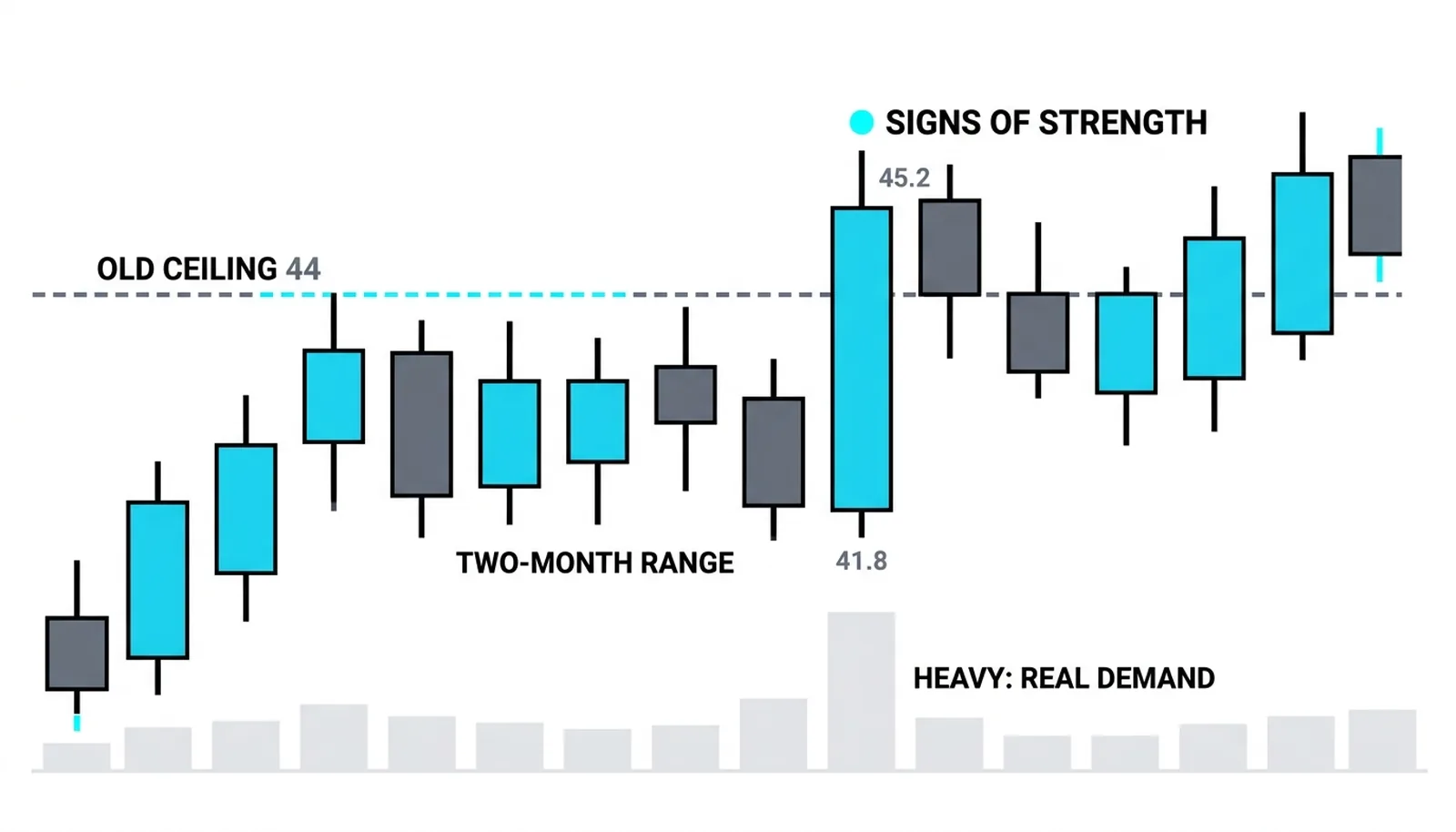
The Sign of Strength: Demand Goes Public
The sign of strength bar has a specific anatomy. It prints a wide spread upward. It closes in the upper part of its range. It trades on volume clearly above the range average. And it takes out the old resistance: the automatic rally high and the secondary test highs that capped price for weeks.
Each element does a job. The wide spread shows aggressive buying, not drifting. The high close shows buyers held control into the bell rather than fading. The volume shows real commitment, because size cannot be faked cheaply: effort appears where the conviction is. The break of resistance shows the ceiling that absorbed every prior rally has finally been cleared of supply.
One forceful candle anywhere is not a sign of strength. The word appears in modern price-action writing for any strong bull bar, but the Wyckoff sense is narrower. It requires a built range behind it, a campaign of accumulation that the bar is confirming. A big green candle in the middle of nowhere proves nothing about who holds the stock.
The range is what gives the bar its meaning. Weeks of absorption mean the floating supply has moved into strong hands. When that breakout bar arrives, the range delivers.
The Last Point of Support: The Shelf
After the breakout, price pulls back. That pullback, when it holds above the broken resistance on lighter volume, is the last point of support. Old resistance becomes new support, and the decline into it is the test of that flip.
Who buys there? The operator who accumulated through the range and has no interest in letting price fall back into it adds on the dip, defending the level, because a return deep into the range would threaten their whole position. The lighter volume on the pullback tells you the sellers are not the strong hands; the strong hands are the ones bidding.
The shelf beats chasing the breakout bar for a simple reason: risk placement. Buy the breakout bar and your stop must sit far away, under the shelf that has not formed yet or under the whole range. Buy the shelf and your stop sits just under a nearby, recently tested level. Same campaign, same direction, a fraction of the risk per share.
Chasing feels safer because the move is proven. It is actually more expensive in the only currency that matters, points of risk.
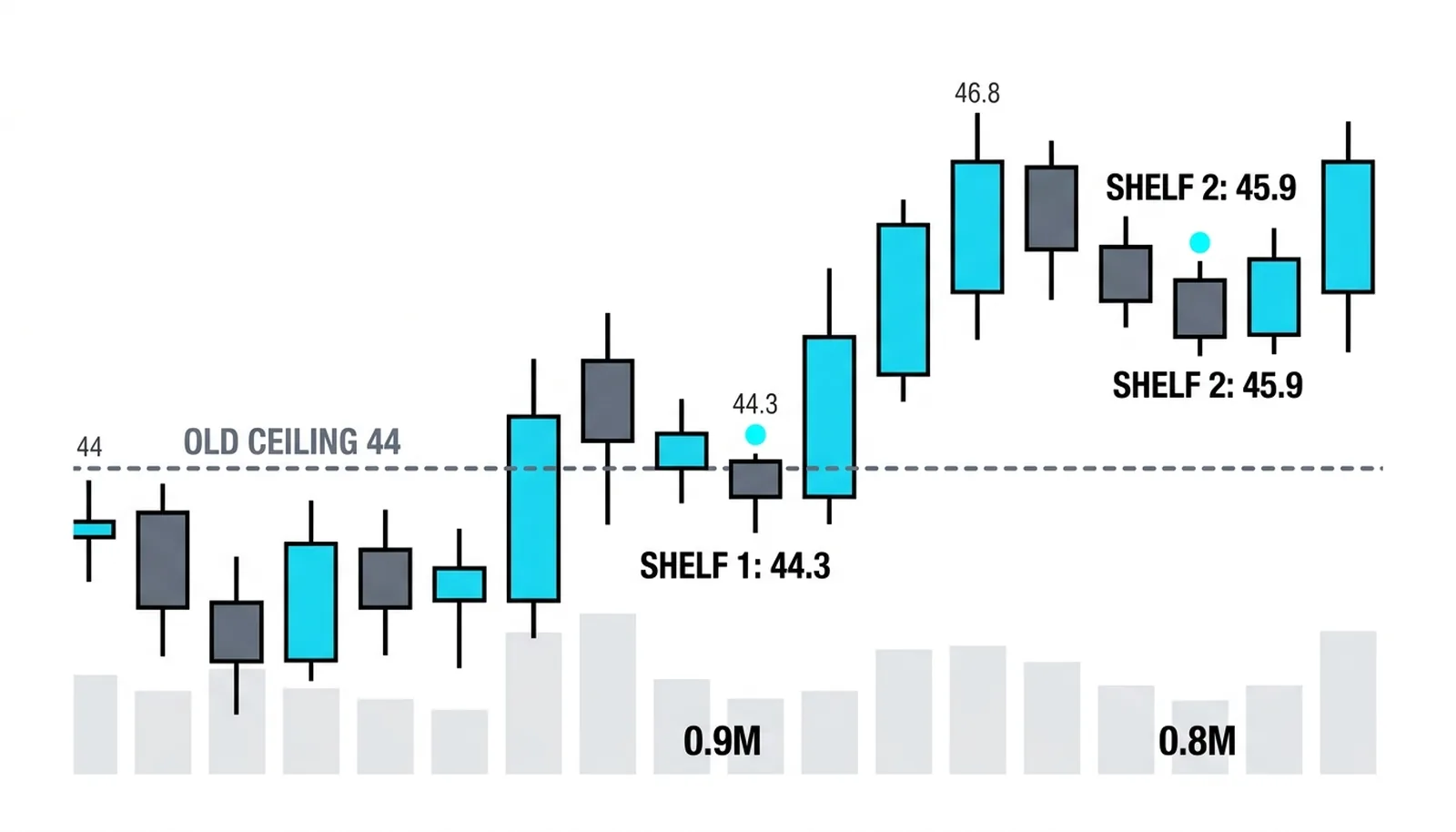
Phase D in Practice
Phase D is the markup getting under way, and it has a rhythm. Sign of strength, pullback shelf, sign of strength, pullback shelf. Each shelf low prints higher than the last. Each expansion confirms demand is still in control, the markup leg of the cycle of market phases.
Watch that sequence of rising lows. It is the campaign's pulse. As long as each pullback holds above the prior breakout zone, the structure is intact and the shelves remain the lower-risk entries.
Now the honesty beat. A shelf that breaks on heavy volume is a warning the campaign may need rebuilding. Demand just failed its first honest test of the trend. The correct read is to step aside, not to argue with it, not to average down into a level the market has just rejected.
A broken shelf on light volume is less damning; it can be a shakeout. A broken shelf on heavy volume is supply returning, and supply returning after an accumulation campaign means the count has changed. Respect it.
The Entry Ladder
Think of the campaign as offering three rungs, each priced in risk.
- The spring entry is the cheapest and the earliest. You buy the final test inside the range, with a stop under the spring low. It carries the most uncertainty because the breakout has not happened. It pays the best price for that uncertainty.
- The breakout entry buys the sign of strength itself. Confirmation is now in hand, but the price is worse and the stop is awkward, sitting under a shelf that has not yet formed or under the range top. You pay more and risk more for certainty.
- The shelf entry is the balance point. The breakout is proven, the pullback has held, and the stop sits just under the shelf low. Slightly worse price than the spring, far better defined risk than the chase.
Each rung states what would prove it wrong. The spring is wrong if the spring low breaks. The breakout entry is wrong if price falls back into the range. The shelf entry is wrong if the shelf low breaks on volume. Know your rung's invalidation before you enter, not after.
One Breakout, Two Shelves
A hypothetical stock ranges between 38 and 44 for two months on average volume of 1.2 million shares. The accumulation is done; the spring has already tested and held.
The sign of strength prints: a 3.4-point spread from 41.8 to 45.2, closing at 44.6, on 2.9 million shares. That is nearly two and a half times the range average, a close in the upper quarter of the bar, and a clean break of the 44 resistance. Demand has gone public.
The first pullback holds at 44.3 on 0.9 million shares. Volume dried up on the dip, the level above old resistance held, and the operator's bid showed up. That is the first last point of support.
A second sign of strength carries price to 47.2 on 2.1 million shares. The second shelf holds at 45.9 on 0.8 million. Rising shelf lows: 44.3, then 45.9. The rhythm is intact.
Now price the ladder. The breakout entry at 44.6 with a stop at 44.0, just under the first shelf and the old ceiling, risks about 0.6 points. The shelf entry at 44.5 with the same 44.0 stop risks about 0.5 points, entered on the tested level with confirmation already behind it. The late shelf entry at 46.2 with a stop at 45.6, just under the second shelf, risks about 0.6 points at a higher price but against the tightest, most recently tested level. Every rung costs something; the difference is what you get for the risk.
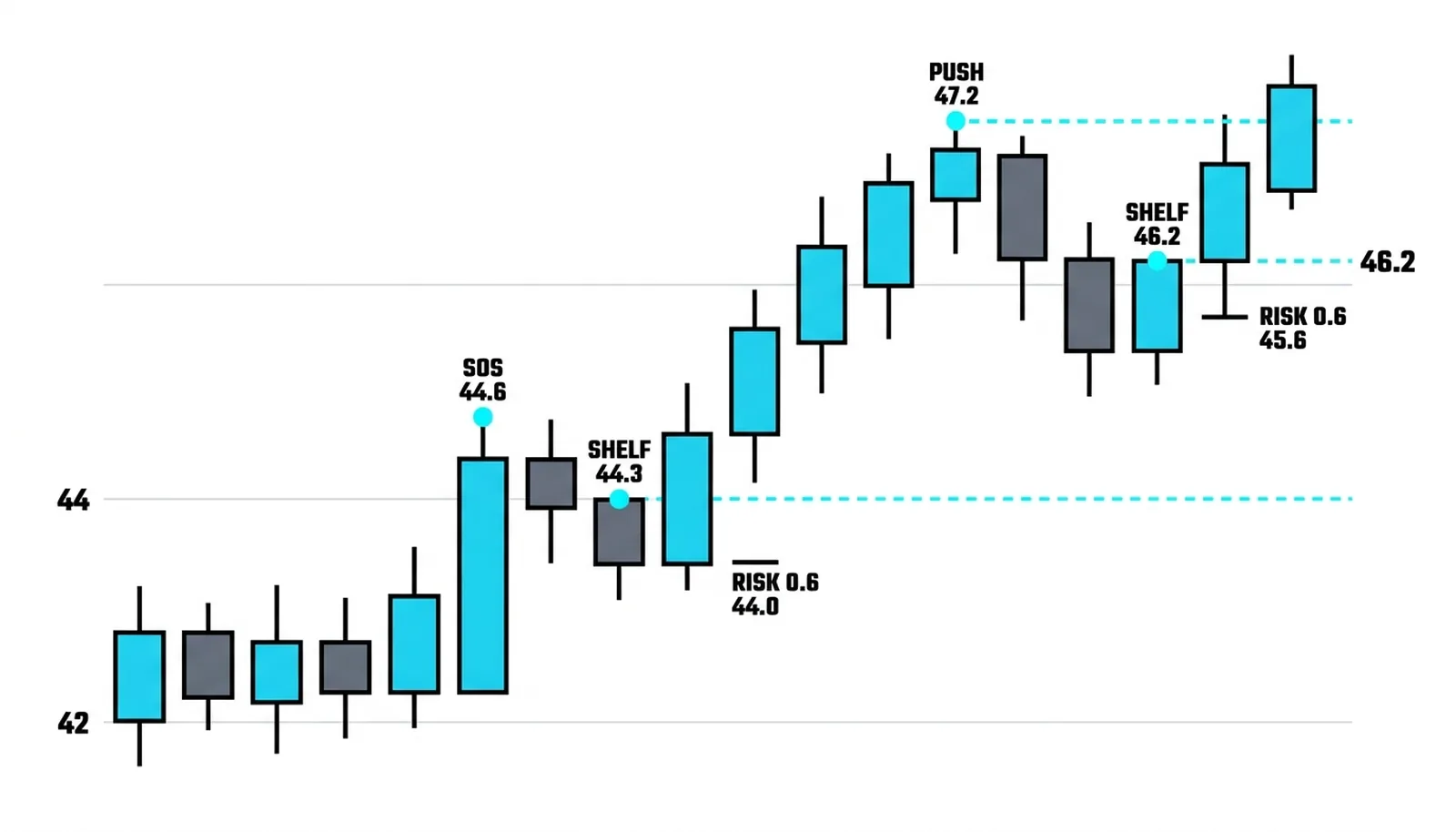
| Event | Price | Volume | The Read |
|---|---|---|---|
| Sign of strength | 45.2 high, close 44.6 | 2.9M | Demand goes public, 44 resistance cleared |
| First shelf (LPS) | Holds 44.3 | 0.9M | Light-volume dip defended above breakout |
| Second sign of strength | Reaches 47.2 | 2.1M | Expansion continues, campaign on schedule |
| Second shelf (LPS) | Holds 45.9 | 0.8M | Higher shelf low, rhythm intact |
Sign of Strength and LPS, Answered
What is a sign of strength in Wyckoff analysis?
A sign of strength is the wide-spread, high-volume up bar that breaks a trading range to the upside and closes near its high, clearing the old resistance. It confirms that the accumulation campaign behind it is complete and demand now controls the stock.
What does LPS mean in trading?
LPS stands for last point of support, the pullback after a sign of strength that holds above the broken resistance on lighter volume. It is the level where professional money adds, and it marks the final low before the next leg up.
When should you buy after a sign of strength?
The balanced entry is the first pullback that holds above the breakout on shrinking volume. You get confirmation from the breakout bar and a tight stop under the freshly tested shelf, instead of chasing the expansion with a stop far below.
What does it mean when a last point of support fails?
A shelf that breaks on heavy volume means demand failed its first honest test and the campaign may need rebuilding. Step aside. A light-volume break can be a shakeout, but heavy volume through support is supply returning, and the structure must be re-evaluated from scratch.
Once you can read the breakout and its shelves, the remaining question is how far the markup can travel. Wyckoff mapped the mirror image too, and the next lessons take up distribution: how the same events look when the campaign is selling into the crowd rather than buying from it.