VSA in Context: Why Location Is Everything
In volume spread analysis, location is the single most important variable attached to any bar, and it changes everything, because the same bar signature means different things at different places in the trend. A wide-spread down bar on huge volume is stopping volume when it arrives after an extended decline into support. The identical bar early in a downtrend is fresh supply hitting the market. Reading a bar without its location is reading a sentence with the rest of the paragraph torn off.

Think of it this way: the same line of dialogue means one thing at a funeral and another at a comedy show, the words are identical, the context does the work. Bars behave the same way. The spread and the volume are the words. The location is the room they are spoken in.
The previous lesson covered the pseudo upthrust, the cleanest single example of location changing a verdict. This lesson zooms out to the general principle that sits underneath every VSA signal you will ever read.
The Same Bar at Three Addresses
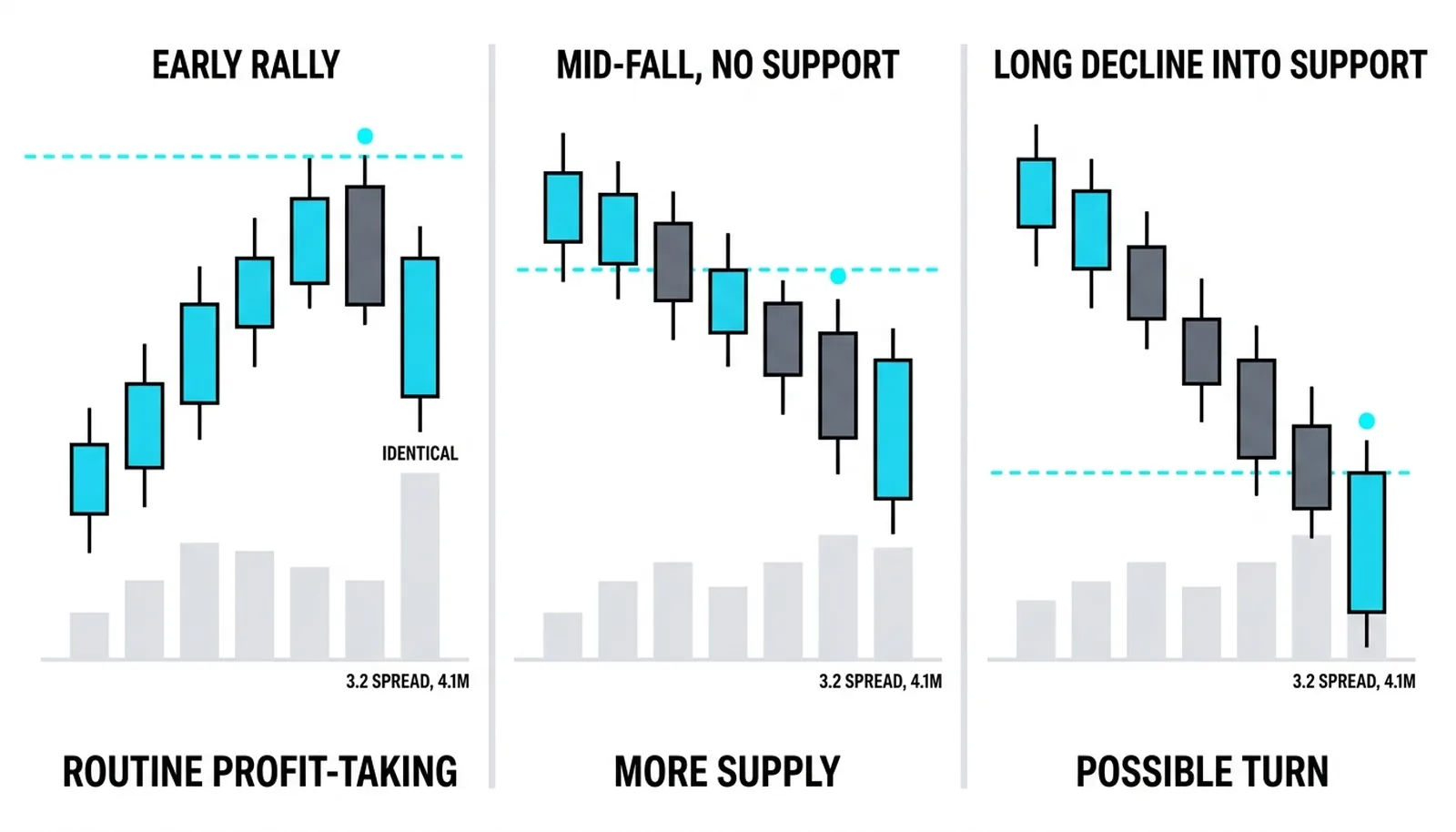
Take a wide-spread down bar closing near its low on very heavy volume. Now place it at three different addresses and watch the meaning change.
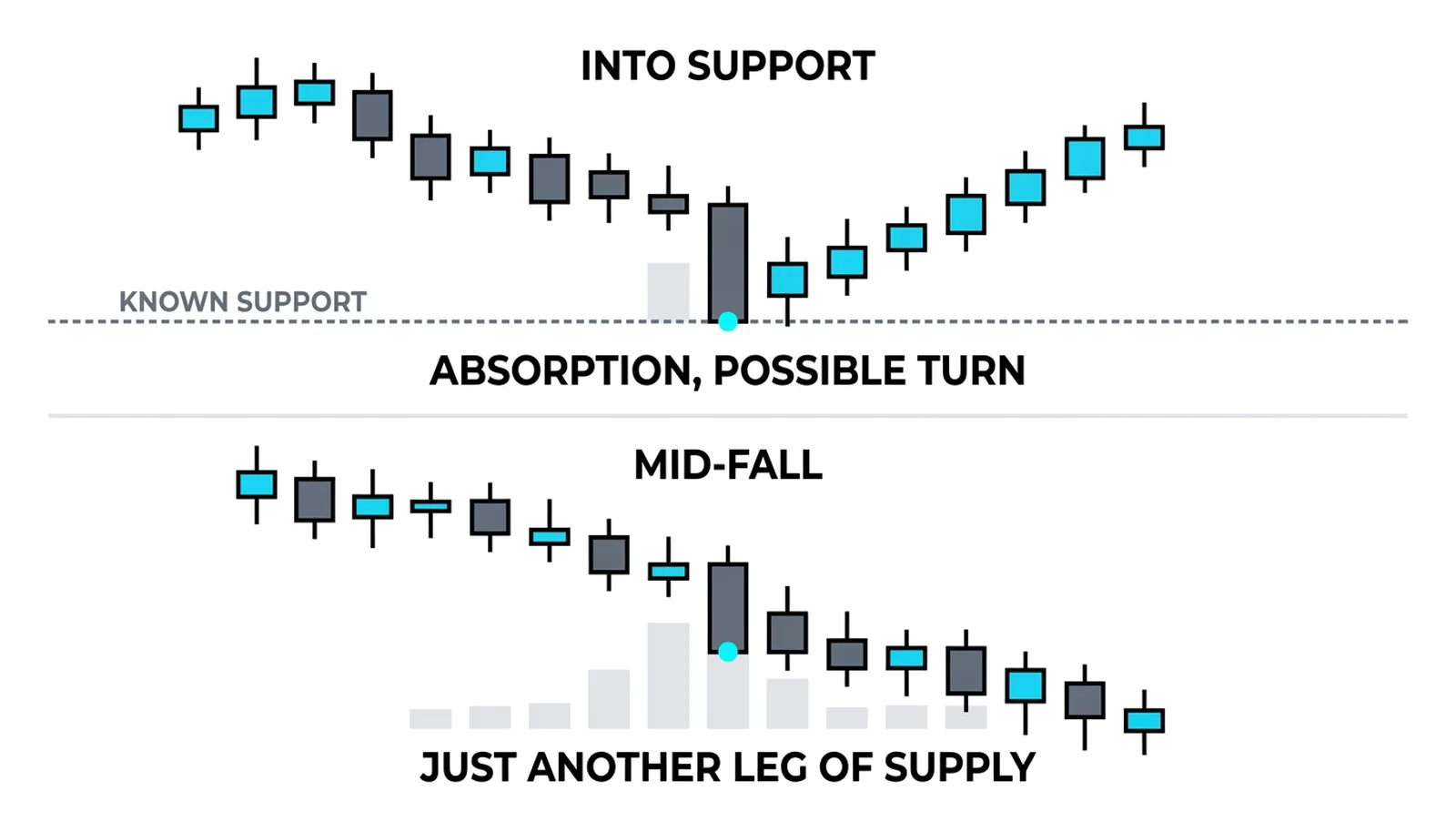
First address: the end of a long decline, right into a known support area. Here, that bar is stopping volume. Sellers are pushing hard, but the spread and the position tell you buyers are absorbing everything offered. This is often the first sign of a turn, because weak hands are finally exiting and stronger hands are taking the other side.
Second address: week one of a fresh downtrend. Same bar, same volume, same spread. Now it is supply hitting the market, not absorption. The trend has just rolled over, and heavy selling here confirms the new direction. This bar is continuation, not a bottom.
Third address: the middle of a trading range, with no prior decline behind it and no level nearby. Now the bar is mostly noise. Heavy volume in the middle of nowhere often resolves into nothing, because there is no structural reason for it to matter.
The shape never changed. The address did.
The Flips That Matter Most
Location flips the verdict on almost every classic VSA signal. Learn the common flips and you stop misreading the chart.
- High-volume up bar. At the bottom of a range or early in a markup phase, it is genuine demand and often the start of a move. After an extended advance, the same bar may be the buying climax, the last burst of public buying into professional selling.
- Upthrust shape. At the top of a range, a narrow up bar on volume into old highs is a true upthrust, a trap for breakout buyers. Mid-trend with no level above, the same shape becomes the pseudo upthrust covered in the last lesson, which carries far less bearish weight.
- Stopping volume. After a long decline into support, a heavy down bar is absorption and a potential turn. Mid-fall, with no support nearby, the same bar is just another leg of supply.
- No-demand bar. After a rally into resistance, a narrow up bar on low volume warns of weakness. Early in a fresh uptrend, the same bar is often a harmless pause.
Notice the pattern. Every flip is the same sentence: location A means X, location B means Y. The bar is constant. The trend position is the variable.
Reading the Background
Tom Williams, who formalized VSA, had a term for this: the background, the story so far. Every bar is evidence, and the background is the case file that evidence gets filed into.
Before you name any signal, ask three questions:
- Where are we in the trend? Beginning, middle, or end. A move that has already traveled far carries a different background than one that just started.
- What did the last major effort versus result say? If the market made a big effort and produced little result, that imbalance is still in force until something overrides it.
- Is this bar confirming or contradicting the background? A bullish bar in a bearish background is a suspect, not a signal, until the background itself changes.
Zoom out first. Mark the structure. Find the last major effort and check whether it was absorbed or rewarded. Only then drop down and name the bar in front of you. The background picks the prior, the bar just files its report.
The Discipline of Waiting
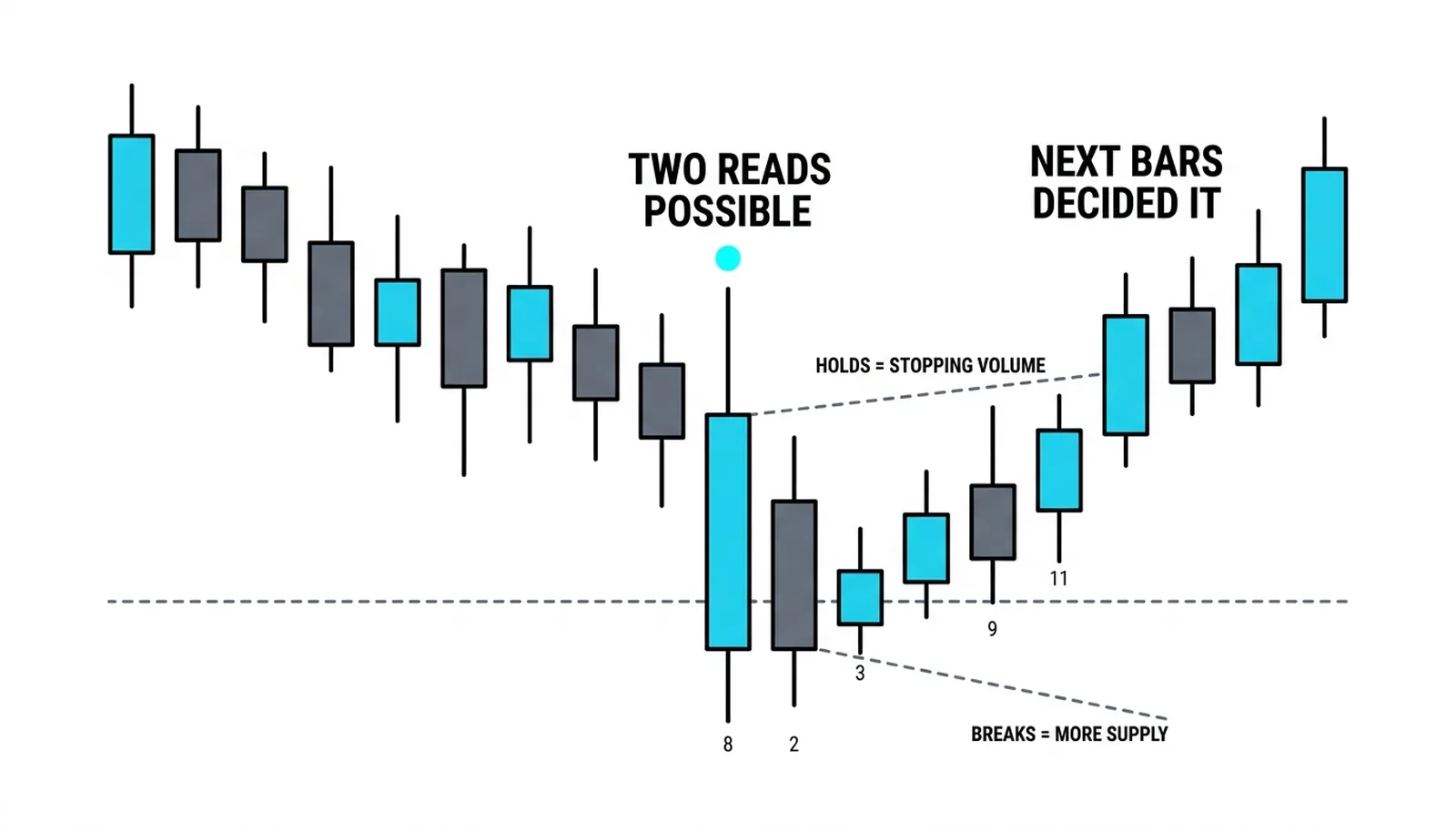
Sometimes two reads are genuinely possible. A heavy down bar arrives near support, but the decline is not clearly exhausted. Stopping volume or more supply. When that happens, the honest answer is that the market has not told you yet.
The resolution is the next bar, or the next few. If the supposed stopping volume is real, price should hold above that bar's low and the following bars should show demand. If supply is in control, price breaks the low and the verdict is continuation. The confirmation bar settles the argument you could not settle yourself.
Single bars are evidence, not verdicts.
The cost of patience is one bar. The cost of guessing is a position on the wrong side of the background, which tends to be far more expensive than the move you missed while waiting.
One Signature, Three Verdicts
Here is a hypothetical illustration with round numbers. Imagine a stock where the exact same bar prints three times across one year of its history: a down bar with a 3.2 point spread on 4.1 million shares, against a 1.3 million share daily average. Three times the volume, same shape, three different outcomes.
| Appearance | Trend location | Reading | What followed |
|---|---|---|---|
| Down bar, 3.2 spread, 4.1M shares | At 44, after a 30 percent decline into prior support | Stopping volume, absorption | Stock based and turned upward |
| Down bar, 3.2 spread, 4.1M shares | At 52, first week of a new downtrend | Fresh supply, continuation | Decline extended to 46 |
| Down bar, 3.2 spread, 4.1M shares | At 58, middle of a trading range | Noise, no structural meaning | Range held, move faded |
Same bar. Same volume. Three verdicts, and every verdict came from the address, not the shape. If you had traded the bar identically all three times, you would have been right once, wrong once, and churned once.
VSA Context, Answered
What does location mean in volume spread analysis?
Location is where a bar sits within the larger trend and relative to support and resistance. It is the context that determines what the bar's spread and volume actually mean, because the same signature carries different implications at the end of a decline than at the start of one.
Why do the same volume patterns mean different things?
Because volume shows effort, and effort only matters relative to what the market is trying to do at that point. Heavy selling into support after a long fall is absorption. Heavy selling at the start of a downtrend is supply. The effort is identical, the situation around it is not.
What is background in VSA?
Background is Tom Williams' term for the story so far: the trend position, the last major effort-versus-result relationship, and the prevailing balance of supply and demand. Every new bar is read against that case file, not in isolation.
How do I know where I am in the trend?
Zoom out to a higher timeframe and mark the structure. Measure how far the current move has traveled, locate the nearest major support and resistance, and identify the last high-volume effort and what it produced. Beginning, middle, and end of a move each carry a different background, and that background decides how you read the next bar.
With location and background in place, one piece of the VSA foundation remains: the three laws Wyckoff built the whole method on, which explain why effort, result, and cause and effect govern everything you have just read.