Wyckoff's Three Laws of Trading
The three laws of the Wyckoff method are the law of supply and demand, which says prices rise when demand exceeds supply and fall when supply exceeds demand, the law of cause and effect, which says the size of a move out of a range is proportional to the effort built inside it, and the law of effort versus result, which says volume and price movement should agree, and the moments they disagree are the signals. Everything in this level of the course sits under this framework. The pseudo upthrust, the climaxes, the absorption reads, the emphasis on location: each one is an application of these three laws, not a separate trick.

The classic accumulation and distribution framework grew out of tape reading, watching the raw stream of prices and volumes to judge who was buying, who was selling, and who was winning. Think of the three laws as three gauges on one dashboard: the fuel, the road, and the engine, and the dashboard is only useful when you read all three together. A single gauge can look fine while the other two are flashing warnings.
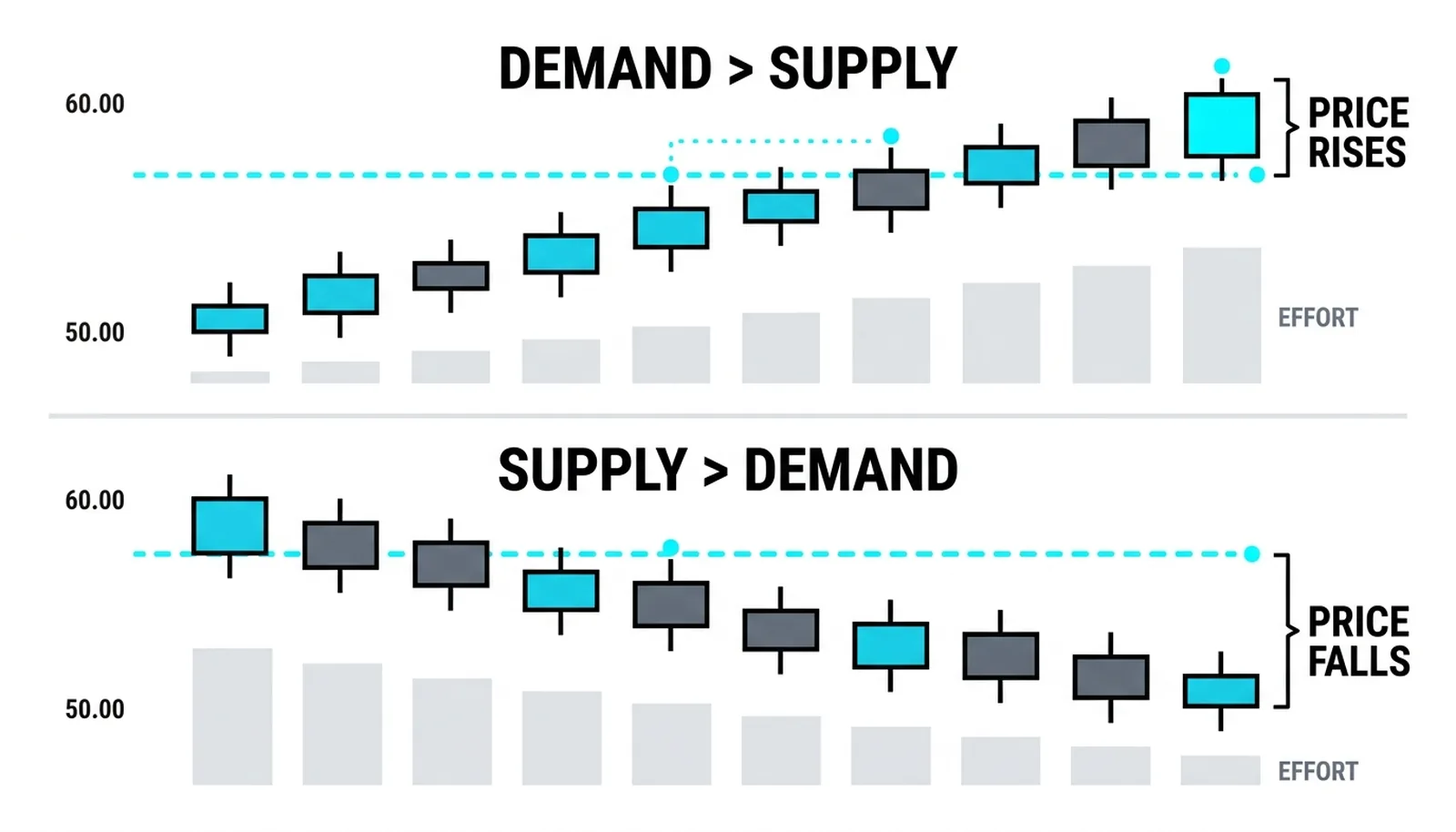
Law One: Supply and Demand
Markets are auctions. When demand exceeds supply, buyers compete for scarce offers and prices rise to meet that demand. When supply exceeds demand, sellers compete for scarce bids and prices fall until the excess is absorbed. There is no sentiment layer underneath this. Price moves because one side's orders outnumber the other's at the current level.
On a chart, volume is how you measure this. Every bar's volume tells you how much business was done, and the bar's result tells you who got the better of the exchange. Rising price on expanding volume means demand is in control. Rising price on shrinking volume means supply has not appeared yet, not that demand is strong. The distinction matters.
This is what the earlier lessons on climaxes and absorption were measuring. A buying climax is demand exhausting itself in one burst. Absorption is supply being met by steady, unglamorous demand that refuses to let price fall. Both are the first law in action: you are watching who is absorbing whom, and the volume signature is the evidence.
Law Two: Cause and Effect
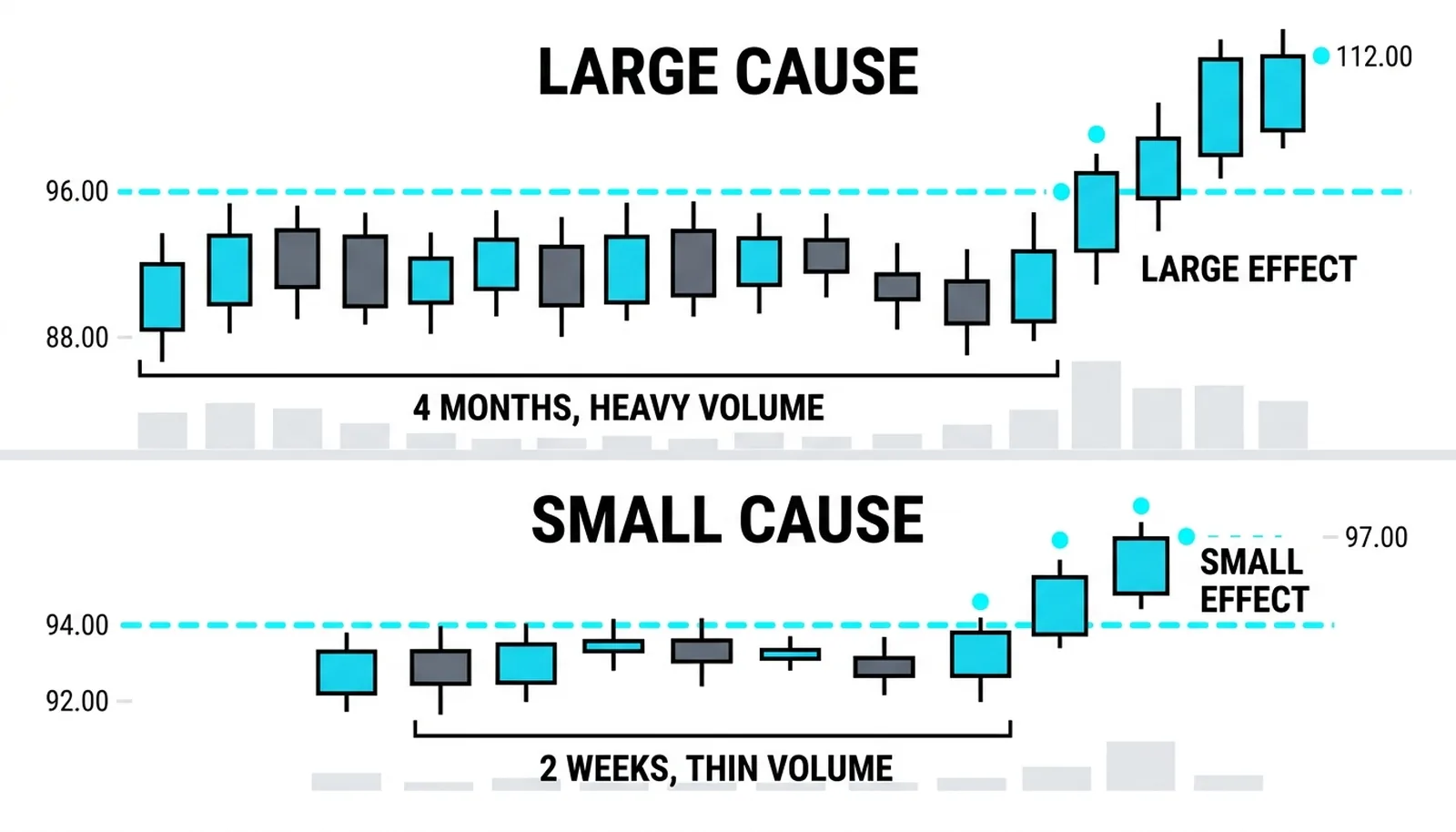
A trading range is not dead time. It is a cause being built. The activity inside the range, the accumulation or distribution happening bar by bar, stores up the energy for what comes next. The trend that follows is the effect being delivered.
The practical version: a long, busy range is a large cause and tends to produce a large trend. A short, quiet range is a small cause and tends to produce a small move. When price breaks out of four months of heavy two-way trade, you expect a substantial follow-through. When price breaks out of a two-week drift, you should expect much less, and you should be quicker to doubt the breakout.
Here is the honest note. The proportionality is a heuristic for sizing expectations, not a calculator. The classic tool for counting the cause in the Wyckoff method was point-and-figure charting, where the width of the range projected a price target. Modern practice usually reads the cause more loosely, through the volume and time spent inside the range. Either way, treat the output as a rough expectation, not a promise. A large cause can still fail, and a small cause occasionally runs further than it should.
Law Three: Effort vs Result
The law of effort versus result has its own full lesson in this level, and it stays there. In brief: volume is the effort, price movement is the result, and the two should roughly agree. When they diverge, something is wrong with the obvious story.
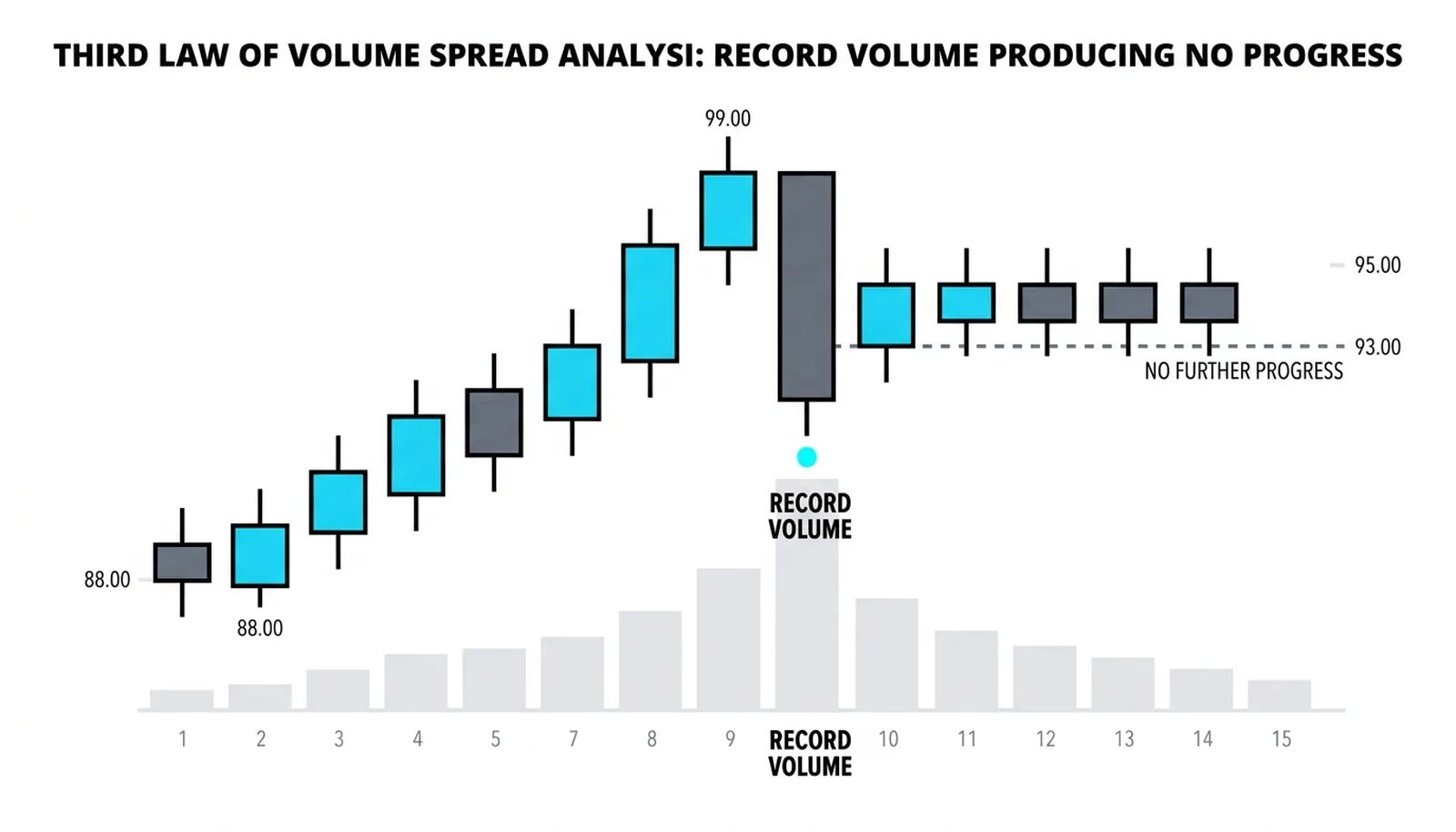
For this framework, what matters is the anomaly and what it means. Huge effort with no progress is the single most important disagreement in VSA. A bar on record volume that fails to push price anywhere tells you the other side met the aggression head-on and absorbed it.
That anomaly is also where the three laws meet. A climax on record volume that stops making progress is supply meeting demand, which is law one. It is an effort-result divergence, which is law three. And if it arrives after a long, heavy range, it is a large cause resolving in the opposite direction of the apparent breakout, which is law two. One bar, three readings, same conclusion.
The Three Laws Working Together
The discipline is to read every VSA signal through all three laws at once. What is the effort saying? Where is the result? How much cause sits behind the move? A signal that answers only one of those questions is incomplete.
One law poses a question, two laws build a case, three laws in agreement are a conviction.
This is also what keeps you out of trouble. A breakout on strong volume looks convincing through law one alone. But if the range behind it was two weeks of thin trade, law two says the cause is too small to trust, and if the breakout bars immediately stall, law three says the effort is producing nothing. Two of three gauges are warning you. That is enough to stand aside.
One Top, Three Laws
A hypothetical stock ranges between 88 and 96 for four months, on some of the heaviest weekly volume of the year. That is a large cause: four months of heavy two-way business, with positions being built on both sides.
Price then breaks out to 99. It stalls. The next bar is a wide-spread move down to 93 on the heaviest daily volume in the dataset, and over the following three bars price makes no further progress in either direction.
| Law | What it says at this top | Weight of evidence |
|---|---|---|
| Supply and demand | Supply overwhelmed demand at 99; the breakout buyers were met and absorbed | Strong |
| Cause and effect | The four-month cause argues the following effect should be large, so the failure matters far more than it would after a two-week range | Strong |
| Effort vs result | Record effort produced no result, no new highs after the heaviest bar | Strong |
Read the sequence through each law. Law one: at 99, supply overwhelmed demand. Someone used the breakout's excitement to sell into it, and the wide bar down to 93 on record volume is the proof. Law two: because the cause behind this move was four months of heavy trade, the effect, whichever direction it resolves, should be large. That is why this failure carries far more weight than the same pattern after a two-week drift. A big cause reversing means a big move down is now a live possibility. Law three: the effort, record volume, produced no result. No new highs followed the heaviest buying day in the dataset.
All three gauges point the same way. This is what a conviction looks like in the Wyckoff framework, and it is also what the pseudo upthrust lesson described from a different angle: the breakout that fails precisely because the cause behind it was distribution, not accumulation.
The Three Laws of the Wyckoff Method, Answered
What are the three laws of the Wyckoff method?
They are the law of supply and demand, prices rise when demand exceeds supply and fall when supply exceeds demand; the law of cause and effect, the move out of a range is proportional to the effort built inside it; and the law of effort versus result, volume and price should agree, and their disagreements are the signals.
What is the law of cause and effect in trading?
The cause is the activity built inside a trading range, and the effect is the trend that follows it. A long, busy range is a large cause and tends to produce a large trend; a short, quiet range tends to produce a small move. It is a heuristic for sizing expectations, not a formula.
What does effort versus result mean?
Effort is volume, result is price movement, and the two should roughly agree. When enormous volume fails to move price, the other side absorbed that effort, and the signal is usually more reliable than the apparent direction of the trade.
How do the three laws work together?
You read every signal through all three: what the effort says, where the result is, and how much cause sits behind the move. One law poses a question, two build a case, and three in agreement justify a real position rather than a watch.
That closes the VSA block of this level. The next lessons move from reading volume on single bars and ranges to reading it across entire campaigns, where these three laws stop being a checklist and start becoming a habit.