Indicators Alone Are Not a Strategy
Indicators alone are not a strategy, and confusing the two is one of the most common beginner mistakes. An indicator is a measurement. A strategy is a set of decisions: what to trade, when to enter, how much to risk, and when to get out. No measurement can make those decisions for you.

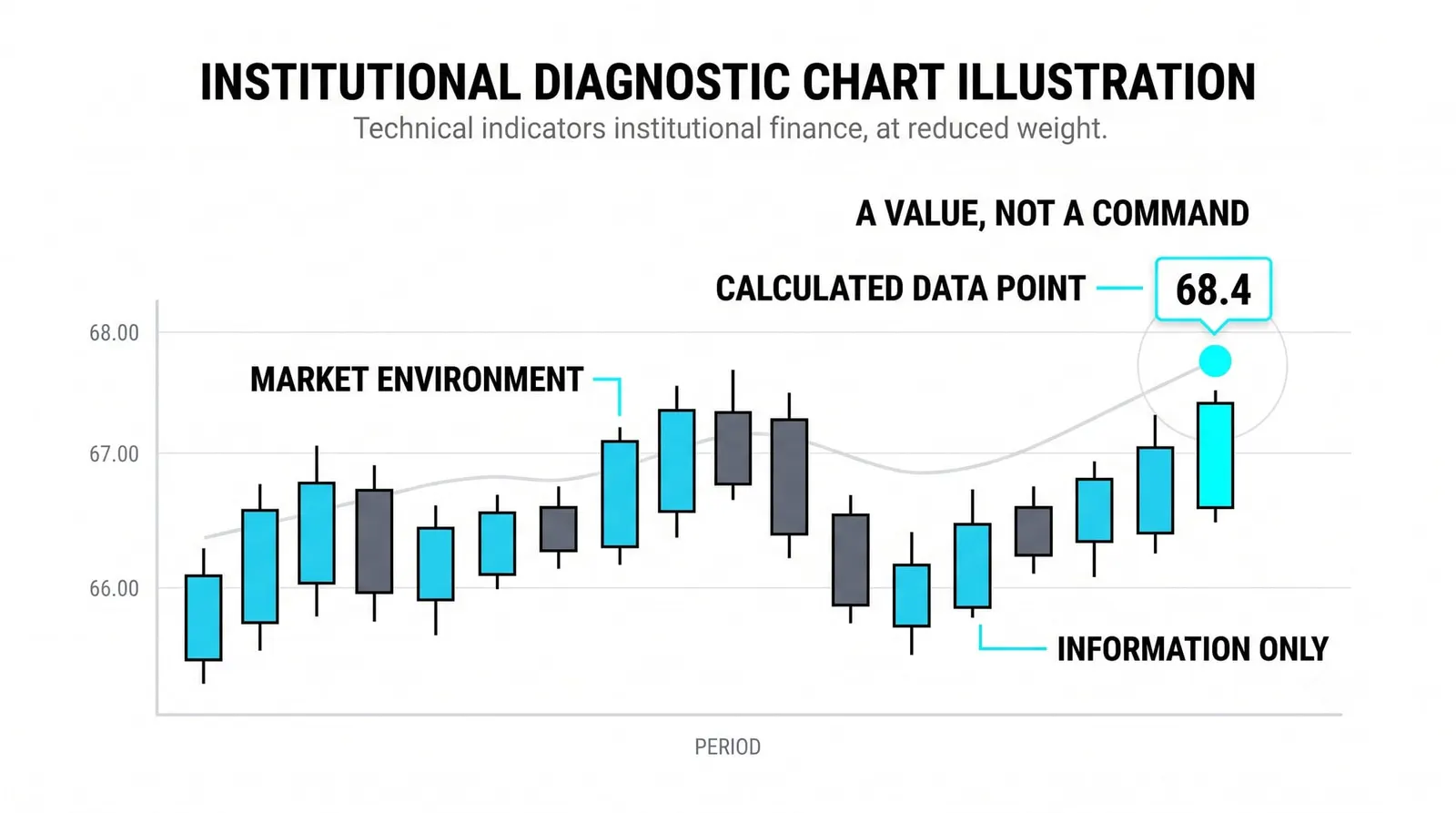
Think of it this way: a gym membership is not a training plan. The equipment is real, and the results still depend entirely on what you decide to do with it. Indicators work the same way. They are real, useful tools sitting inside a plan that only you can write.
Remember where this layer sits. Indicators sit on top of chart reading, never instead of it. And keep the earlier distinction in mind: an approach is your general philosophy, while a strategy is the concrete rulebook that follows from it. Indicators serve the rulebook. They never replace it.
What an Indicator Can and Cannot Decide
An indicator can describe things. It can describe direction, as a moving average slope does. It can describe momentum, as MACD does. With the right tool, it can describe volatility or participation. These are honest, useful descriptions of what price has been doing.
Description is where the ability ends. An indicator cannot size a position. It cannot decide how much risk you accept on a trade. It cannot define your time horizon. It cannot make you actually take the trade or actually exit it.
Those are decisions, and decisions belong to you or to a plan you wrote in advance. A crossover appearing on your screen is an event. Whether that event means anything for your money is a question the indicator cannot answer.
Keep the split clear in your head:
- Indicators describe: direction, momentum, volatility, participation.
- Strategies decide: entries, exits, size, risk, and which markets to touch at all.
When someone says an indicator "told them to buy," they have quietly handed a decision to a description. That works until it doesn't.
What the Strategy Layer Adds
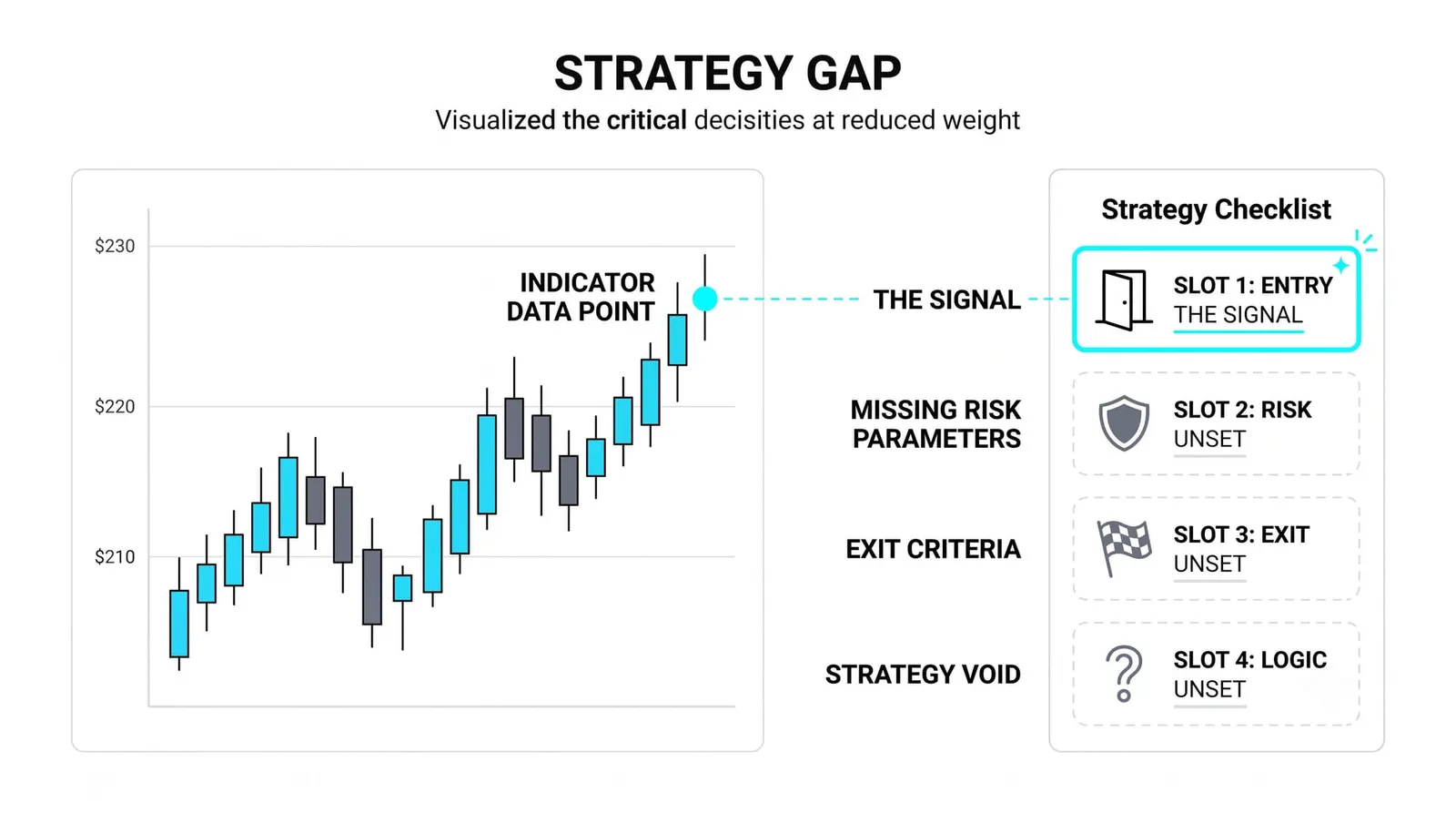
A strategy is a short list of decisions made once, in advance, while you are calm. It is not a feeling you have while watching a bar form. The core list is short enough to write on one card:
- Entry rule. The exact condition that puts you into a trade. Not a vague sense of strength. A condition you could explain to another person in one sentence.
- Exit rule. Both halves: where you get out if you are wrong, and how you get out if you are right. Most beginners write the first half and improvise the second.
- Position size. How many shares, contracts, or units. This flows from your risk, not from your confidence.
- Fixed risk per trade. A set fraction of your account, chosen in advance. Many traders use a small fixed percentage so no single trade can hurt them badly.
- Regime filter. A rule about when the strategy is allowed to trade at all. Trending conditions, quiet conditions, whatever fits the method.
Notice the pattern. Every item is decided once, before the trade, and then simply executed. None of them is checked live and renegotiated in the moment. The moment is the worst time to make decisions, because the moment is when fear and hope are loudest.
This is the layer that turns measurements into a method. Without it, you have observations. With it, you have a process you can evaluate, adjust, and repeat.
Why Tool-Collecting Feels Like Progress
Adding another indicator to a chart produces a small, pleasant feeling of rigor. More windows, more lines, more numbers. It looks like diligence. It changes nothing about your decisions.
The comfort is real and the progress is not. Objective numbers are soothing because they feel like evidence. Commitments are uncomfortable because they can be judged. So beginners drift toward collecting measurements and away from making commitments, because one feels safe and the other feels exposed.
More tools is not more rigor.
There is also a subtler trap. With enough indicators on a chart, one of them will always agree with whatever you already wanted to do. The stack becomes a permission machine. You are no longer reading the market. You are shopping for confirmation.
The honest test is simple. If removing an indicator from your chart would not change a single trade you take, it was decoration. Most charts have at least one decoration on them.
Where Indicators Do Belong
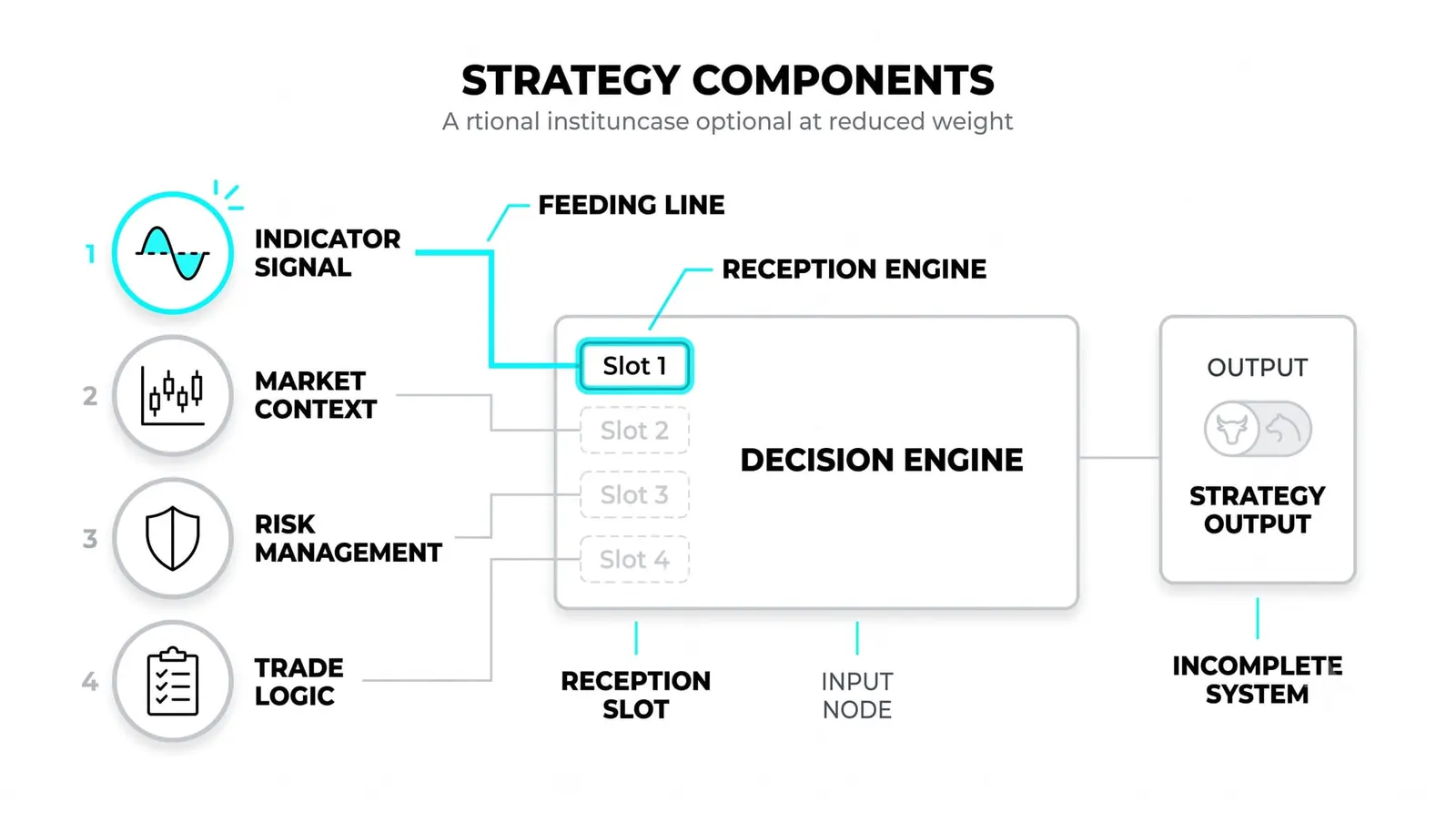
None of this means indicators are useless. It means they belong inside rules, not above them. A good indicator earns its place by carrying one specific job inside a decision you have already made.
Three jobs suit them well. First, as a filter inside an entry: you only take longs when price is above a chosen moving average, so the indicator narrows which signals count. Second, as a trailing guide on an exit: you hold while price stays on one side of a line and leave when it crosses, so the indicator manages the exit mechanically. Third, as a regime check: a momentum reading tells you whether your trend-following rules are allowed to trade this week at all.
In each case the pattern is identical. The rule is decided once, written down, and applied consistently. The indicator supplies an objective input. The strategy supplies the decision. That division of labor is the point of this lesson.
Same Signal, Two Traders
All numbers here are invented round figures for illustration. Two traders watch the same chart. On the same bar, MACD crosses up while price sits at 52. Same signal, same moment.
Trader A has a plan. Trader A risks 2 percent of the account per trade. The stop sits just under the recent swing low at 49. Trader A exits on a trailing rule and holds a maximum of two positions at once. The crossover is simply the entry trigger, one input inside a written rule.
Trader B has the signal and nothing else. No stop, no size logic, no exit plan. Trader B buys because the lines crossed.
Outcome one: price runs cleanly to 58. Trader A trails the exit and banks a planned gain with predefined risk. Trader B also profits, but he exits on a whim, maybe at 55, maybe at 58, and learns nothing repeatable.
Outcome two: price drops to 49. Trader A is stopped out for a controlled 2 percent loss and moves on. Trader B holds, hopes, watches 47, then 45, and eventually sells in frustration at a loss several times larger.
Outcome three: weeks of chop. Price oscillates between 50 and 54 and the crossover whips back and forth. Trader A's regime filter keeps them mostly out, and the few triggered trades cost small, known amounts. Trader B gets ground down trade by trade, each one unplanned, each one a fresh emotional decision.
Same indicator. Same signals. Trader A survives all three scenarios roughly intact. Trader B's result depends entirely on luck. The difference was never the tool.
| Strategy component | Question it answers | Can an indicator help carry it? |
|---|---|---|
| Entry rule | When do I get in? | Yes, as the trigger condition |
| Exit rule | When do I get out, right or wrong? | Yes, as a trailing guide or stop reference |
| Position size | How much do I trade? | No, it comes from your risk limit |
| Regime filter | Should I be trading at all? | Yes, as a go or no-go check |
Indicators and Strategy, Answered
Can you trade using indicators alone?
No, because indicators only measure and cannot decide your size, risk, or exits. Anyone who appears to trade from indicators alone has a strategy running in their head, whether they have written it down or not. Writing it down is what makes it testable.
How many indicators does a strategy need?
As few as can each carry one distinct job. Many working strategies use one or two. If two tools measure the same thing, one of them is decoration, and decoration adds confidence without adding information.
What turns a tool into a strategy?
Surrounding it with decisions: an entry rule, an exit rule, a position size, a fixed risk amount, and a regime filter, all chosen in advance. The moment you can state when you get in, when you get out, and how much you risk, you have a strategy. Before that, you have a chart.
Should beginners buy indicator signals?
Be skeptical, because a purchased signal hands you entries with none of the decisions that determine your result. Even an honest signal cannot know your risk tolerance, your account size, or your exit plan. Learning to build your own rules teaches you something a subscription never will.
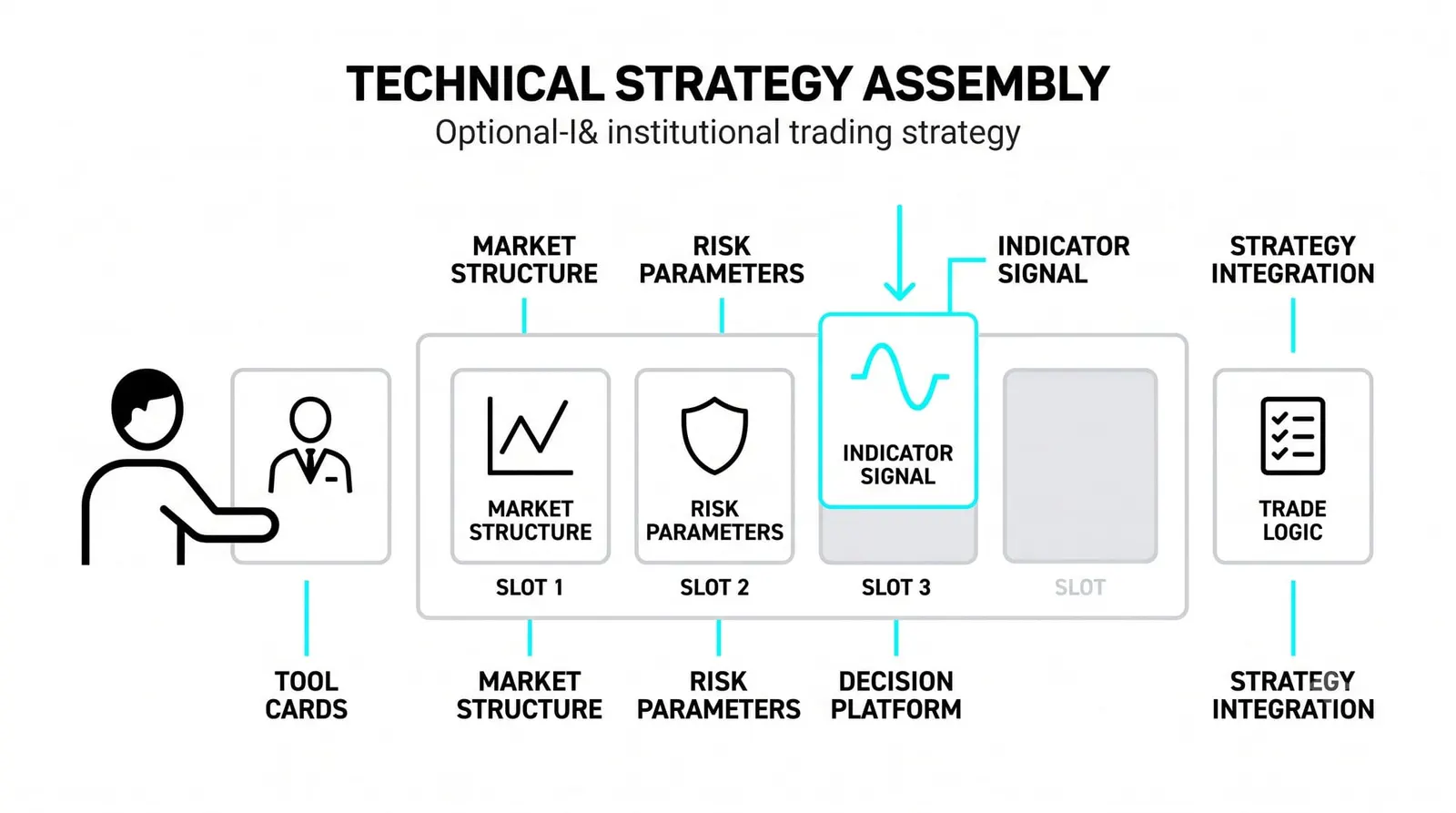
Next, the lessons move from individual tools to assembling them: how a small set of measurements slots into a complete, written trading plan you can actually follow.