What Central Banks Are and What They Do
Central banks are the institutions that issue a currency, set its short-term interest rate, and stand behind the banking system as lender of last resort. Those two jobs, keeping prices stable and keeping the financial system working, put them at the center of nearly every macro move you have studied in this level. When you hear that "the market is waiting on the Fed" or "the ECB decision is Thursday," this is the institution everyone means.

A central bank is the thermostat on the economy, and the weather outside is everyone else's problem. It turns one dial, slowly, and the room takes months to notice. That lag between action and effect shapes everything about how these institutions behave, and everything about how traders react to them.
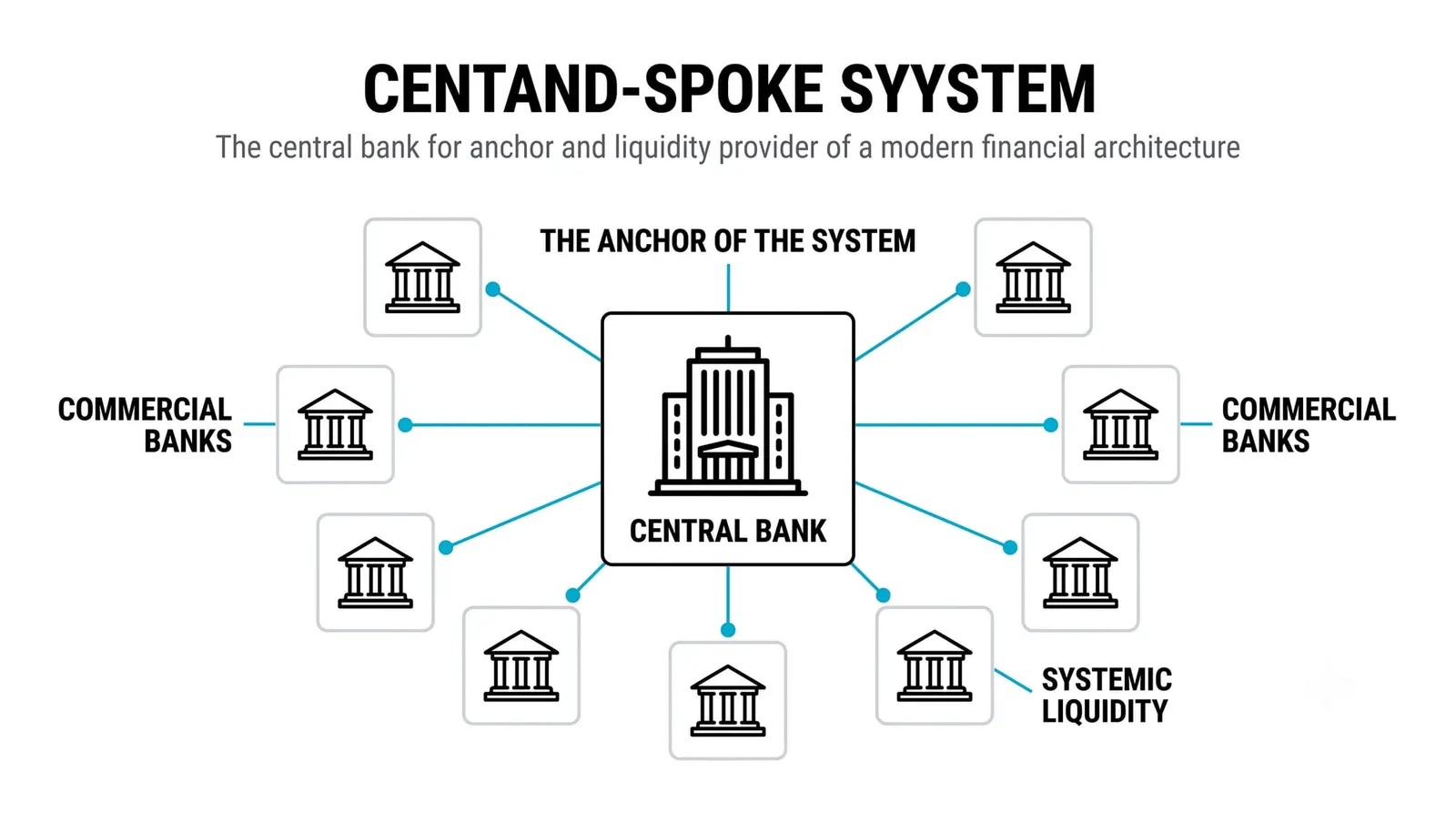
Why Central Banks Exist
Most central banks were born from banking panics. In the era before them, a rumor about one weak bank could trigger a run, depositors would pull cash from every bank at once, and healthy institutions would collapse alongside the sick ones. Someone had to stand ready to lend when no private bank would. That someone became the central bank, the lender of last resort.
Modern mandates grew out of that origin. The first is price stability: keeping inflation low and predictable, usually defined as a target near 2 percent a year. The second is financial stability: making sure the banking and payments system keeps functioning even under stress. Some countries add a third. The United States, for example, gives its central bank a dual mandate that includes maximum employment alongside stable prices.
These institutions are independent from governments by design. Politicians face elections every few years and always benefit from cheap money and a hot economy in the short run. If elected officials controlled the rate, they would keep it too low for too long, and inflation would be the recurring result. Independence means a central bank can raise rates into an election year if the data demands it, and no one can fire the leadership for doing so. That insulation is deliberate.
What a Central Bank Actually Controls
The list of direct controls is short. A central bank sets the short-term policy rate, which you studied in the interest rate lessons earlier in this level, including how that rate transmits into asset prices. It controls the supply of base money, meaning physical currency plus the reserves commercial banks hold at the central bank. And it sets the rules around those reserves.
Be honest about the other list, the things a central bank does not control directly. It does not set long-term interest rates; those emerge from the bond market's expectations about the future. It does not control fiscal spending; governments decide taxing and spending. It cannot create productivity, invent technology, or train workers. And it cannot force millions of households and firms to borrow, lend, spend, or save. It changes the price of money and hopes behavior follows.
That gap between control and influence explains the thermostat problem. The bank adjusts the dial, but the room responds through millions of individual decisions, each with its own delay.
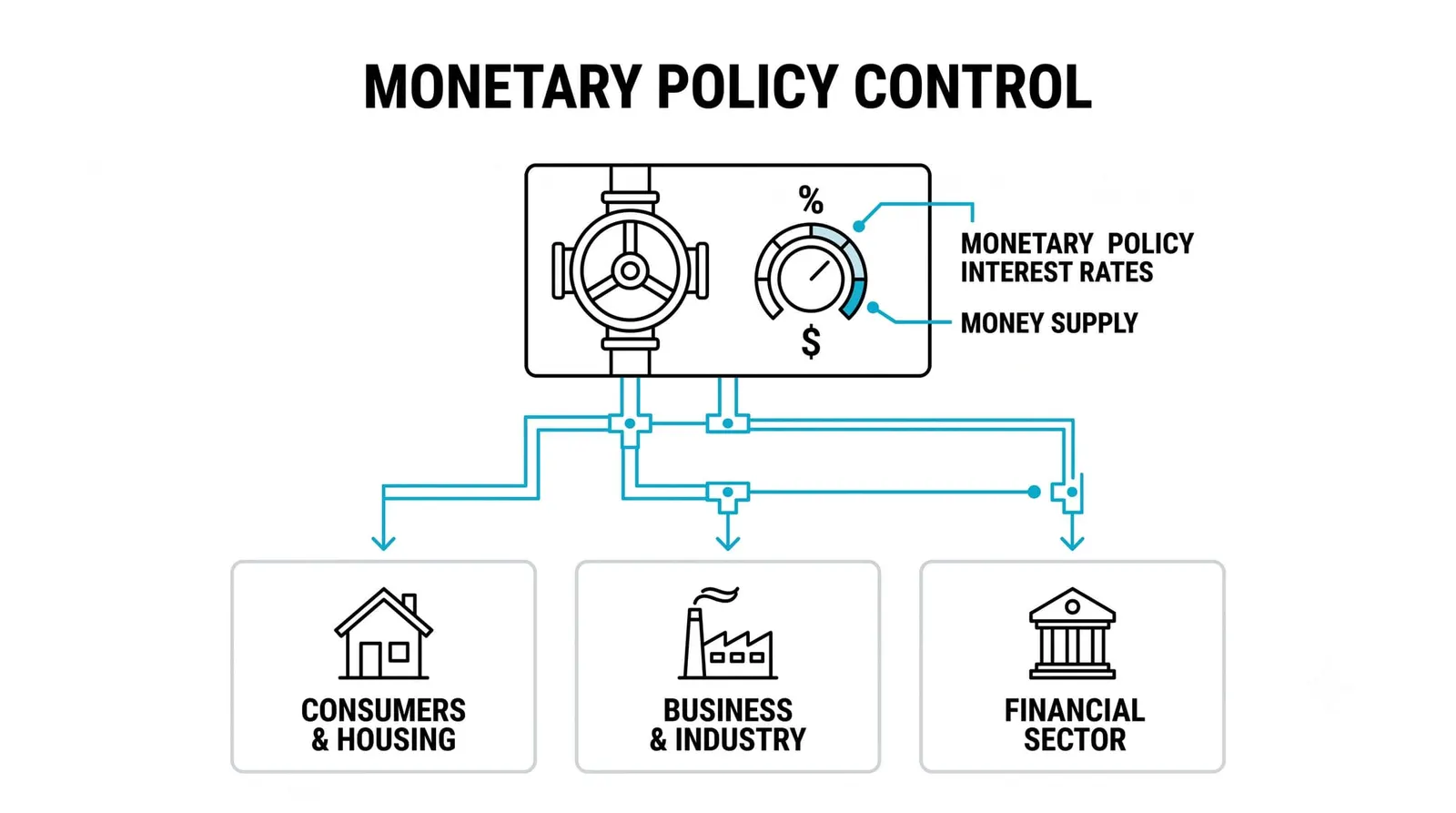
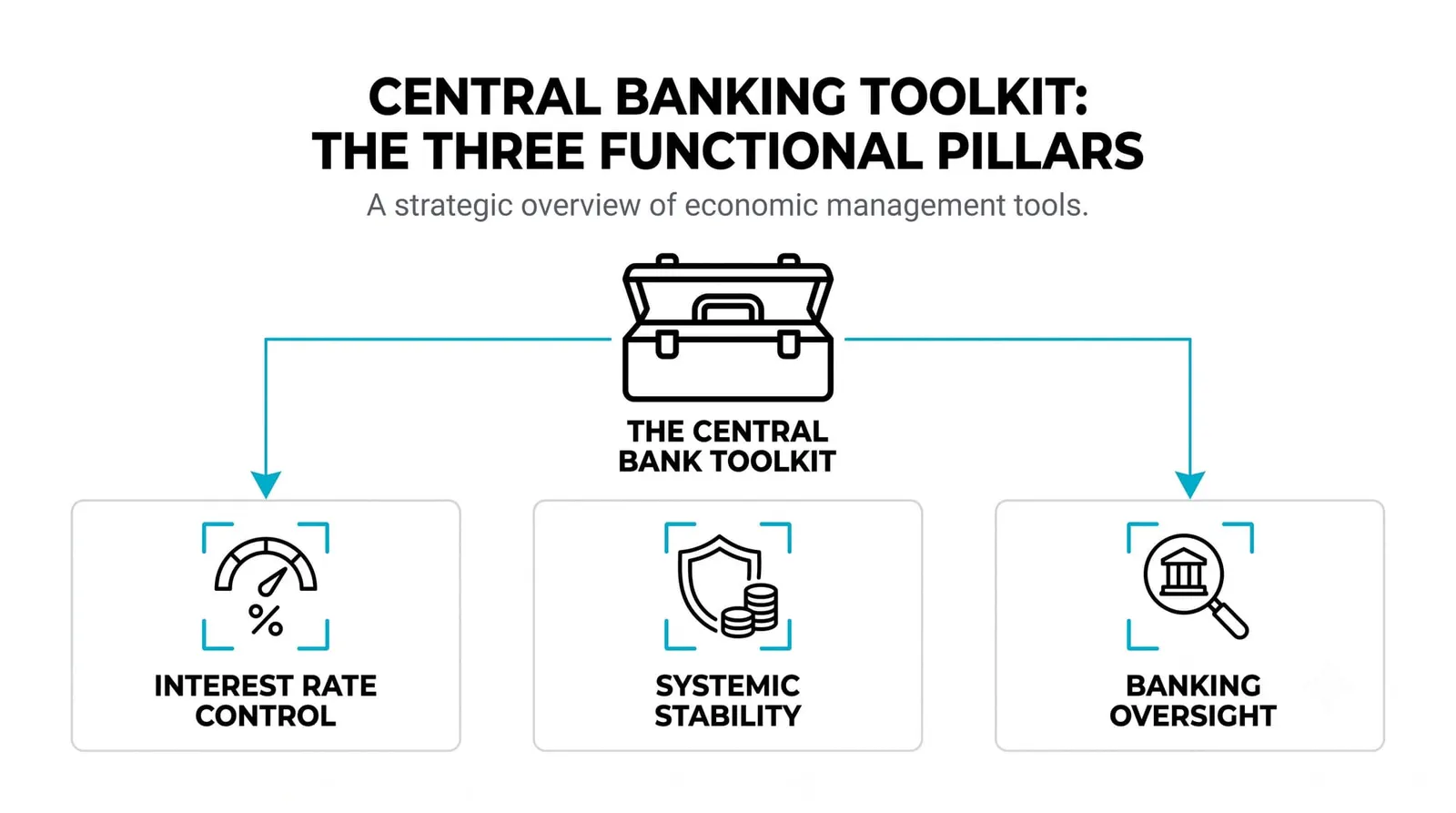
The Tools Central Banks Use to Do Their Job
Four instruments do most of the work.
- The policy rate. The headline tool. Raising it makes borrowing more expensive across the economy and cools demand. Cutting it does the reverse.
- Reserve requirements. The fraction of deposits banks must hold rather than lend out. Raising the requirement drains lending capacity; lowering it releases capacity. Used rarely in some countries, actively in others.
- Open market operations. Buying and selling securities, usually government bonds, to keep the actual short-term market rate near the policy target. This is the daily plumbing that makes the announced rate real.
- Asset purchase programs. Large-scale bond buying, known as quantitative easing, or its reversal, quantitative tightening. QE gets its own lesson later in this level, so for now just file it as the tool used when the policy rate alone is not enough.
Every one of these tools works through the same channel: the cost and availability of money in the banking system.
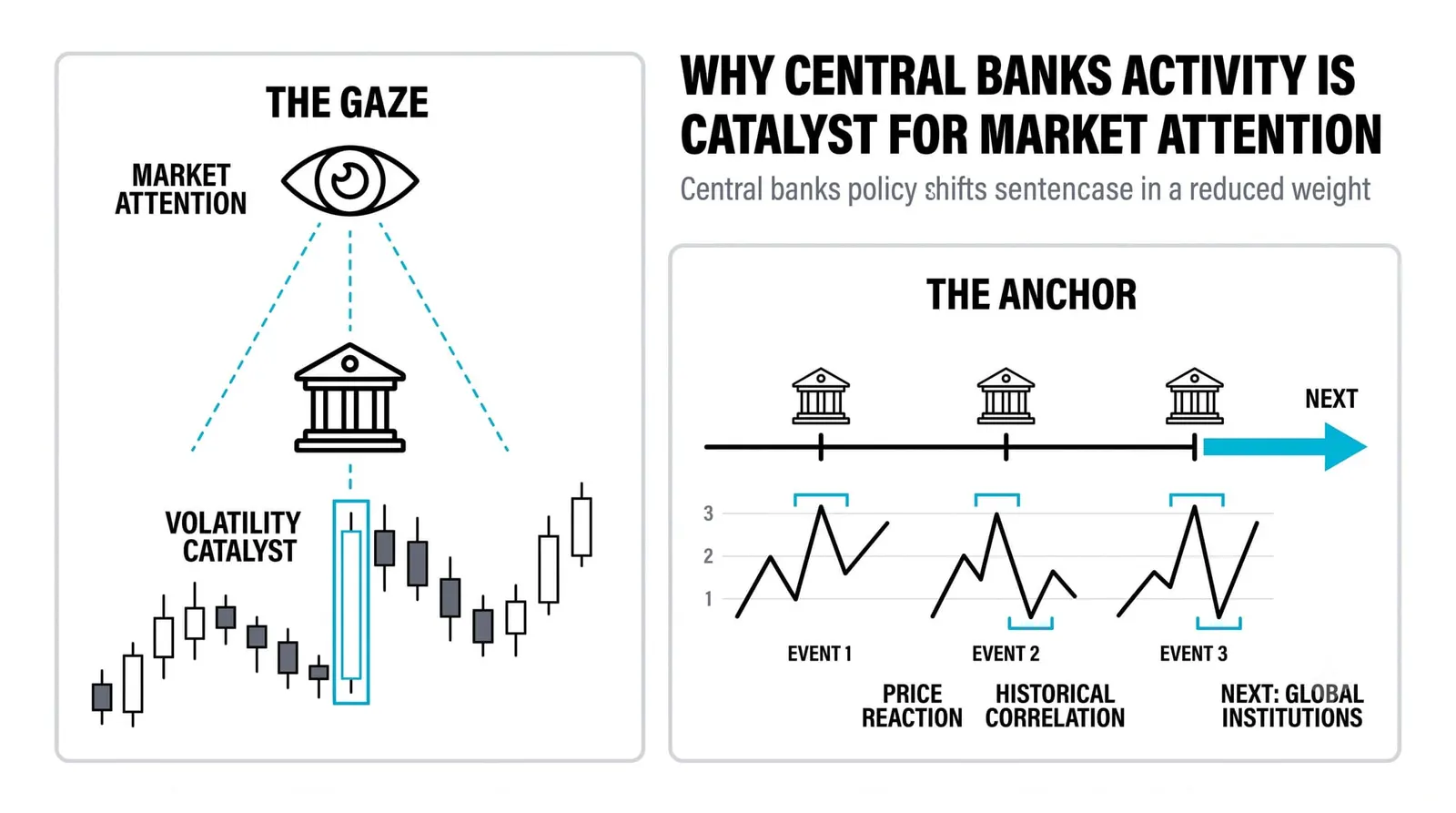
Why Traders Watch Central Banks So Closely
The policy rate is the price of money, and every valuation leans on it. Bond yields, stock valuations, currency exchange rates, mortgage costs, corporate borrowing decisions: all of them are built on top of that one number. Change the base and every structure above it reprices.
Central bank decisions are also scheduled news with the highest stakes on the calendar. You know the meeting dates months in advance. You know the decision arrives at a fixed time. Volatility clusters around those moments because the entire market reprices at once when the number differs from expectation.
Then there is the language. The words around a decision move markets as much as the decision itself. A rate held steady can still crash a currency if the statement signals hikes ahead, and a cut can lift a currency if the statement sounds reluctant. Hawkish and dovish language, and the tool called forward guidance, each get their own lessons later in this level. For now, hold one fact: traders trade the sentence as much as the number.
One Dial, One Room
Here is a purely hypothetical walkthrough with invented round numbers. Imagine an economy running hot, with prices rising 6 percent a year against a 2 percent target.
- The central bank raises its policy rate from 3 percent to 3.5 percent at one meeting, then to 4 percent at the next.
- Commercial banks reprice loans within weeks. Mortgages, business credit lines, and car loans all get more expensive.
- Households postpone big purchases. Firms shelve expansion plans that no longer clear the higher cost of capital.
- Spending slows, so firms need fewer workers. Hiring cools, then wage growth cools behind it.
- With demand softer, sellers lose the ability to push prices up. Inflation grinds lower.
None of that happens in a week. The rate moved in two meetings, but the room cools over quarters, sometimes a year or more. The whole way down, the bank watches the data: inflation prints, jobs reports, spending figures. If the room cools too fast, it can ease the dial back. If it stays hot, it holds the rate high and waits. The dial is fast. The room is slow. Every trader pricing the next meeting is really pricing that lag.
How the Tools Compare
| Tool | What It Touches | How Fast It Works |
|---|---|---|
| Policy rate | Short-term borrowing costs across the economy | Announcement is instant; full effect takes quarters |
| Reserves | How much banks can lend | Weeks to months as banks adjust balance sheets |
| Asset purchases | Long-term rates and market liquidity | Markets react on announcement; economy responds over months |
| Communication | Expectations about future policy | Immediate, often within seconds of release |
Notice the pattern. Every tool hits markets fast and the real economy slowly. Traders live in the fast column. Central bankers are forced to live in the slow one.
Central Banks, Answered
Do central banks control the whole economy?
No. They control the short-term price of money and the plumbing of the banking system, and everything else is influence. Governments control spending and taxation, businesses control hiring and investment, and households control most spending. A central bank can make borrowing cheap, but it cannot make anyone borrow.
Why do markets hang on one speech?
Because a speech can shift expectations about the future path of rates, and expectations are what prices actually trade on. A single sentence hinting at tighter policy can reprice bonds, currencies, and stocks within seconds, even with no rate change at all.
What happens when a central bank gets it wrong?
The two classic failures are tightening too late, which lets inflation become embedded and forces harsher hikes later, and tightening too much, which tips the economy into an unnecessary recession. Both have happened repeatedly in history, which is why markets debate every decision rather than simply trusting it.
Are all central banks built the same?
No. The core functions are shared, but mandates differ. Some target inflation alone, some add employment, some also manage an exchange rate, and the degree of independence from government varies by country. When you compare two central banks, start with their mandates, because the mandate defines what each one is allowed to care about.
Next in this level, the biggest ship on the water: the Federal Reserve, the institution behind the dollar, and why one committee in Washington reprices every asset you will ever trade.