How News Events Move Price: A Deep Dive
News events move price through the gap between what the market expected and what actually arrived. That gap, the surprise in either direction, is the engine behind almost every violent candle you will ever see on a data release. The number itself is almost beside the point. What matters is the distance between the number and the crowd's prior guess.

Think of a data release as an ingredient. What dish it produces depends entirely on what is already in the pot. The same print can taste like inflation panic in one market and growth relief in another, because the broth, the positioning and the narrative, was different before the ingredient landed. Earlier in this level you covered the basics of news and price, and the lesson on reading a data release taught you how to parse the release itself. This lesson goes deeper into the mechanics of why price does what it does around those releases. The practical protocols for trading around news get their own lesson next.
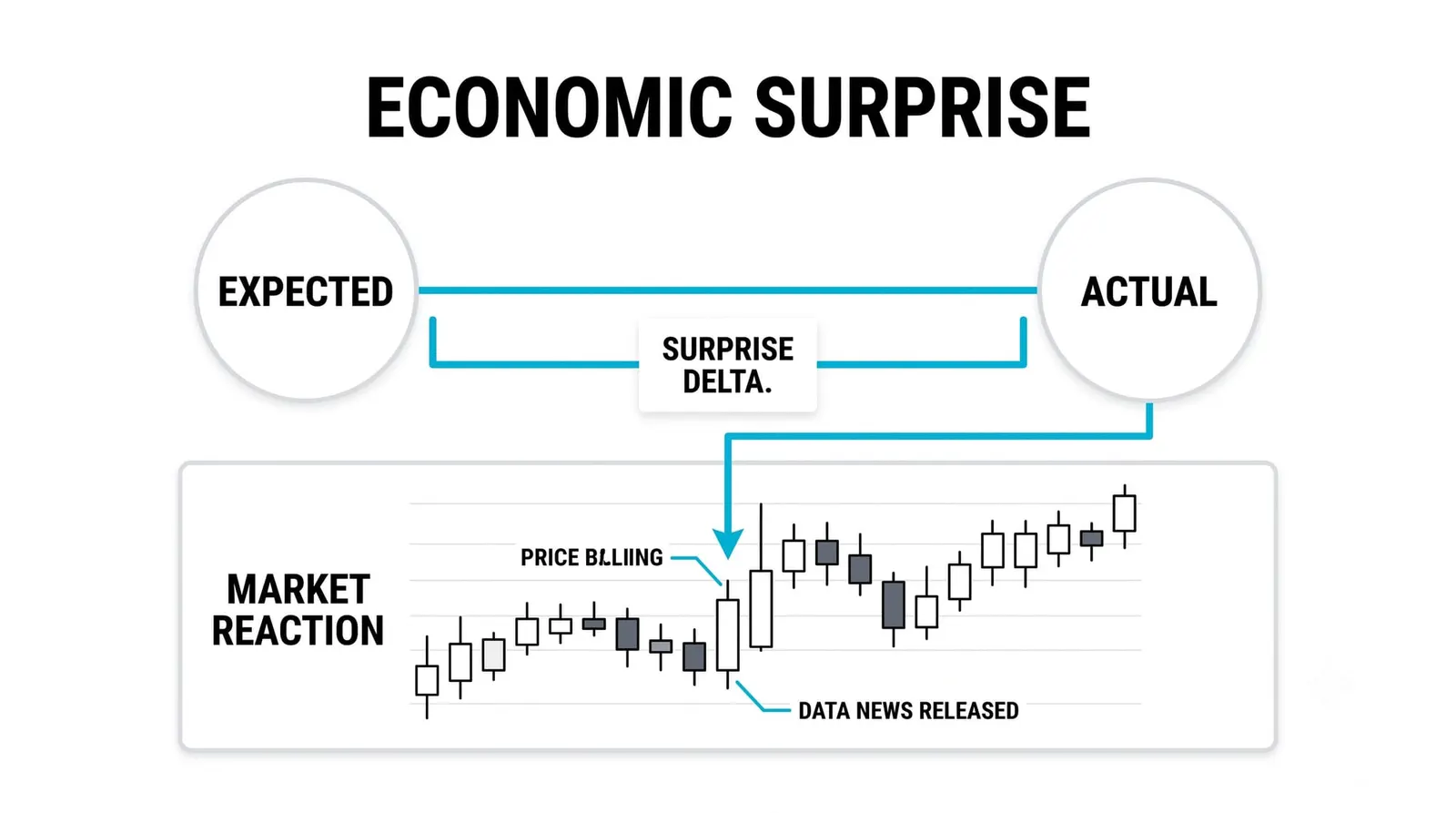
Expected vs Actual: Why the Number Itself Isn't What Moves Price
Before any major release, economists and analysts publish forecasts. Those forecasts get collected into a consensus number, and that consensus is public well in advance. Traders, funds, and machines all see it. They position around it for days.
By the time the release lands, the consensus is already inside the price. A CPI print of 3.0 percent against a consensus of 3.0 percent carries almost no new information. The market already believed 3.0 percent. Nothing needs to be repriced, so price often barely twitches, and when it does move, the move is noise rather than signal.
Only the deviation from consensus carries new information. A print of 3.4 percent against a 3.0 percent consensus forces every participant to update their view of inflation, rate expectations, and growth, all at once. That forced, simultaneous updating is what a spike on a chart actually is.
This is why an in-line number can be a complete non-event even when the number looks dramatic in isolation. A big figure that everyone expected is old news wearing a new timestamp. A small figure nobody expected can move markets for days.
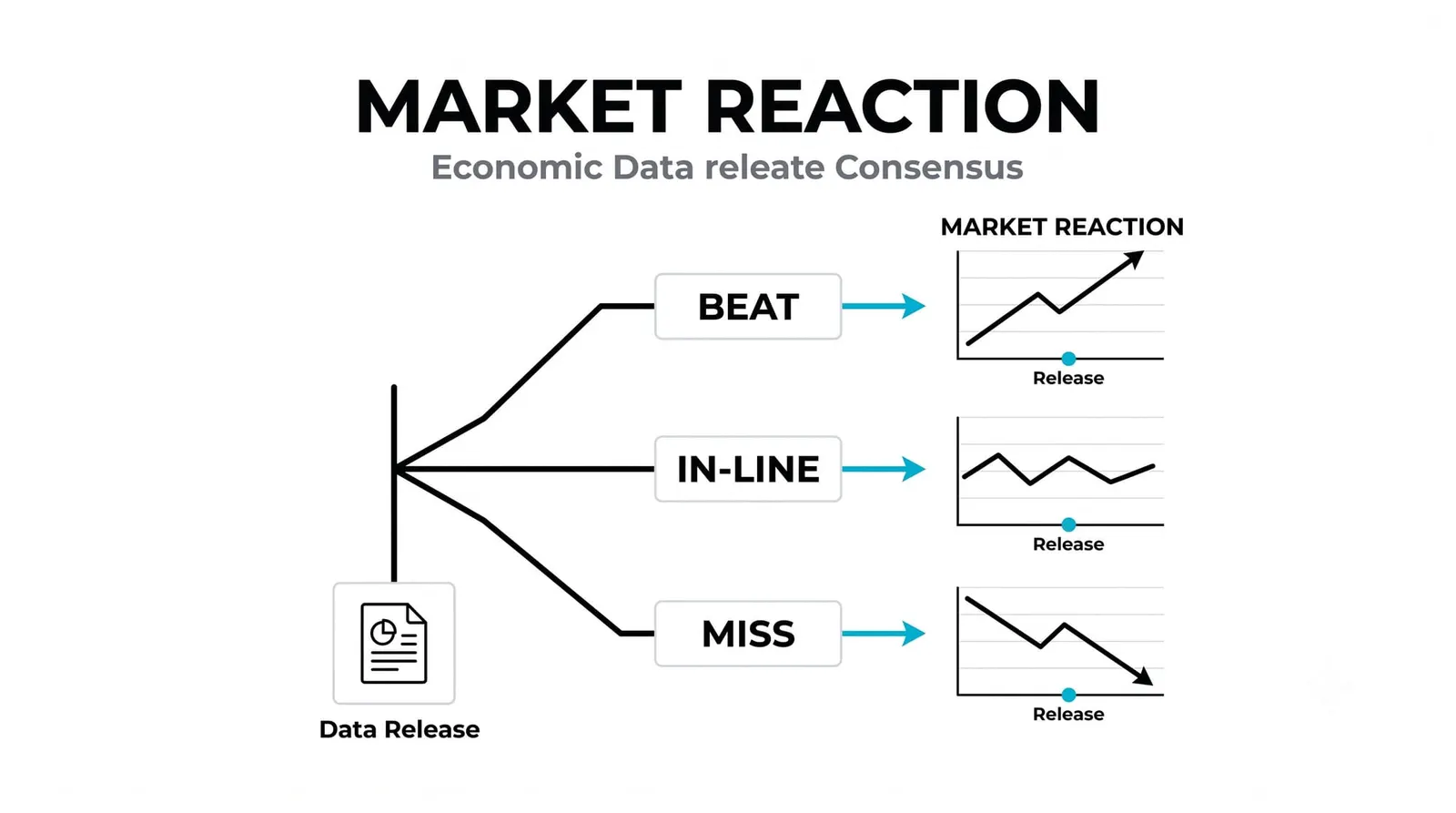
Beat, Miss, and In-Line: What Each Means for Direction
Every release resolves into one of three outcomes. A beat means the actual figure came in above consensus. A miss means it came in below. In-line means it matched, within a rounding tolerance the market treats as zero.
Direction follows from what the indicator implies. A beat on jobs data is generally read as economic strength, which can lift a currency through rate expectations. A beat on inflation can cut the other way for stocks, because it implies tighter policy ahead. The label beat or miss tells you the direction of the surprise. The asset's response depends on what the surprise means for rates, growth, and risk appetite.
Size matters as much as sign. A one-tenth deviation on an inflation print is a shrug. A full percentage point is a regime question. Markets treat small deviations as forecast error and large deviations as information about the world.
Then there is the detail under the headline. A strong headline jobs number can hide weak subcomponents, falling hours worked or rising part-time share. Revisions to prior months can quietly erase the apparent beat. Experienced traders read the first revision and the key subcomponents before trusting the headline reaction, because the market often re-prices once the detail circulates.
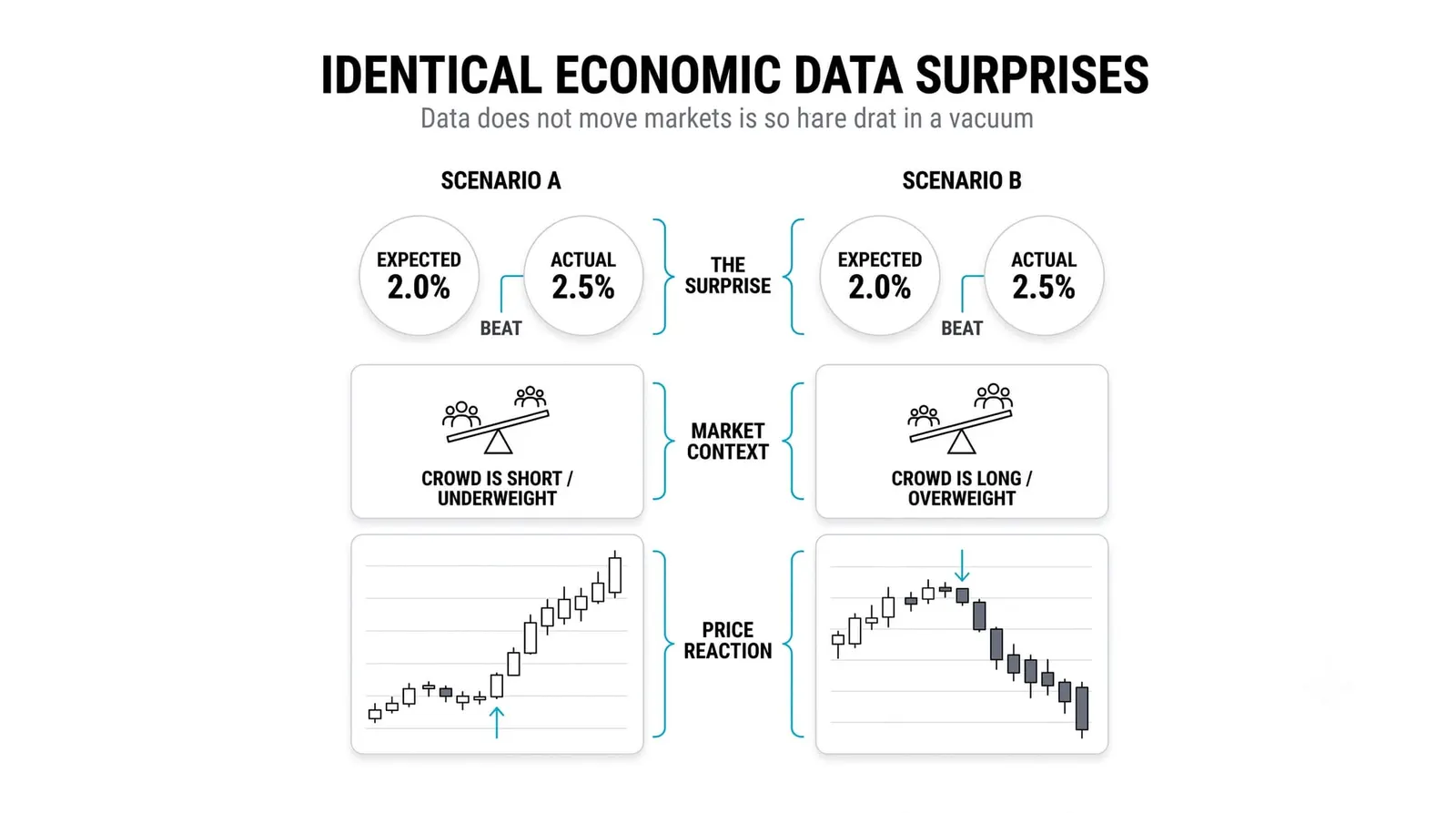
Why the Same News Can Move Price in Opposite Directions
Identical prints produce opposite reactions more often than beginners expect. Three forces explain most of it.
First, positioning. If the crowd is already heavily long a currency in anticipation of a strong number, a strong number gives nobody new a reason to buy. The buyers are already in. The only remaining flow is profit-taking, and price falls on good news. The release confirmed what positioning had already paid for.
Second, the stage of the rate cycle. Early in a hiking cycle, strong growth data reads as healthy. Late in the cycle, the same data reads as a reason for the central bank to tighten further, which threatens growth and valuations. The print is identical. The cycle stage flips its meaning.
Third, what was already leaked or priced. Some releases are partially anticipated through related data, official hints, or simple calendar logic. A surprise that was widely whispered is no longer a surprise by release time.
Watch how a single strong activity print can be read two ways. One desk calls it an inflation worry, because demand is running hot. Another desk calls it growth relief, because recession fears were overcooked. Both readings are rational. The dominant one is whichever fear the market carried into the release.
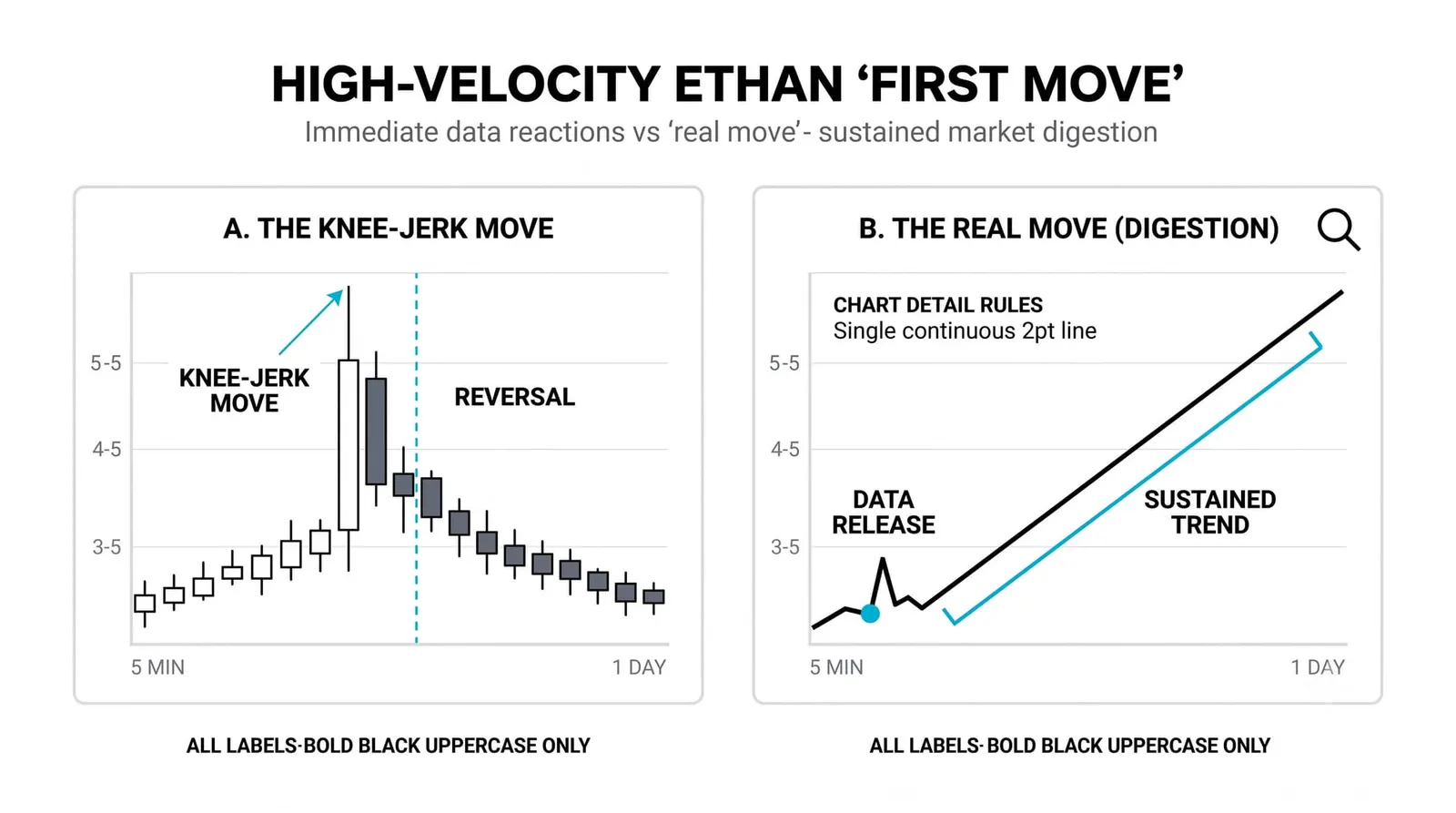
The First Move Isn't Always the Real Move
The first seconds after a release are the worst information of the day. Liquidity thins out because market makers pull quotes to avoid being run over. Machines react to the headline keyword before any human has read the subcomponents. The resulting spike reflects thin books and fast algorithms, and thin books exaggerate everything.
Some first moves extend into genuine trends. Others fade within minutes as the detail gets read and the early flow exhausts itself. Follow-through usually requires the detail to confirm the headline and the broader narrative to cooperate. Fades happen when the headline said one thing and the subcomponents said another.
The second hour often tells you more than the first minute. By then, analysts have published takes, revisions have been absorbed, and real money has decided whether to act. A move that survives that digestion period has a claim on being real. A move that fully retraced was mostly a liquidity event, and treating it as signal is a common and expensive beginner mistake.
One Release, Three Reactions
Everything below is hypothetical, with invented round numbers, to show how context rewrites the same print.
Imagine a CPI release printed at 3.0 percent against a consensus of 2.9 percent. A small beat, one-tenth of a point.
Scenario A: mid hiking cycle. The central bank has been raising rates and the market is debating whether it goes again. The beat reads hawkish: inflation is stickier than hoped, so another hike looks more likely. The currency rallies as rate expectations shift up. The pot was already simmering with rate speculation, and the ingredient fed it.
Scenario B: recession fear dominant. The market's obsession has flipped to growth. The same 3.0 percent print now reads as bad news twice over: inflation still elevated while the economy weakens, a squeeze with no clean policy answer. The currency sinks as traders price a central bank trapped between mandates. Same ingredient, different pot, opposite dish.
Scenario C: after a week of leaks. Related data and official comments all week pointed to a firm print. By release day, anything under roughly 3.1 percent was already positioned for. The 3.0 percent lands and price barely moves. The crowd had pre-eaten the surprise.
Three reactions, one number. The ingredient never changed. The pot and the crowd did.
| Outcome | What it is | First-order market read |
|---|---|---|
| The beat | Actual lands above consensus | Surprise priced in the direction the indicator implies; size sets the force |
| The miss | Actual lands below consensus | Reverse repricing; crowded positioning can amplify it |
| The in-line print | Actual matches consensus | Often a non-event; residual moves are positioning noise |
| The revision | Prior figures restated up or down | Can erase or double the headline surprise once noticed |
News Events and Price, Answered
Why does price sometimes fall on good news?
Because the good news was already priced and the buyers were already in. When a release confirms what positioning anticipated, the remaining flow is profit-taking, so price drifts down even though the headline was strong.
What does buy the rumor, sell the fact mean?
It describes the pattern where price rises in anticipation of an expected positive event and then falls when the event actually happens. Traders bought the expectation, and the confirmation gives them their exit, so the fact itself becomes a selling opportunity rather than a buying one.
How long does a news move usually last?
It ranges from minutes to weeks depending on whether the surprise changes the bigger story. A pure liquidity spike can retrace within the hour, while a surprise that shifts rate expectations or the growth outlook can drive trends for days or longer.
Why do markets move before the release?
Because positioning happens in advance. Traders adjust exposure based on consensus forecasts, related indicators, leaks, and official hints, so a meaningful share of the reaction is already in the price before the number prints.
Next, the news trading protocols lesson turns these mechanics into a concrete framework: how to prepare before a release, how to handle the first minutes, and how to decide when a move deserves your participation at all.