Quantitative Easing and Tightening
Quantitative easing is a central bank buying large amounts of bonds with newly created money to push long-term interest rates down when the policy rate alone is not enough. Quantitative tightening is the reverse: the bank shrinks those holdings so yields can rise again. Together they are the two extremes of the policy toolkit.

Think of QE as the central bank taking over the air pump when everyone else has stopped inflating the tire, and QT as letting the air back out slowly. The previous lesson covered the interest rate decision itself, the standard lever. QE and QT are what the bank reaches for when that lever runs out of room. And earlier this level you saw how interest rates move asset prices; QE works through that same channel, just at a much larger scale.
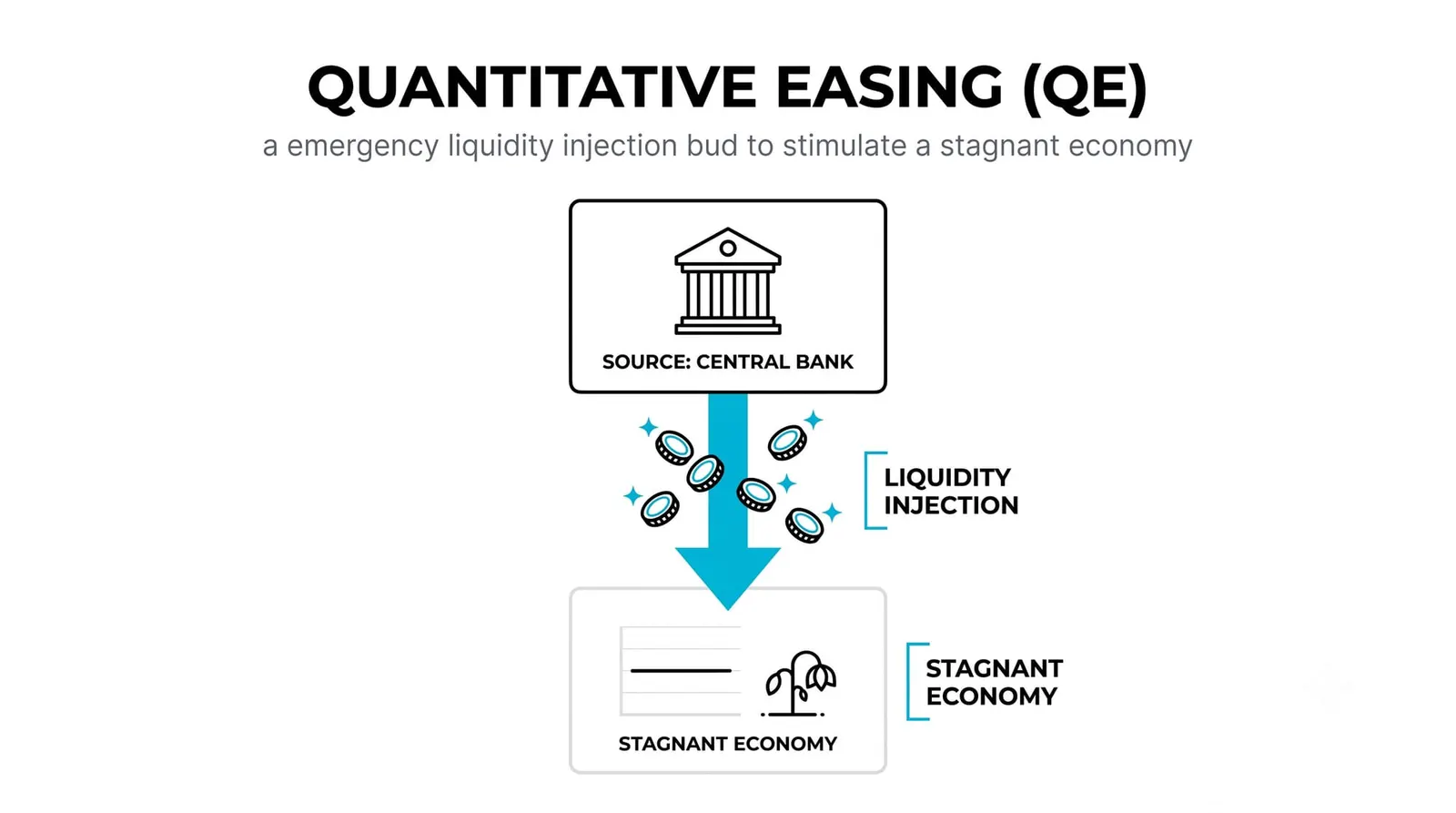
What Quantitative Easing Actually Does
The mechanics are simpler than the name suggests. The central bank creates new reserves, essentially money that did not exist before, and uses them to buy government bonds from banks and other large institutions in the open market.
Heavy buying lifts bond prices. Bond prices and yields move in opposite directions, so when prices rise, yields fall. The buyer of last resort has arrived, and it has effectively unlimited buying power because it creates the money it spends.
Then the second effect kicks in. The institutions that sold their bonds now hold cash earning very little. Safe bond yields have been pushed down. So that money goes looking for a return somewhere else: corporate bonds, equities, property, anything with a higher expected yield. This is called the portfolio rebalancing effect, and it is the main transmission channel of QE into the wider economy.
When does a central bank do this? When the policy rate is already at or near zero and cutting further is not possible or not useful. The rate lever has hit the floor. Buying bonds is how the bank keeps pushing stimulus into the system after that.
Key points to hold onto:
- New money is created as bank reserves; QE expands the central bank's balance sheet.
- Bond prices rise, yields fall, lowering long-term borrowing costs across the economy.
- Investors are pushed toward risk as safe yields shrink, lifting equities and credit.
- It is a tool of last resort, used when the policy rate cannot go lower.
What Tightening Does and Why It Is the Reverse
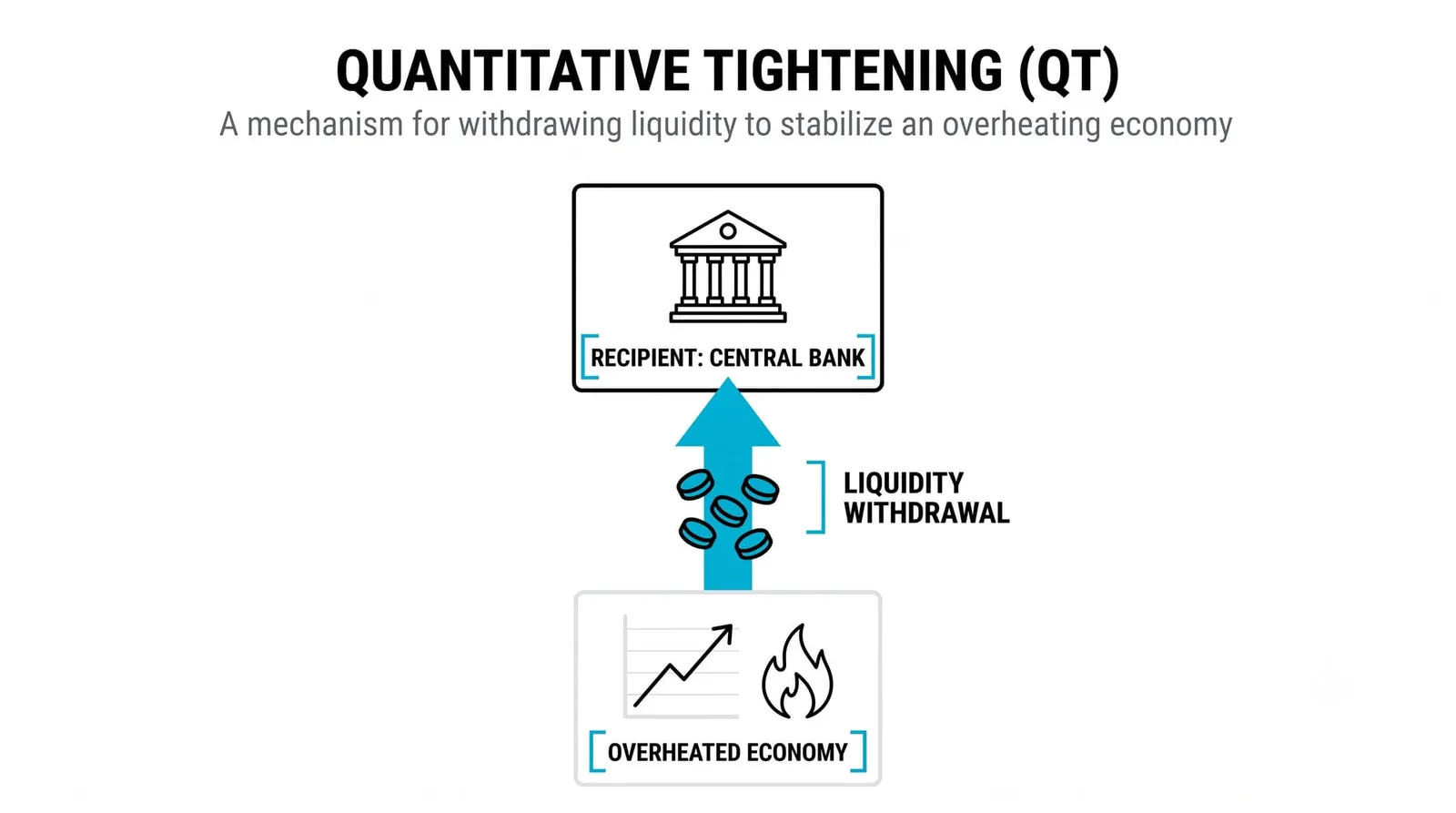
Quantitative tightening unwinds the process. The central bank stops reinvesting the proceeds of maturing bonds, letting them roll off its balance sheet. In some cases it sells bonds outright before they mature.
Either way, two things happen. The bank's steady demand disappears from the bond market, so prices soften and yields drift upward. And the reserves created during QE are drained back out of the banking system as the balance sheet shrinks.
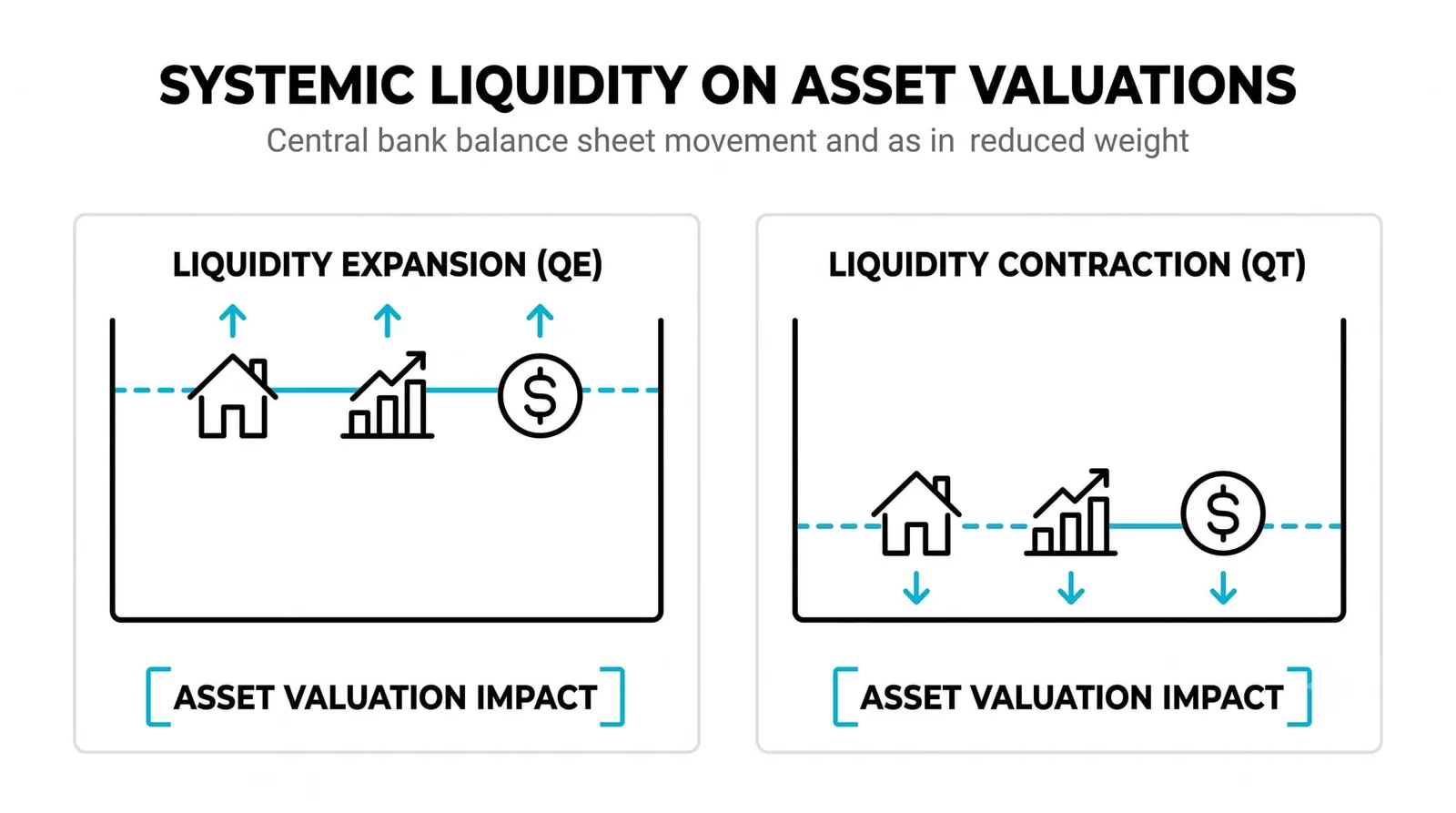
Liquidity is the word you will hear. QE adds liquidity to the financial system; QT removes it. Less liquidity means less easy money chasing assets, tighter financial conditions, and higher borrowing costs at the long end of the curve.
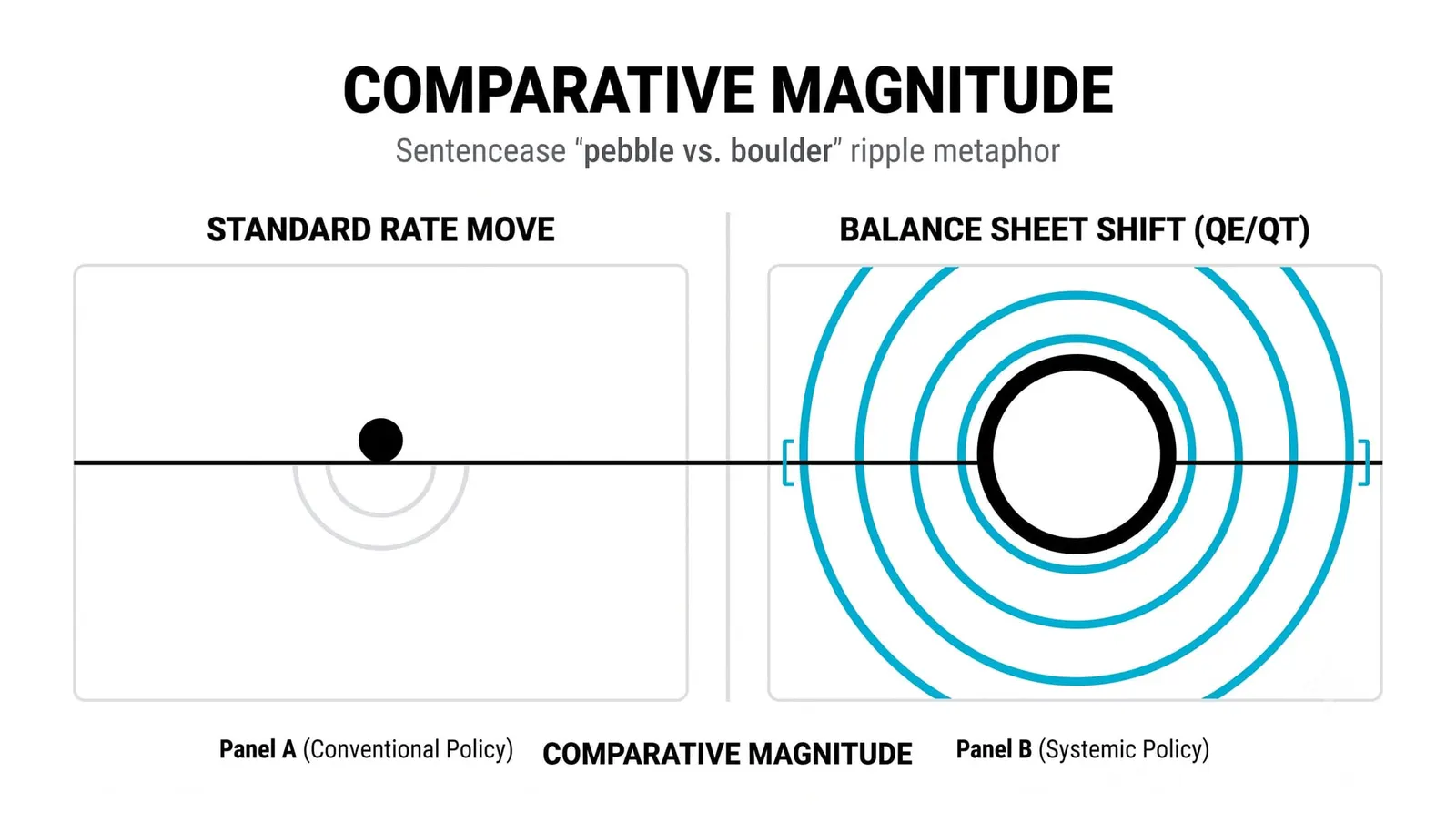
Notice that QT is usually designed to be slow and quiet. Central banks learned from experience that markets grew dependent on the buyer being there. Pull that support away too fast and bond markets can seize up. So QT typically runs on a published schedule, at a capped monthly pace, in the background, while the policy rate does the talking.
That asymmetry matters. QE is announced with fanfare because the bank wants markets to react. QT is run like plumbing maintenance because the bank wants as little reaction as possible.
How QE and QT Reach Your Charts
The transmission lines are direct enough to trace. Start with currencies. QE pushes domestic yields down, which makes the currency less attractive to hold, so it tends to weaken. QT does the opposite: rising yields support the currency, all else equal.
Equities respond through the portfolio channel. When safe bonds yield almost nothing, investors accept more risk to earn a return, and that demand lifts stock prices and compresses the extra yield investors demand for holding risk. QE eras are therefore associated with rising asset prices and unusually calm credit markets.
Risk appetite broadens beyond stocks. Lower safe yields and abundant liquidity tend to flow toward higher-yielding currencies, emerging markets, and anything with a growth story attached. The tide lifts most boats.
QT reverses the pressure, but gradually. Yields grind higher, liquidity thins, and the easy bid under risk assets fades. Markets that were priced for permanent support have to reprice. That repricing is rarely smooth, but it is also rarely instant, because QT is deliberately paced.
For a trader, the practical read is this: QE and QT set the background conditions for every other signal you follow. The same chart pattern means something different when the central bank is adding liquidity than when it is draining it.
The Limits and the Risks of Both
Neither tool is a switch. Both are calibration exercises, and both carry failure modes worth knowing.
QE suffers from diminishing returns. The first round, launched in a crisis, does the heavy lifting because panic is high and yields have room to fall. Later rounds push on markets that have already adjusted. Each additional unit of buying tends to produce less economic effect, while the side effects accumulate: inflated asset prices, stretched valuations, and a growing gap between financial markets and the underlying economy.
There is also a dependency problem. Years of QE teach markets that the central bank will step in when things wobble. Investors take more risk on that assumption. Unwinding that belief is harder than creating it.
QT has its own tipping point. The bank is draining reserves without knowing exactly where the floor is, the level below which the financial system starts to malfunction. Money markets can suddenly seize when reserves get scarce, forcing the bank to stop or reverse. The history of QT programs includes abrupt endings for exactly this reason.
The honest summary: QE risks doing too much for too long, and QT risks discovering the limit only after crossing it. Central banks manage both by moving in steps and watching market plumbing closely. You should read their actions the same way, as adjustments, not verdicts.
One Bond Market, Two Directions
Here is a purely hypothetical illustration with round numbers. Imagine a government bond that pays 30 per year and trades at 1,000. Its yield is 3 percent: 30 divided by 1,000.
Now the central bank launches QE and starts buying these bonds in size. Demand pushes the price to 1,200. The payment is still 30, so the yield falls to 2.5 percent: 30 divided by 1,200.
Follow the money. An institution holding cash from selling bonds at 1,200 now earns 2.5 percent if it buys back in. That return looks thin next to dividend yields or corporate bonds. So the money migrates toward equities and riskier credit. Stock prices rise, risk premiums compress, and the domestic currency softens because its safe yield just fell relative to alternatives.
Now reverse it. The bank shifts to QT and stops reinvesting. Without the big buyer, the bond's price slides back toward 1,050. The yield climbs toward 2.9 percent: 30 divided by 1,050. Safe returns look better, liquidity is draining, and some of the money that fled to risk assets comes home. The currency finds support, and risk appetite cools.
One bond, one fixed payment, two directions. Everything else in the market is reacting to that arithmetic at scale.
| Step | What happens | What it pushes investors to do |
|---|---|---|
| The bond purchase | The central bank creates reserves and buys bonds, lifting the price from 1,000 toward 1,200 | Sell bonds to the bank and hold cash earning little |
| The yield effect | The yield falls from 3 percent to 2.5 percent as the price rises | Look elsewhere for a decent return |
| The portfolio effect | Safe yields are compressed across the curve | Move into equities, corporate credit, and higher-yielding currencies |
| The reverse under QT | The price slides back toward 1,050 and the yield climbs toward 2.9 percent | Rotate back toward safe bonds as risk appetite fades |
QE and QT, Answered
Does quantitative easing print money?
In a narrow sense, yes: the central bank creates new bank reserves electronically to pay for the bonds. But those reserves sit inside the banking system and only reach the broader economy if banks lend and institutions spend. QE expands the monetary base directly and the wider money supply only indirectly, which is why it does not automatically produce consumer inflation.
Why does QE push stock prices up?
Because it compresses the return on safe assets. When government bonds yield very little, investors seeking returns move into equities, and that buying lifts prices. Lower rates also raise the present value of future company earnings in valuation models. Both forces push the same direction.
Is QT dangerous for markets?
It can be, mainly because markets adapt to the central bank's presence and QT removes it. The danger is less about the pace of selling and more about hitting the point where reserves become scarce and funding markets seize. That is why central banks run QT slowly, on a schedule, and have stopped programs early when plumbing showed stress.
How can a trader tell QE effects from QT effects?
Watch the direction of long-term yields, the size of the central bank's balance sheet, and the behavior of risk assets. Falling yields, an expanding balance sheet, a soft currency, and buoyant equities point to easing conditions. Rising yields, a shrinking balance sheet, a firmer currency, and tiring risk appetite point to tightening. The balance sheet is the cleanest tell, since it is published on a schedule.
QE and QT tell you which direction the liquidity tide is moving. The next lesson covers forward guidance, the tool central banks use to shape expectations before they move any money at all.