Forward Guidance: How Words Move Markets
Forward guidance is a central bank telling markets what it expects to do with policy in the future: the conditions it is watching, the direction it leans, and the patience it plans to show. Because markets price the expected path of rates rather than just today's rate, those words move prices before any rate ever changes.

Think of forward guidance as the bank reading the first page of its diary aloud, so the market stops guessing the rest. Two lessons ago you learned to read hawkish versus dovish tone; guidance is that tone made explicit and conditional. Last lesson covered the rate decision itself, and the statement and press conference that accompany it are exactly where guidance gets delivered.
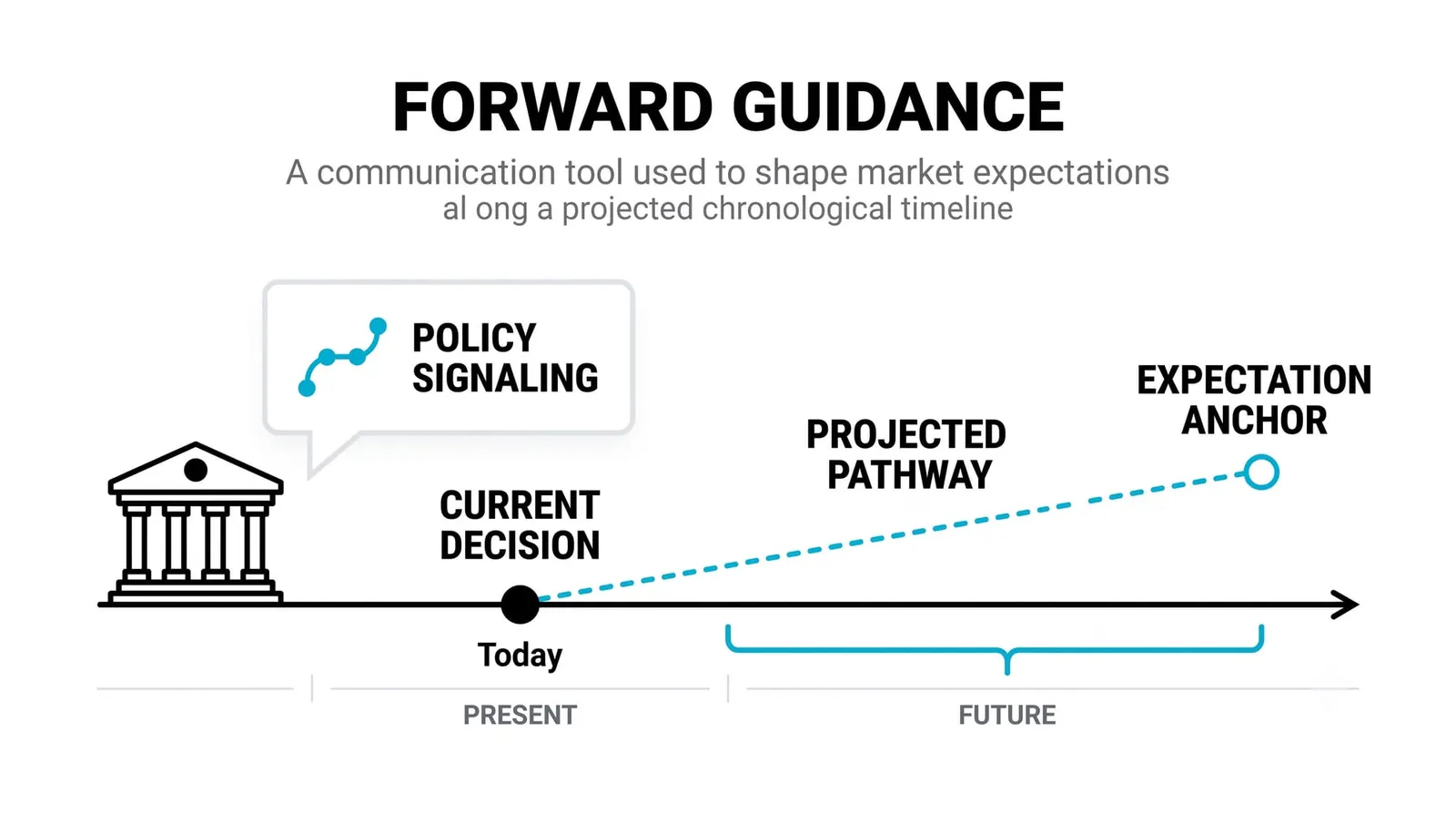
What Forward Guidance Actually Is
At its simplest, guidance is a set of sentences that describe the future. The bank says what it intends, under what conditions, and with what degree of confidence. Sometimes it commits. Sometimes it only sketches.
The language comes in a few standard shapes. A commitment is a near-promise: "we expect rates to remain at this level for an extended period." A threshold ties policy to a number: "we will not consider tightening while unemployment sits above seven percent." Conditional language hedges everything: "if inflation evolves as projected, a gradual adjustment would be appropriate."
The big structural split is date-based versus outcome-based guidance.
- Date-based guidance ties policy to the calendar. "Rates will stay here through the end of the year." It is easy to read and easy to price. It is also fragile, because the economy does not care about the bank's calendar.
- Outcome-based guidance ties policy to economic conditions. "Rates stay here until inflation returns to target on a sustained basis." It is harder to price because the trigger is a moving data point, but it survives surprises better.
Most real guidance blends the two. A bank might say it expects to hold rates "for some time" while listing the conditions that would change its mind. Your job is to identify which type dominates, because that tells you what can kill the guidance: a date, or a data print.
Why Promising in Advance Works
Long-term interest rates are built from expectations. A ten-year yield is roughly the market's average guess of short rates over ten years, plus a risk premium. The bank only controls one overnight rate, but it wants to influence the whole curve.
Guidance is the tool for that. If the market genuinely believes rates stay low for a year, long-term yields adjust today. Borrowing costs fall across the economy without a single additional cut. Financial conditions ease on words alone.
Expectations do the heavy lifting. A central bank that merely acts must move the rate and wait for the effect to spread. A bank that guides aims the expectations directly, and the market does the spreading for free.
This is why former central bankers have described their job as managing expectations more than managing rates. The rate is one lever. The story about where the rate is going is a lever on every maturity at once.
There is a catch. Guidance only works if it is believed. A bank with a record of abandoning its own forecasts finds its words discounted, and each new promise buys less reaction than the last.
How Traders Decode the Language
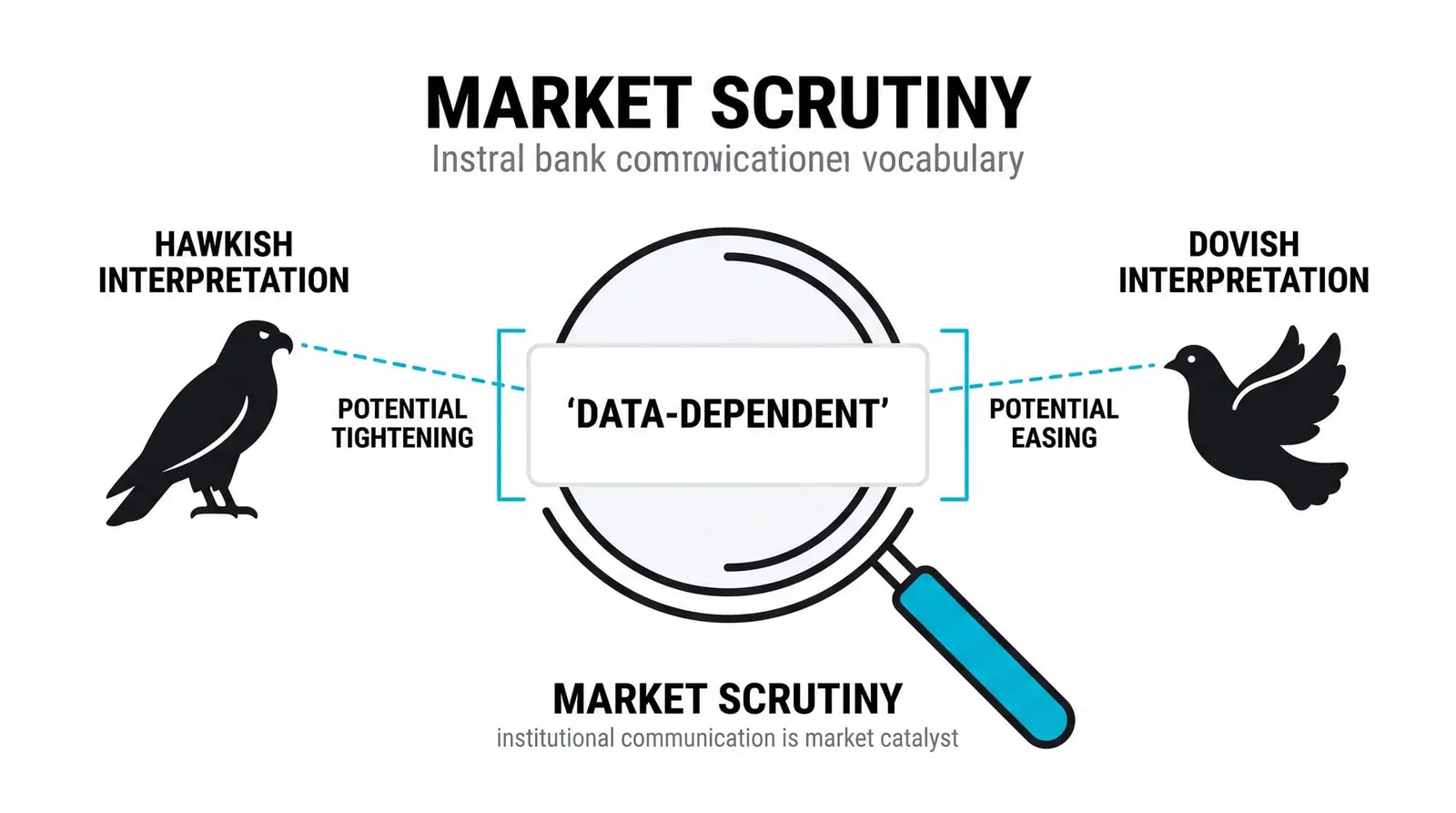
Certain phrases carry a heavy history. When a bank says policy will stay restrictive "for as long as needed," markets hear a floor under rates. "Higher for longer" became shorthand for an entire regime. "Patient" has been used to signal a pause. "Timely and gradual" signals movement, but slow movement.
"Data dependent" is the great escape hatch. It means the bank refuses to pre-commit and will react to each release as it comes. Traders read it as: the calendar is dead, watch the numbers instead.
The market's sensitivity to a single dropped or added phrase is not irrational. Every word in a statement survived a drafting fight among the people who actually vote on rates. A phrase that appears for six straight meetings and then vanishes is a signal that the internal debate shifted.
That is why desks compare statements word by word. The diff between this month's statement and last month's gets read like evidence in a case file. Added words, deleted words, softened qualifiers: each one is a clue about what changed in the room.
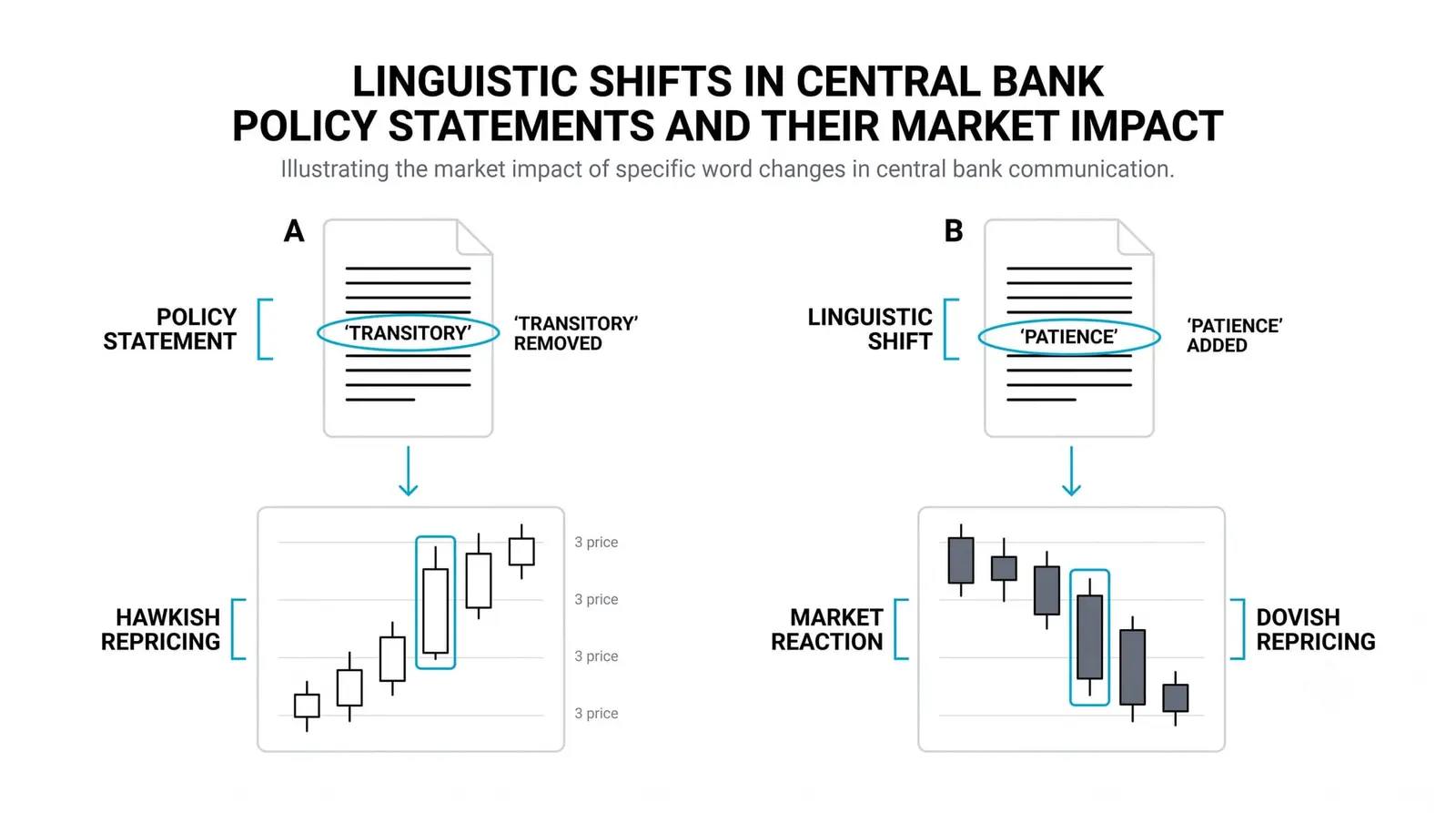
Watch for three things in any statement.
- The forward sentence. The line that describes the future path. Changes here matter most.
- The condition list. What the bank says it needs to see before acting. Additions raise the bar; removals lower it.
- The risk balance. Whether risks are described as balanced, tilted to inflation, or tilted to growth. This frames which surprise would trigger action.
When Guidance Breaks and What Follows
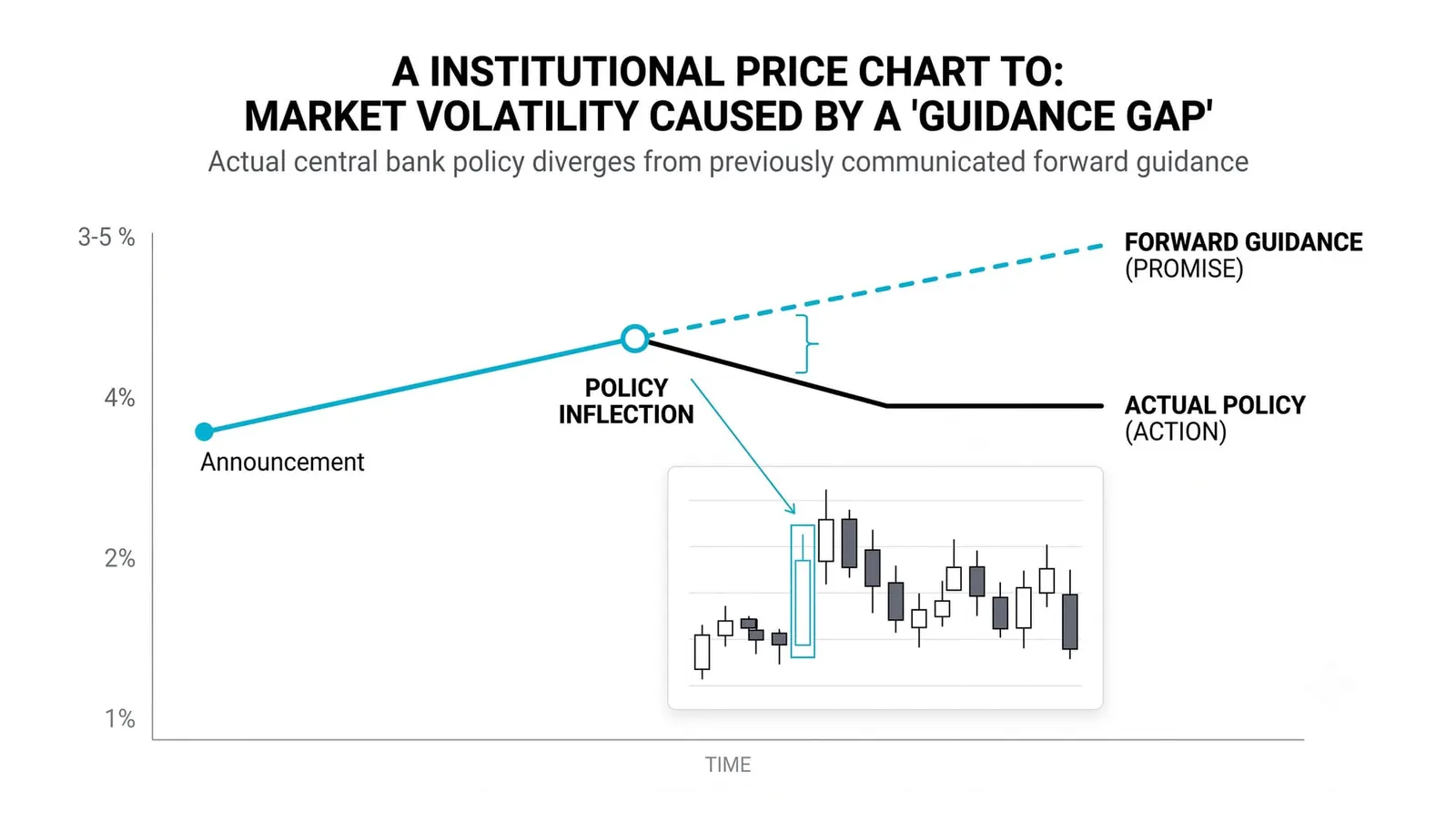
Guidance dies in one of two ways. The bank retires it on schedule, which is normal and usually priced. Or reality kills it early: an inflation surprise, a shock, a data run that makes the promised path untenable.
The second kind is expensive. When a bank abandons guidance mid-promise, two things reprice at once. The expected path jumps to the new reality. And the credibility premium resets, meaning every future statement gets trusted a little less.
The re-pricing is often violent because positioning was built on the promise. Traders who leaned on date-based guidance get caught furthest out. The market was wrong about rates, and it was also wrong about how much the bank's word was worth.
The lesson is structural. Guidance is a forecast dressed as a plan. Treat it as strong information about intent, never as a guarantee, and always ask what data would force the bank off its own script.
One Phrase, One Repricing
Here is a hypothetical with round numbers. A central bank has repeated for months that rates will stay at current settings through the end of the year. At the next meeting, that sentence disappears. In its place: "rates will rise as conditions warrant."
No rate changes that day. But the expected path steepens immediately. Markets had priced zero hikes for the year; now they price two. Two-year yields rise by roughly the equivalent of those two extra hikes, because the short end of the curve is pure rate expectation.
The currency gains about 1.5 percent as higher expected rates pull in capital. Equities fall, and the pain is uneven: companies whose value sits in distant future cash flows, the long-duration growth names, fall the most, because a higher discount rate hits far-off earnings hardest.
One sentence did all of that. The rate never moved.
| Element | What it is | What it does to the expected path |
|---|---|---|
| Date-based guidance | A promise tied to the calendar, e.g. rates on hold through year-end | Flattens the priced path until the date; breaks hard if data turns first |
| Outcome-based guidance | A promise tied to conditions, e.g. until inflation returns to target | Ties the path to data releases; shifts gradually as the numbers evolve |
| The phrase change | One sentence swapped in the statement, no rate move | Re-prices the whole path at once; yields, currency, and equities adjust together |
| The broken promise | Guidance abandoned early because reality forced it | Path jumps and credibility resets; future guidance gets discounted |
Forward Guidance, Answered
Is forward guidance binding on a central bank?
No. Guidance is a statement of intent, not a contract. A bank can always change course when the data demands it, and every statement includes enough conditional language to allow that. The cost of changing course is credibility, not legality.
Why do markets react to single words?
Because each word survived a vote. Statements are drafted and fought over by the people who set the rate, so a single added or dropped word reflects a real shift in the committee's thinking. Markets are pricing that shift, not the word itself.
What does "data dependent" actually mean?
It means the bank declines to commit to a path and will decide meeting by meeting based on incoming releases. For traders, it converts every major data print into a potential policy event, because the next decision genuinely hangs on the numbers.
Can guidance be wrong on purpose?
A bank can speak more firmly than its private uncertainty justifies, and some argue that over-committing is sometimes the point: a strong promise moves markets further. But deliberately misleading language destroys the tool itself, so the incentive runs toward honest signaling with heavy hedging rather than deception.
Next in this cluster, you will put the full central-bank toolkit together: the meeting calendar, the statement, the press conference, and the guidance, read as one connected event rather than four separate ones.