Volume in Trending vs Ranging Markets
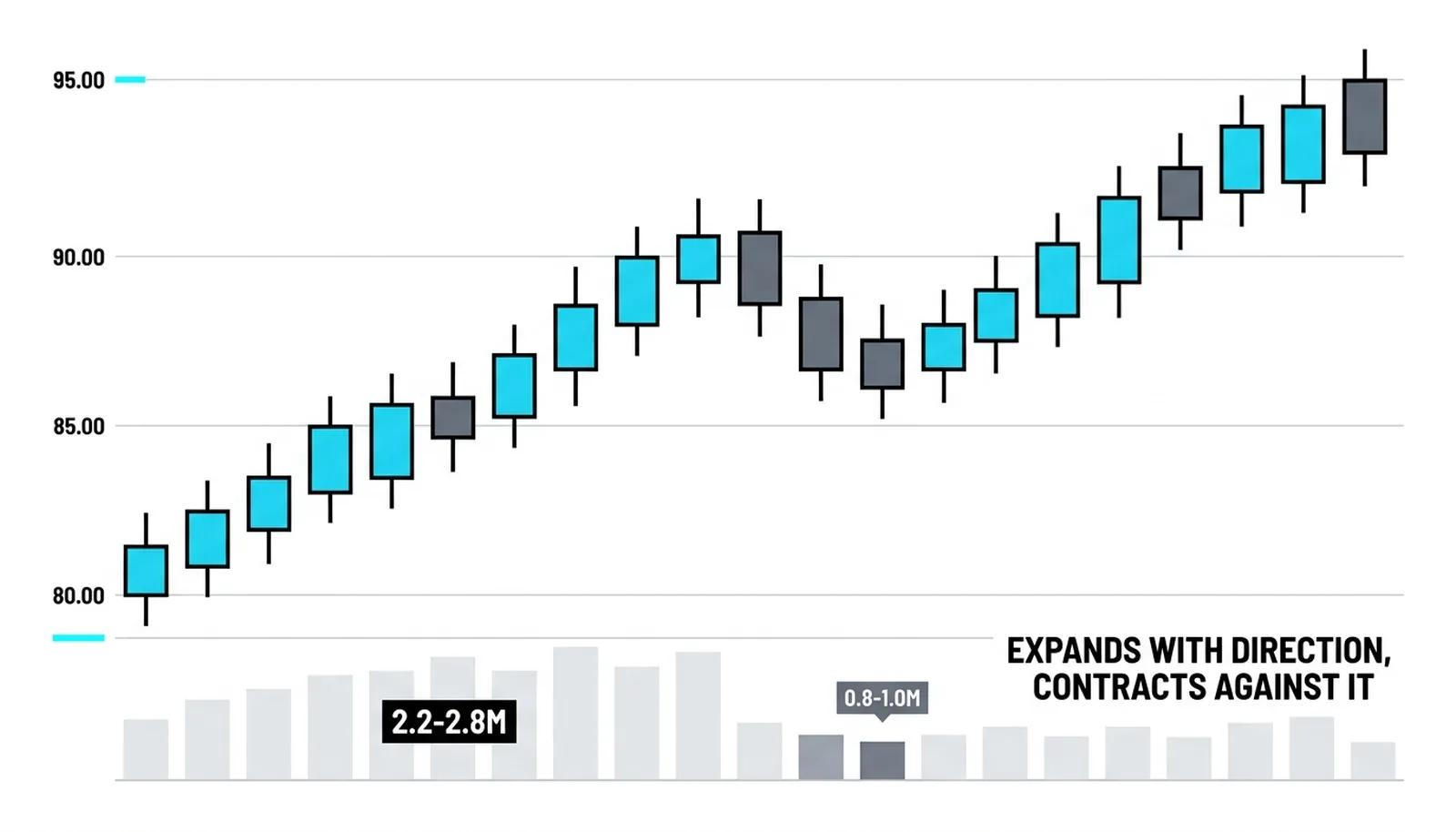
Volume behaves differently in trending and ranging markets, and the same bar can mean opposite things depending on which regime you are in. In a healthy trend, volume expands in the direction of the move and dries up against it. In ranging markets, the opposite texture wins: overall contraction, with the only loud bars at the edges where the boundaries get tested. Knowing which regime price is in changes what any volume bar is allowed to tell you.

Think of a corridor versus a waiting room: a corridor has direction and flow, a waiting room is people shuffling between the same four walls. Volume reads the flow. Before going further, one handoff: the previous lesson covered volume divergence, the slow disagreement between price and participation, so this lesson will not re-teach it. And an earlier lesson in this level already owns the impulse-versus-pullback asymmetry inside trends; what follows is the full regime comparison and, most importantly, the transitions between regimes.
What Volume Does in a Healthy Trend
A trend is a crowd moving one way, and the volume signature reflects that. Pushes in the trend's direction draw expanding participation. Pullbacks draw shrinking participation. Each new leg should pull in fresh traders who were not involved in the last one.
That expansion matters more than the level. A trend printing higher volume on each successive push is being fed. New money is arriving, which means the move has fuel left.
Watch for the inversion. When pullbacks start printing heavier volume than the pushes, the asymmetry has flipped, and the trend is telling you something before price confirms it. Sellers are now working harder than buyers. That inversion is often the earliest readable warning that the regime itself is about to change.
What Volume Does in a Range
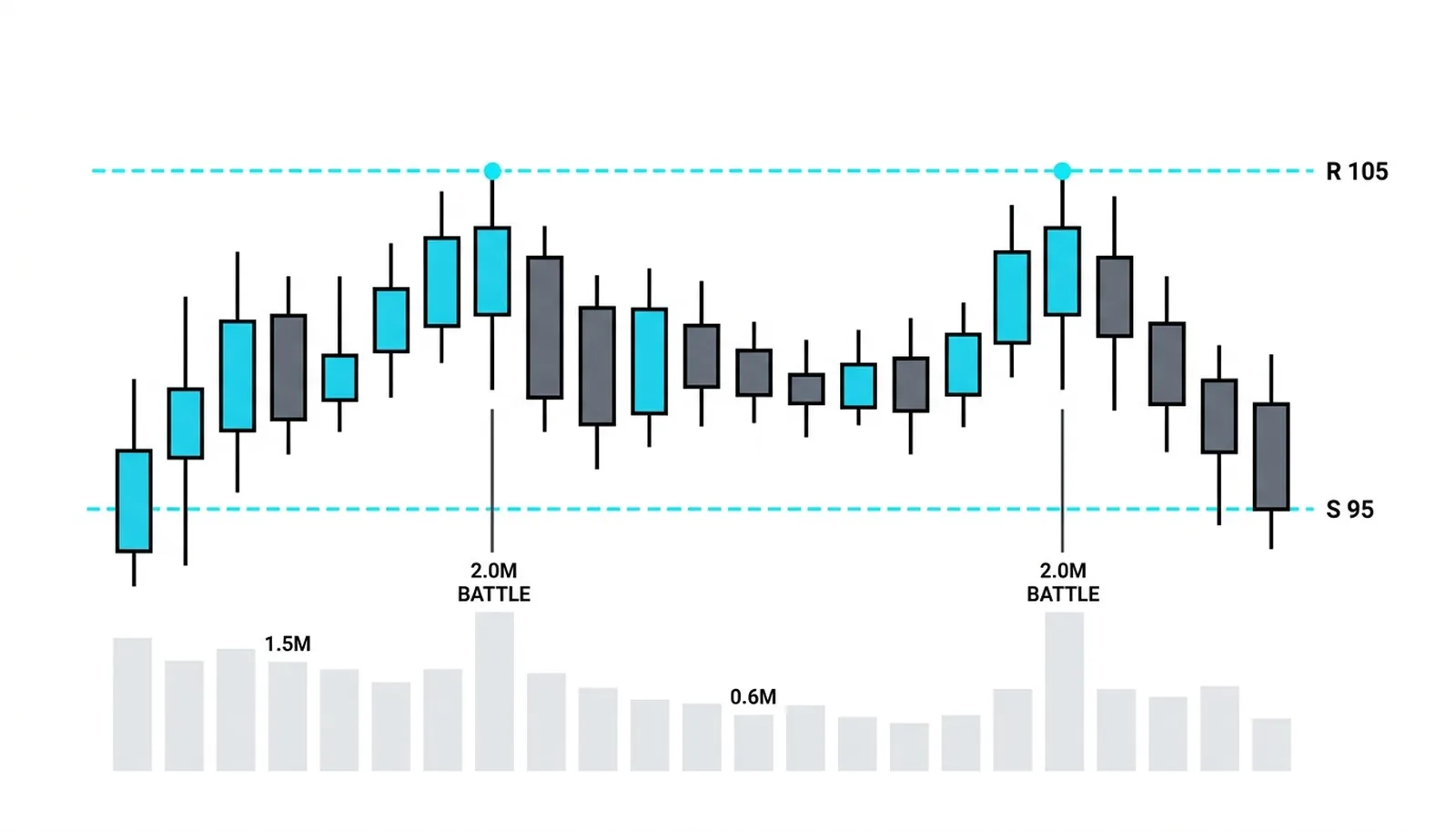
Ranges are built on disagreement with no resolution, and the volume texture shows it. Overall activity contracts as the range matures. The middle of the range goes quiet because neither side has a reason to commit there.
The loud bars migrate to the edges. That is where the defenses live: buyers absorbing supply at the floor, sellers absorbing demand at the ceiling. A heavy bar at range resistance followed by rejection is a battle, and the rejection tells you who won it.
A very old, very quiet range deserves extra respect. When a market has gone nearly silent inside tight boundaries for weeks, someone is usually accumulating or distributing inside it, quietly, without moving price. The stillness is the position being built.
The loudest version of that story is a climax at an edge. A huge bar slamming into the boundary, then failing to break it, is often the final inventory of one side being absorbed by the other. That is frequently the last act before the range resolves.
The Transitions Are the Real Signal
Regimes do not announce themselves. Volume does it for them, if you watch the handoffs.
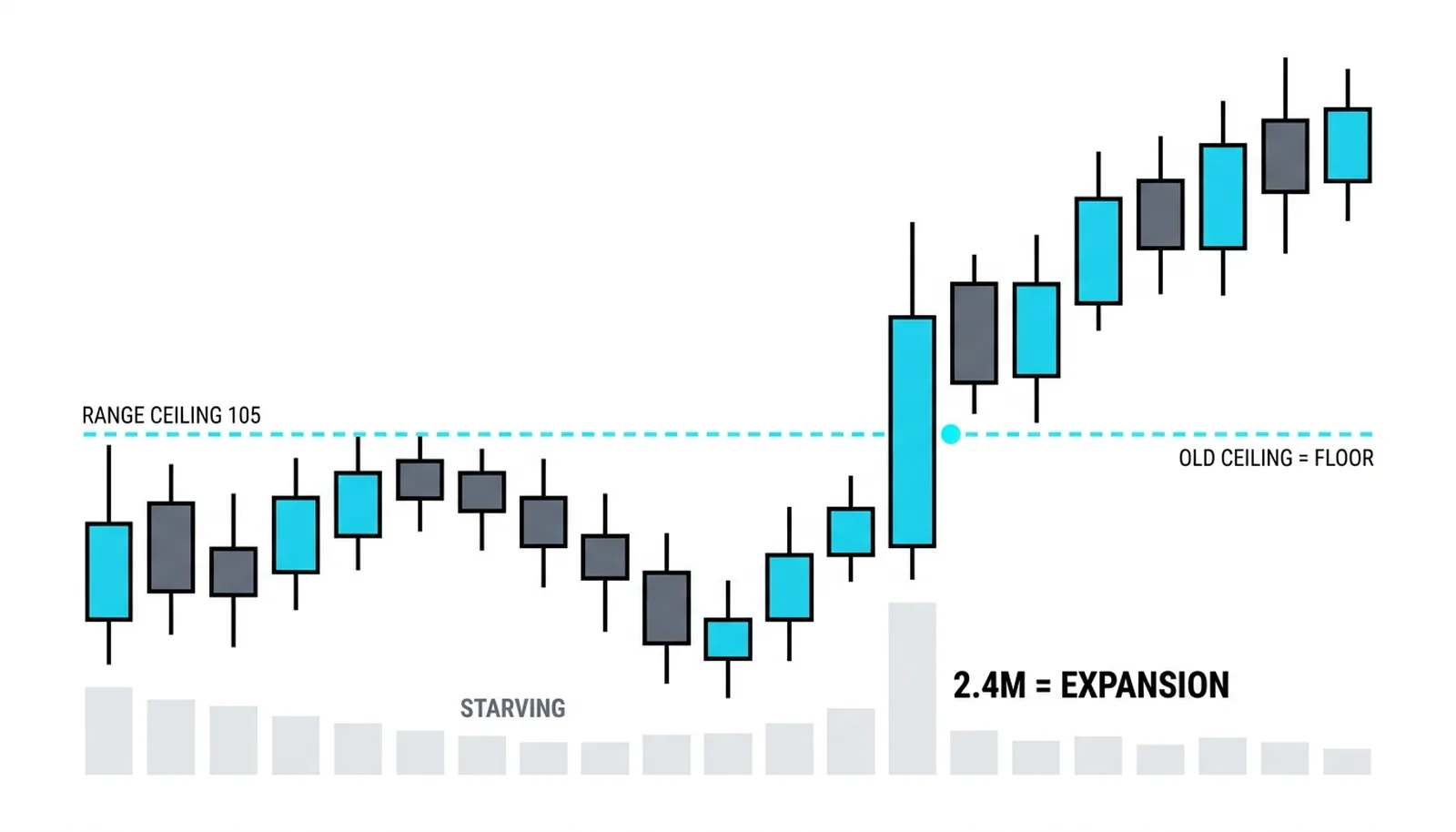
Trend to range looks like starvation. Participation contracts as the move stalls. Pushes stop drawing fresh volume, price stops making progress, and the market settles into a base. The trend was not defeated so much as it stopped being fed.
Range to trend is the single most reliable volume signature in this entire level: expansion on the break. When price leaves a range and volume surges on the breaking bar, the crowd is paying to leave the waiting room. That commitment is hard to fake.
A break on no expansion is suspect no matter how clean the candle looks. A beautiful breakout bar on average or falling volume is a break nobody showed up for, and those fail far more often than traders expect. Wait for the participation, or treat the trade as lower quality from the start.
Reading Volume by Regime, Not by Habit
The same bar means different things in different places. Heavy volume mid-range is churn, noise with no destination. Heavy volume at an edge is a battle, a test of a defended boundary. Heavy volume on a break is commitment, the market choosing a direction with its money.
A volume reading without a regime is a word without a sentence.
This is why mechanical rules like "high volume is bullish" fail. High volume is information about effort, and effort only means something once you know where it happened and what the market was doing around it. Build the habit of classifying the regime first, then reading the bar.
One Level, Three Regimes
Here is a hypothetical illustration with round numbers. A stock averages 1.5 million shares a day.
Phase one, the trend. During its uptrend, pushes print 2.2 to 2.8 million shares while pullbacks fade to 0.8 to 1.0 million. Expansion with direction, contraction against it. Textbook.
Phase two, the range. The trend stalls and price settles between 95 and 105. Total daily volume fades from 1.5 million, to 0.9 million, to 0.6 million over three weeks. The only exceptions are two days printing 2.0 million, both at the 105 edge, both rejected. Those are battles at the ceiling, and the sellers won both.
Phase three, the break. Price finally pushes through 105 on 2.4 million shares, well above anything the range produced. Expansion on the break. The range becomes an uptrend, and the old ceiling at 105 starts acting as a floor.
| Regime | Typical volume shape | What loud bars mean there | What quiet bars mean there |
|---|---|---|---|
| Trend | Expands with direction, contracts on pullbacks | Fresh participation feeding the move | Healthy pullback, weak counter-pressure |
| Mature range | Overall contraction, quiet middle | Battles and absorption at the edges | Neither side committed, position quietly building |
| The break | Sharp expansion on the breaking bar | Commitment, the crowd leaving the range | A suspect break likely to fail |
| Early trend resumption | Elevated on pushes, fading on pullbacks | Confirmation the new regime is being fed | Normal rest, as long as pullbacks stay quiet |
Volume in Trends and Ranges, Answered
How should volume behave in a trend?
It should expand in the direction of the trend and contract against it. Pushes draw rising participation, pullbacks draw falling participation. When that pattern inverts, with pullbacks getting heavier than pushes, treat it as an early warning that the trend is weakening.
Why does volume dry up in ranges?
Because neither side has a reason to commit in the middle. Buyers will not chase near the ceiling and sellers will not dump near the floor, so activity concentrates at the edges and the middle goes quiet. That contraction is normal and expected, not a problem.
What does a volume spike at range resistance mean?
It means a battle is happening at a defended boundary. If the spike is followed by rejection, sellers absorbed the demand and the range holds. If the spike carries price through and holds, you are watching a potential regime change instead.
How do I know a range breakout is real?
Look for clear volume expansion on the breaking bar, well above the range's typical activity. A break on flat or falling volume is suspect no matter how clean the candle looks. Expansion on the break is the most reliable volume signature in this level.
Next, this level moves from reading volume in bulk to reading it bar by bar: volume spread analysis, the framework that turns everything above into a checklist you can run on a single candle.