Volume Climaxes: Buying and Selling
A volume climax is the extreme end of the volume-price relationship: a burst of unusually high volume and unusually wide price spread after an extended move, marking the moment one side of the market exhausts itself. In the standard Wyckoff naming, volume climaxes split by position: a buying climax fires at the top of an uptrend and a selling climax fires at the bottom of a downtrend.

You have already learned the two laws that produce this pattern. The effort versus result lesson showed you what it means when heavy effort fails to move price. The high versus low volume lesson showed you how to judge the quality of a move by the fuel behind it. A climax is both laws running at maximum intensity, so this lesson stands on those two and does not re-teach them.
Think of musical chairs in the final round, when everyone can hear the music slowing and scrambles for the last chairs. That scramble is the climax. The energy is enormous, the outcome is nearly settled, and the people still sprinting are about to find out there is nowhere left to sit.
One naming warning before anything else. Wyckoff names climaxes for the panicking public: the buying climax is the public's last buying frenzy at the top, the selling climax is the public's panic at the bottom. Some volume-price approaches, notably volume price analysis, flip this and name the climax for what insiders are doing, so the buying climax sits at the bottom where strong hands absorb. This course follows Wyckoff, because the phase lessons later in this level use that convention. When you read other books, check which convention the author uses before trusting any climax description.
Anatomy of a Climax Bar
A climax bar has three signatures, and you want all three together. One alone is just a busy day.
- Extreme volume. Far above the recent average, often the highest print in months. This is effort at its limit.
- Unusually wide spread. The bar's range dwarfs the bars around it. Price is traveling far because both sides are transacting in size.
- A close far from the bar's extreme. The bar carries a deep wick, and the close pulls back toward the middle or the opposite end. That wick is the result refusing to follow the effort.
Location matters as much as shape. Climax bars tend to appear pressed against old support or resistance, where trapped traders and breakout chasers collide. A wide-spread, huge-volume bar in the middle of nowhere means less than the same bar jammed into a level the whole market is watching.
Read the three signatures as one sentence: enormous effort, enormous travel, and a close that gives much of the travel back. That is exhaustion rendered on a chart.
Buying Climax at the Top
After a long advance, the public finally capitulates to greed. The buying climax is their last euphoric rush: a wide spread up, staggering volume, and a deep upper wick as the close falls back off the highs.
Insiders sell into that rush. They do not dump into weakness and crash their own exit; they feed stock to the crowd while the crowd is begging for it. Price pushed to new highs on record effort and could not stay there, because every buy order was being met by a willing, patient seller with deep inventory, and the deep upper wick is where that failure is written.
Watch for repetition. A real distribution top often shows the climax pattern two or three times near the same level: heavy volume, wide spread, close off the highs, each attempt failing to push meaningfully higher. Each repeat tells you the supply at that level is not finished.
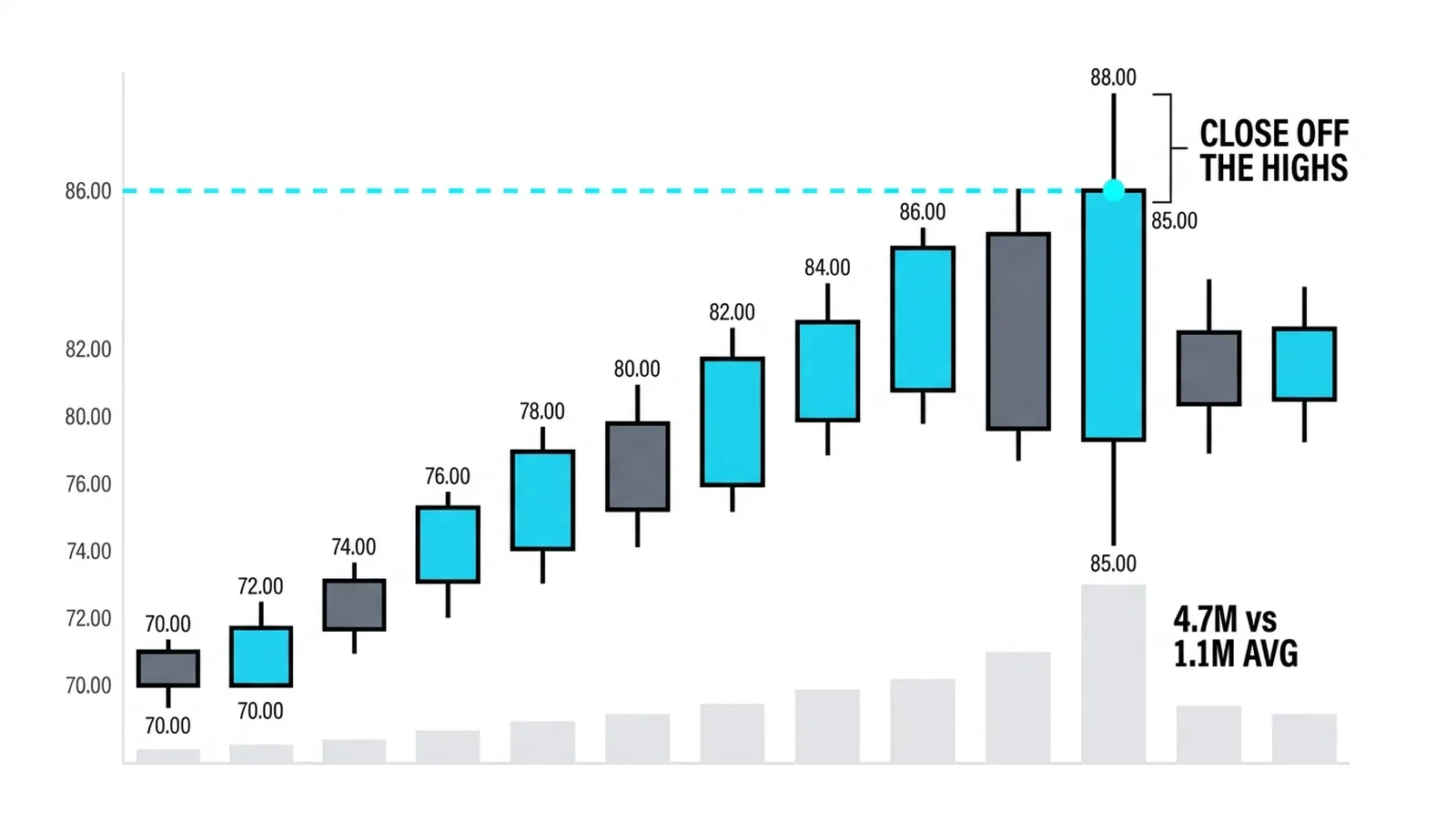
The trader who buys the breakout on the third heavy-volume attempt is usually buying from someone who has been waiting for exactly that buyer.
Selling Climax at the Bottom
The mirror image fires at the end of a long decline. Holders who endured weeks of losses finally give up all at once. Panic selling hits the tape on enormous volume, the spread blows wide to the downside, and then the close recovers off the lows, leaving a deep lower wick.
Strong hands absorb that panic. Someone has to buy every share the crowd dumps, and at the bottom of a trend the willing buyers are usually the informed ones. The recovered close is the evidence that absorption happened in real time.
Like its twin at the top, a selling climax often repeats. Two or three heavy-volume flushes into the same zone, each closing off the lows, is the signature of large players accumulating without letting price run away from them.
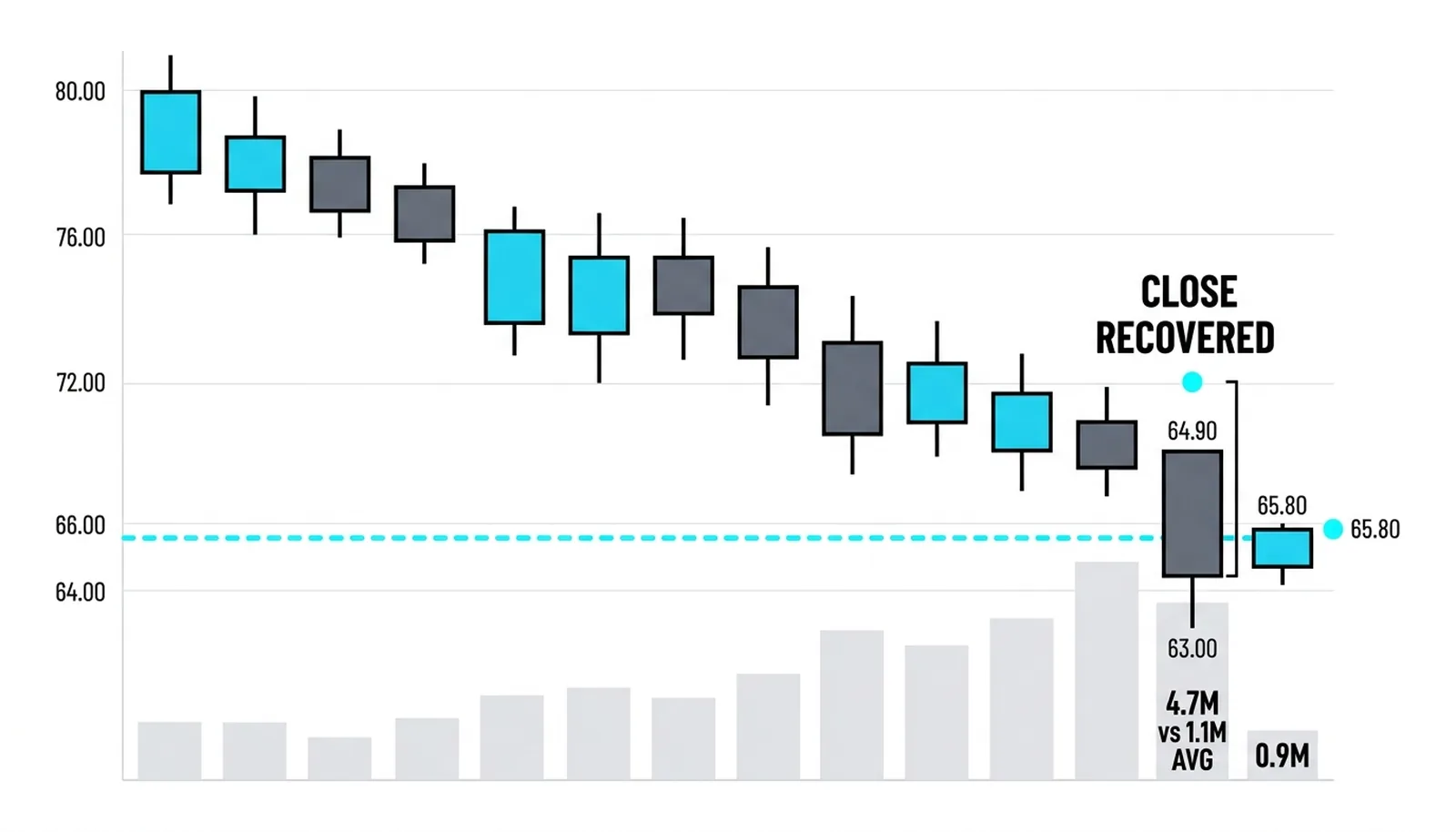
The emotional read is simple. The public sells because they cannot take another day of pain. The absorber buys precisely because that pain is being sold at a discount.
A Climax Is a Warning, Not a Signal
Climaxes rarely reverse the market on the spot. Treat the bar itself as a flare, not an entry.
The usual sequence runs in three steps. First the climax bar. Then an automatic rally or reaction, a sharp counter-move as the exhausted side stops pressing and the other side probes. Then a secondary test, where price returns toward the climax extreme. The volume on that test is the verdict. If the test arrives on clearly shrinking volume and holds, the absorption is confirmed: the supply or demand that caused the climax is gone. If the test arrives on heavy volume again, the move is not finished.
The trader who sells the first climax bar usually sells into strength they misread. The climax tells you to stop, widen your attention, and wait for the test. It does not tell you to reverse your position that afternoon.
Patience here is cheap. The test almost always comes, and it hands you the confirmation with a fraction of the risk of guessing at the climax bar itself.
One Downtrend, One Climax, One Test
Everything below is a hypothetical illustration with invented round numbers.
A stock falls from 90 to 63 over five weeks, with volume rising the whole way down. Then the climax day prints 4.7 million shares against a 1.1 million average, a range 3.2 wide, and closes at 64.9, in the upper third of the bar. Extreme effort, extreme spread, close well off the low. All three signatures.
The next two sessions rally on 0.9 and 0.8 million shares. That is the automatic reaction: the sellers are spent, so even modest buying lifts price. Three sessions later, price retests 63.2 on just 0.5 million shares and holds. The low-volume test, not the climax bar itself, is what turned the reading bullish. The sellers who showed up at 63 with 4.7 million shares could not be found at 63.2 with half a million.
| Phase | Volume signature | What it suggests |
|---|---|---|
| Climax bar | 4.7M vs 1.1M average, wide spread, close off the low | Panic exhausted, strong hands absorbing |
| Automatic reaction | 0.9M then 0.8M, price rising | Selling pressure gone, buyers probing |
| Secondary test | 0.5M at the retest of 63.2, holds | Absorption confirmed, bullish reading |
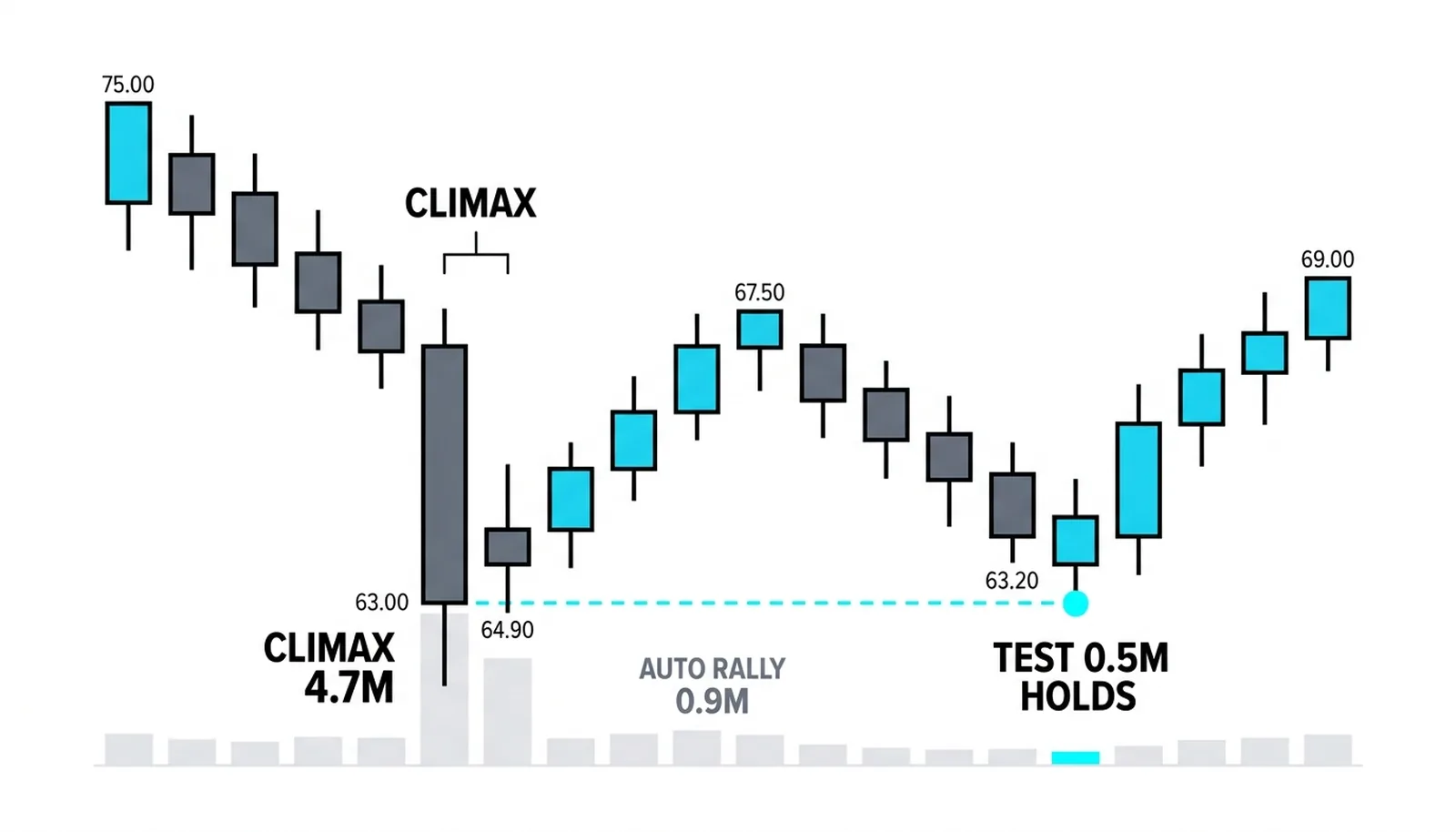
Note the order of operations. The climax bar alone proved nothing. The test proved the supply was gone.
Volume Climaxes, Answered
What is a buying climax in trading?
A buying climax is a bar of extreme volume and wide upward spread at the top of an extended uptrend, closing well off its highs. It marks the public's last euphoric rush, which informed sellers use as liquidity to exit. Under Wyckoff naming, it is a warning of distribution, not an invitation to chase.
What is a selling climax?
A selling climax is the mirror pattern at the bottom of a downtrend: enormous volume, a wide downward spread, and a close back off the lows with a deep lower wick. It shows panic sellers being absorbed by strong hands, and it warns that the decline may be nearing exhaustion.
Why do some books flip the climax names?
Authors name the event for different actors. Wyckoff names it for the panicking public, so the buying climax is at the top. Volume price analysis names it for insider activity, so the buying climax is at the bottom where strong hands buy. Both describe the same bars; check the author's convention before applying any description.
Does a volume climax mean the trend reverses immediately?
No. A climax is a warning, not a trigger. The standard sequence is the climax bar, an automatic counter-move, then a secondary test, and only the low volume on that test confirms the reversal. Acting on the climax bar alone means acting on the least reliable bar in the sequence.
Next in this level, the phase lessons take these climax events and place them inside the full Wyckoff cycle, showing how climaxes, tests, and trading ranges connect into one continuous story of accumulation and distribution.