A Complete Volume-Based Market Read
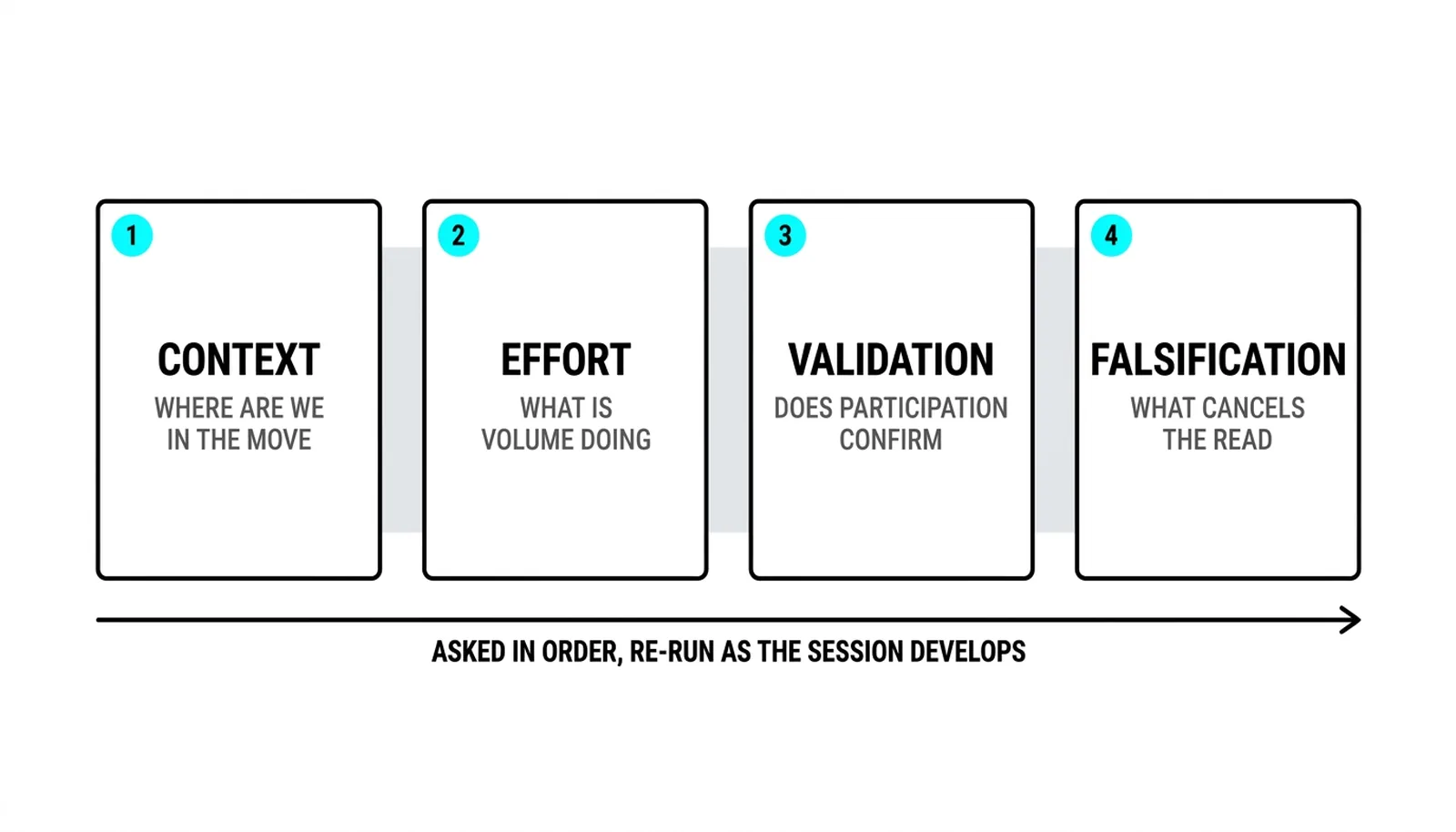
A volume-based market read is the full frame this block has been building toward: one pass through a session that asks four questions in order. What is the context. What is the effort. Is the price action validated or an anomaly. And what would change my mind. The pieces are simple. The read is the discipline of asking them together, in that sequence, every time.

Earlier lessons supplied each piece on its own: validation and anomaly, breakout confirmation, reversal confirmation, false breakout detection. This lesson assembles them into one repeatable pass. An orchestra makes the point: each instrument checked alone is just tuning, and the music only exists when every part is read together off one score. Volume price analysis builds an entire methodology on this principle, price and volume read as one story rather than two separate feeds.
The Four Questions
Context comes first. Where is price in its trend, at a level, inside value. This question frames everything after it, because the same volume print validates in one place and warns in another. Heavy volume into a breakout at range resistance means something different from heavy volume into the middle of nowhere. Skip this question and the other three lose their meaning.
Effort comes second. Is current volume heavy, average, or dry against the recent past. Not against a textbook standard, against what this market has actually been doing over recent sessions. A print that looks modest on a quiet contract can be enormous on a normally thin one. Effort is always relative.
Validation comes third. Does the price action match the effort. The confirming patterns are expansions behind moves and dry pullbacks against them. The anomaly signs are the mirror image: new highs on fading volume, climactic bars closing off their extreme, breaks that nobody joined. This is where the earlier lessons plug in. Breakout confirmation and false breakout detection are all just this third question asked at specific locations.
Falsification comes fourth. What specific event would cancel the read. A close back inside the range. A reclaim of the level on expanding volume. A climax that gets absorbed and ignored. Write it down before the position goes on, not after. A read without a cancellation condition is an opinion, and opinions get defended long after they should be dropped.
One Session, Read Twice
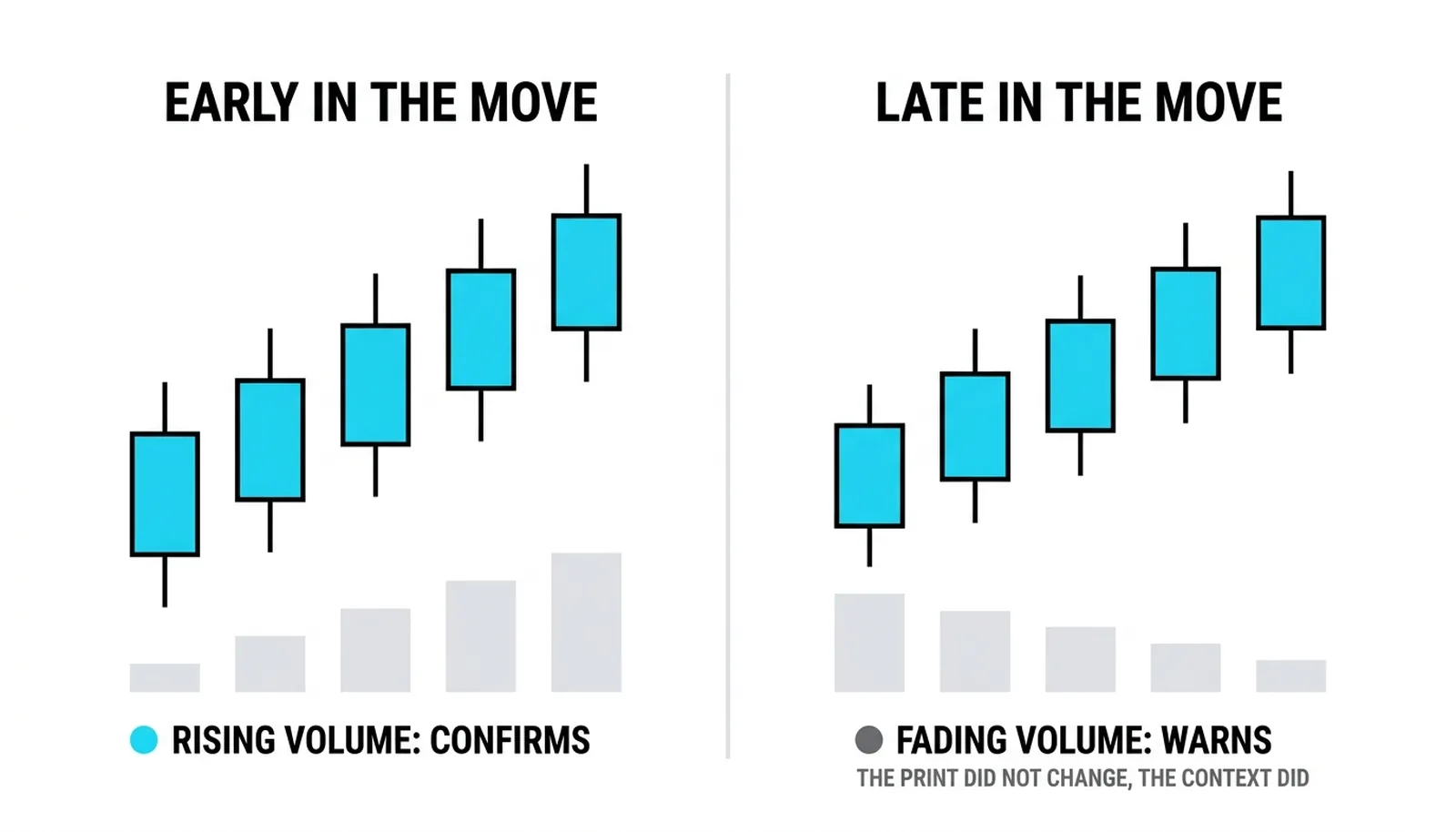
The same print can validate early in a move and warn late in it. Heavy volume on an expansion off a fresh base confirms participation. The identical volume signature three pushes later, at an extended price, often marks exhaustion instead. The print did not change. The context did.
This is why the four questions run in order and why context leads. A trader who jumps straight to effort sees heavy volume and calls it strength. A trader who asks context first notices the move is old, the level is far behind, and the expansion is arriving late to its own party.
The practical habit is to re-ask the questions at natural checkpoints: after a breakout resolves, after a pullback completes, after any climactic bar. Each checkpoint is a fresh pass, not a continuation of the old one. What validated an hour ago earns nothing now.
The Read Expires
A volume-based read is a bias with an expiry, never a prediction. It says: given the context, the effort, and the match between them, one side currently has the better case. It says nothing about next week.
Two cautions keep this honest. First, the read is a probability statement, not a forecast. A validated trend can still end without warning. That is exactly why the falsification event gets written down before entry, while judgment is calm, instead of improvised mid-trade when the trader is emotionally invested in being right.
Second, more indicators do not improve the read. The block's tools already answer the four questions. Stacking additional signals on top usually builds a story the reader wants to tell rather than a clearer picture of the market. The discipline is fewer inputs, asked in the same order, every single time. The reality is that consistency of process beats richness of inputs.
As the session develops, the read gets re-asked. New volume prints arrive, context shifts, and yesterday's answer expires. Treating a morning read as still binding in the afternoon is how traders hold losers that the tape already told them to leave.
One Morning, Two Reads
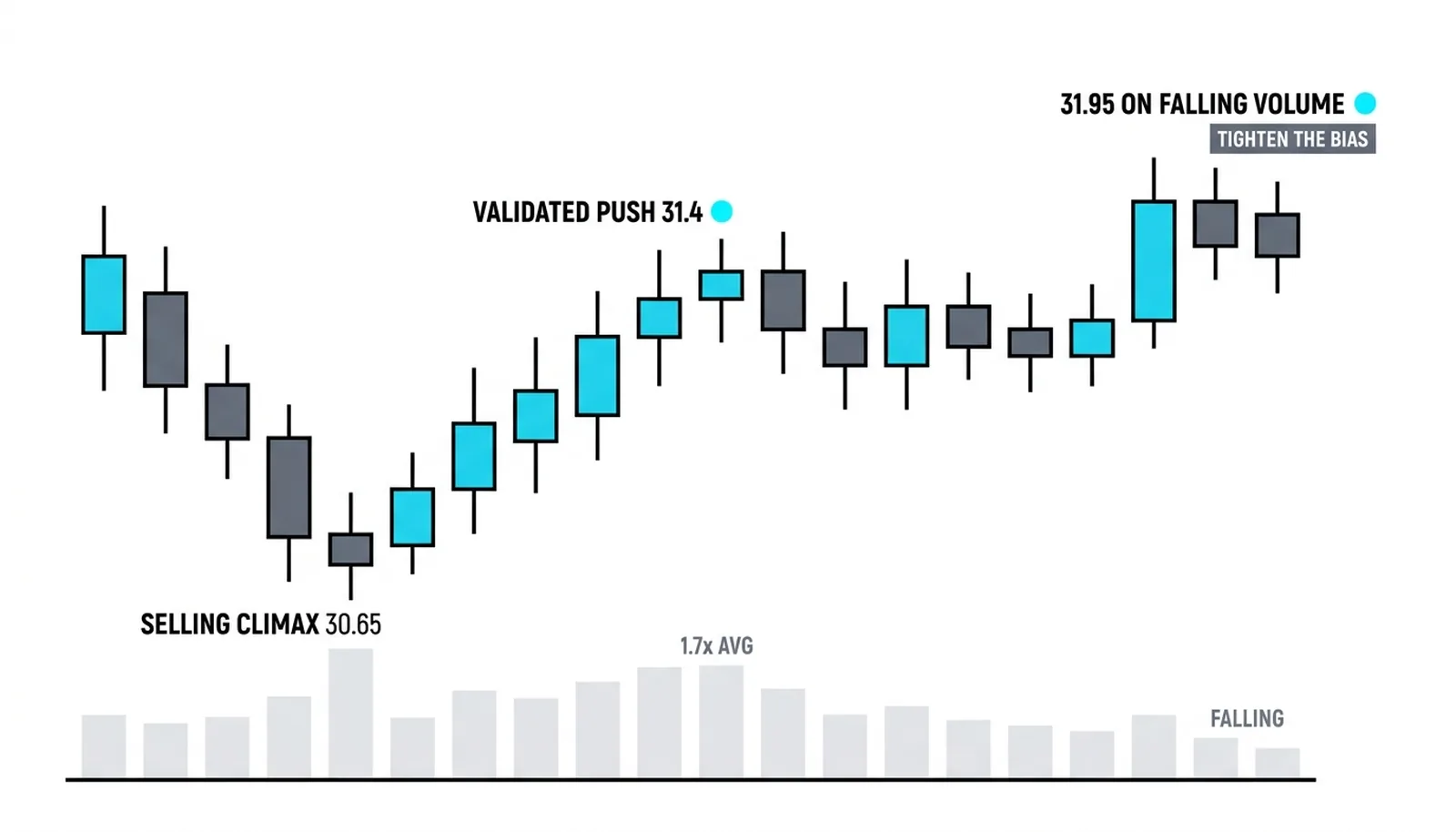
A hypothetical futures session, all numbers invented for illustration. The contract opens at 31.20 and sells hard to 30.65 on the heaviest volume of the morning, a selling climax. That bar is a selling climax: huge effort, and the close comes off the low. Context: price has reached a level. Effort: extreme. Validation: the close off the extreme is an anomaly against the selling, a first hint of absorption.
From there, price bases between 30.70 and 30.90 on drying volume. Sellers who were so forceful an hour ago cannot push through a shallow shelf. The read forms: the climax was exhaustion, the base is absorption, and the bias flips constructive.
The push to 31.40 arrives on 1.7 times average volume and holds. That is validation. The long bias is confirmed, with a stop under 30.65 and the falsification written down in advance: a close back below 30.90 on expanding volume cancels the read.
Midday, price drifts back to 31.20 on shrinking volume while 31.10 holds. A dry pullback against a validated advance. The read stands.
The afternoon pushes to 31.95, but this time on falling volume. New high, fading effort. That is the anomaly, and it triggers the second full read of the same session. The same expansion that validated the morning is now absent. The response is mechanical: partial off, stop tightened, falsification level raised. Nothing about the morning read was wrong. It simply expired.
| Question | Asked in the Morning | Asked in the Afternoon | What Changed |
|---|---|---|---|
| Context | Price at a fresh low after a climax, basing | Price extended, far above the base | Location shifted from cheap to stretched |
| Effort | Climactic volume, then dry base, then 1.7x expansion | Falling volume on the push to 31.95 | Participation faded as price rose |
| Validation | Expansion confirmed the move off the base | New high without effort, an anomaly | Price and volume stopped agreeing |
| Falsification | Close below 30.90 on expanding volume | Stop raised, partial taken, tighter cancel level | The bias tightened with the evidence |
Notice what the table shows. Three of the four answers changed between morning and afternoon while price kept rising. A trader reading price alone saw strength all day. A trader running the four questions saw strength, then caution, and acted on each in turn.
The Complete Read, Answered
What is a volume-based market read?
It is one structured pass through a session using four questions in a fixed order: context, effort, validation, and falsification. The output is a directional bias with a written cancellation condition, produced from price and volume together rather than from either alone.
What are the four questions of a volume read?
Context: where price sits in its trend and relative to levels. Effort: whether current volume is heavy, average, or dry against the recent past. Validation: whether price action matches that effort or contradicts it. Falsification: the specific event that would cancel the read, written before entry.
How often should a market read be updated?
At every natural checkpoint: after a breakout resolves, after a pullback completes, and after any climactic bar. Each checkpoint is a fresh pass through all four questions, because the previous read expires as new volume prints arrive.
Does a volume read replace price action?
No. Volume is the confirmation layer, and price remains the subject being confirmed. The read asks whether the effort behind a move supports the move itself, so it needs the price action first in order to have anything to judge.
The next block takes this same effort-and-acceptance thinking to a specific reference line: VWAP, the volume-weighted average price, where the session's own participation draws the level that price keeps having to answer to.