Reversal Confirmation Using Volume
Confirmation is what turns a warning at the top into a trade, and volume provides it in two distinct pieces. The first piece is the climactic effort that marks the extreme: the heaviest bar of the entire move, closing off its high, telling you someone is paying any price and getting nothing for it. The second piece is the follow-through: a real break of structure on expanding volume that proves the other side has taken control. Either piece alone is a hint. The pair is a signal.

Think of a spinning top beginning to wobble: the wobble shows momentum dying while the top is still upright, and the reversal's early warnings work the same way, visible before the fall, decisive only after it. Traders lose money at tops in one of two ways. They short the first warning and get squeezed by the last push. Or they wait for everything, and enter after the move is half done. The two-piece sequence fixes both errors by giving each piece a job.
The order flow block read exhaustion and absorption at the extremes through the tape. This lesson reads the same events on the volume chart, which is where most traders actually watch. The events are identical. Only the instrument changes.
The Warning Piece
The warning is climactic volume at the extreme. After a sustained advance, one bar prints the heaviest volume of the whole move and closes well off its high. That is effort without result. Enormous participation, minimal progress. At a top, this is the classic buying climax: buyers paying up aggressively, and price refusing to reward them.
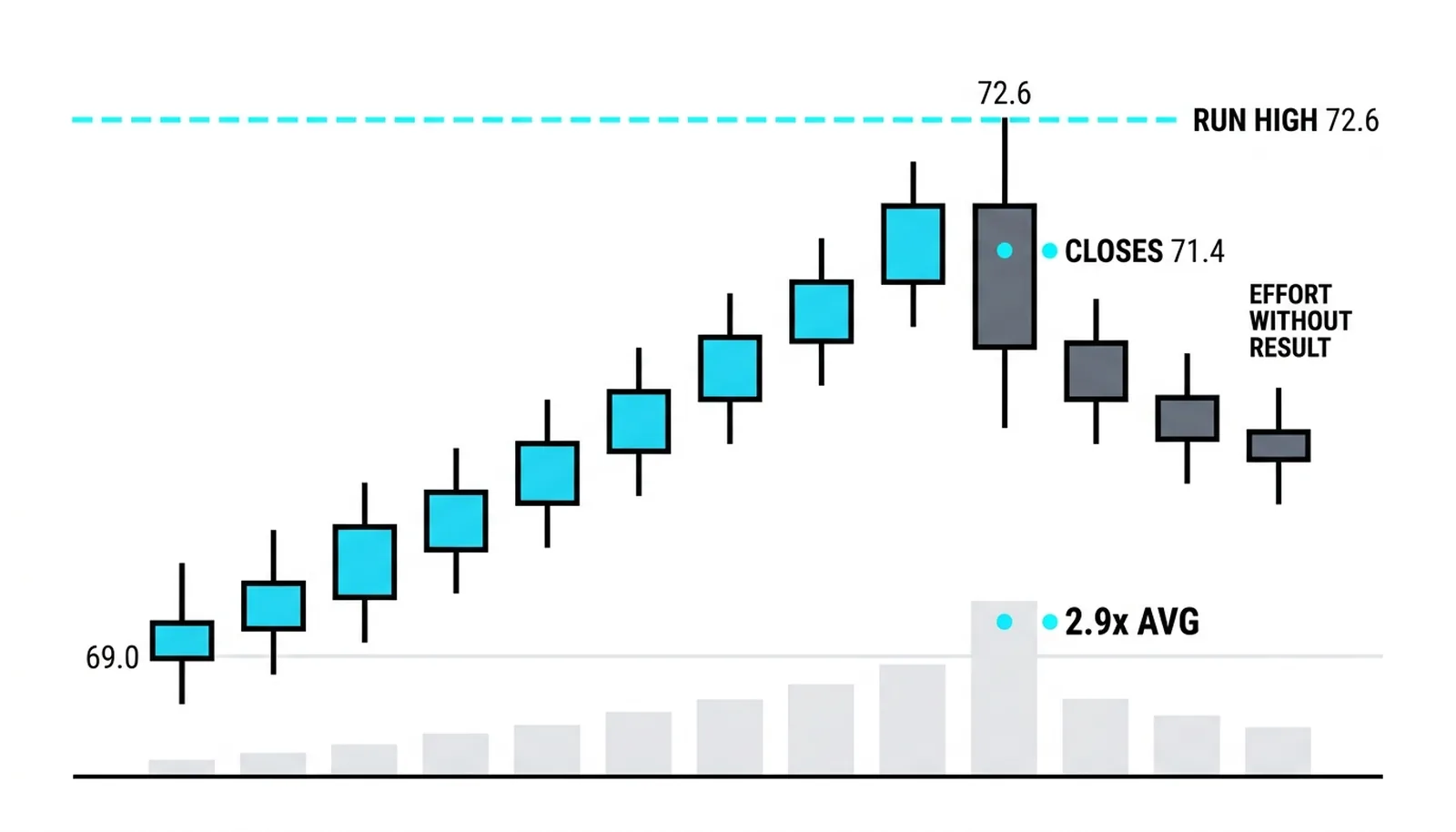
The vocabulary of volume price analysis applies directly here, the climax family describing exactly this condition. The lesson's canon stays the course's canon: buying climaxes mark tops, selling climaxes mark bottoms. The mirror image at a low is the heaviest bar of a decline closing well off its low, sellers dumping everything and price refusing to fall further.
Read the anatomy carefully. Volume at two or three times the recent average. A wide range that fails to hold its upper half. A close in the lower portion of the bar. Every one of those details says the same thing: supply met demand at the extreme and won the exchange. The buyers were there in force. So were the sellers, and the sellers had more to give.
Warnings can stack for bars while the top holds. A climax bar, then a churning bar, then a narrow bar on falling volume near the high. Each one adds evidence that momentum is dying. None of them starts the fall. That distinction is the discipline of this lesson, and it deserves its own section below.
The Proof Piece
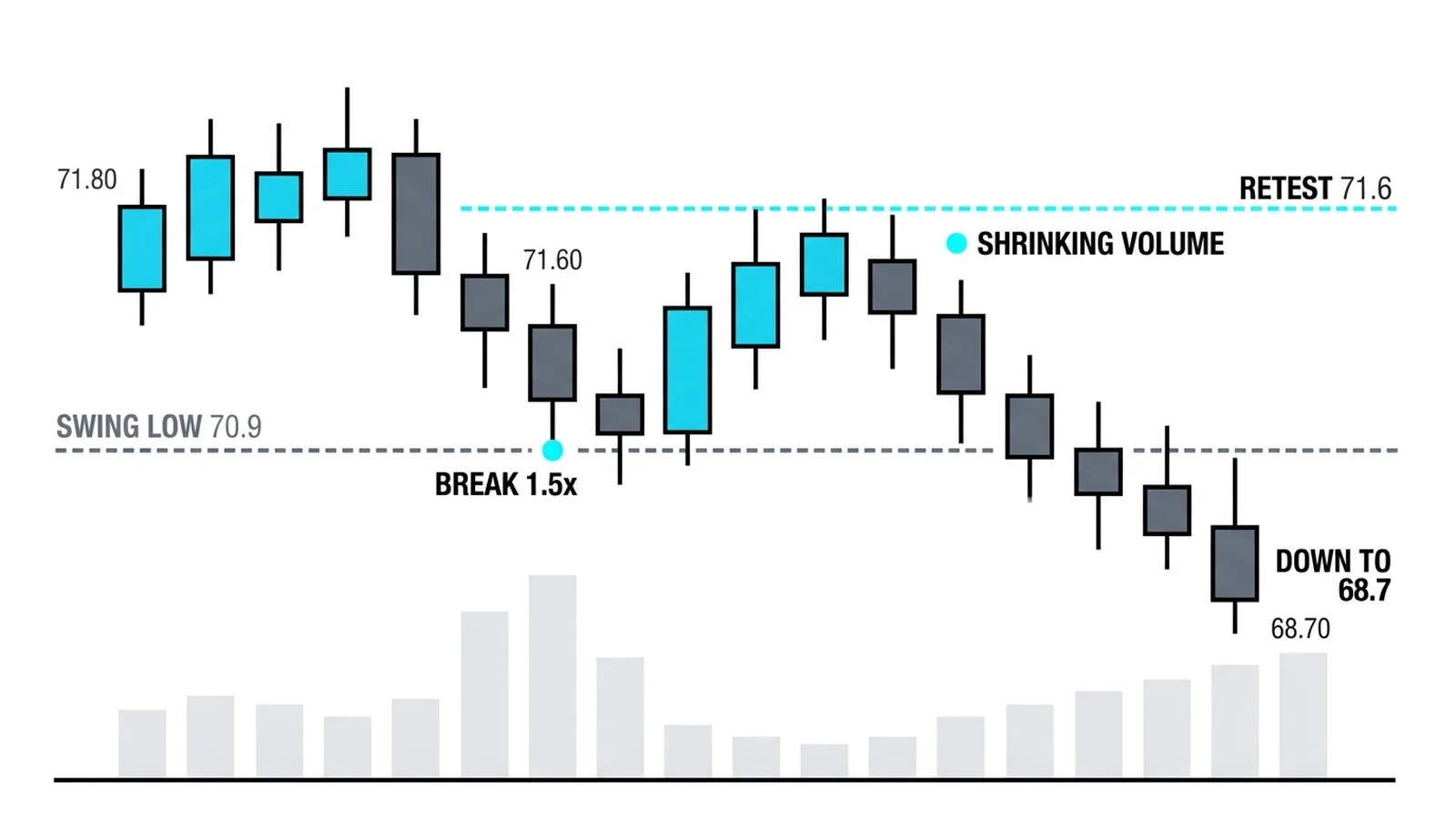
The proof is follow-through: price breaking a real structure level on expanding volume. Under a top, the level that matters is the prior swing low, the last pullback low the advance was built on. When price breaks that low on volume that expands versus the recent average, the warning stops being a warning. The other side has demonstrated control with participation behind it.
Then comes the retest, and the retest is what separates a confirmed reversal from a coin flip. After the break, price pulls back toward the broken level from below. A healthy retest arrives on shrinking volume, stalls under the old support, and cannot get back above it. The old floor becomes the new ceiling, and the failure of the retest confirms the break was real.
The sequence has a strict order. Climax first, break second, failed retest third. Each step answers a question the previous one raised. The climax asks whether the move is exhausted. The break answers that sellers are in control. The failed retest answers that buyers cannot take it back. Three questions, three answers, one trade.
Volume behavior at each step is the common thread. Expanding on the climax, expanding on the break, shrinking on the retest. If the retest arrives on rising volume and pushes back through the level, the read is wrong and the position thesis dies with it.
Why the Climax Bar Is Not the Entry
Climactic volume marks the extreme, not the entry. Shorting the heaviest bar of a parabolic run is the fastest way to get squeezed. The climax tells you someone is paying any price, and a market where someone pays any price can run further than any account can stand. The final vertical leg of a move is often the most violent part of it, and it happens after the first climax bar, not before.
The discipline is sequence discipline. The warning piece puts the market on watch. The proof piece puts you in the trade. Skipping the proof because the warning looked dramatic is how traders donate money to the last leg of trends. Patience through the stacking warnings is a skill, and it is cheaper than the alternative.
The second caution runs the other direction. The follow-through break can itself be the trap. A violent break of the swing low on heavy volume that reverses by the close is the engineered break the earlier false-breakout material describes, a flush designed to trigger stops and load positions. This is why the confirmation is the break plus the failed retest, never the break alone. A break that cannot survive its own retest was liquidity, not conviction.
The Top at 72.60
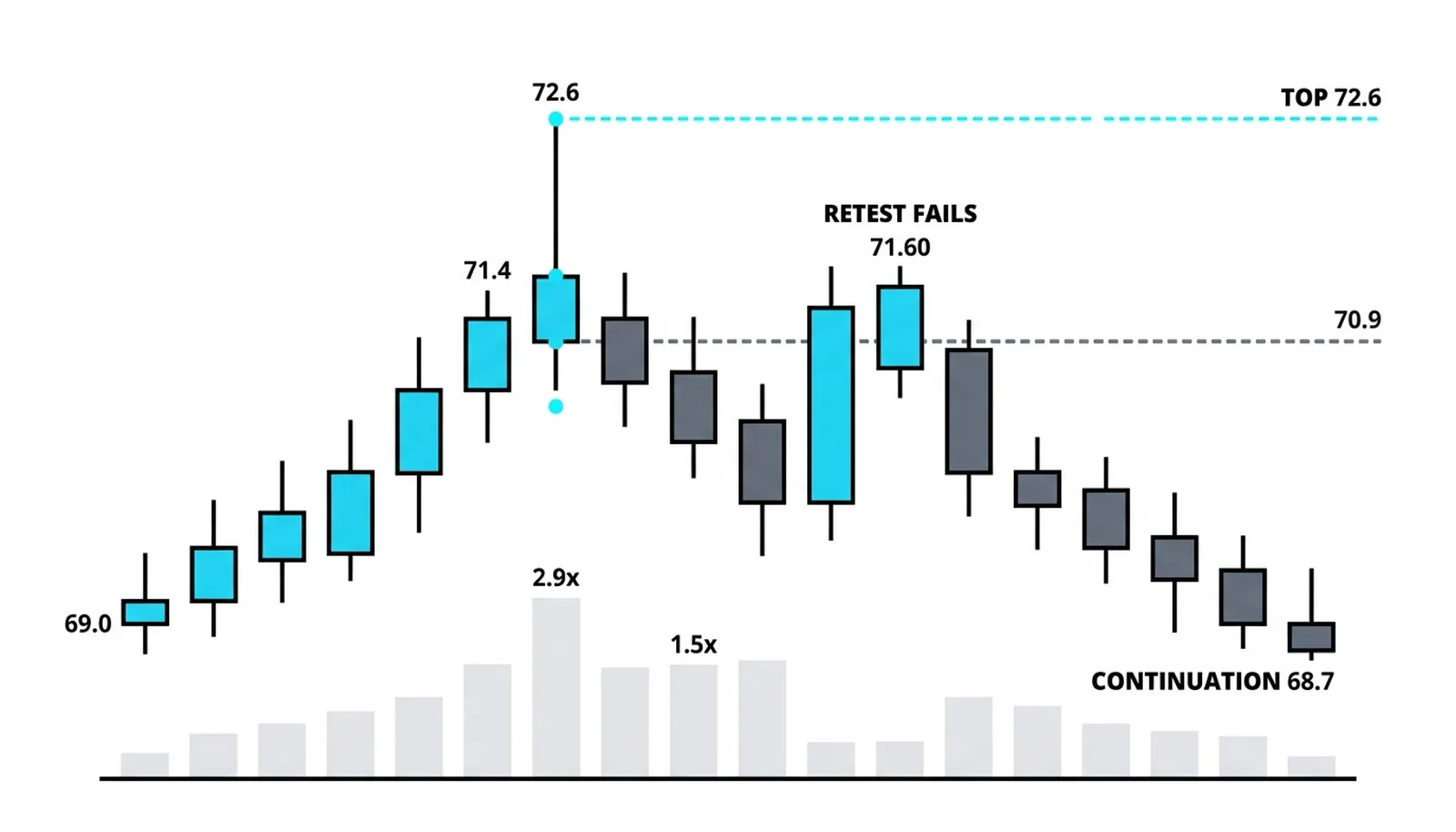
All numbers here are hypothetical and invented for illustration. A stock runs from 66.80 to 72.60 over two weeks, a steady advance with orderly pullbacks. On the final up day, the stock prints volume at 2.9 times its recent average, tags 72.60, and closes at 71.40, deep in the lower half of the bar. Effort without result. The warning is on the chart.
Two bars later, price breaks the prior swing low at 70.90 on volume at 1.5 times average. That is the follow-through: structure broken, participation behind the break. The trader who shorted the climax bar at 71.80 has already been through a squeeze to 72.60. The trader who waited is only now paying attention.
Price then pulls back toward the broken level. The retest reaches 71.60 on shrinking volume, roughly half the volume of the break bar, and stalls. It cannot reclaim 70.90's old floor zone with any force, and it never threatens the high. The failed retest completes the confirmation. The short entry, with a stop above the retest high, is now a structured trade instead of a guess.
Over the following days, price auctions down to 68.70. The full sequence paid: climax, break, failed retest, continuation. Now consider the cancellation case. If price instead closes back above 72.60 on expanding volume, the entire reversal read is void. That close is itself validation of continuation, and the correct response is to abandon the short thesis completely. The same two-piece logic that builds the trade also tears it down.
| Reversal stage | Validating volume | Anomalous volume | The read |
|---|---|---|---|
| Climax at the extreme | Heaviest bar of the move, close off the high | Heavy bar closing at its high | Warning only; watch, do not enter |
| Break of the swing low | Volume expands versus recent average | Break on thin, drifting volume | Proof begins; control has shifted |
| Retest of the broken level | Shrinking volume, fails below the level | Rising volume, reclaims the level | Confirmation complete, or thesis void |
| Close back above the high | Expanding volume through 72.60 | Not applicable | Reversal cancelled; continuation validated |
Reversal Confirmation, Answered
What is reversal confirmation?
Reversal confirmation is the proof piece that follows the warning: price breaking a real structure level on expanding volume, then failing the retest of that broken level. The climax bar says the move is exhausted. Confirmation says the other side has taken control and held it.
Does high volume at a top always mean reversal?
No. High volume at a top is a warning, not a verdict. A climax bar can be absorbed, and price can push higher for several bars afterward. Only the subsequent break of structure on volume turns the warning into a signal.
What is follow-through in a reversal?
Follow-through is price doing something with the warning: breaking the prior swing low under a top, or the prior swing high above a bottom, on volume that expands versus the recent average. It is the market demonstrating new control with participation behind the move.
How do you avoid shorting the climax bar?
Refuse to treat the warning as the entry. Mark the climax bar, define the swing low that must break, and wait for the break plus the failed retest. The trade starts when structure breaks, and the climax bar's only job is to put the market on your watchlist.
The next lesson applies the same volume test to the push that fails: false breakouts, where the missing expansion is the tell and the failure itself becomes the trade.