VWAP as a Volume-Weighted Value Reference
The volume-weighted average price is the session's average trade price, every transaction counted by its typical price and weighted by how much size actually traded there. It answers one question cleanly: what did the average participant in this session actually pay. That single answer is why the line matters. Execution desks at institutions are graded against it, so the level is watched, defended, and argued with all day.

Think of a credit score. One large payment never defines it; the weighted history of everything paid does. VWAP is the session's version of that score, a running verdict on where the day's business was truly transacted rather than where price briefly visited. An earlier lesson introduced VWAP as a benchmark on the chart; this deep-dive owns why it earns the role of value.
How the Number Is Built
The construction is simple arithmetic repeated all session. For each trade or bar, take the typical price: high plus low plus close, divided by three. Multiply that typical price by the volume traded. Keep a cumulative sum of those products, and divide it by the cumulative volume so far. That quotient is VWAP at any moment in the day.
The reset is the defining feature. VWAP starts from nothing at each session open. The first trade of the day is the only input; by midday, thousands of prints have been absorbed. Early in the session the line is jumpy because a few prints dominate it. As data accumulates, it stabilizes and sharpens, which is why seasoned intraday readers trust the afternoon VWAP more than the 9:35 version.
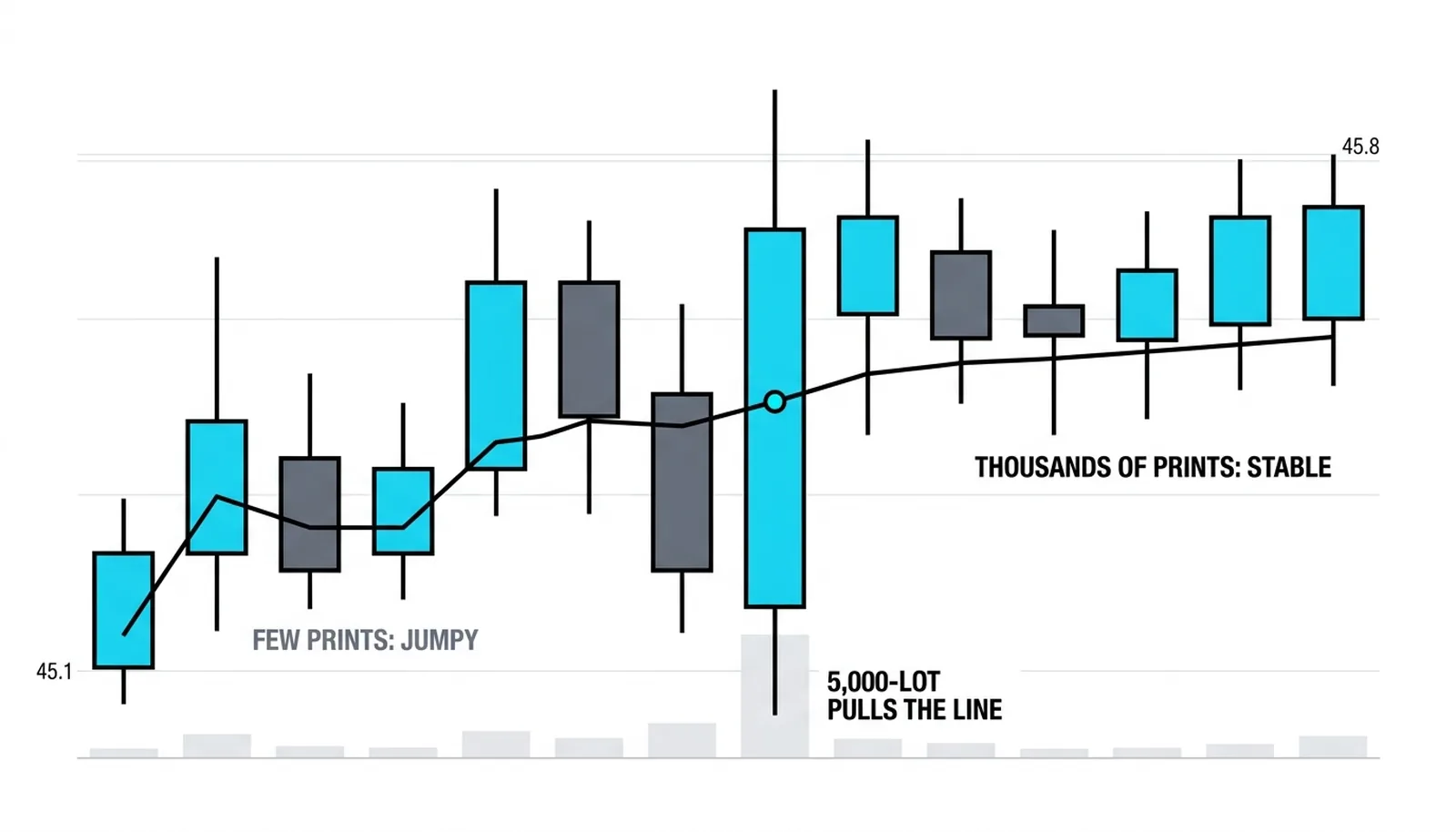
The volume weighting is the point of the formula. A 5,000-lot print at one price moves VWAP far more than fifty separate 100-lot prints scattered elsewhere. VWAP measures where business actually happened, not where price merely ticked. A thin spike to a new high on a handful of shares barely dents the line, while a heavy block at an unremarkable price bends it.
Two cautions belong here. First, VWAP is a session construct. It resets to zero every open, so yesterday's VWAP is a different tool entirely, and the weekly, monthly, and anchored forms get their own lessons later in this block. Second, order flow analysis skips VWAP on the grounds that it generalizes too much, and the objection has teeth where volume is thin or the session is one-sided. Treat VWAP as one reference among the tools, never a verdict on its own.
Why Institutions Argue With It
Execution desks are graded against session VWAP. A desk ordered to buy during the day wants fills below the session's volume-weighted average, because buying below it means beating the average participant. A desk ordered to sell wants fills above it. Paying above VWAP on a buy order is recorded as underperformance, and that record follows the desk.
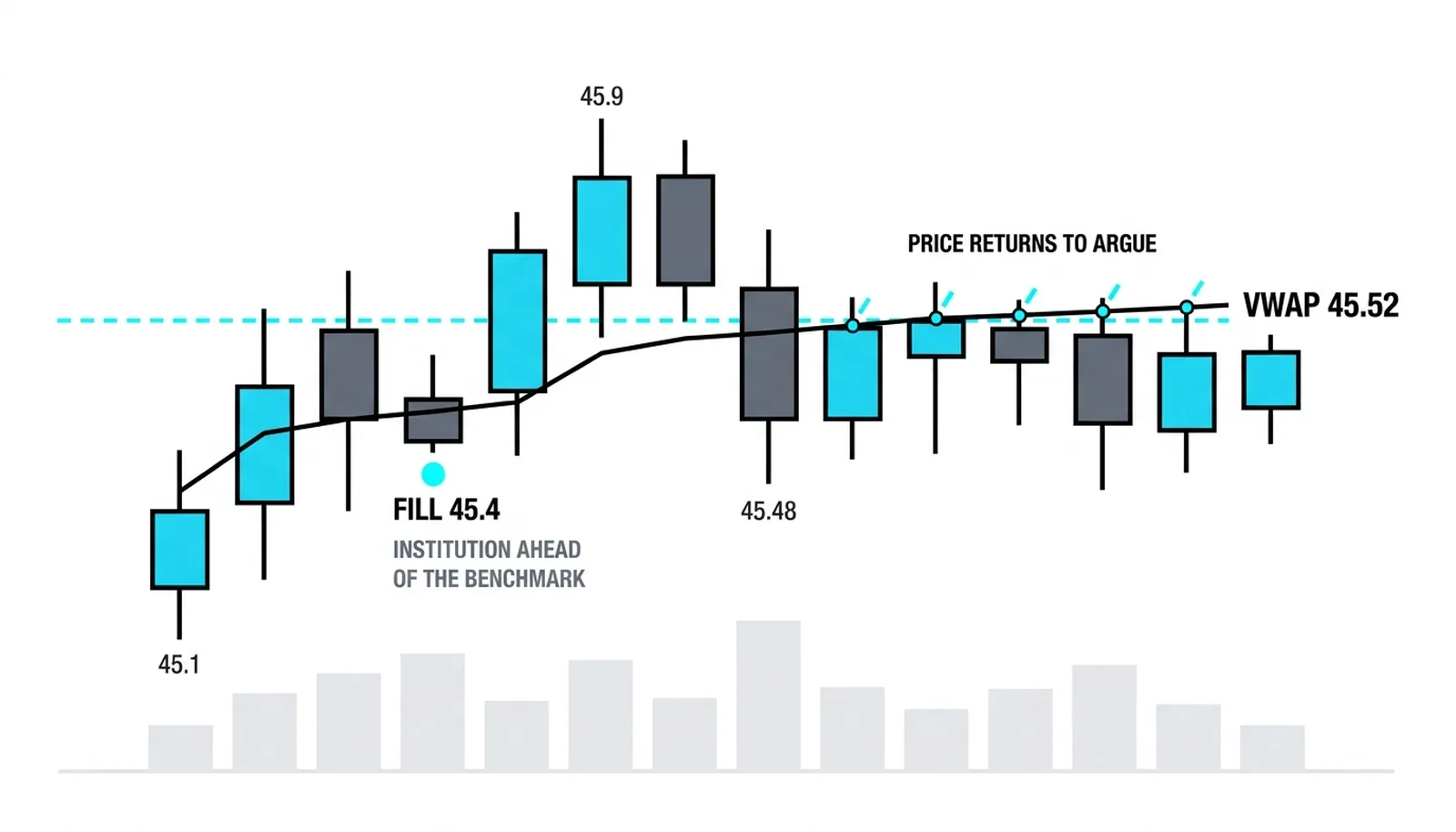
This grading creates real behavior at the line. When price dips to VWAP in an uptrend, buy programs that are behind schedule see a chance to fill at or better than the benchmark. Their orders cluster there. The level gets defended not by tradition or mystique but by desks with a measurable incentive to transact at that price.
The same logic explains the tests from above. A rally that stretches far above VWAP leaves late buyers paying a premium over the day's average. Some of them fold on the first pullback, and the pullback often runs until it finds the benchmark, where the grading math flips back in favor of the buyers. Price keeps returning to argue with the line because the line is where the day's verdict gets written.
Volume price analysis frames the same idea from the other side: price alone is an opinion, but price confirmed by volume is where commitment actually sits. VWAP is that principle compressed into one number.
What Value Means Here
Value, in this lesson, means the price the volume-weighted crowd settled on. It is not the midpoint of the day's high and low, not the open, and not the close. The number that matters is the weighted center of everything that traded.
The distinction matters on lopsided days. Picture a session that opens low, spikes to a dramatic high on thin volume, then spends six hours grinding sideways at a middling price on heavy turnover. The high and low describe the extremes of the range. VWAP sits near that heavy middling zone, because that is where the business happened. A trader reading only the range would misjudge where the day's real agreement lived.
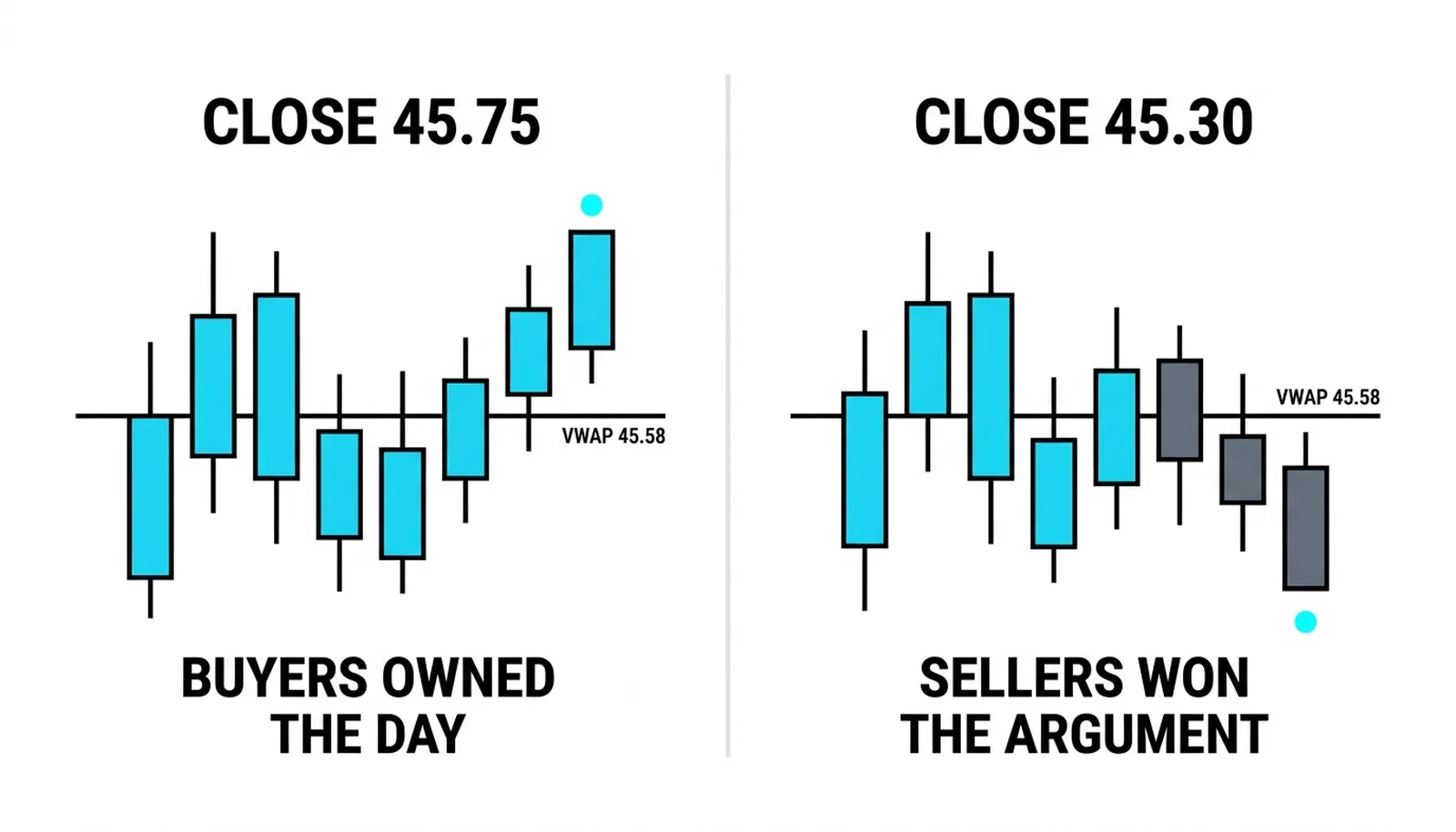
Closing position against VWAP carries the day's verdict. A close above VWAP means the final price beat the average participant's cost, so buyers won the argument. A close below it means sellers did. The read is blunt, and blunt is useful.
None of this makes VWAP a signal by itself. It is a reference, a line against which other evidence is measured. Structure, trend, and the volume patterns from earlier lessons still do the heavy lifting. VWAP tells you where the scale balanced; the rest of the chart tells you what to do about it.
One Session Around 45.50
All numbers here are hypothetical and round, used only to show the mechanics.
A stock opens at 45.10. Buyers push it to 45.90 by mid-morning on heavy volume, and by 11:00 the session VWAP sits at 45.52. An institution working a large buy order has been filling patiently and averages 45.40. That fill beats the benchmark, so the desk is graded as having bought better than the average participant.
In the afternoon the stock pulls back to 45.48, tags the VWAP line, and holds. Desks still behind on their buy programs step in at the benchmark, and the level does its job. The close prints at 45.75 against a final VWAP of 45.58. Buyers owned the day: the close beat the value.
Flip the ending. Suppose the same session closes at 45.30 against that same VWAP of 45.58. The close sits below the volume-weighted value, which says sellers won the argument and the average participant from the day is underwater. Same line, opposite verdict.
| Session phase | Price | VWAP | The read |
|---|---|---|---|
| Open | 45.10 | forming | Too early to trust the line |
| Mid-morning | 45.90 high | 45.52 | Rally stretched above value |
| Afternoon pullback | 45.48 | 45.55 | Tag and hold at the benchmark |
| Close | 45.75 | 45.58 | Close beats value; buyers win |
VWAP as a Value Reference, Answered
What does volume-weighted average price mean?
It is the average price of every trade in the session, with each trade counted in proportion to its size. Large prints pull the average toward their price; small ones barely move it. The result is the price the average participant actually paid, not a simple midpoint of the range.
Why do institutions care about VWAP?
Because execution desks are graded against it. Buying below session VWAP means beating the day's average participant; paying above it counts as underperformance. That grading creates real orders clustered at the line, which is why price so often reacts there.
What is typical price in the VWAP formula?
Typical price is the high plus the low plus the close, divided by three. It stands in for where the bulk of trading likely occurred within each bar. Multiply it by volume, sum the products, divide by cumulative volume, and you have VWAP.
Does VWAP work in illiquid markets?
Poorly. Where volume is thin, a handful of prints dominate the calculation and the line becomes noise rather than a reference. The order flow objection, that VWAP generalizes too much, lands hardest in exactly these conditions. Use it where participation is deep, and lean on other tools where it is not.
The next lesson in this block takes the same line and watches how price behaves around it intraday: the tags, the rejections, and the stretches that snap back. From there, the weekly and monthly forms extend the idea beyond a single session.