Swap and Overnight Fees: What They Cost You
Swap and overnight fees are small charges, sometimes small credits, applied to leveraged positions that stay open past the market's daily cutoff. Each night the amount looks trivial. Over weeks it quietly becomes one of the biggest lines in your cost column, and most new traders never see it coming because it never asks permission.

Think of overnight fees as the parking meter on a leveraged position: the spot trade is cheap to park, but the meter runs all night whether you watch it or not.
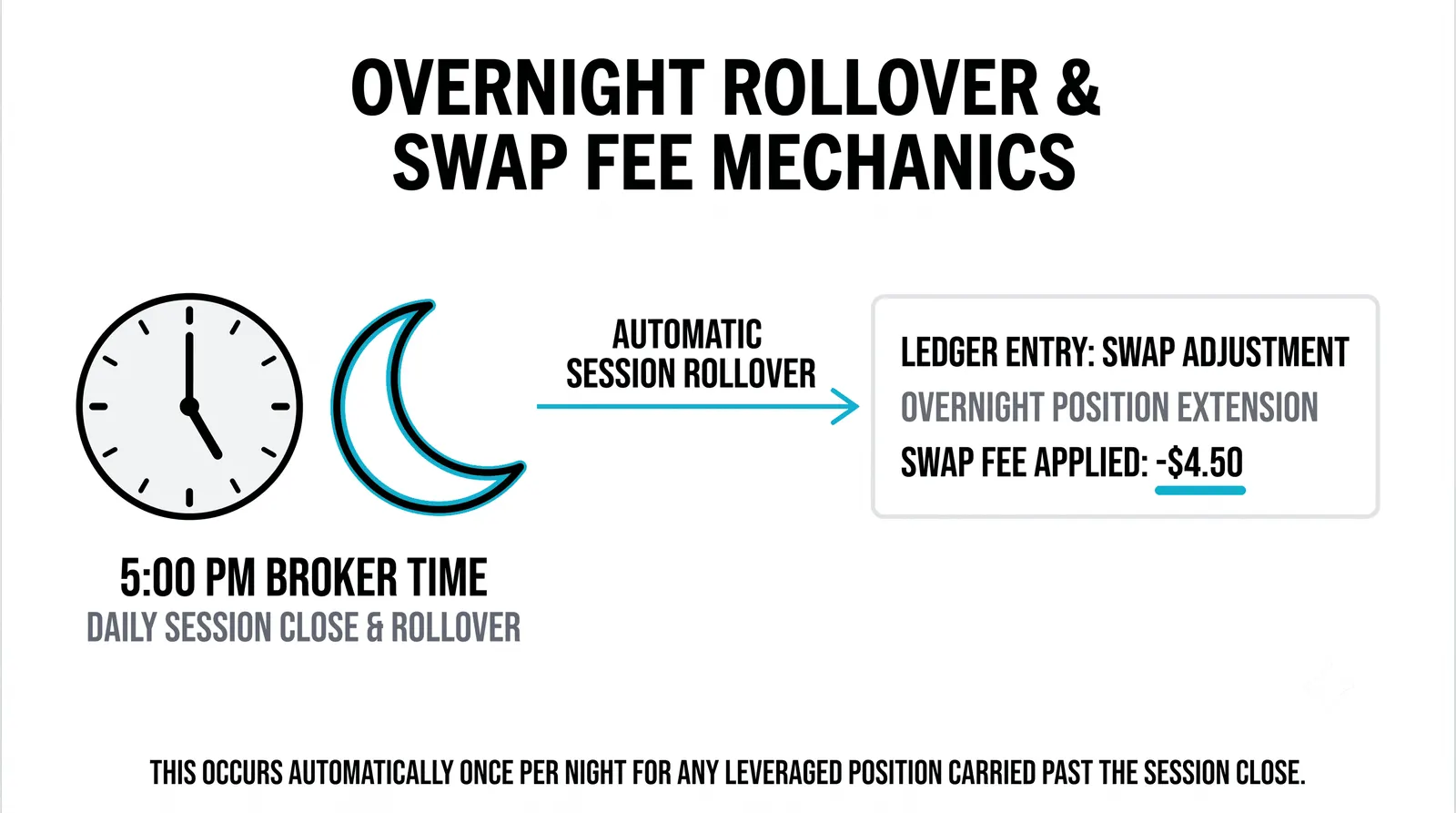
Where the Fee Actually Comes From
When you hold a leveraged position overnight, you effectively hold borrowed money. Your broker funds the bulk of the position, and interest applies to that full notional amount, not just to your margin deposit.
In forex the fee has two sides. You earn interest on the currency you bought and pay interest on the currency you sold. The swap is the difference between the two rates.
That difference can work in your favor. Some positions pay you a small credit each night, called positive swap, because the currency you hold yields more than the one you sold. Most positions, though, charge you.
On CFDs and other margin products the mechanic is simpler. The broker applies a daily financing charge on the full position value, built from a reference rate plus their markup.
What It Costs on Different Instruments
The fee wears different clothes depending on what you trade. Know the mechanism before you pick the instrument.
- CFDs: a daily financing charge on the full position value, applied every night you hold.
- Futures: no nightly financing, but you pay roll costs when you move a position from an expiring contract to the next one.
- Stocks on margin: borrowing interest on the loaned portion of the position, accruing daily.
- Crypto perpetual contracts: funding rates paid or received every few hours between longs and shorts on some platforms.
- Spot forex: the two-sided swap described above, charged or credited at the daily rollover.
Notice the pattern. Anything leveraged and held past the close carries a time cost. The only question is what form it takes.
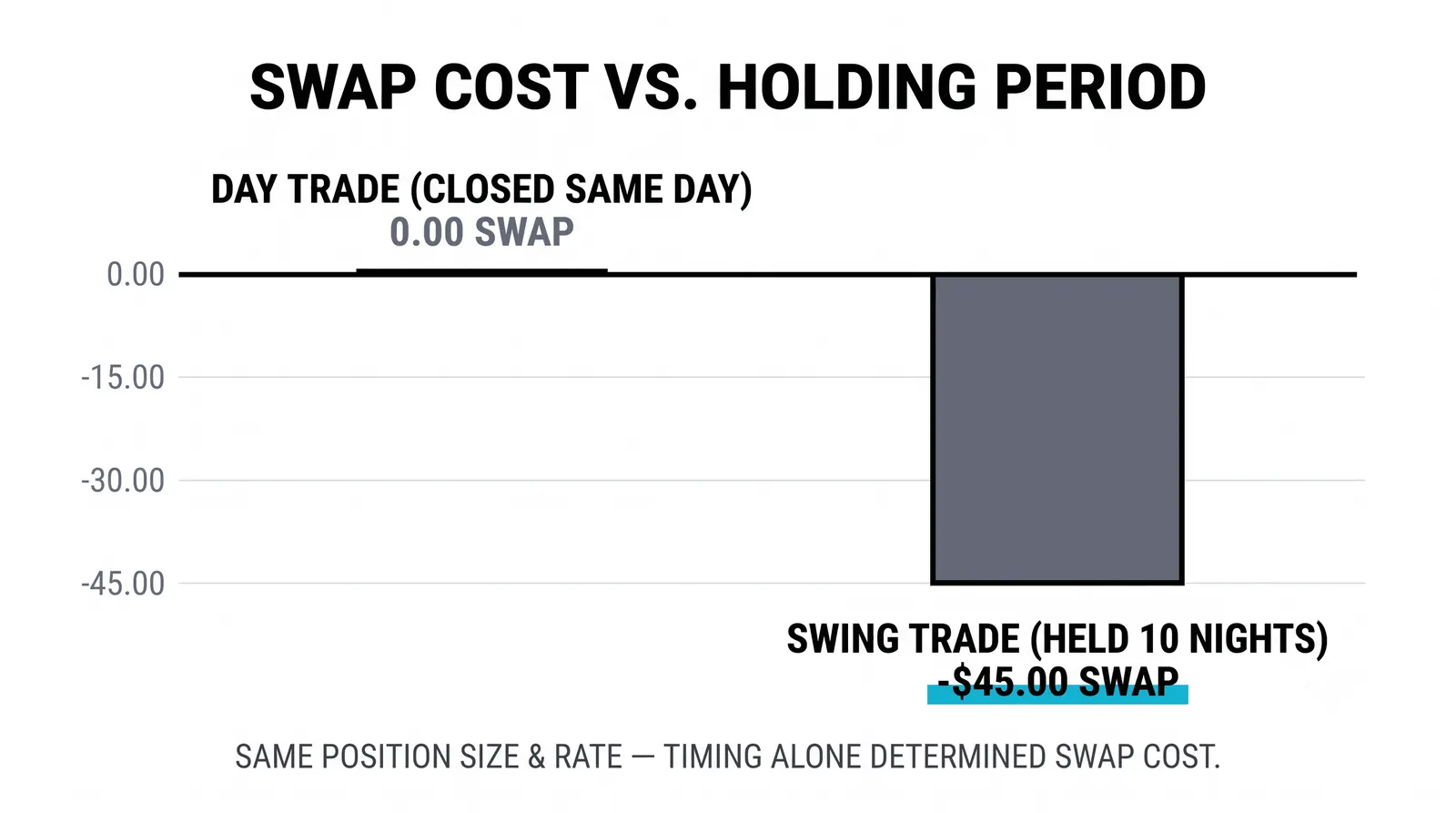
Why It Feels Invisible and Is Not
Each night's fee is small enough to ignore. That is precisely the problem.
The charge hits automatically. No order ticket, no confirmation, no decision point. It just appears in your account history, blended into your profit and loss where a quick glance will never isolate it.
And for the holder of a leveraged long, it runs one way. You pay. Night after night, in flat markets and rising ones.
This is why long-term CFD positions are structurally losing setups regardless of market direction. The instrument was built for short holding periods, and the pricing reflects that.
Costs you never decided to pay are still costs.
A Worked Example With Round Numbers
Here is a hypothetical. Say you hold a 10,000 CFD position that charges 0.01 percent per night.
That is 1 per night. Harmless looking. Hold it for 60 nights and you have paid 60, which is 0.6 percent of the position's value.
Now the uncomfortable part. If the market went nowhere over those 60 nights, your position still lost 60. The fee is a loss in disguise, deducted whether the trade worked or not.
Stretch the holding period and the math scales linearly. Triple the time and the fee quietly triples with it. A trade that needed a 2 percent move to profit now needs 2.6 percent just to break even after costs.
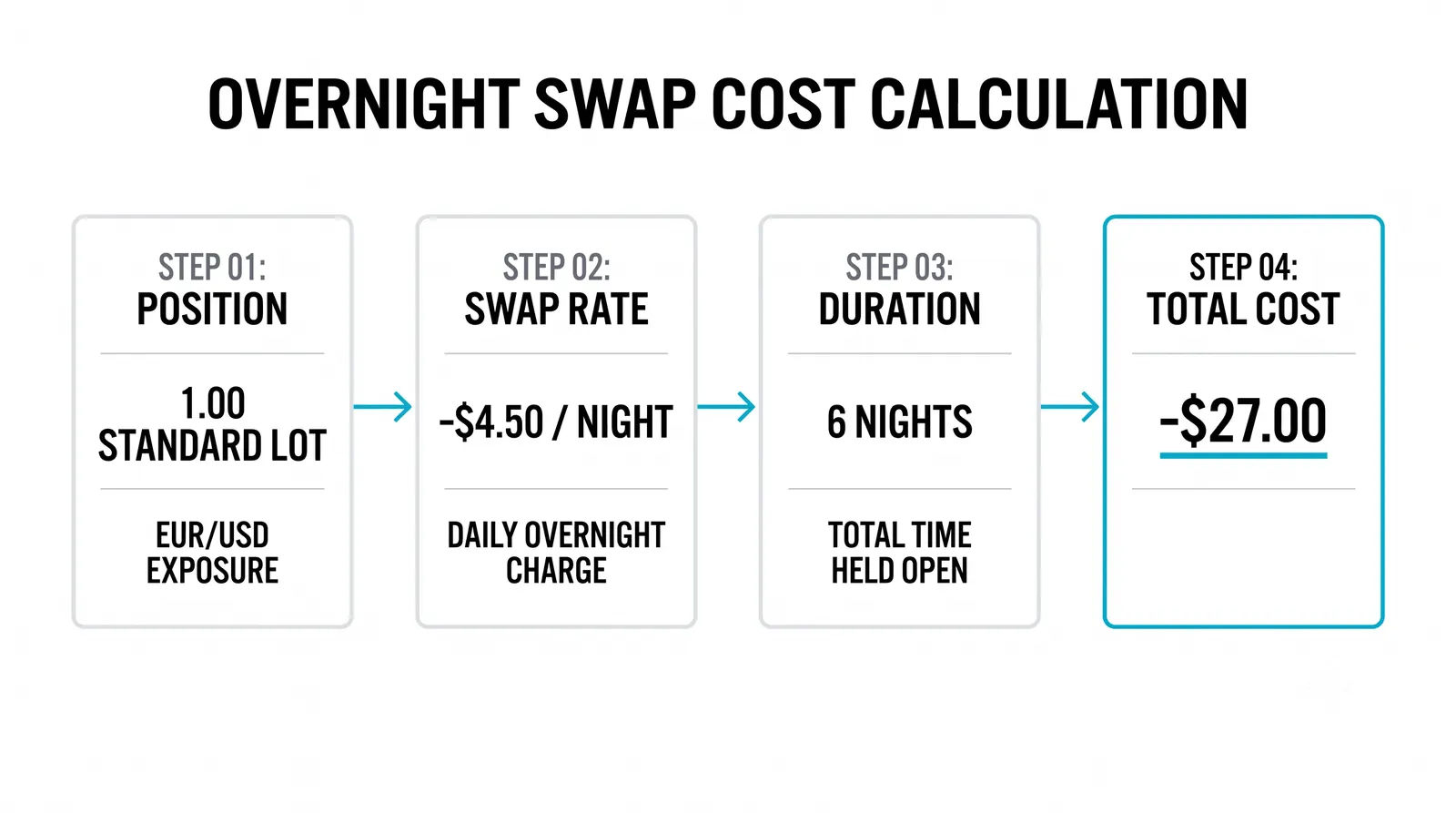
How to Manage It
Match the wrapper to the horizon. That single habit eliminates most of the damage.
- Day trades and short swings: rarely hold long enough to pay meaningful nights. The fee is noise at this horizon.
- Multi-week holds: belong in instruments without nightly financing, such as futures or outright stock purchases, where the time cost is structured differently or absent.
- Any leveraged hold: know your broker's triple-charge day. Many brokers apply three times the fee on one weekday to cover the weekend, so a position held through that day pays for three nights at once.
Check the swap rate before you enter, not after. Every reputable platform publishes it per instrument, and it takes thirty seconds to look.
Instrument by Instrument
| Instrument | Overnight Cost Mechanism | Who Should Hold It Overnight |
|---|---|---|
| CFDs | Daily financing on full position value | Short-term traders, days not months |
| Futures | No nightly fee; roll cost at expiry | Traders holding weeks to months |
| Stocks on margin | Daily borrowing interest on the loan | Traders with a defined short thesis |
| Crypto perpetuals | Funding every few hours, paid or received | Active traders monitoring funding |
| Spot forex | Two-sided swap at daily rollover | Swing traders who check the rate first |
Questions About Swap and Overnight Fees
Why do some swaps pay me instead of charging?
Because in forex you earn interest on the currency you bought and pay interest on the one you sold. When the currency you hold has the higher rate, the difference lands in your account as a small nightly credit. This is the basis of carry-style positioning, though the credit alone is never a reason to enter a trade.
What is triple swap day?
It is the one weekday, commonly Wednesday in forex, when brokers apply three times the normal overnight fee. The extra two nights cover Saturday and Sunday, when markets are closed but the position still exists. Holding through that day costs three nights in one hit.
Do I pay swap on weekend positions?
Yes, but usually through the triple charge rather than nightly deductions. Markets close over the weekend, yet the borrowed money behind your leveraged position does not stop accruing cost. Brokers settle it in advance on the triple-charge day.
How do I check a position's swap before holding it?
Open the instrument's specification or contract details on your platform. Every broker lists the long and short swap rates per instrument, usually in points or as a daily percentage. Check both sides, because the long and short rates often differ, and check again if you plan to hold for weeks since rates can change.
Once you can see the nightly cost clearly, the next step is folding it into position sizing itself, where the fee, the stop distance, and the account risk all meet in one calculation.