Risk Per Trade: How to Define and Control It
Risk per trade is the exact amount of your account you agree to lose on one position if the stop is hit, decided before you enter, and for most retail traders it sits somewhere between half a percent and two percent. That single number controls whether a losing streak is a bad month or the end of your account. Everything else in this lesson follows from it.

What Risk Per Trade Actually Is
Risk per trade is not the margin your broker holds. It is not the value of the position. It is the distance from your entry to your stop, multiplied by your position size. That product, and nothing else, is what a stopped-out trade costs you.
Say you buy at 100 with a stop at 97.5. Your risk per unit is 2.50. If you hold 20 units, your risk per trade is 50. If the stop gets hit, you lose 50, plus a little for costs. The position might be worth 2,000, but 2,000 is not your risk. Your risk is 50.
Think of it as the price of admission you agree to pay before the show starts; deciding it after the show is how people end up paying anything.
Traders who confuse position value with risk make the same error repeatedly. They see a small margin requirement and assume the trade is small. It is not. The stop distance and the size together define the real exposure, and you control both.
Defining Your Number
The standard approach is the percent rule: you risk a fixed fraction of your account on every trade. For most retail traders, that fraction lands between 0.5 and 2 percent. Beginners do better at the low end.
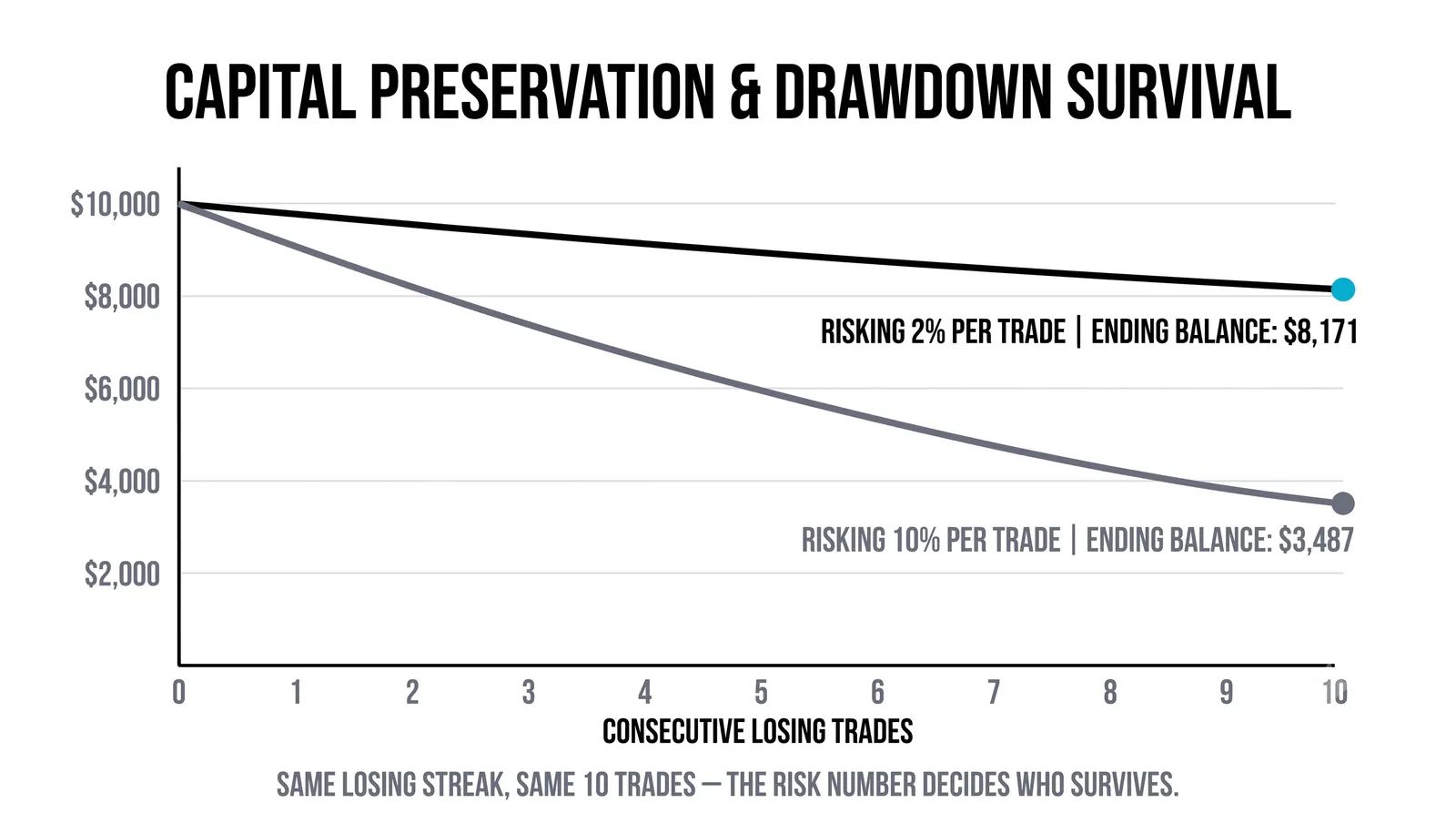
Why so small? Because losing streaks are normal, not exceptional. Any real strategy will produce ten or more consecutive losses at some point. The question is what your account looks like afterward.
At 1 percent risk, twenty straight losses cost you roughly 18 percent of the account. That hurts, but you recover from it with ordinary trading. At 10 percent risk, the same streak removes about 88 percent of the account. You are done.
Small risk is not timid. It is what keeps you in the game long enough for your edge to show up.
Controlling It in Practice
Most new traders get this backwards: position size is the output, not the input. You do not decide to buy 100 shares and then hope the risk works out. You start with the risk and derive the size.
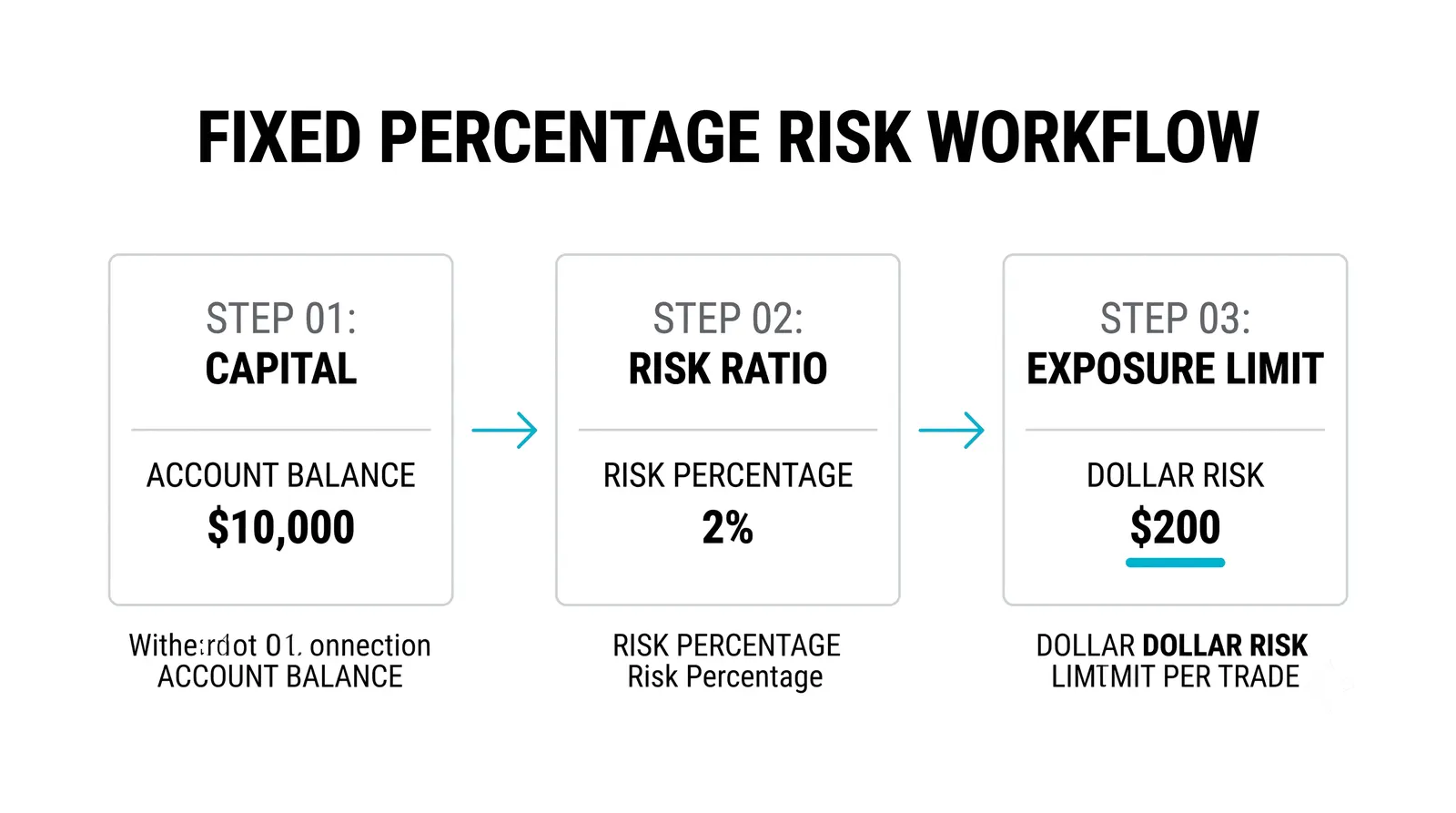
The process has three steps, in this order:
- Define the risk in money. One percent of a 5,000 account is 50.
- Measure the stop distance. Entry minus stop, in price terms.
- Divide. Risk money divided by stop distance equals position size.
The formula is that short. Risk money divided by stop distance equals position size. If the result is bigger than your account can fund, the trade is not for you at this size, and you either find a tighter valid stop or skip it.
Notice what this does to your decision-making. A wide stop automatically produces a smaller position. A tight stop produces a larger one. The risk stays constant either way, which is exactly the point.
A Worked Example
Take a hypothetical 5,000 account risking 1 percent, so 50 per trade. A setup appears with an entry at 100 and a stop at 97.5, a stop distance of 2.50.
Fifty divided by 2.50 gives 20 units. The position is worth 2,000, but if the stop is hit, the loss is 50. One ordinary losing trade costs one percent of the account.
Now run the identical setup with a trader risking 5 percent. Same entry, same stop, same 2.50 distance. The risk budget is 250, so the position is 100 units. One ordinary loss hands back 250.
Nothing about the trade changed. Only the sizing decision did. Ten losses later, the first trader is down about 9.6 percent and trading normally. The second is down over 40 percent and needs a 67 percent gain just to get back to even.
Why the Fixed Fraction Wins
The fixed fraction method scales itself. When the account grows, the same percentage is a larger amount of money, so your size grows with your success. When the account shrinks, the same percentage is a smaller amount, so your risk contracts automatically during a drawdown.
That automatic contraction is what makes losing streaks survivable without heroics. Each loss makes the next loss slightly smaller in money terms. You never need to make a brave decision to cut size mid-streak; the math does it for you.
Fixed-money risk, by contrast, does the opposite. Risking a flat 50 per trade on a shrinking account means each loss is a growing percentage of what remains. Traders who blow up during drawdowns are often running fixed-money risk without realizing it.
What Different Risk Levels Do to the Same Account
The table below assumes a 5,000 starting account and ten consecutive losses, with the percentage applied to the current balance each time.
| Risk per trade | Loss on first trade | Account after 10 straight losses | How it feels to keep trading |
|---|---|---|---|
| 1% | 50 | About 4,522 | Uncomfortable, fully functional |
| 2% | 100 | About 4,086 | Shaken, still rational |
| 5% | 250 | About 2,994 | Stressed, tempted to force trades |
| 10% | 500 | About 1,744 | Desperate, likely to abandon the plan |
Read the last column carefully. The real damage of oversized risk is not the money. It is what the money does to your judgment. A trader down 40 or 65 percent stops following their process at the exact moment following it matters most.
Questions About Risk Per Trade
What percentage of my account should I risk?
Start at 0.5 to 1 percent and stay there until you have at least a hundred trades of live data showing your process works. Two percent is a reasonable ceiling for experienced traders with a proven edge. Anything above that is a bet on never having a normal losing streak, and you will have one.
Does risk per trade include fees and spread?
It should. Your true risk is the stop distance plus the spread, commission, and any expected slippage. On liquid instruments during normal hours the extra cost is small, but on thin instruments or around news it can be significant. Add a buffer to your stop distance when you calculate size, especially if you trade CFDs or less liquid markets.
Should I risk more when I feel confident?
No. Confidence is not information. Your stop placement and your win rate already contain everything the market has told you, and your feeling about a particular trade has no predictive value you can verify. Traders who size up on conviction tend to size up right before their biggest losses, because confidence peaks when a setup looks obvious, and obvious setups fail too. Keep the fraction fixed and let the edge express itself over many trades.
How do I size a position when the stop has to be wide?
The same way as always: divide your risk money by the stop distance and accept the smaller position the formula gives you. A wide stop does not mean a bigger risk; it means a smaller size at the same risk. If the resulting position is too small to be worth the costs, or your broker's minimum size forces you over your risk limit, skip the trade. A setup you cannot size correctly is a setup you cannot take.
Once risk per trade is mechanical, the next question is how much total risk to carry across all your open positions at once. That is portfolio-level risk, and the lesson on correlations between markets shows how hidden overlap concentrates it.