Margin Call: What It Is and How to Avoid It
A margin call happens when your account's equity falls so low relative to the margin you are using that your broker demands you add funds or close positions, and if you do neither, the broker starts closing them for you. It is not a warning about a bad trade. It is the point where the broker stops trusting your account to cover its own losses.

Think of it as the landlord knocking because your damage deposit no longer covers the damage. The deposit was fine when you moved in. The damage accumulated. Now someone wants more money or the keys back.
Most traders who get margin-called did not take one reckless trade. They took several reasonable-looking trades that added up to one reckless account. That distinction matters, and the rest of this lesson explains why.
What Actually Happens, Step by Step
Your open positions lose value. Your equity, which is your balance plus or minus floating profit and loss, falls with them.
The number your broker watches is the margin level: equity divided by used margin, expressed as a percentage. If you have 2,000 in equity and 1,000 locked up as used margin, your margin level is 200 percent.
As losses grow, equity shrinks while used margin stays roughly fixed. The ratio sinks.
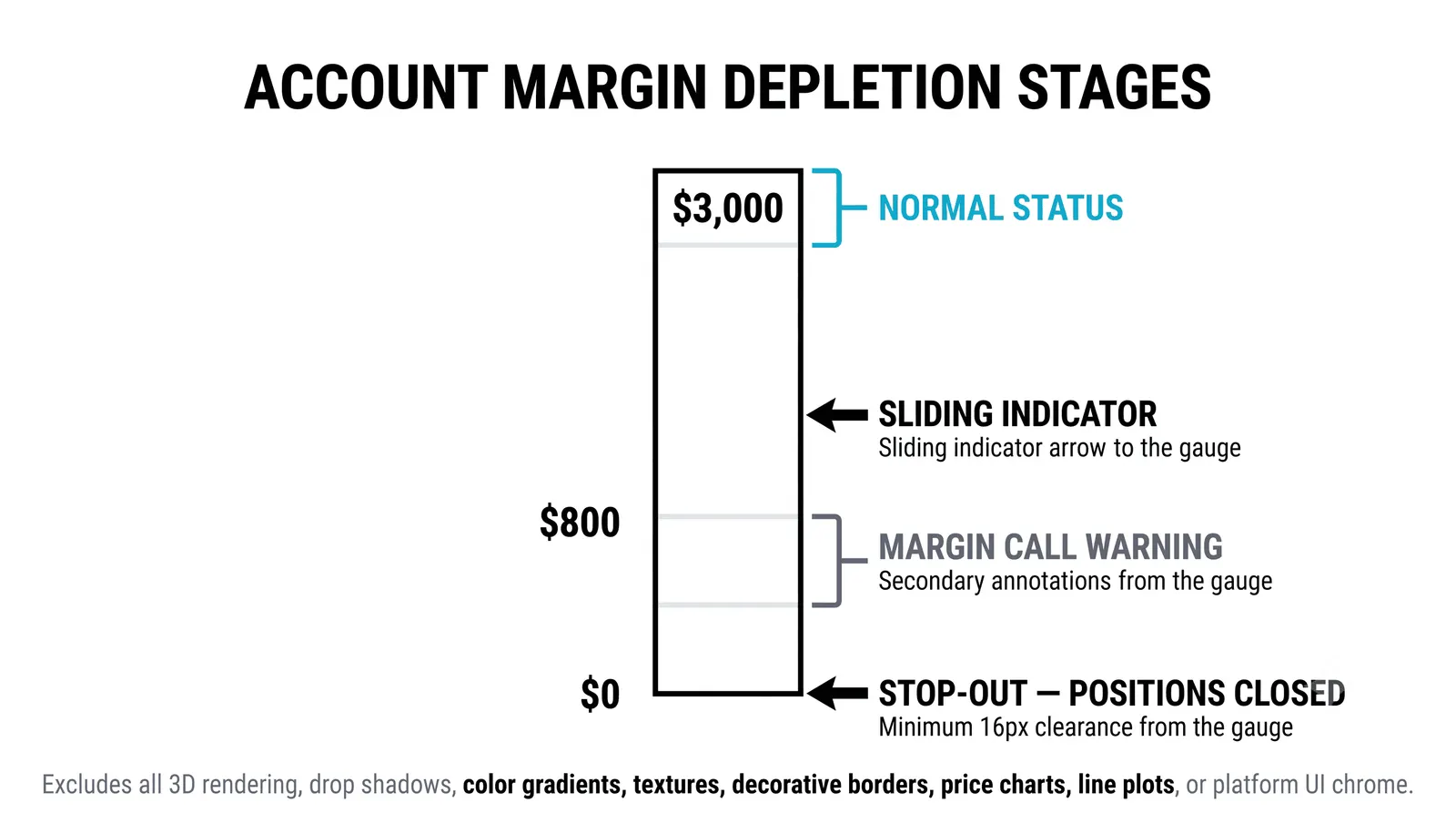
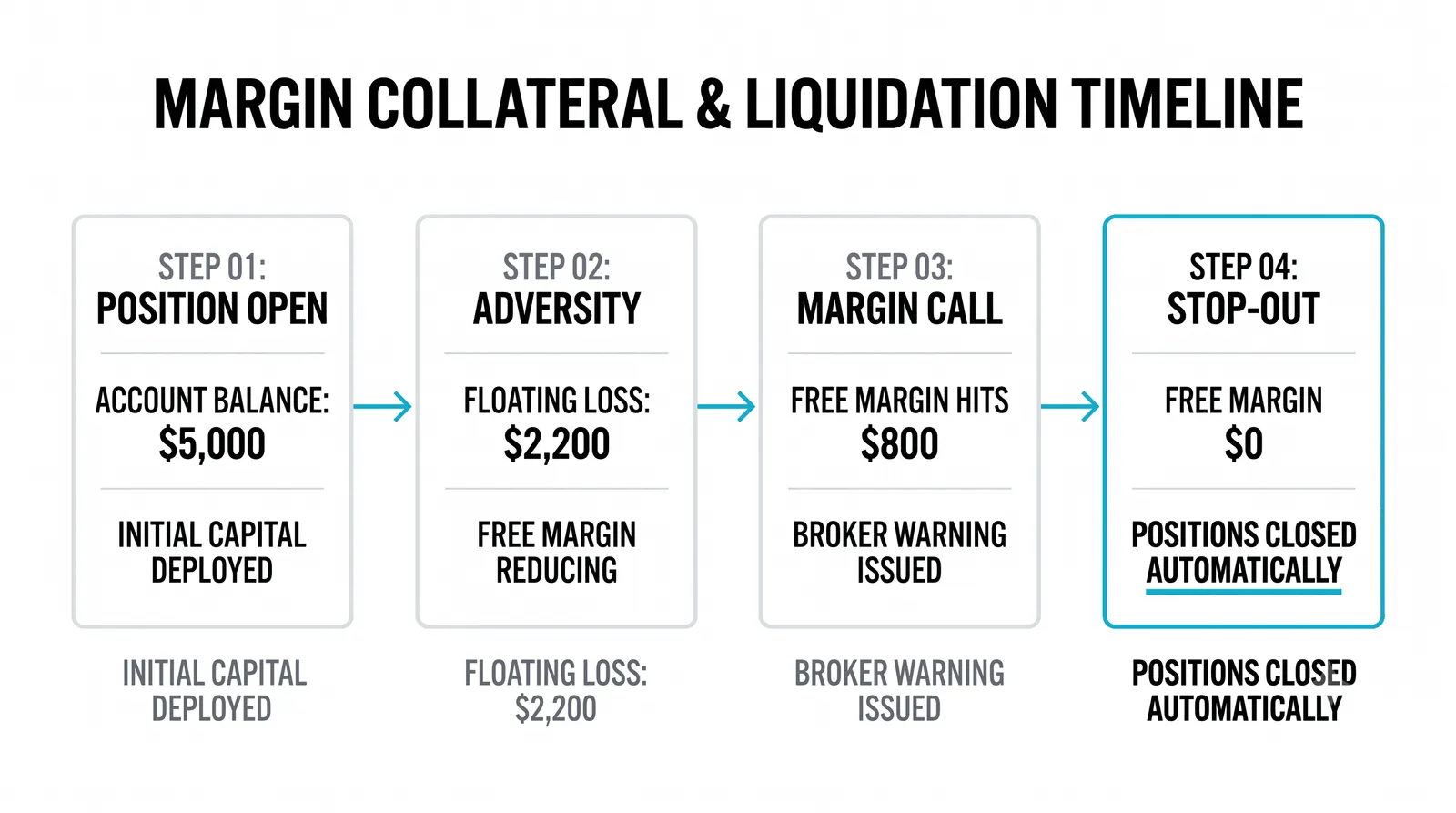
At a warning threshold, often around 100 percent, the broker notifies you. This is the margin call itself. You can deposit funds or close positions to free up margin.
At a lower threshold, often 50 percent, the broker stops asking. The system begins force-closing your positions at market prices, typically starting with your largest loser. No approval. No negotiation.
The exact percentages vary by broker and by regulation. Read your broker's margin policy before you fund the account, not after the first warning email.
Why It Happens Without You Noticing
Margin calls rarely arrive with drama. They arrive as a slow bleed.
Each open position loses a little. No single trade looks like the problem, so you hold all of them, waiting for each to come back.
The sum is the problem. Five positions each down 2 percent of your account is a 10 percent hole, and your margin level has been sliding the whole time.
Correlated trades make this worse. Three pairs that all move with the same currency are not three trades. They are one trade wearing three labels, and they bleed together.
By the time the warning arrives, the easy exits are gone. The forced liquidation that follows locks in the worst prices of the entire move.
Why Force-Closing Is the Worst Possible Exit
Forced liquidation happens into falling prices. That is what makes it the worst possible exit. You are selling into the exact conditions that hurt you, often when liquidity is thinnest and spreads are widest.
The system is automatic. It does not know your plan, your analysis, or your reason for holding. It closes the largest loser first, at market, whatever the market happens to be at that second.
It converts paper losses into permanent ones at the precise moment patience would have mattered most. Plenty of margin-called positions would have recovered days later. The account that held them is no longer around to find out.
This is the part traders underestimate. The loss itself is survivable. Losing the position, the capital, and the recovery all at once is not.
A Worked Example With Round Numbers
Here is a hypothetical account. The numbers are round on purpose so the mechanics stay visible.
You have a 1,000 account. You open a 10,000 position at 5 percent margin, so 500 of your account is locked as used margin. Your margin level at entry is 1,000 divided by 500: 200 percent.
The position moves against you by 6 percent. On a 10,000 position, that is a 600 loss.
Your equity is now 400. Your used margin is still 500. Your margin level is 400 divided by 500: 80 percent, and falling with every tick.
Your broker's warning threshold is 100 percent. You blew through it without noticing because you were watching the chart, not the account. The stop-out level is 50 percent. At 50 percent, equity would be 250, so the position only needs to lose another 150 before the system acts.
It does. The broker closes the position at market. The account survives with roughly 250, a quarter of its starting capital, and no positions.
Two days later the market turns and rallies past your original entry. That recovery belongs to someone else.
Notice what killed the account: not the 6 percent move, but a position size that made a 6 percent move equal to 60 percent of the account.
How to Avoid It, Honestly
The prevention is boring. That is why people skip it.
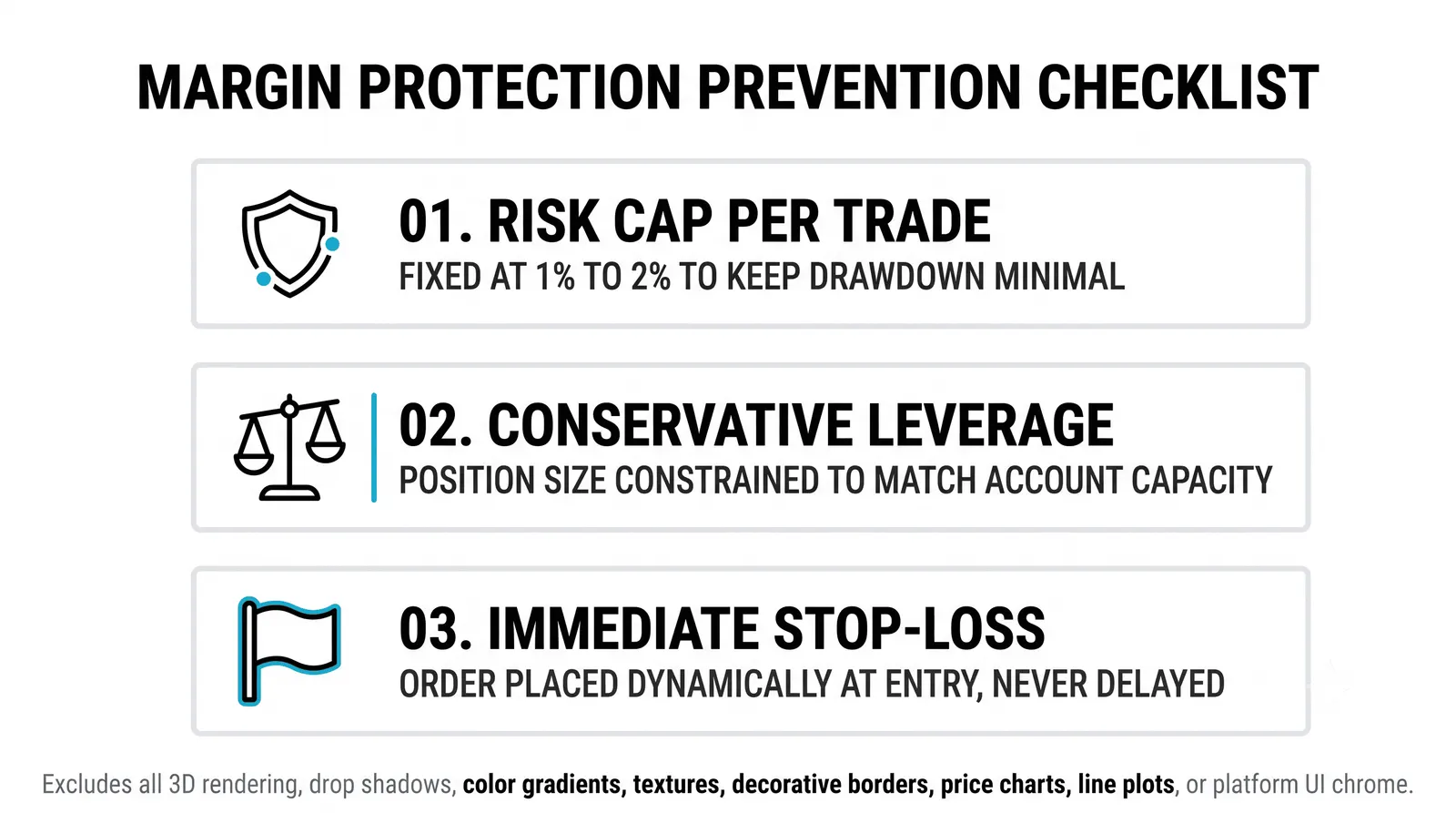
- Keep total open risk to a small fraction of the account. Many disciplined traders cap it at 1 to 2 percent per trade and a fixed ceiling across all trades combined.
- Calculate position size from your stop distance, not from how much margin is available. Available margin tells you what you can open. It says nothing about what you should open.
- Limit correlated positions. Three trades driven by the same currency or the same index count as one big trade for risk purposes.
- Hold a cash buffer well above required margin. If your margin level at entry is anywhere near the warning threshold, you are already too big.
Here is the blunt version: if a margin call is even possible in your setup, your sizes are too big.
A trader risking 1 percent per trade with sensible stops cannot be margin-called by normal market movement. The math does not allow it. The call is the fever, and position size is the infection.
Margin Level at a Glance
| Margin Level | What It Means | What Happens Next |
|---|---|---|
| Above 200% | Equity comfortably exceeds used margin | Normal trading, no action needed |
| 150% to 200% | Cushion is thinning | Review open risk before adding positions |
| Around 100% | Equity equals used margin | Margin call: deposit funds or close positions |
| Around 50% | Equity is half of used margin | Broker force-closes positions at market, largest loser first |
| Below 50% | Account cannot support its positions | Liquidation continues until the level recovers or positions are gone |
Thresholds differ between brokers and jurisdictions. Treat these as typical, not universal, and confirm the actual numbers in your account agreement.
Questions About Margin Calls
Can a margin call be reversed?
Yes, if you act before the stop-out level. Depositing funds raises your equity, and closing positions frees used margin, and either move lifts your margin level back above the threshold. Once force-closing has started, though, those closed positions and their losses are final.
Does the broker warn me first?
Usually, yes, at the margin-call threshold, by email, platform alert, or both. But in fast markets your margin level can fall from warning to stop-out quicker than you can read the message, and in extreme gaps the broker may close positions with no useful warning at all. The alert is a courtesy, not a safety system.
How much margin is safe to use?
There is no universal figure, but a practical guideline is to keep used margin to a small share of equity so your margin level sits comfortably in the hundreds of percent. If you size positions from stop distance and risk 1 to 2 percent per trade, you will usually find margin usage takes care of itself.
What happens if I ignore a margin call?
The broker closes your positions for you once equity hits the stop-out level, at whatever prices the market offers. In a fast move, losses can exceed your deposit depending on your broker and jurisdiction, leaving you owing money. Ignoring the call does not freeze the situation. It hands control to a system with no interest in your plan.
Margin level is one half of the survival equation. The other half is the stop-loss itself: where you place it, how you size from it, and why moving it is the most expensive habit a new trader can build. That is where we go next.