CFDs: What They Are and How They Work
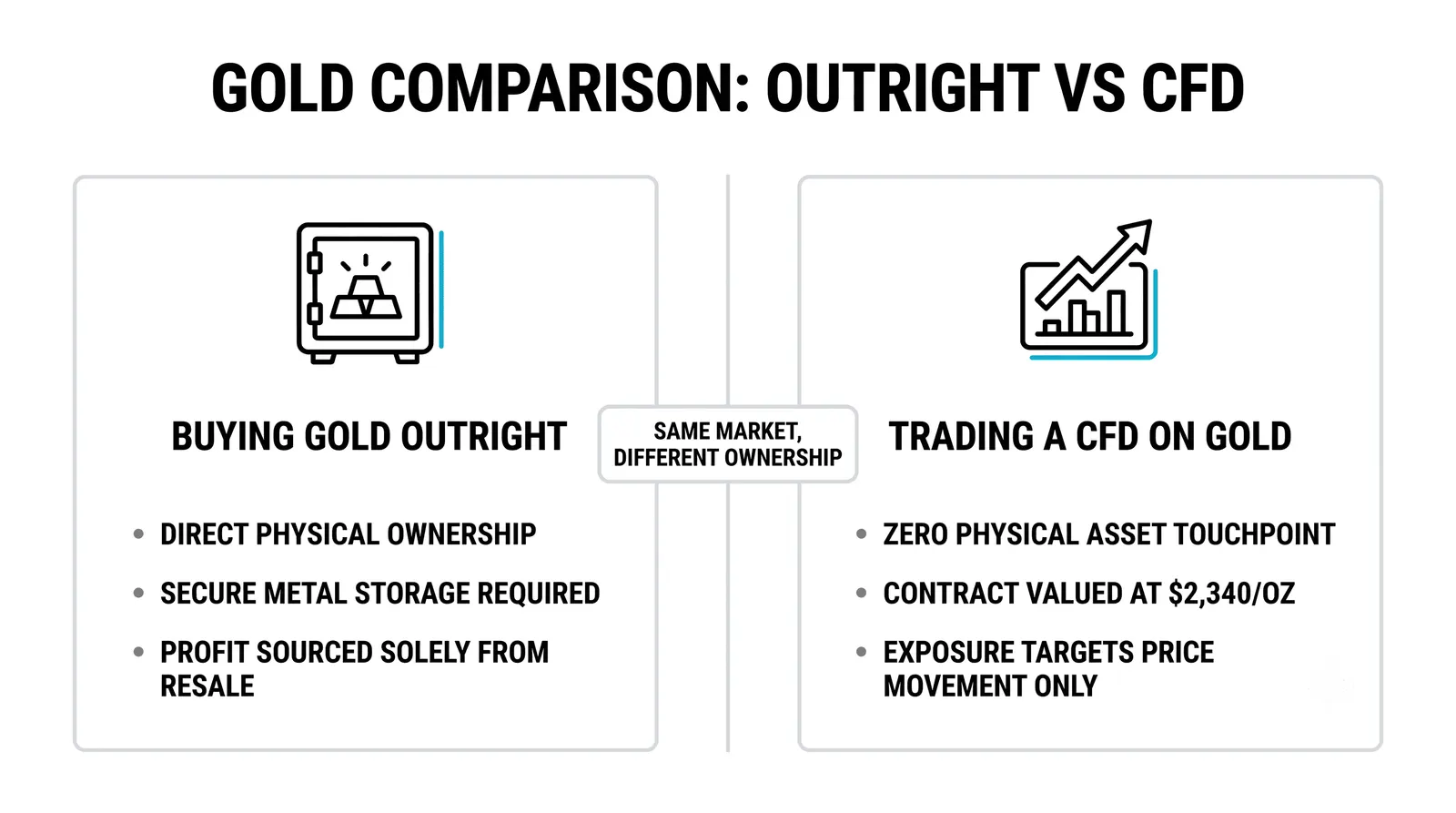
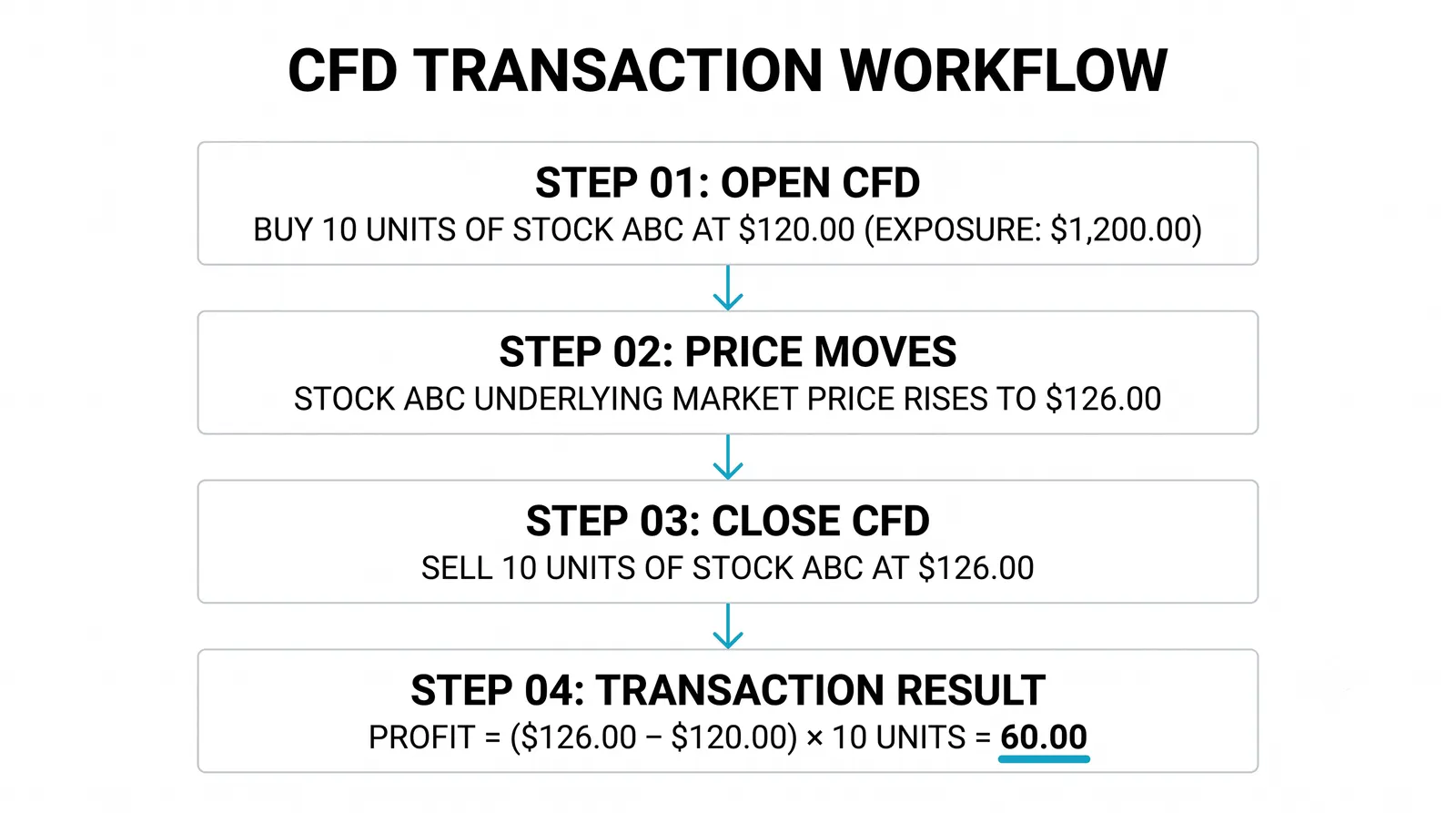
A CFD, or contract for difference, is an agreement with a broker to exchange the difference in an asset's price between the moment you open the trade and the moment you close it. You never own the asset itself. You profit if the price moves your way, and you pay if it moves against you, all settled in cash through your account.

Think of it as a side bet with a bookmaker on where a price will go; the bookmaker never hands you the thing itself, only the difference. That single fact shapes everything else about how CFDs behave, from their costs to their risks to who should touch them at all.
What a CFD Actually Is
A CFD is a derivative contract that mirrors the price of something else: a stock, an index, a commodity, or a currency pair. When the underlying market moves one point, your CFD position gains or loses one point per unit you hold. The tracking is close to exact.
You can go long if you expect the price to rise, or short if you expect it to fall. Both directions take the same effort. There is no borrowing shares, no special account approval, no extra paperwork. You click sell instead of buy, and you are short.
This symmetry is the main reason CFDs exist. They strip away the mechanics of ownership and leave only the price exposure. For a trader who wants to speculate on direction rather than hold an asset, that is a clean arrangement.
How CFD Trading Works
You open a position by posting a margin deposit, typically a fraction of the full position value. If the margin requirement is 5%, a 10,000 position needs 500 in your account. This is leverage in the literal trading sense: a small deposit controlling a large exposure, with gains and losses calculated on the full amount.
Most CFD brokers charge through the spread rather than a separate commission. You buy at the offer and sell at the bid, and the gap between them is the broker's fee. Every round trip pays it twice, once in and once out.
Positions held past the daily cutoff pay an overnight financing fee. The logic is simple: the broker is effectively lending you the full position value, and lending costs interest. The fee is small per night and relentless over weeks.
Unlike futures, a CFD has no expiry date. You can hold as long as you keep paying the financing and maintain your margin. That flexibility is real, but it is not free, and the next sections show why.
Where CFDs Sit Legally
CFDs are banned for retail traders in the United States and offered by regulated brokers across much of Europe, Asia, Australia, and elsewhere. Check your local regulator's rules before opening anything; one search on your national regulator's website answers it.
What Makes CFDs Appealing
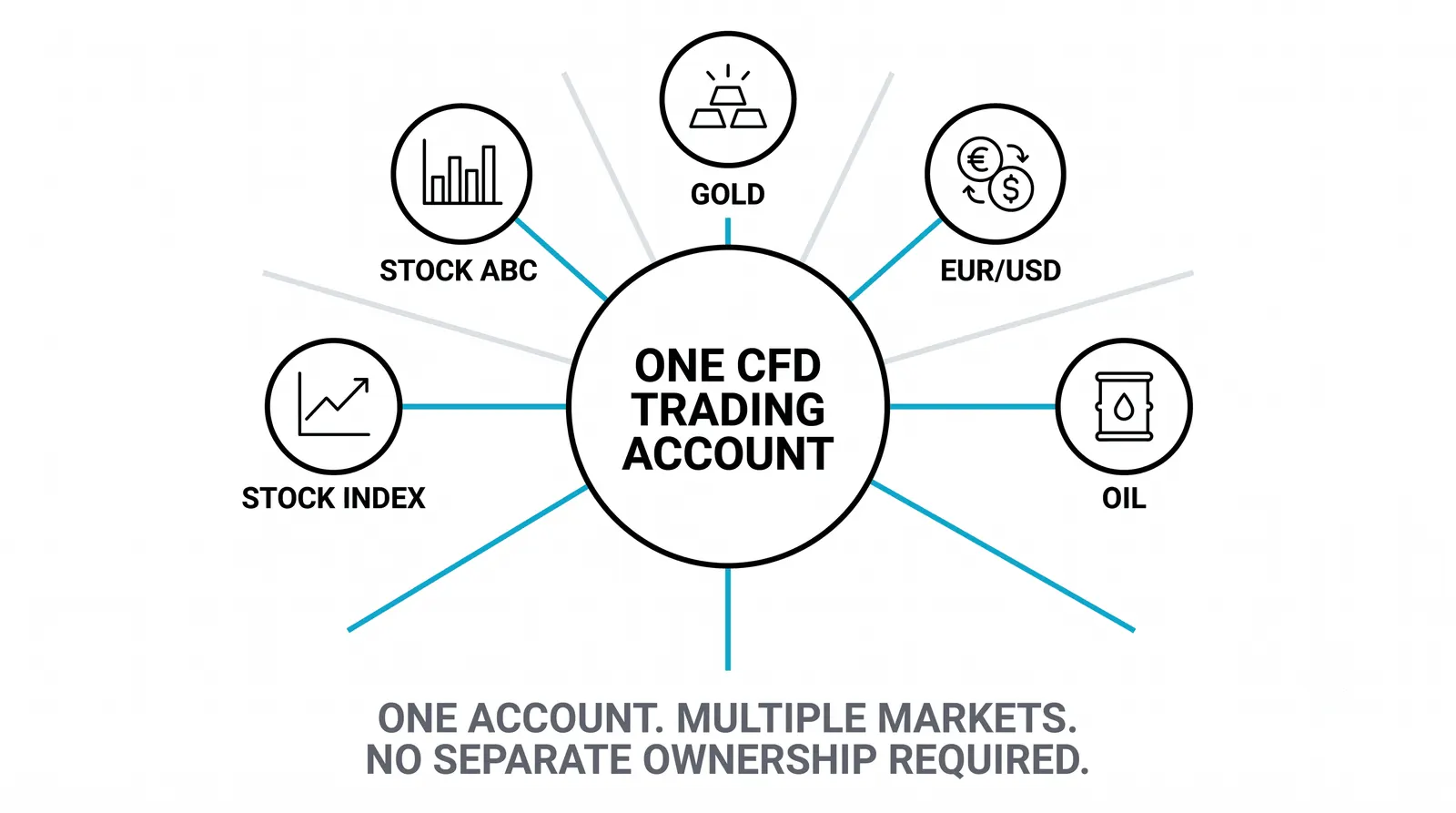
One account can reach thousands of instruments across every asset class. Stock indices, gold, oil, individual shares, currency pairs, all from a single login with a single balance. For a trader who follows several markets, that convenience is genuine.
Position sizes can be very small. You can trade a fraction of what a futures contract or a round lot of shares would demand, which lets you size risk precisely on a modest account.
Shorting is as easy as going long, and there is no expiry clock forcing you to roll positions the way futures do. For short-horizon styles, the instrument gets out of your way.
What Makes CFDs Demanding
The costs are individually small and collectively heavy. Overnight financing compounds against holders day after day. Spreads are usually wider than the native market's, so you start every trade slightly behind. Neither cost looks alarming on a single trade. Both add up across a year of trading.
Your counterparty is the broker itself. When you buy, the broker sells to you; when you sell, the broker buys from you. Pricing and execution depend on their feed and their dealing practices, which is why broker regulation and reputation matter more here than in exchange-traded markets.
Margin magnifies both directions, exactly as it does in every leveraged market. A 5% margin means a 5% move against you wipes out your deposit. That is not a flaw in CFDs specifically. It is arithmetic.
Nobody should hold a CFD for months and call it investing. The financing math makes that a losing posture before the market even moves.
A Worked Example
Here is a hypothetical with round numbers. You open a CFD on a stock trading at 100. You buy 100 units, a position worth 10,000, posting 500 of margin at a 5% requirement.
The price rises to 104 over 30 days and you close. Your gross gain is 4 per unit times 100 units: 400.
Now the costs. Say the spread cost you 0.10 per unit each way, so 10 entering and 10 exiting. Say overnight financing runs about 1.50 per night on the 10,000 position, so roughly 45 over 30 nights. Total costs: about 65. Net gain: about 335 on your 500 margin.
The return looks strong because of the margin, not because the stock moved much. It moved 4%. And notice the direction of every fee: the spread and the financing only ever run one way, against the holder. If the trade had gone nowhere for 30 nights, you would have lost money on a flat market.
CFDs vs Futures vs Owning the Asset
| CFD | Futures | Owning the asset | |
|---|---|---|---|
| What you own | A contract with your broker | A standardized exchange contract | The asset itself |
| Expiry | None | Fixed date, must roll or close | None |
| Costs while holding | Spread plus nightly financing | Commission plus roll costs | None beyond custody or fund fees |
| Counterparty | The broker | The exchange clearing house | No counterparty for the holding |
Read the counterparty row twice. With futures, a clearing house stands between you and default risk. With ownership, there is no counterparty at all. With a CFD, the broker is the trade. That is the structural difference everything else hangs on.
Who CFDs Fit
CFDs fit traders in regions where they are regulated, running short-horizon styles: day trades, swing trades lasting days, positions where the financing fee stays a minor line item. The instrument rewards brevity.
They fit poorly for anyone whose plan is to buy and hold for months. If your horizon is long, the financing math punishes you, and owning the asset or a fund is almost always the cheaper route. Match the wrapper to the holding period, not the other way around.
Questions About CFDs
Are CFDs regulated?
Yes, in most regions where they are legal, CFD brokers operate under financial regulators that set margin caps, disclosure rules, and client-money protections. The strength of that oversight varies by jurisdiction, so check which regulator licenses your broker and what protections that license actually includes.
What does overnight financing really cost?
Typically a benchmark interest rate plus the broker's markup, charged daily on the full position value. On a 10,000 position, that often works out to a small amount per night, but over a month it can reach a meaningful percentage of your margin. Ask your broker for the exact formula and run the numbers for your expected holding period before you trade.
Why are CFDs banned in the US?
US regulators classify CFDs as over-the-counter derivatives that do not fit their retail framework, and they have long restricted off-exchange leveraged products for retail traders. The ban reflects a regulatory choice about counterparty risk and investor protection, not a judgment that the instrument cannot work elsewhere.
CFD or buying the stock: which is better?
Neither is universally better; the answer depends on your horizon and goal. For a short-term directional trade with limited capital, a CFD offers flexibility and easy shorting. For anything you plan to hold for months or years, owning the stock avoids financing costs entirely and removes the broker as your counterparty.
You now know how the CFD wrapper works, what it costs, and where it fits. The next step is comparing it against the other wrappers available in your region, because the instrument you trade often matters as much as the market you trade it on.