Approach vs. Strategy in Trading
The difference between trading approach vs trading strategy is simple once someone states it plainly: an approach is your broad style of trading, meaning what kind of moves you chase, which timeframes you watch, and how long you hold, while a strategy is the specific rule set you execute inside that style, with an exact entry trigger, a defined stop, and a clear exit. Most beginners mix these two words together and end up confused about what they are actually building. You need both, and you need them in the right order.
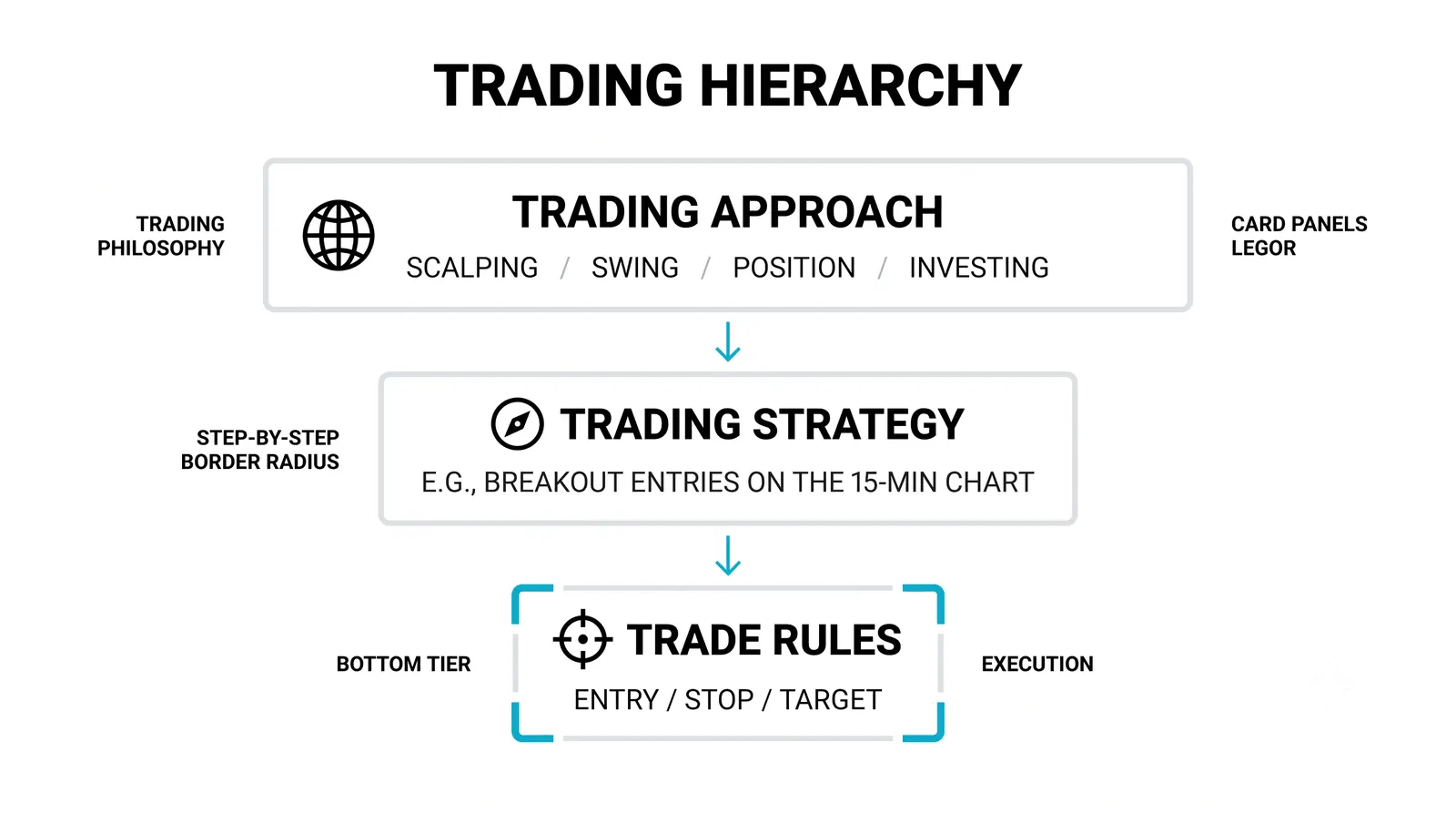
Think of it this way: an approach is the cuisine you cook, and a strategy is the recipe you follow tonight.
What an Approach Actually Is
An approach is a style of trading with a holding period and a way of reading the market attached to it. Trend following, swing trading, day trading, and position trading are approaches, and the previous lesson covers what an approach is in depth. Each one answers the question: what kind of trader are you?
That answer shapes almost everything downstream. It decides how many trades you take in a month, how much screen time you need, and which markets fit your week. A day-trading approach demands hours of attention during the session. A position-trading approach might ask for twenty minutes on a Sunday.
Your approach also has to fit your life. If you work a full-time job away from screens, a scalping approach is not a strategy problem. It is a mismatch at the top level, and no rule set will fix it.
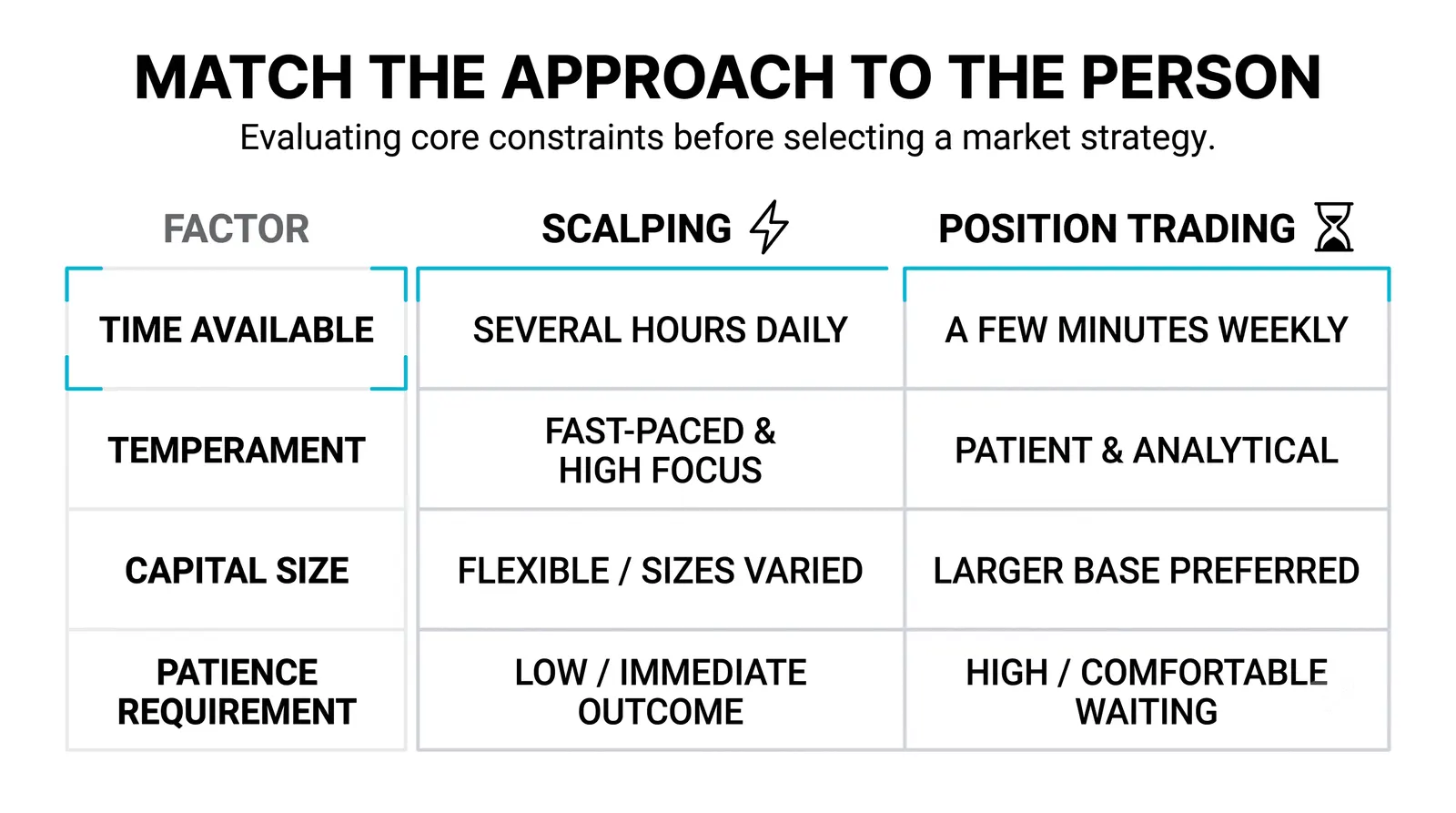
Choose the approach based on your available time, your temperament, and the holding period you can tolerate. Some people cannot sleep holding overnight risk. Others go mad watching a one-minute chart. Neither is wrong. They just belong to different approaches.
What a Strategy Actually Is
A strategy is the concrete, repeatable rule set that lives inside your approach. It answers a different question: what exactly do you do on this trade?
A complete strategy specifies four things:
- Entry trigger. The exact condition that puts you in the trade. Not a feeling. A condition you could write down and hand to someone else.
- Stop placement. Where you are wrong, defined before you enter.
- Exit rule. How you take profit, whether that is a fixed target, a trailing rule, or a signal-based exit.
- Position size. How much you risk, usually as a fixed fraction of the account.
The test of a real strategy is that it is testable. It either fired or it did not. If two honest traders look at the same chart and disagree about whether the setup triggered, the rule is too vague. Tighten it until the answer is yes or no.
Vague strategies feel flexible. They are actually just untestable, and untestable means you can never know if they work.
Why the Order Matters
Pick the approach first, then build or adopt strategies that belong to it. This sounds obvious. Almost nobody does it.
The reversed order is how beginners end up with five strategies pulled from five incompatible styles: a scalping rule from one video, a swing setup from a forum, a position-trading idea from a book. None of them tested. All of them swapped out after a bad week. The trader is busy but going nowhere, because there is no stable frame to measure anything against.
Here is the quieter failure. A strategy inherited from the wrong approach fails slowly and without a clear error message. The same pullback-buy rule belongs to one holding horizon and collapses in another. The entry still triggers. The trades still fill. But the logic that made the rule work assumed time you do not have, or patience the approach does not allow.
When results disappoint, the beginner blames the rule and goes hunting for a new one. The rule was fine. It was planted in the wrong soil.
A Worked Example With Round Numbers
Here is a hypothetical with clean numbers. Say your approach is trend following on daily charts. You hold trades for days to weeks, you check the market once a day, and you risk 1% of a $10,000 account per trade, so $100 at risk each time.
Inside that approach sits one strategy: buy a pullback to the 20-day average in an established uptrend. Your stop goes just below the pullback low, say $2 below your entry. Your exit is at twice the amount risked, so $4 above entry. With $100 of risk and $2 of stop distance, you buy 50 shares. The trade either hits the stop for a $100 loss or the target for a $200 gain. Clean, testable, repeatable.
Now drop the same entry rule into a day-trading approach. You buy the pullback to the 20-day average at 10 a.m., but your approach requires you to close everything by the end of the session. The trade needed days to reach its target. The approach gave it hours. You exit at 4 p.m. for a small loss or a scratch, again and again, and the cost of trading compounds with every forced exit.
The rule was never wrong. It was misplaced. Everything downstream depends on getting that placement right.
Where the Trading Plan Fits
The full stack runs top to bottom. The approach sits at the top. Strategies live under it. Below the strategies sits the trading plan: your session times, your risk per trade, your maximum daily loss, and your review routine.
Each layer answers a different question, and each changes at a different speed. The approach changes rarely, maybe once in years, because it reflects who you are and what your week looks like. A strategy changes only after testing, never mid-drawdown on a hunch. Execution notes in the plan change constantly as you refine the practical details.
Changes flow downward, not upward. A bad week does not justify a new approach. A new approach, chosen deliberately, justifies rebuilding everything beneath it.
| Layer | Question It Answers | Example | How Often It Changes |
|---|---|---|---|
| Approach | What kind of trader am I? | Trend following on daily charts | Rarely, if ever |
| Strategy | What exactly do I do on this trade? | Buy the pullback to the 20-day average, stop below the low, exit at 2R | Only after testing |
| Execution plan | When, how much, and how do I review? | Check charts at 6 p.m., risk 1% per trade, journal every Sunday | Constantly, in small ways |
Questions About Approach vs Strategy
Can I have more than one approach?
Yes, but not at the start. Run one approach until you have a tested strategy and a track record inside it. Adding a second approach doubles your learning load and halves your sample size in each. Most traders who juggle two approaches are really just avoiding committing to one.
How many strategies do I need?
One is enough to start, and one good one beats five untested ones. A single strategy with a verified edge, sized correctly, is a complete trading business. Add a second only when the first is documented, tested, and you want to cover conditions it misses.
Should I copy someone else's strategy?
You can borrow a strategy as a starting point, but only if it belongs to your chosen approach and you test it yourself. A rule you did not verify is a rule you will abandon at the first losing streak, because you have no evidence to fall back on. Borrow the skeleton. Earn the conviction through your own testing.
Which approach is best for beginners?
None of them is universally best, but slower approaches are more forgiving. Swing trading or position trading on daily charts gives you time to think, time to place orders calmly, and room for the small errors everyone makes early. Fast approaches compress every mistake into seconds. Start where your mistakes are cheap, then speed up only if your results and your temperament both say so.
Once you can name your approach and write down one strategy inside it, the next step is putting numbers to the risk side: exactly how much you stake per trade and how that sizing holds up across a string of losses.