Stopping Volume: When Selling Is Absorbed
Stopping volume is the heavy-volume bar, usually a down bar with a wide spread that closes off its lows, that appears after a sharp decline when professional buyers suddenly absorb the selling. It is the moment the effort of the panic meets, for the first time, an opponent with real size. Volume spikes far above anything seen in weeks, yet price refuses to keep falling.

That refusal tells you everything. A trampoline does not stop a fall by force; it catches it and sends it back. The sellers do not run out of energy on their own. They run into someone willing to take everything they offer, and the bar's shape tells you the collision happened.
What Stopping Volume Looks Like
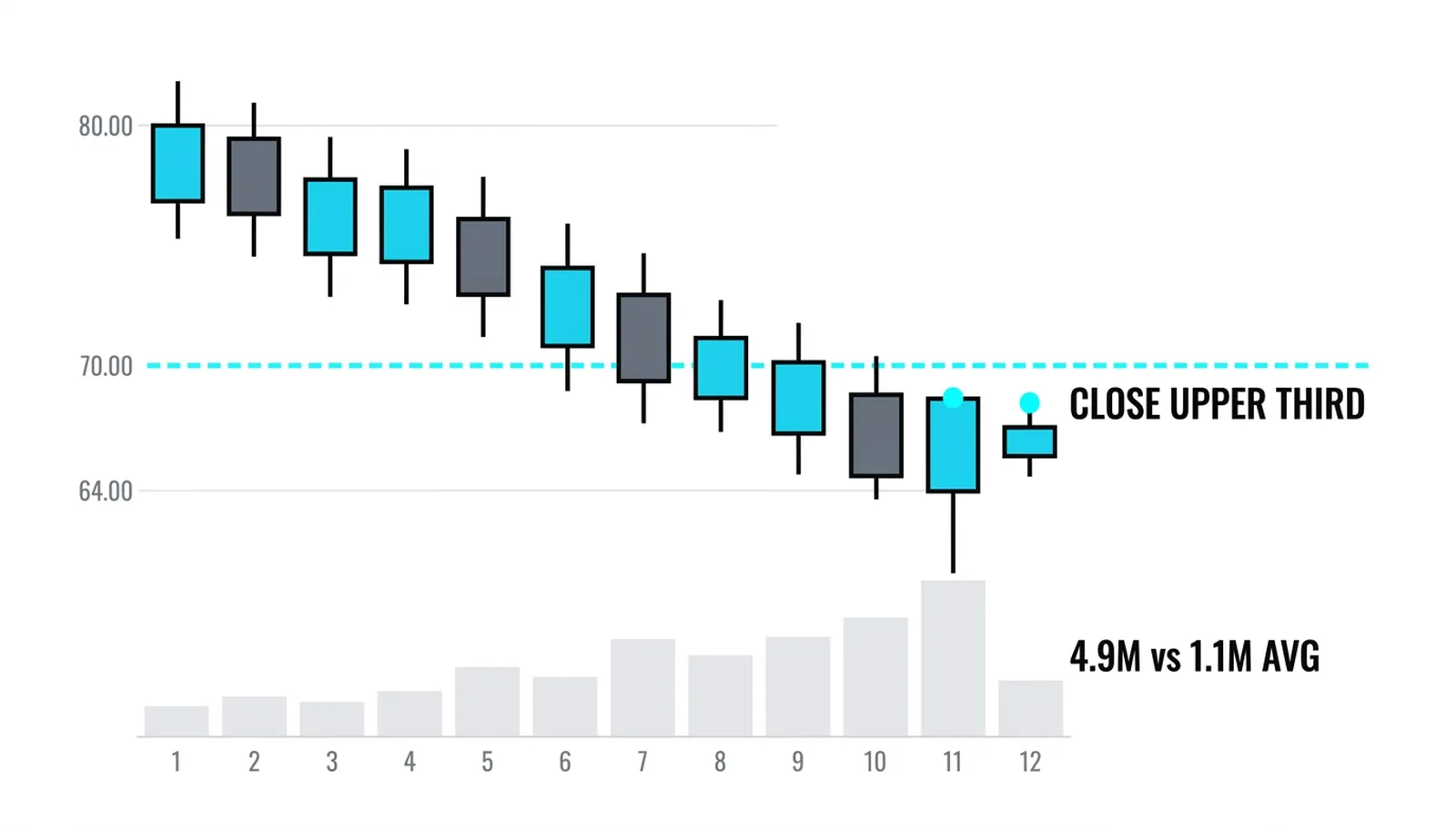
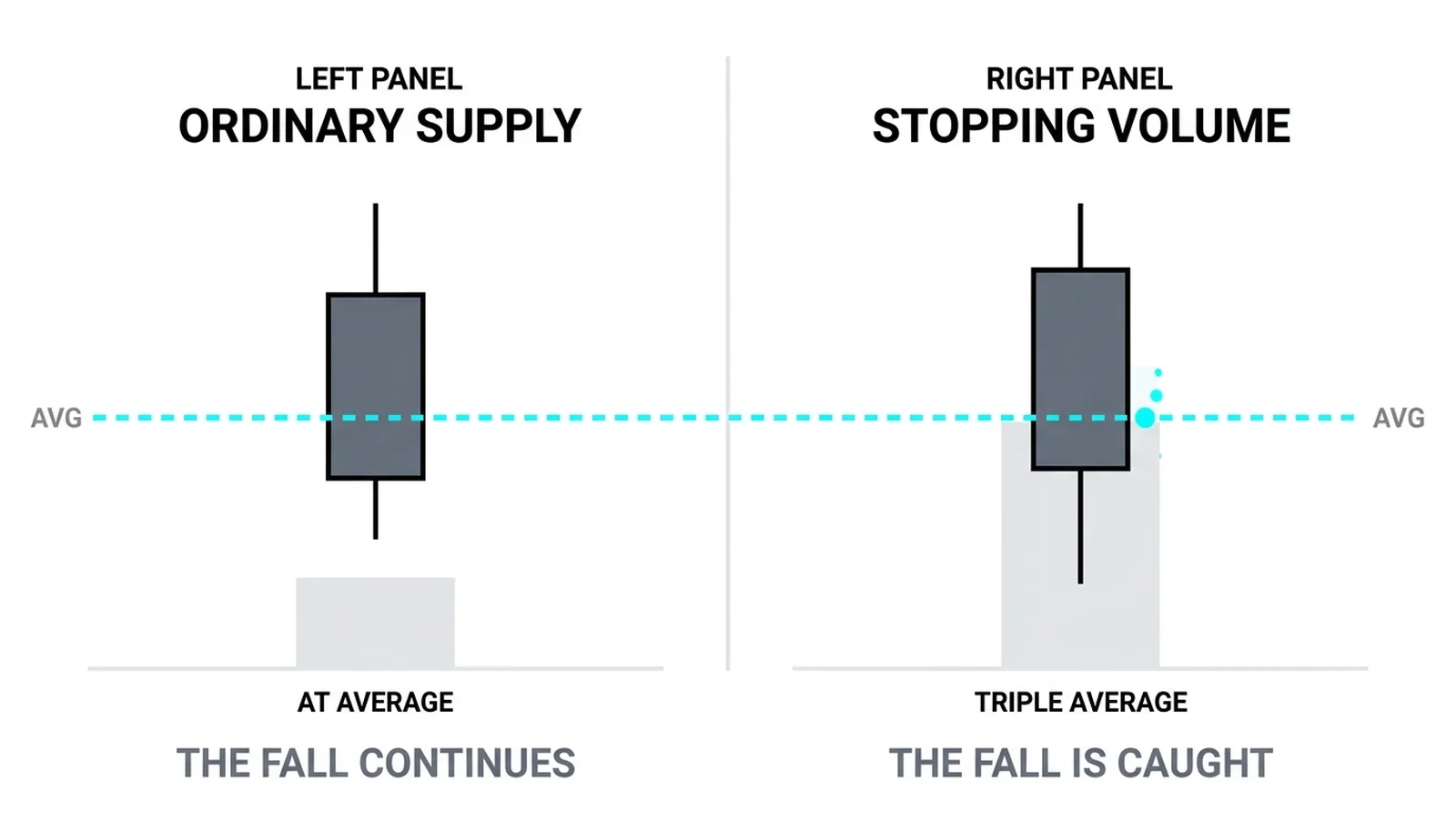
The classic print is a wide-spread down bar on volume far above average that closes back off its lows, often in the upper third of its range. The spread tells you the sellers pushed hard. The close tells you they lost ground by the end. The volume tells you both sides showed up in size.
There is a second shape worth knowing. Sometimes the heavy flush bar closes weak, but the bars immediately after it go tight and quiet, with small spreads and shrinking volume. The effort went in, the price stopped going down, and the follow-through selling never arrived. Either way, the message is the same: someone took the other side of the panic.
Note what this is not. The preceding lessons covered the absence patterns, the no-supply and no-demand bars, where thin volume signals a lack of interest. Stopping volume is the opposite texture. It is not absence. It is heavy presence getting absorbed in real time.
Why It Marks the End of the Easy Fall
A decline needs fuel the same way a rally does. Every leg down requires sellers willing to hit lower bids. The panic wave at the end of a long fall is the last large supply, the late holders and forced sellers finally giving up all at once.
When that supply is absorbed by strong hands, the decline loses its fuel. The fall did not run out of price room. It ran out of sellers with size. Once the weak holders have sold to someone who is not scared, there is nobody left to press the price lower with conviction.
That is why the close matters so much. Effort went in, and the result was a recovery off the lows rather than a collapse through them. Effort without result, read in reverse, is the signature of absorption.
One more texture is worth knowing in advance: absorption can need more than one attempt. Sometimes the first heavy bar catches some selling but the market drifts lower again over the next sessions, and a second heavy bar, often on even higher volume, catches the rest. Two heavy bars at the same level a week apart is not a failed signal followed by a new one; it is the same buyer finishing the job. What would actually fail the read is the opposite: a heavy bar followed by an immediate collapse through its low, which means the buyer was smaller than the bar implied.
Stopping Volume Is Not a Reversal Signal
It marks where the fall stops, not where the rise starts.
The usual sequence has three parts. First, the heavy bar itself. Then an automatic reaction, a reflex bounce as the selling pressure lifts. Then a low-volume test back toward the lows, which is where the reading gets confirmed or rejected. The next lesson covers that test bar in detail.
Jumping in on the heavy bar itself is guessing. You are buying while the panic is still printing, with no evidence yet that the absorption will hold. The trader who waits for the test gives up a few points of entry and gains an actual read on whether supply is truly exhausted.
Stopping volume also needs a neighbor clarified. A selling climax is the panic wave itself, the widest, loudest flush of the decline. Stopping volume names the moment that wave hits a buyer big enough to catch it. The same bar can be both. The label depends on which question you are asking: how extreme was the panic, or who absorbed it.
Reading It Honestly
Context decides how much weight the bar carries. Stopping volume means the most after an extended decline, ideally into a known support area, where a large buyer has a logical reason to act. The same shape after a two-day dip in a strong uptrend is usually just noise.
Stay honest about what you can actually see. The absorption story is a model, a useful one, but the observable facts are simpler: wide spread, huge volume, close off the lows. You do not know who bought. You know that enormous selling failed to push the close lower. Trade the facts, and treat the story as a working hypothesis the next few bars will either confirm or kill.
The Bar That Ended the Decline
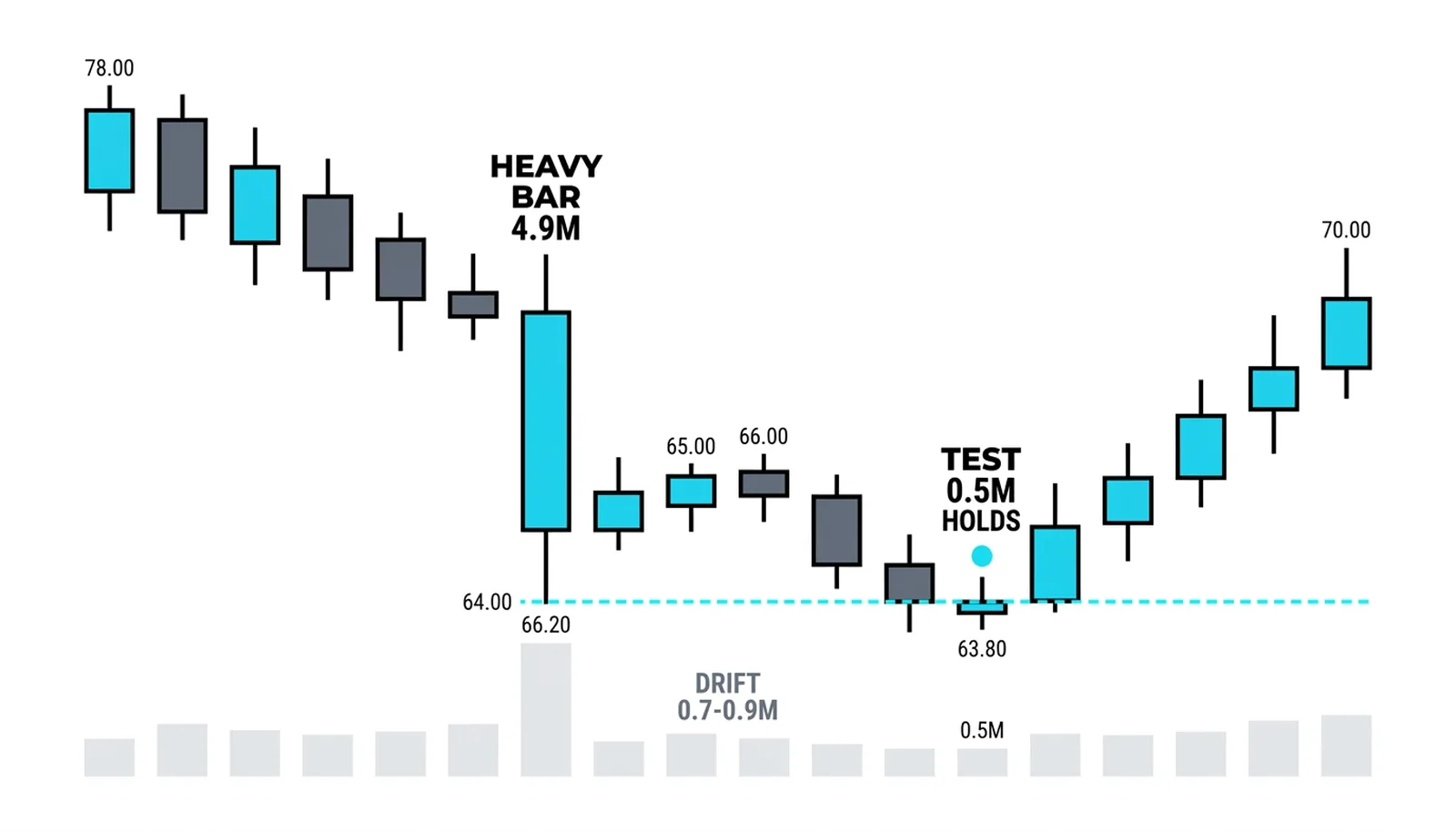
Hypothetical numbers, for illustration. A stock falls from 80 to 64 over three weeks, with daily volume rising from 1.0 million to 1.8 million shares as the decline accelerates. Then one session prints 4.9 million shares against a 1.1 million average, a spread of 3.4 points, and closes at 66.2, in the upper third of the bar.
The next two sessions drift on 0.7 and 0.9 million shares. Three sessions later, price dips to 63.8 on just 0.5 million, holds, and closes firm. The reading turns: the panic was absorbed, the retest found no sellers, and the decline is done until proven otherwise. What stays open is only how far the recovery can run, and the volume of the rally away from the lows answers that question in its own time.
| Phase | Reading | Verdict |
|---|---|---|
| Heavy bar at 64-66.2 on 4.9M | Wide spread, huge volume, close in upper third | Stopping volume, absorption suspected |
| Quiet drift on 0.7M and 0.9M | No follow-through selling after the flush | Supply drying up, hypothesis intact |
| Test at 63.8 on 0.5M | Low-volume dip holds above the lows | Confirmed, short-term floor in place |
Stopping Volume, Answered
What is stopping volume in trading?
It is a very high-volume bar after a sharp decline, usually a wide-spread down bar that closes off its lows, showing that large buyers absorbed the panic selling and halted the fall.
How is it different from a selling climax?
The selling climax is the panic wave itself, the loudest flush of the decline. Stopping volume names the moment that wave meets a buyer big enough to catch it. One bar can be both; the label depends on the question.
Does stopping volume mean the trend has reversed?
No. It marks where the decline stops, not where an uptrend begins. Reversal still requires the follow-up evidence: an automatic reaction and a successful low-volume test.
What confirms stopping volume?
A low-volume test that holds near or above the stopping bar's low. Shrinking volume on the retest shows the supply is gone, and that is the confirmation the heavy bar alone cannot give you.
The natural next step is that test bar itself: how to read it, what volume signature it needs, and what separates a passing test from a failed one. That is where the sequence either becomes a trade or stays a story.