The No Demand Bar, Explained
A no demand bar is an up bar with a narrow spread on clearly low volume, usually appearing after a rally, and it tells you professional buyers are absent. Price went up, but nobody with real size paid up to make it happen. The advance has no demand behind it. The push higher is running on nothing.

Think of it as an invitation that draws no RSVPs: the event is technically on, but the silence tells you what the crowd actually thinks. A rally that keeps printing higher closes while volume thins out is the same kind of silence. Price can drift upward on very little effort. That drift is not strength. It is the absence of sellers, which is a different thing from the presence of buyers.
The Anatomy of a No Demand Bar
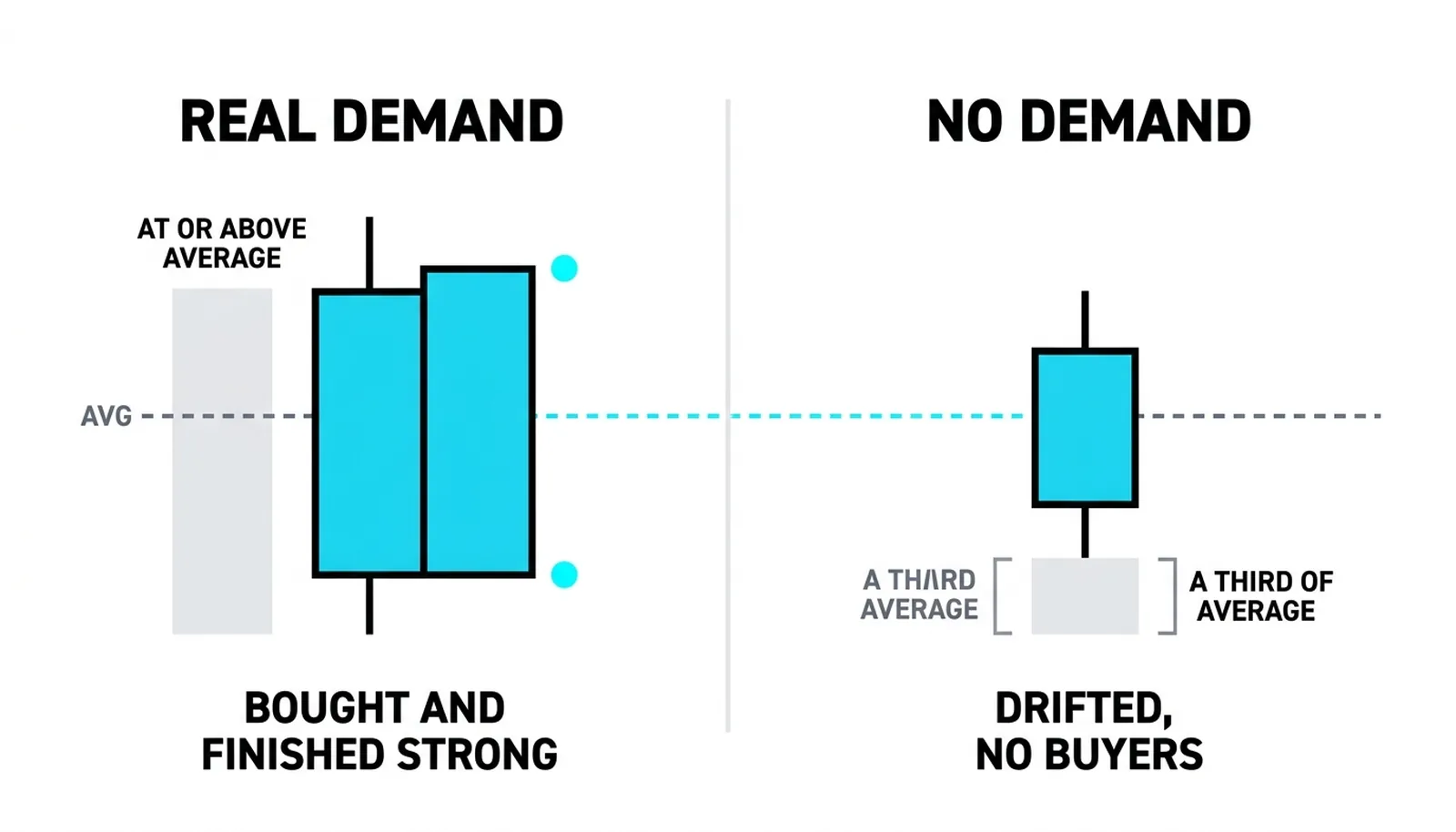
Three conditions define the bar, and all three must be present together. First, the bar closes up. Second, its spread is narrow against recent bars, meaning the distance from high to low is visibly smaller than what the chart has been printing. Third, volume is clearly below that bar's own average, not marginally below but obviously thin.
The narrow spread matters because it shows limited range of disagreement. The low volume matters because it shows limited participation. Put them together on an up close and you get a bar that moved without a fight and without a following.
Location sharpens the read. A no demand bar carries the most weight when it prints into resistance, into a prior high, or into the upper region of an extended advance. That is where buyers need to show up in force to push through. When they do not, the bar is telling you the level is being approached without conviction.
The previous lesson covered the mirror image of this pattern, the no supply bar on the downside, and the logic runs in the opposite direction. Here the focus stays on the upside failure.
Why Quiet Rallies Warn
Rising price with no buyers behind it cannot be trusted. Markets need committed money to sustain a move, and committed money leaves a volume signature. When the signature is missing, the rise is resting on inertia rather than intention.
Professionals are not paying up when a no demand bar prints. That is the core message. If the large, informed participants wanted higher prices, they would be bidding aggressively, and the bar would show expansion in both spread and volume. Their absence is information.
The same bar means something slightly different inside a downtrend. There, a quiet up bar marks a weak bounce. Price drifts up for a few sessions, volume stays thin, and the bounce is really the market floating into overhead supply. Sellers who missed the first exit wait above. A bounce nobody bought is a bounce waiting to be sold.
This is why the pattern belongs in a framework rather than on a checklist. The bar itself is simple. What it implies depends entirely on where it appears and what came before it.
The Topping Texture
One no demand bar is a question. A series of them at one resistance level, while price stalls and churns, is the classic late-stage picture. Each bar asks the market for buyers, and each bar gets the same empty answer.
This repeated failure has a texture you learn to recognize. Price keeps nudging the same ceiling. Spreads stay narrow. Volume stays subdued. The chart looks calm, almost healthy, and that calm is exactly the danger. Distribution often looks orderly from the outside.
The pattern rarely appears alone. It frequently sits alongside the divergence behavior and the climactic volume signatures covered earlier in this level. A momentum divergence on the oscillator, a quiet stall at resistance, a string of thin up bars: these pieces corroborate each other.
The market does not top out on loud days alone, it tops on quiet ones nobody checks.
When the Read Fails
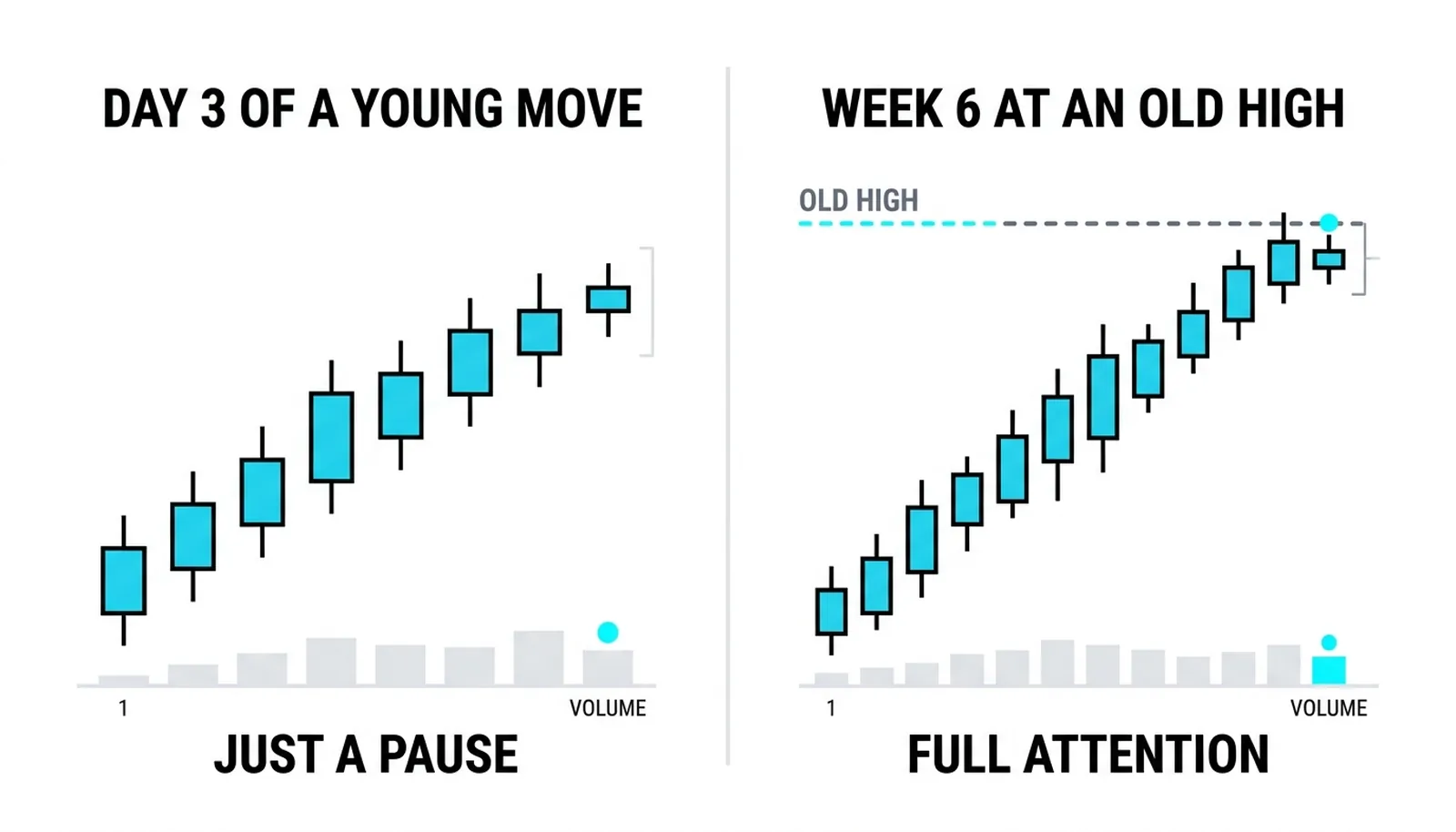
Context decides whether the bar warns or simply rests. Early in a fresh uptrend, a quiet up bar can be nothing more than a market pausing. The trend is young, pullbacks are shallow, and low volume on an up day may reflect comfort rather than absence. Treating every thin up bar as a warning will have you exiting healthy trends at the first yawn.
The pattern also dies a clean death when demand shows up late. If the next bar expands on heavy volume and breaks through the level, the no demand reading is void. Buyers were late, not absent. The correct response is to discard the warning immediately, not to defend it.
Timing matters more than the bar itself. A no demand bar after six weeks of advance, pressing against a level that has rejected price before, deserves full attention. The identical bar on day three of a young move deserves almost none. The bar is the same. The situation is not.
One more boundary deserves a name. The next lesson in this level covers stopping volume, the pattern where heavy selling suddenly gets absorbed, which is a different animal entirely and gets its own treatment there.
Three Quiet Bars at 118
The numbers below are invented, round, and purely illustrative. They show how the read unfolds across a short sequence.
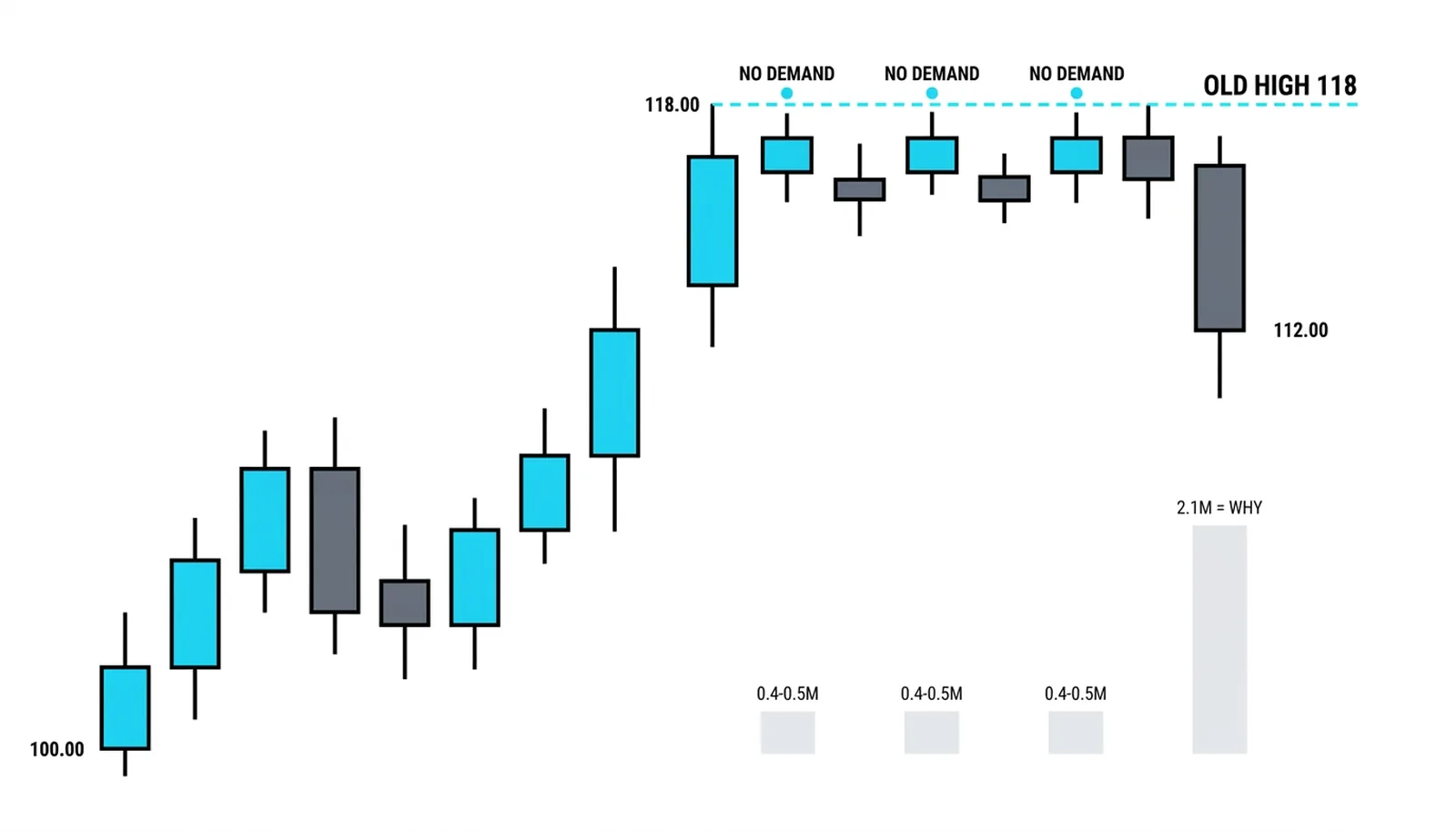
Suppose a stock rallies from 100 to 118 over six weeks. The advance looks clean. At 118, just under an old high, the character changes. Over five sessions the stock prints three up bars, each with a spread under 0.7, each on volume between 0.4 and 0.5 million shares against an average of 1.3 million, and each stalling just under the high.
Two sessions later, price breaks down on 2.1 million shares.
| Session | Up Bar Reading | Verdict |
|---|---|---|
| Session 1 | Spread 0.6, volume 0.5M vs 1.3M average, stalls under 118 | First no demand bar; a question, not yet a warning |
| Session 3 | Spread 0.5, volume 0.4M, stalls at the same level | Second quiet bar at resistance; suspicion grows |
| Session 5 | Spread 0.7, volume 0.45M, third failure under the high | Topping texture confirmed; stop trusting the advance |
The first bar alone proved nothing. The second turned a question into a pattern. The third completed the picture: three separate attempts, three separate absences of buyers, all at the same ceiling.
The breakdown on 2.1 million shares was the honest follow-up. The no demand bars said stop trusting the advance. The heavy down bar said why: sellers were waiting, and the moment price stopped drifting up, they acted.
The practical takeaway is sequencing. The quiet bars gave the early warning, days before the break. A trader reading only price saw a sideways pause. A trader reading spread and volume together saw a rally nobody was willing to fund.
The No Demand Bar, Answered
What is a no demand bar in trading?
A no demand bar is an up bar with a narrow spread and clearly low volume, typically appearing after a rally. It signals that professional buyers are absent and the advance has no real demand behind it. Price rose because sellers stepped aside, not because buyers stepped in.
How is it different from a normal up bar?
A normal healthy up bar shows a reasonable spread and volume at or above average, indicating genuine participation. A no demand bar shows a thin spread on volume well below average. Both close higher, but only one has money behind it.
Where does a no demand bar matter most?
It matters most after an extended advance, at or near resistance and prior highs, and as a bounce inside a downtrend. In those locations, the absence of buyers is decisive information. Early in a fresh uptrend, the same bar often means nothing more than rest.
What confirms a no demand warning?
Repetition at the same level confirms it: a series of quiet up bars stalling at one resistance is the classic topping texture. Final confirmation comes when price breaks down on expanding volume, which reveals the supply that was waiting above all along.
With both absence patterns in hand, the level turns next to the opposite problem: what it looks like when heavy selling arrives and suddenly finds a floor.