The Test Bar in VSA
A test bar is a low-volume return to an area where heavy trading happened before, and it asks one question: is anybody left. When price comes back to the scene of a prior battle and almost nobody trades, the answer is that the supply or the demand on the other side is gone.

Think of it as probing the ice with a toe before committing your weight. The market already fought hard at that level once. The return visit checks whether the ice still holds, and the volume on that visit is the entire reading.
An earlier lesson covered the test as one step inside the climax sequence, and the no-supply lesson treated its bullish special case. This lesson owns the full pattern in both directions, so those pieces slot into place here without re-teaching.
The Test of Supply
Start with the bullish version. Price has fallen hard, often into a selling climax where volume exploded and the decline finally stalled. Then the market rallies off that low.
After the rally, price drifts back down toward the area of the low. This is the moment of truth. If sellers were finished at the climax, they should still be finished now.
The test of supply confirms when the return happens on clearly low volume and the price holds above or near the old low. The question being asked was whether sellers remained. The silence says no.
Read the bar itself too. A narrow spread, a close off the low, and volume well below the climax-day figure all point the same way. Supply that was dumped in a panic has not come back.
This is the sequence that turns a bottom read into a position. The climax told you selling reached an extreme. The rally showed buyers could lift the price. The quiet retest confirms the sellers did not return to contest it.
The Test of Demand
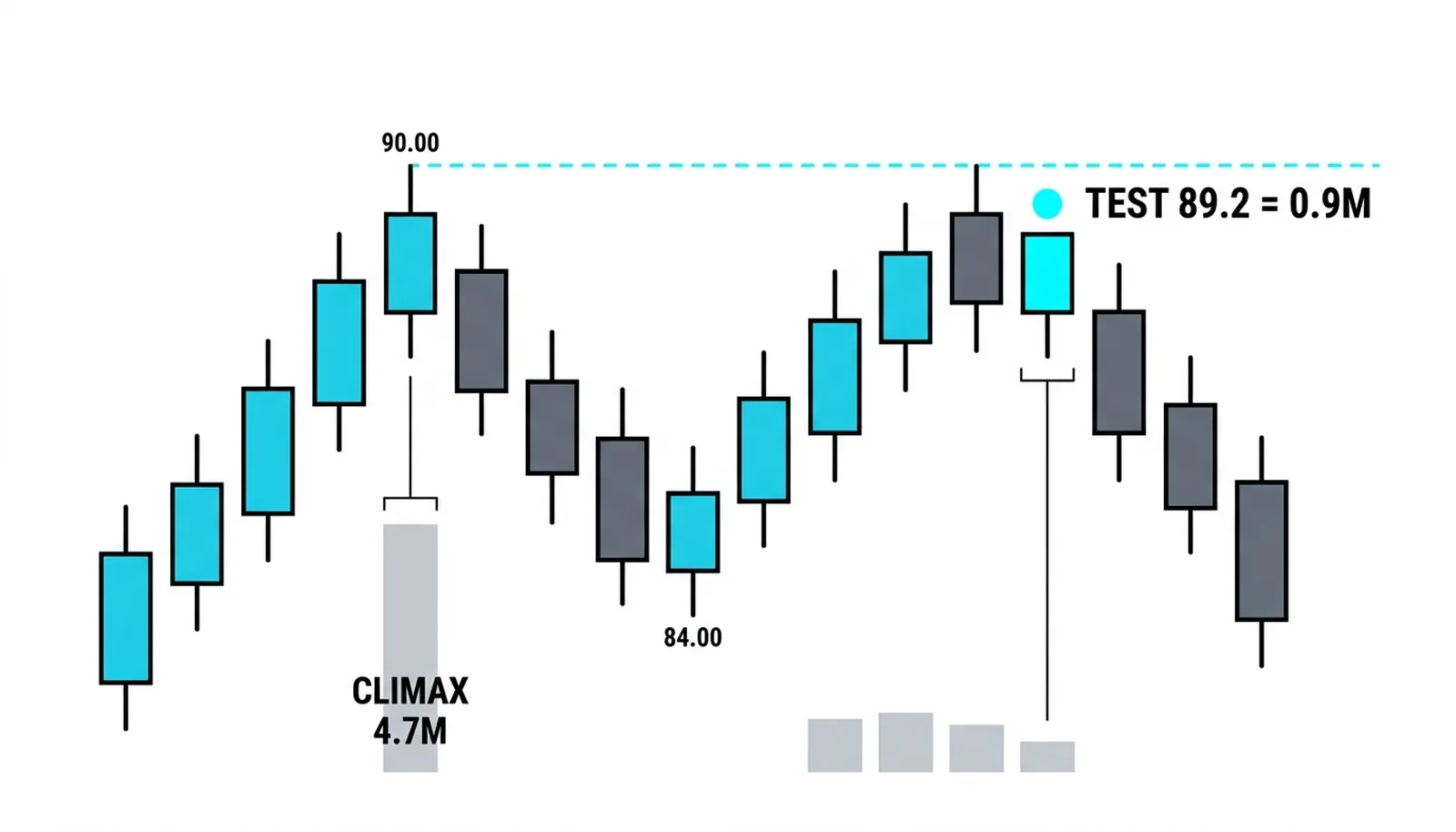
The mirror image works the same way, upside down. After a top or a buying climax, where volume surged and the advance stalled, price reacts downward.
Then the market rallies back up toward the old high. The question now is whether buyers remain. If the rally back arrives on thin volume and fails to push through, the answer is no.
The weak rally is the tell. Buyers had their chance to reclaim the high and could not generate the participation to do it. Demand that looked overwhelming at the climax has quietly left the building.
Watch for the same signatures in reverse: a narrow-spread bar near the high, volume far below the climax reading, and a close that fades off the top of the bar. Each element says the crowd is gone.
Why Low Volume Is the Point
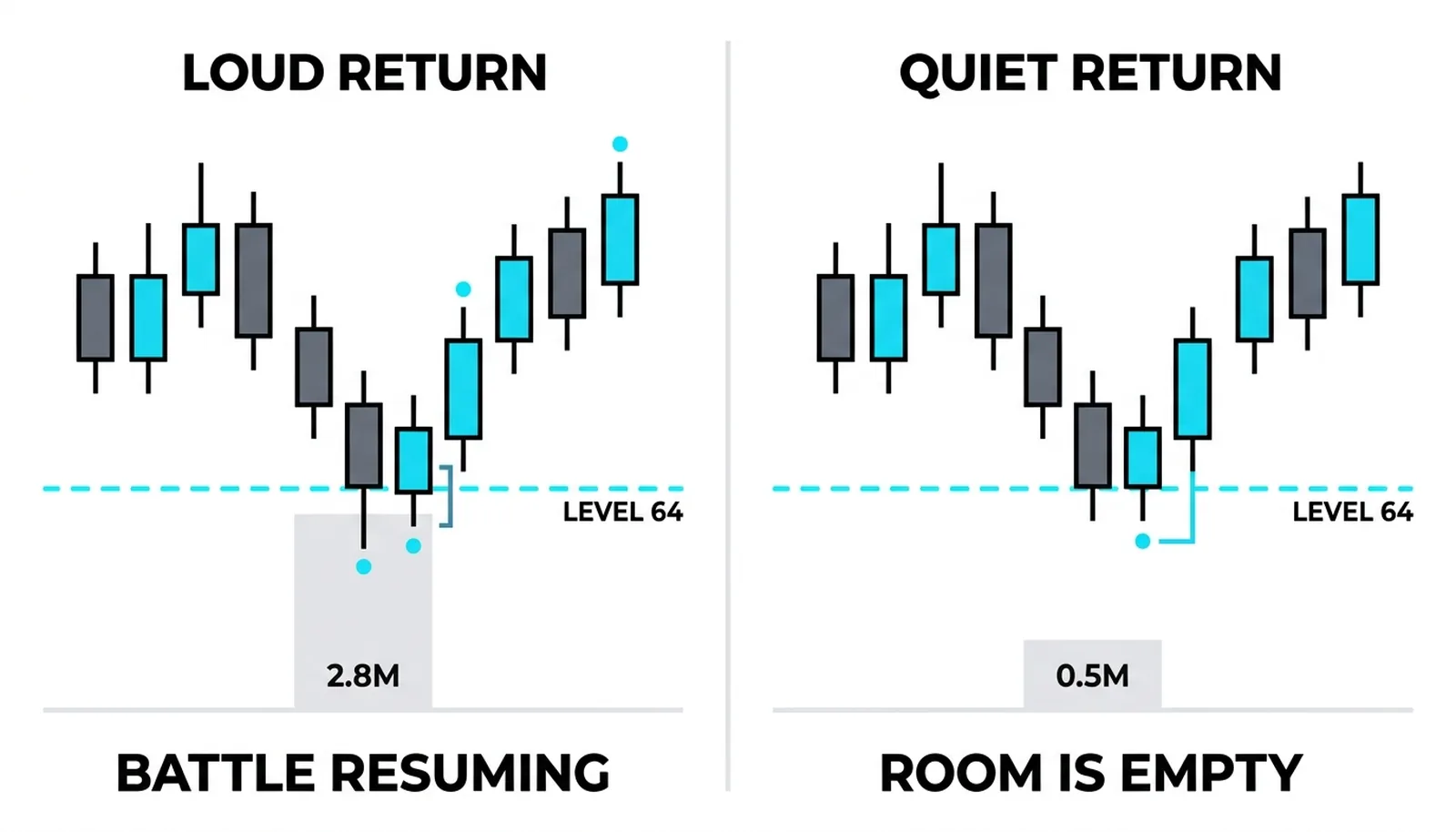
Volume at the retest is a census. When price returns to the scene of heavy trading, the market is counting its remaining participants on the other side.
A quiet return means nobody is waiting to trade against you. The sellers who would dump at that level already dumped. The buyers who would chase at that high already chased. The level is clear.
A loud return means the opposite side was resting, not gone. Heavy volume on the retest is fresh opposition showing up for another round. That is not a test; it is a battle resuming.
The quietest bar in the sequence is the loudest answer.
This is why traders who only watch price get fooled at retests. The price returning to the level looks identical in both cases. The volume separates an empty room from a loaded one.
Scale matters too. A test on a daily chart after a climactic week carries more weight than the same shape on a five-minute chart after a loud hour, for the same reason a bigger battle leaves more to count. The method is identical on every timeframe; the size of the original engagement sets how much the retest can prove.
Failed Tests and Second Tests
Tests fail, and the failure is information. A return on heavy volume that breaks straight through the level voids the read entirely. The other side was not exhausted, and the level does not hold.
When that happens, drop the thesis. The climax low or high was not the turning point it appeared to be, and price is telling you the move has further to go.
Tests also tend to come in pairs. The first return probes the level. The second, often days later, probes it again, and it usually runs on even lower volume than the first.
When the second test holds on lower volume than the first, the confirmation strengthens. Each quiet visit recounts the census and finds fewer opponents. Two passing tests are worth more than one.
One Bottom, Two Tests
Here is a hypothetical sequence with round numbers to show the readings at each stage.
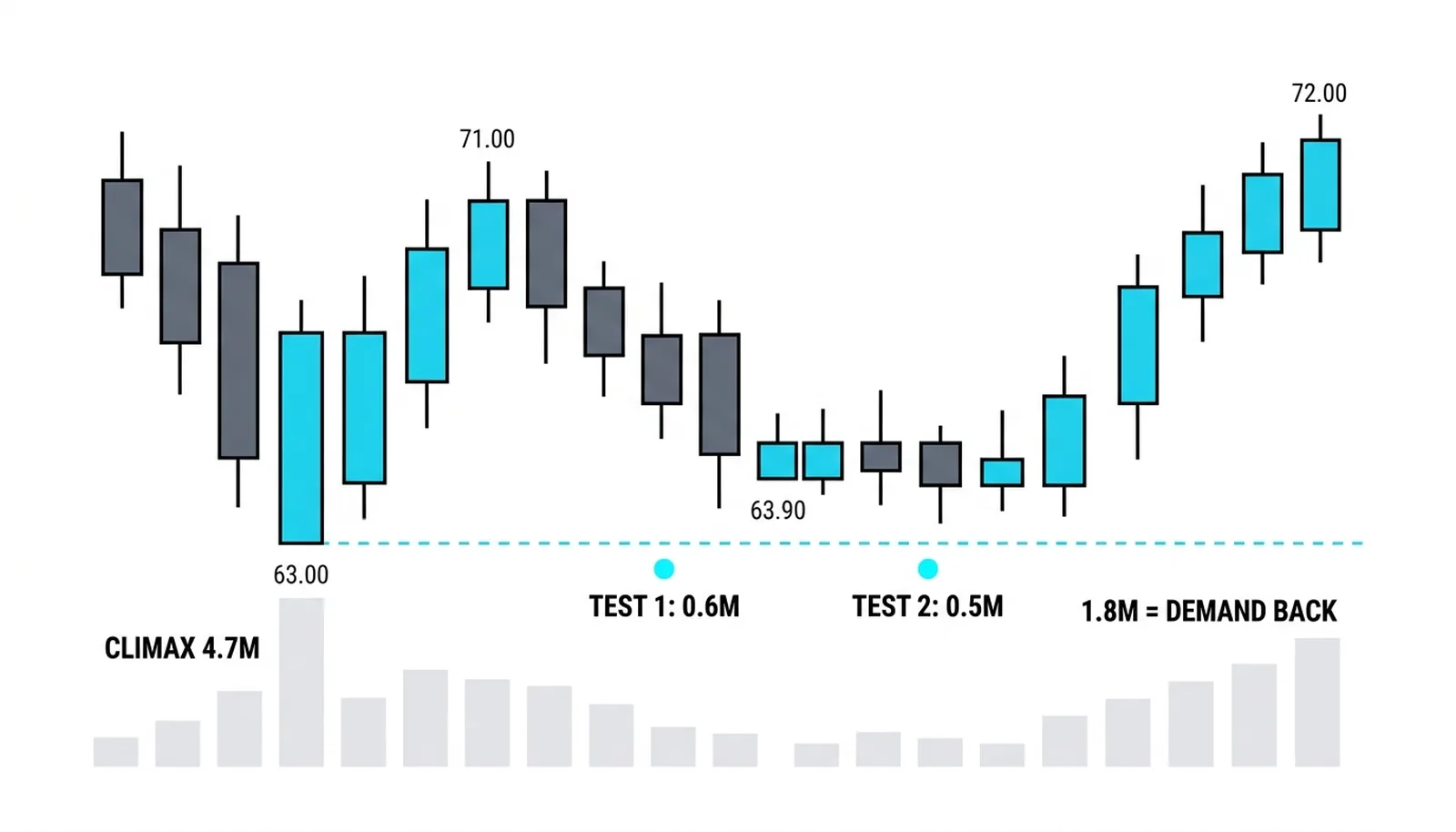
A stock falls into a selling climax and bottoms at 63 on 4.7 million shares. That is the extreme: enormous volume, a stalled decline, and a close off the low. The first question is answered; panic selling reached a peak here.
Price rallies to 71 over the following sessions. Buyers can lift the market, which is necessary but not sufficient. Now the market will check whether sellers are truly done.
The first test comes as price drifts back down to 63.9 on 0.6 million shares and holds. Volume is a fraction of the climax reading. The census finds almost no sellers left at the old battlefield.
A second test follows, touching the same zone on 0.5 million shares, and it holds again. Quieter than the first test, which is exactly the progression you want. The confirmation strengthens.
Price then expands upward on 1.8 million shares. Rising volume on the move away from the level shows demand returning now that supply has been proven absent. The bottom read is complete.
The kill condition matters as much as the confirmations. A return through 62.5 on 2.5 million shares would have voided everything. Heavy volume breaking the level means the sellers were resting, and the whole sequence gets discarded.
| Stage | Volume signature | What it answered |
|---|---|---|
| Climax at 63 | 4.7 million shares, decline stalls | Selling reached an extreme |
| Two tests near 63.9 | 0.6 million, then 0.5 million, both hold | Sellers are gone |
| Expansion upward | 1.8 million shares, price lifts | Buyers are in control |
The Test Bar, Answered
What is a test bar in VSA?
A test bar is a low-volume return to a price area where heavy trading happened before. It checks whether the supply or demand that showed up there the first time is still present.
What does a test of supply look like?
After a decline or selling climax, price rallies, then drifts back down toward the old low on clearly low volume and holds. The quiet return says the sellers are finished.
Why does low volume confirm a test?
Because the retest is a census of remaining participants. If the other side still had ammunition, they would trade heavily when price returns to their level. Silence means the room is empty.
What happens when a test fails?
A return on heavy volume that breaks through the level voids the read. The opposing side was resting rather than gone, the level does not hold, and the prior thesis gets discarded.
Next in this level, effort to rise versus effort to fall takes the same logic and applies it bar by bar, measuring whether the volume being spent is actually producing movement.