Margin: What It Is and How It Is Used
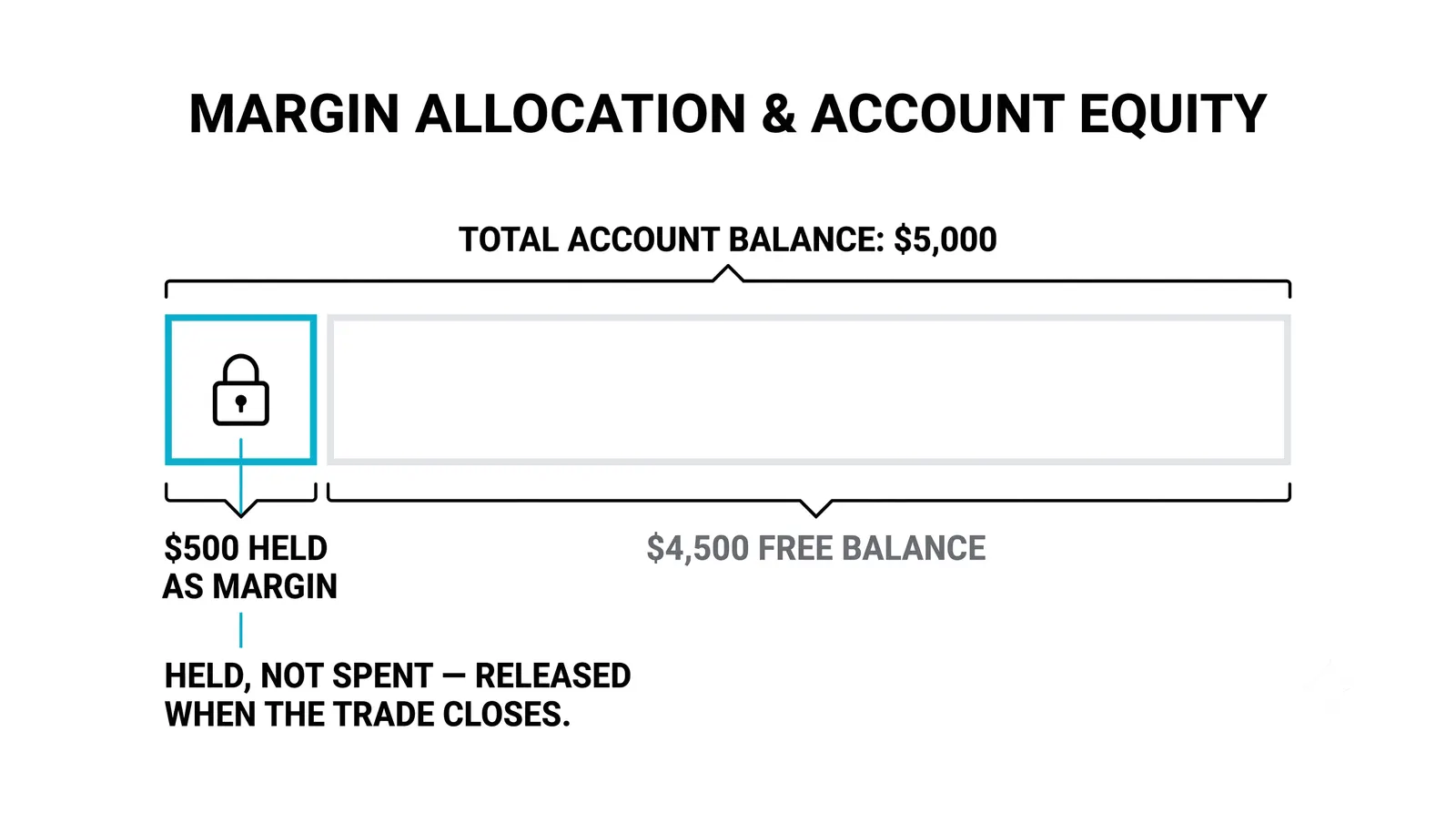
Margin is the deposit you post to open and hold a leveraged position. It is not a cost, not a fee, and not a payment to the broker. It is collateral, held against your potential losses, and you get it back when the position closes.

Think of it as the security deposit on a rented apartment: it is not rent, but losing your damage deposit is very possible.
Most new traders meet margin as a number on a screen and never ask what it actually does. That gap in understanding is where blown accounts begin.
What Margin Actually Is
When you open a leveraged position, your broker sets aside part of your account balance as a guarantee. That set-aside amount is your margin. The broker holds it. It does not spend it, and it does not charge it to you.
Two numbers matter from the moment you trade. The first is used margin, the amount locked up to keep your open positions alive. The second is free margin, whatever is left in the account and available to open new positions or absorb losses.
Used margin plus free margin equals your equity. Equity is your balance adjusted for the floating profit or loss on open trades. It moves tick by tick.
Then there is margin level, the health gauge of your account. It is your equity divided by your used margin, expressed as a percentage. High margin level means breathing room. A margin level sliding toward 100 percent means your equity is shrinking down to the size of your deposit, and the broker is about to step in.
The Life of One Position
Follow a single trade from open to close and the mechanics become obvious.
- You open the position. The broker locks the required margin from your account. That money is now untouchable.
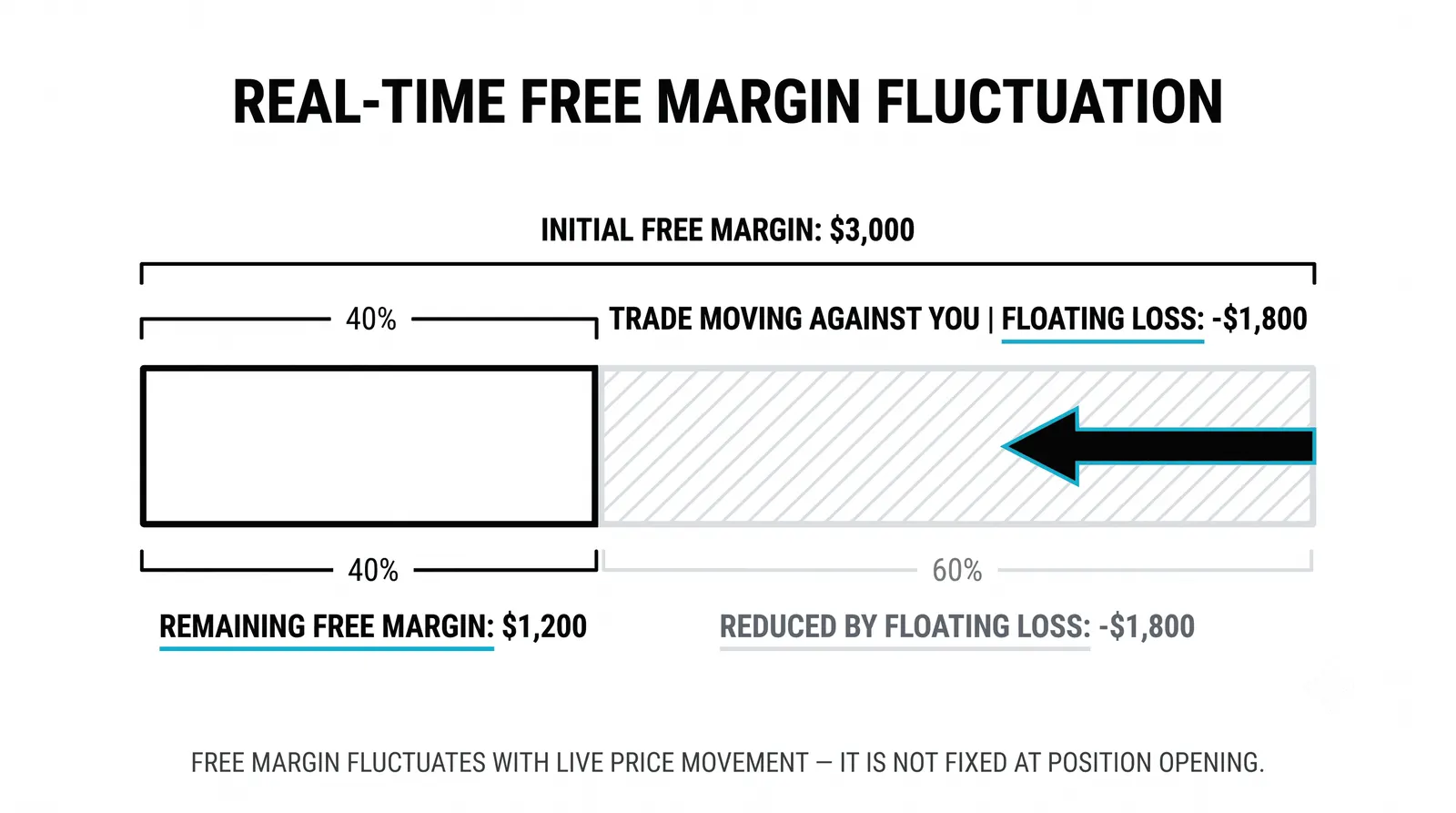
- The position runs. Every price movement changes your floating profit or loss, which changes your equity. The used margin stays fixed the whole time.
- Your free margin rises and falls with equity, because free margin is just equity minus used margin.
- You close the position. The broker releases the deposit back to you, plus your profit or minus your loss.
Notice what never moved: the used margin. The deposit is static. Everything dangerous happens in the equity line around it.
What Margin Makes Possible, and What It Hides
Margin exists so a small account can control a large position. With a 5 percent margin requirement, $500 controls a $10,000 position. In one sentence, that is why people trade with borrowed size.
Here is the blunt truth: the deposit is not your risk.
Your risk is the full position size. A 3 percent move against a $10,000 position is a $300 loss, whether you posted $500 or $5,000 to open it. Margin changes how much cash you need up front. It changes nothing about how much the market can take from you.
The dangerous confusion is looking at the small margin figure and feeling safe. The number on the margin line looks like the stake. It is not. It is the entry ticket, and the actual exposure sits quietly behind it, ten or twenty times larger.
A Worked Example With Round Numbers
Hypothetical scenario, for illustration only. You have a $1,000 account. You open a $10,000 position with a 5 percent margin requirement, so you post $500 as used margin. Your free margin is $500.
The position drops 3 percent. That is a $300 loss on the full position size. Your equity falls to $700. Your used margin is still $500. Your margin level is now 700 divided by 500, which is 140 percent.
The market moves another 2 percent against you. That is roughly another $200. Equity slides to about $500, the same as your used margin. Margin level hits 100 percent.
At 100 percent, you have no free margin left. Every dollar of equity is spoken for. This is the line where the broker starts acting, first with warnings, then with forced closure if things get worse. A 5 percent move in the market just consumed half your account, because your position was ten times your deposit.
The Numbers of One Position
Here is that same account at the moment equity sits at $700, with each term defined.
| Term | Value | What It Means |
|---|---|---|
| Account balance | $1,000 | Your closed-trade total, before counting open positions |
| Used margin | $500 | The deposit locked to hold the open position |
| Free margin | $200 | Equity minus used margin; available for new trades or further losses |
| Equity | $700 | Balance plus floating profit or loss; your real-time account value |
| Margin level | 140% | Equity divided by used margin; the account health gauge |
Watch these five numbers on any demo trade and the whole system clicks into place. They are not abstractions. They are the dashboard of every leveraged account you will ever run.
Where Margin Calls Come In
A falling margin level is how a margin call begins. When equity erodes toward the used margin, the broker's protections trigger in stages: warnings, restrictions on new trades, and finally forced liquidation of your positions.
That process has its own mechanics, its own thresholds, and its own lesson. The dedicated margin call lesson covers exactly how brokers intervene and how to stay far away from that line. For now, hold one idea: margin level is the early warning system, and you should be watching it long before the broker is.
Questions About Margin
Is margin a fee?
No. Margin is collateral, not a charge. The broker holds it while your position is open and returns it when you close. Fees in trading are things like spreads, commissions, and swap charges. Margin is separate from all of them.
How much margin should I use?
As little as your trade plan allows. Using a small fraction of your available margin keeps your margin level high and gives losing trades room to breathe. Traders who commit most of their account as margin are one ordinary losing streak away from forced liquidation.
What happens to my margin if I win?
You get it back in full, plus your profit. When a winning position closes, the broker releases the used margin and credits the gain to your balance. The deposit was never at risk of being kept; only the market's judgment of your trade decides what you walk away with.
What is a safe margin level?
There is no universal number, but many experienced traders treat anything below 500 percent as a sign they are overexposed, and anything approaching 100 percent as an emergency. The higher your margin level, the more adverse movement your account can absorb before the broker intervenes.
Next, you will look at margin calls in detail: the exact thresholds brokers use, the sequence of events when an account runs out of room, and the position-sizing habits that keep you permanently clear of that situation.