Lots, Pips, and Units — per Asset Class
Lots, pips, and units are the measuring systems every market uses to describe position size and price movement, and you cannot control your risk until you know what one unit of movement is worth in your account currency. Every asset class speaks its own dialect. Forex talks in lots and pips. Stocks talk in shares and dollars. Futures-style contracts talk in points and ticks. Crypto just talks in coins.

Trading across markets without knowing the units is like driving through countries without knowing whether the signs are in miles or kilometers; the speed feels the same and the consequences are not. This lesson translates each system, then shows the same risk taken four different ways.
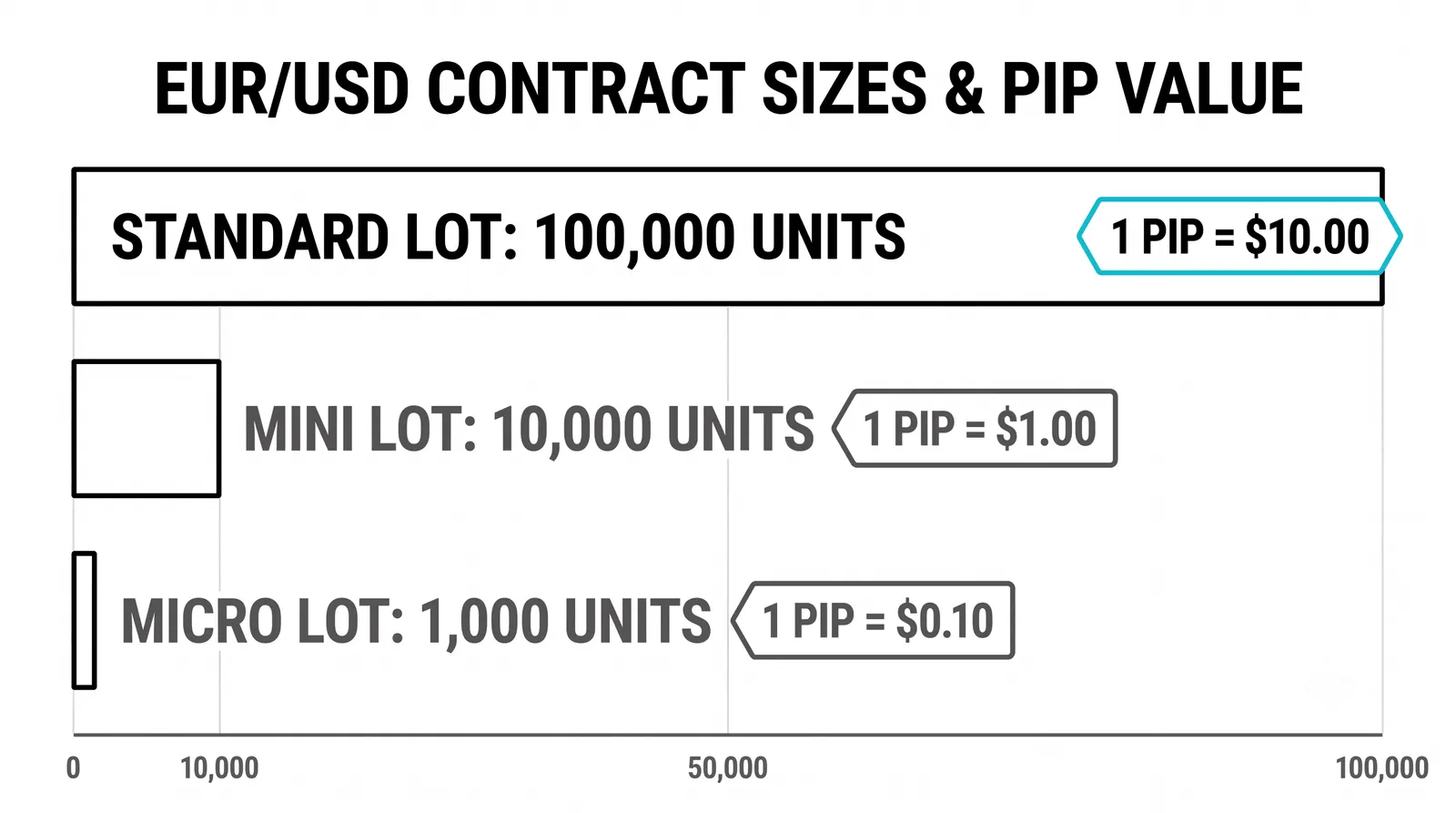
The Forex Vocabulary: Lots and Pips
In forex, a lot is a position size, not a price. The standard sizes are fixed:
- Standard lot: 100,000 units of the base currency.
- Mini lot: 10,000 units.
- Micro lot: 1,000 units.
A pip is the standard price increment. For most pairs it is the fourth decimal place, 0.0001. When EUR/USD moves from 1.0850 to 1.0851, that is one pip.
Risk lives in the next step. By convention, one pip of movement is worth roughly 10 units of the quote currency per standard lot, 1 per mini lot, and 0.10 per micro lot. On EUR/USD, where the quote currency is the dollar, one pip on one mini lot is about $1.
So a 20-pip stop on two mini lots is a $40 risk. The arithmetic is simple once you hold the conversion in your head. Without it, a "20-pip stop" is just a number with no meaning attached.
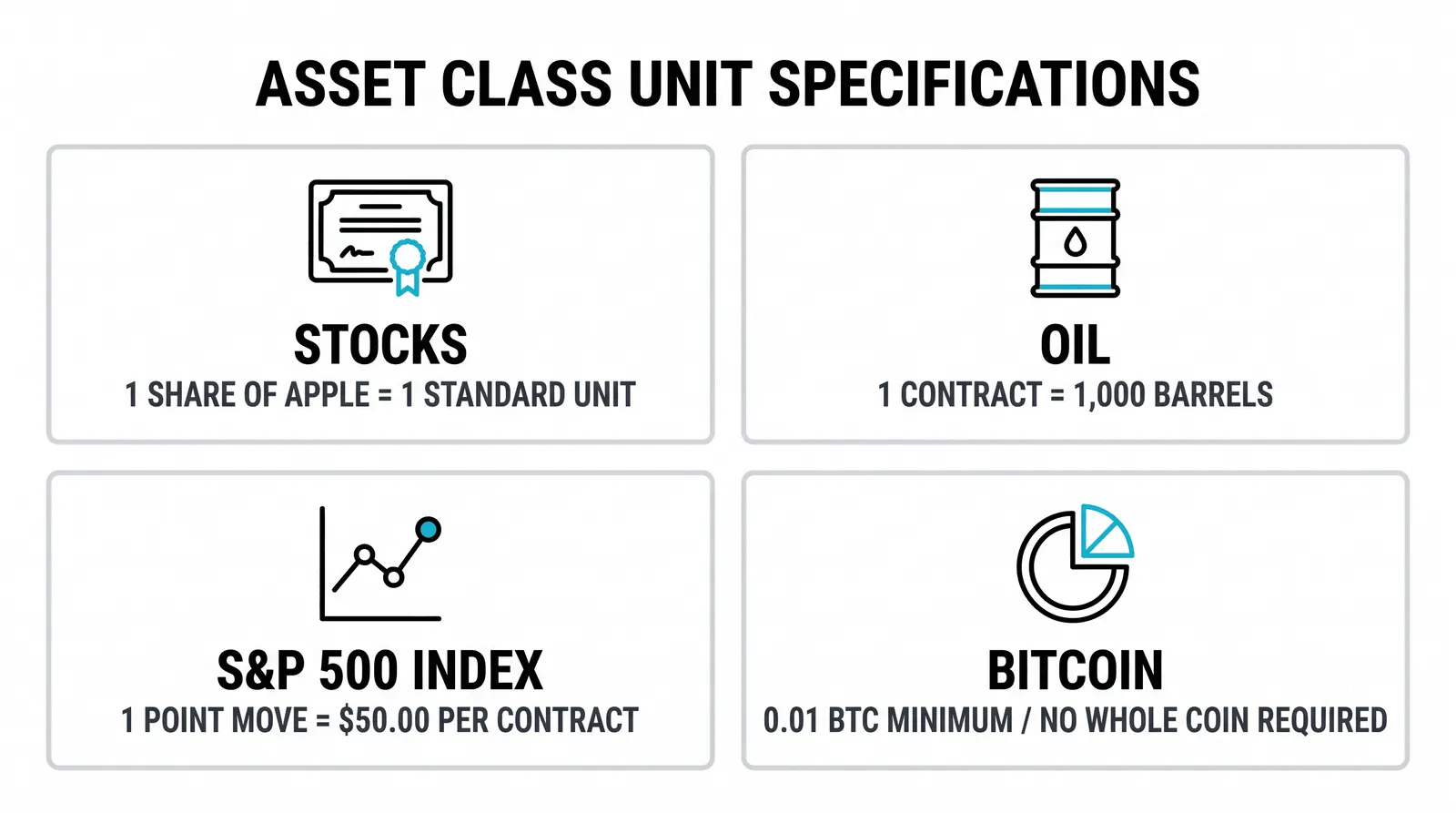
Stocks: Shares and Dollars
Stocks are the most direct system you will meet. Your position size is a number of shares. Price moves in dollars and cents, and people say "points" when they mean whole dollars of price movement.
Risk is per share, so the math needs no conversion at all. Buy 100 shares with a stop $2 below your entry, and your risk is $200. The calculation is that short.
This simplicity is why many traders find position sizing easiest to learn on stocks first. The unit of size and the unit of movement are both already in your account currency.
Index and Commodity Contracts: Points, Ticks, and Multipliers
Index and commodity markets trade in contracts, and each contract carries a fixed multiplier set by the exchange. One point of index movement might be worth a fixed currency amount per contract. If the multiplier is $10 per point, a 15-point move is $150 per contract, for you or against you.
Commodity contracts work the same way but add a physical quantity. One contract represents a fixed amount of the underlying, and the smallest price increment, the tick, is worth a fixed sum of money. You do not need to memorize every contract specification. You do need to look it up before you trade it.
The multiplier is where new futures traders get hurt. A stop that looks small in points can be large in money once the multiplier is applied. Check the contract specification first, size second.
Crypto: Just Coins and Price
Crypto strips the system down to its simplest form. You hold units of the coin. There is no lot ladder and no contract multiplier.
Risk is position size times price change. Hold 0.5 of a coin and the price drops 800, and you are down 400. The unit of size and the unit of movement are both visible on the screen in front of you.
The trap here is not the units but the size of the numbers. A coin priced at 60,000 moves in thousands, so even a small fraction of a coin carries real risk. The math is easy. The discipline is not.
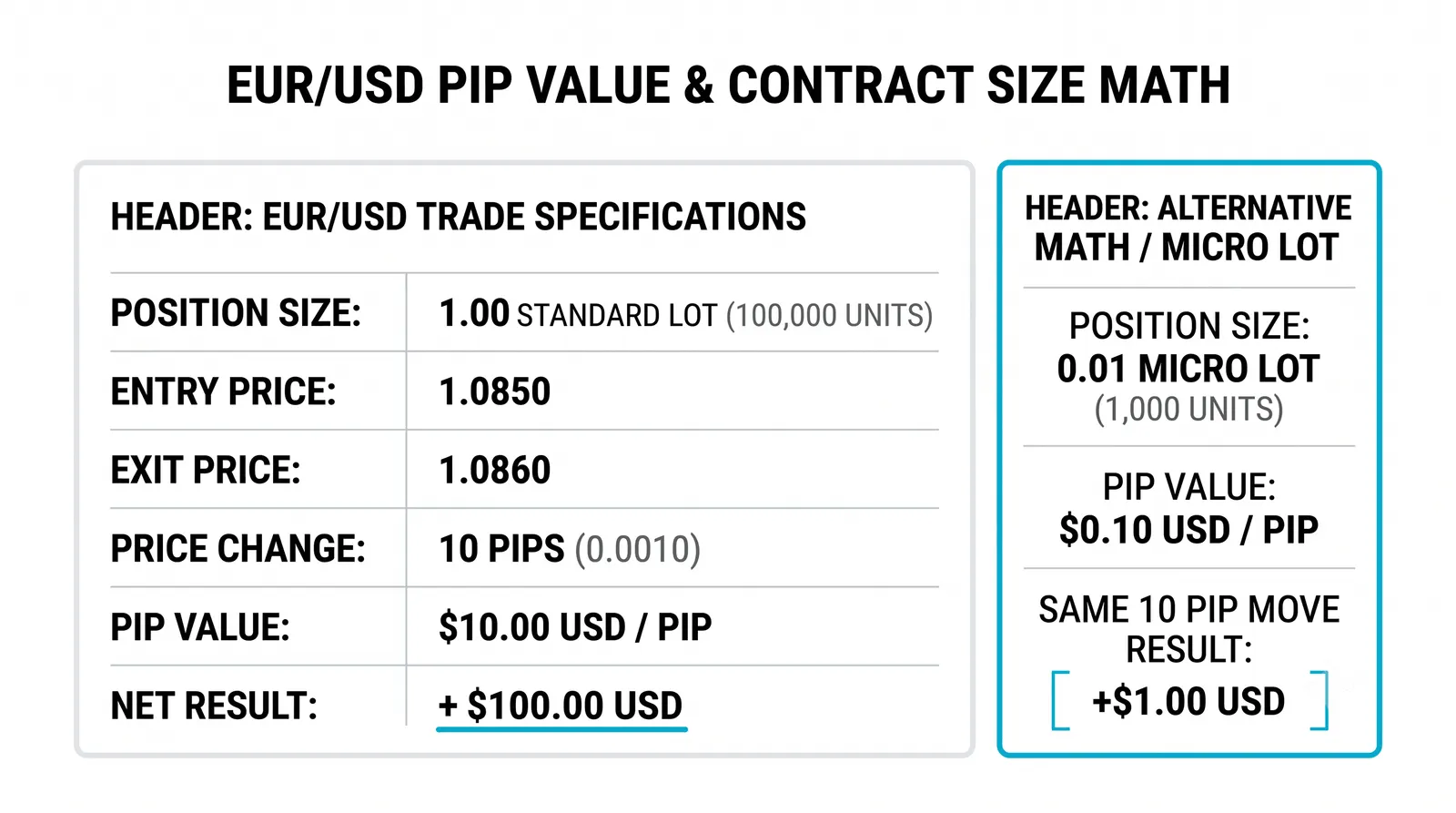
One Risk, Four Markets: A Worked Example
Here is a hypothetical with round numbers. You decide to risk exactly $200 on a trade, and you take that same risk in four different markets.
- Forex: 10 mini lots with a 20-pip stop. At $1 per pip per mini lot, that is 10 × 20 × $1 = $200.
- Stocks: 100 shares with a $2.00 stop. 100 × $2 = $200.
- Index: 1 contract worth $10 per point with a 20-point stop. 1 × 20 × $10 = $200.
- Crypto: 0.2 of a coin with a stop 1,000 points below entry. 0.2 × 1,000 = $200.
Four markets, identical risk, four completely different unit systems. The position sizes look nothing alike: 10 mini lots, 100 shares, 1 contract, 0.2 of a coin. Yet each one loses exactly $200 if the stop is hit.
That is the skill this lesson is building. You start from the risk in your account currency and work backward into whatever units the market speaks.
Why the Conversion Step Matters
A stop distance means nothing until it is multiplied by what one unit of movement costs you. "My stop is 15 points away" is half a sentence. The other half is "and each point costs me $10 per contract, on 3 contracts."
Traders who skip this step routinely risk five or ten times what they intended. They pick a position size that feels normal, place a stop that looks reasonable on the chart, and only discover the true risk after the trade is closed. By then it is a lesson paid for in cash.
Run the conversion before every order, in every market, every time. It takes twenty seconds and it is the cheapest insurance in trading.
The Units at a Glance
| Asset Class | Size Unit | Movement Unit | What One Movement Unit Is Worth |
|---|---|---|---|
| Forex | Lot (standard, mini, micro) | Pip (usually 0.0001) | About 10 / 1 / 0.10 of quote currency per standard / mini / micro lot |
| Stocks | Share | Dollar (point) | $1 per share per $1 move |
| Indices | Contract | Point | Fixed multiplier per contract, e.g. $10 per point |
| Commodities | Contract (fixed quantity) | Tick / point | Fixed cash amount per tick per contract |
| Crypto | Coin (or fraction) | Price point | Position size × price change, no multiplier |
Questions About Lots, Pips, and Units
What is a pip worth in my account currency?
A pip is worth whatever the quote-currency value converts into in your account currency. If your account is in dollars and you trade EUR/USD, the quote currency is already dollars, so one pip is about $10 per standard lot, $1 per mini, $0.10 per micro. If the quote currency is something else, like yen or francs, your platform converts it automatically, but you should know the approximate figure before you size the trade.
How do I calculate position size from my risk?
Divide your intended cash risk by what one unit of movement costs, then by your stop distance. Risk $200, stop is 25 pips, each pip is $1 per mini lot: $200 ÷ 25 = $8 per pip, so 8 mini lots. The formula is the same shape in every market; only the unit names change.
Do I need to memorize all the units?
No. You need to memorize the system you trade most and know how to look up the rest. Contract multipliers and tick values are published by every exchange and broker. What you must internalize is the habit: never enter a trade until you have converted the stop distance into cash.
Which market has the simplest units?
Crypto and stocks tie for simplest, because both express size and movement in units you already think in. Forex adds one conversion layer with lots and pips. Index and commodity contracts add the multiplier, which is the layer most likely to surprise you.
Once these conversions feel automatic, the next step is putting them to work: Turning a fixed percentage of your account into a position size on every trade. That is where position sizing stops being vocabulary and becomes a risk system.