Cost of Trading — the Real Math
The cost of trading is the total you pay to enter and exit a position, and active traders pay three costs on every round trip: the spread, the commission, and slippage, with a fourth line for leveraged positions held overnight. Each one looks small on its own. Together, multiplied by your trading frequency, they set a hurdle your profits must clear before you earn anything at all.

Most new traders never add these numbers up. They track wins and losses and ignore the meter running underneath. That is a mistake, because the meter runs on losers and winners alike. Every trade is a taxi ride: the meter starts the moment the doors close, and it runs whether the traffic moves or not.
The Spread: The Gap You Always Pay
Every instrument quotes two prices. The bid is where you can sell. The ask is where you can buy. The gap between them is the spread, and you cross it every time you trade.
You enter on one side and exit on the other, so the spread is paid on every round trip. Buy at the ask, sell at the bid, and the gap is gone from your account before the market moves a tick in either direction.
Size varies enormously. Deep, liquid instruments like major currency pairs or large index products charge fractions of a percent. Thin markets, exotic pairs, and quiet hours charge multiples of that. The same strategy can be cheap in one instrument and ruinous in another.
Commission: The Explicit Fee
Commission is the broker's stated charge, billed per trade or per round trip. It is the one cost printed clearly on the receipt, which is why traders fixate on it.
That focus is misplaced. Zero-commission products usually recover the fee inside a wider spread. The broker still gets paid; the line just moved. The honest comparison is total cost per round trip, not one line of the receipt.
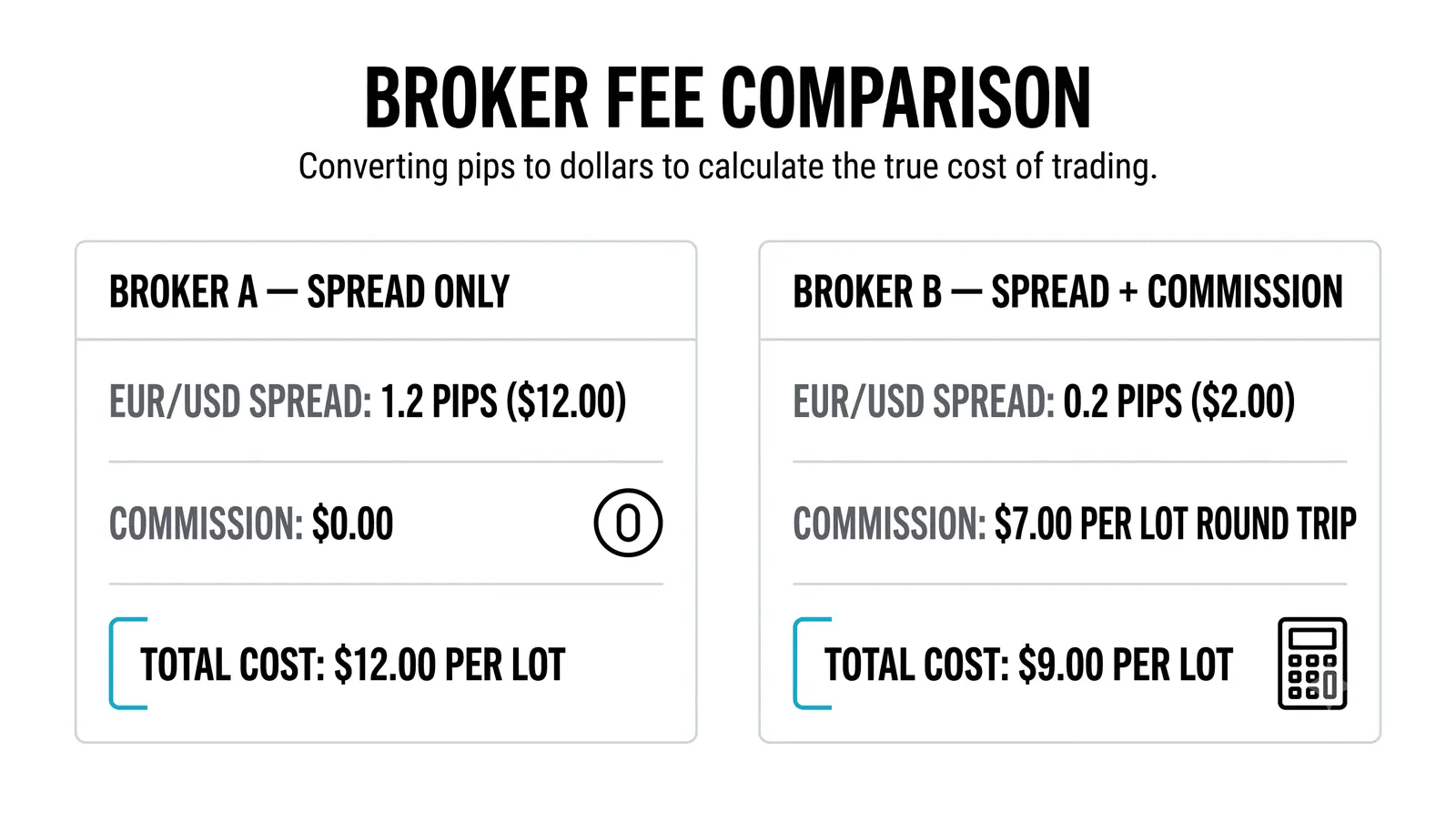
When you evaluate a broker, add the spread and the commission together for the instruments you actually trade. A two-dollar commission with a wide spread can cost more than a five-dollar commission with a tight one.
Slippage: The Price You Intended Versus the Price You Got
Slippage is the distance between the price you expected and the price you received. You clicked at one number; the fill came at another. The difference is yours to keep, and it is rarely in your favor.
It grows in fast markets, around news releases, and in illiquid hours. A stop order triggered during a news spike can fill far past your level. That gap is slippage, and no setting removes it entirely.
Order type is the trade-off. Market orders guarantee a fill and pay whatever slippage the moment demands. Limit orders cap the price but sometimes do not fill at all. You choose between a certain cost and an uncertain entry.
The Fourth Line: Overnight Financing
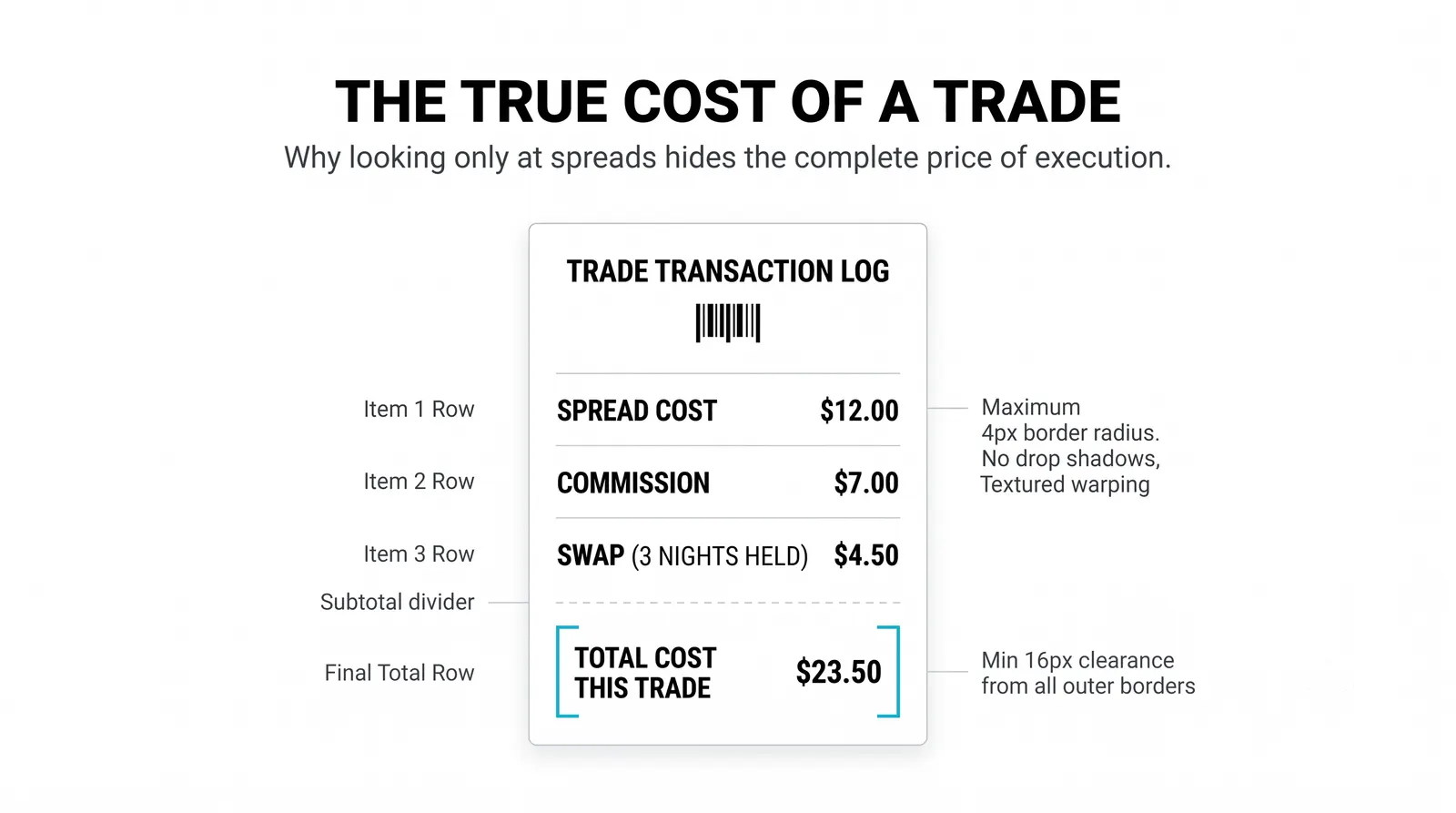
A leveraged position, common in CFDs and other margin products, pays or earns a swap charge when held past the daily cutoff, and it belongs in the same ledger as everything else. The dedicated lesson on overnight financing covers the mechanics; here, just know the line exists and grows with time and size.
Why Frequency Multiplies Everything
Costs are charged per round trip. That single fact reshapes the math of every trading style. Two hundred round trips at four dollars each is eight hundred dollars gone before direction ever mattered.
This is where many active traders fool themselves. A scalper's high win rate can be entirely real and entirely unprofitable at the same time. Winning seventy percent of the time means nothing if each round trip carries a toll that eats the average win.
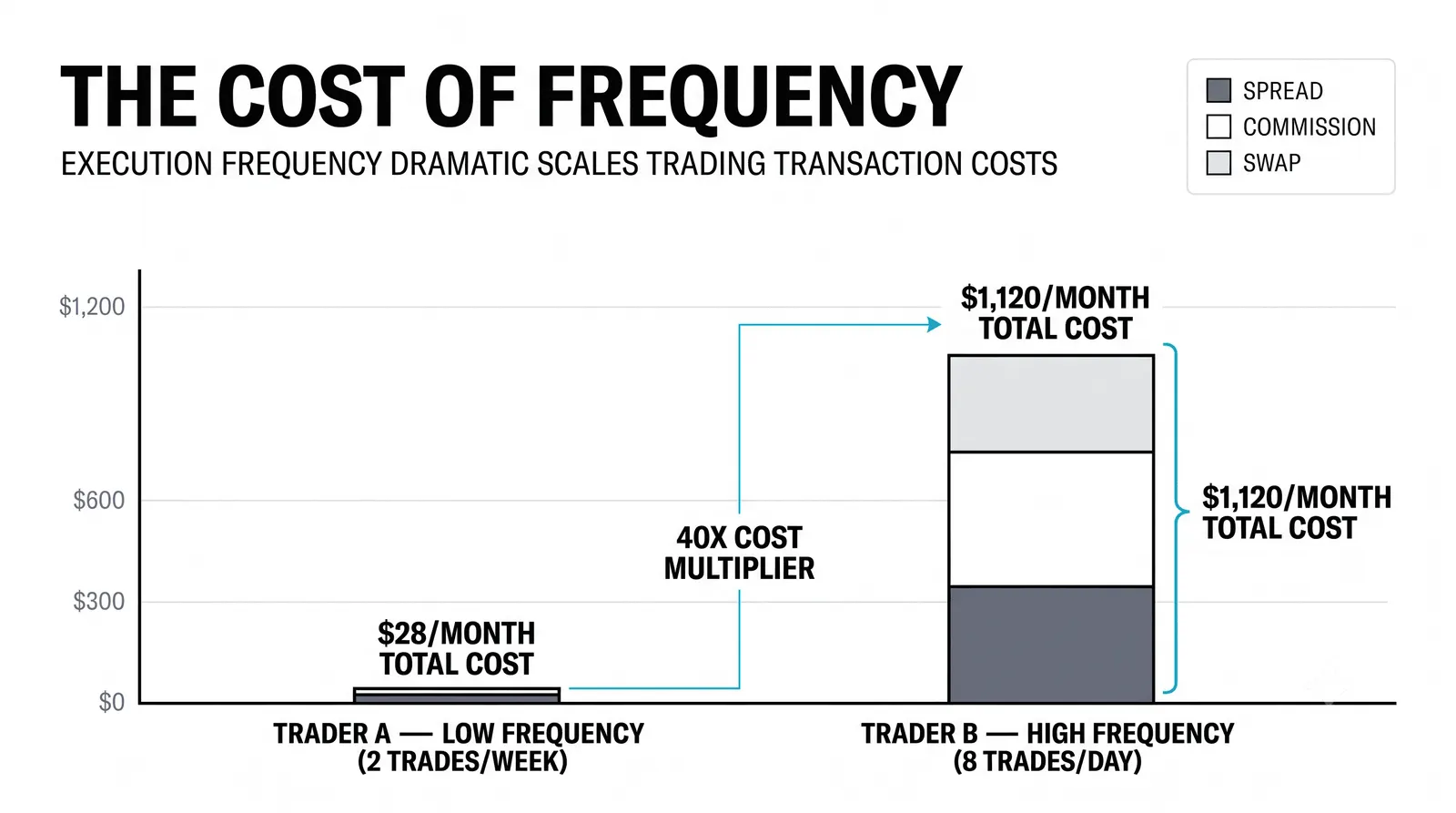
Trading more raises the hurdle, not just the opportunity. Each additional trade is another meter running. The question is never only "is this a good trade" but "is this trade good enough to pay its toll and still leave something."
A Worked Example With Round Numbers
Consider a hypothetical trader with a 10,000 account who day trades five times a week. Spread plus commission average 6 per round trip. Slippage averages 2. Total cost: 8 per trip.
Twenty round trips a month at 8 each is 160. That is 1.6 percent of the account spent before any direction, any skill, any edge. The trader must earn 1.6 percent in a month just to stand still.
Now the swing trader next door. Same account, same per-trip cost of 8, but only four round trips a month. The bill is 32, a 0.3 percent hurdle. Same market, same skill, a five-times difference in the starting line. Frequency alone created that gap.
How to Shrink the Bill
You cannot eliminate trading costs, but you can cut them hard. The levers are few and they all work.
- Trade less and better. Cost per opportunity is the filter. Fewer, higher-quality trades lower the monthly toll without lowering your edge.
- Pick instruments with tight spreads for your style. A scalper needs the deepest liquidity available. A position trader has more room.
- Use limit orders where the style allows. Capping your entry price removes slippage on that side, at the cost of occasional missed fills.
- Measure your own totals monthly. Sum every spread, commission, and slippage cost for the month. Most traders have never once done this. The number usually changes behavior on its own.
The Four Costs Side by Side
| Cost | When It Is Paid | Typical Size | How to Reduce It |
|---|---|---|---|
| Spread | Every round trip | Fractions of a percent in liquid markets; multiples of that in thin ones | Trade liquid instruments and active hours |
| Commission | Per trade or per round trip | Fixed fee, or hidden inside a wider spread | Compare total round-trip cost, not the headline fee |
| Slippage | At execution, especially in fast or thin conditions | Near zero in calm liquid markets; large around news | Use limit orders; avoid news moments and dead hours |
| Overnight financing | Leveraged positions held past the daily cutoff | Small daily, compounding with time and size | Shorten holding time or reduce position size |
Questions About the Cost of Trading
Do I pay the spread on both sides of a trade?
Effectively, yes. You buy at the ask and sell at the bid, so the full gap is captured across the round trip even though no one bills you a line item called "spread."
Is low commission always cheaper?
No. A low or zero commission often comes packaged with a wider spread, and the total round-trip cost is the only number that matters. Add both lines before comparing brokers.
How much slippage is normal?
In calm, liquid markets with modest size, slippage is often near zero. Around news releases, in fast moves, or in thin hours, it can exceed the spread itself. Track your intended price against your fills for a month and you will know your own normal.
How do I calculate my true cost per trade?
Add the spread you crossed, the commission charged, and the slippage between your intended and actual fill prices, for both entry and exit. Divide the monthly total by your number of round trips. That average is the toll every trade must repay before profit begins, and it is the number your risk per trade has to absorb rather than ignore.
Once you know your true per-trade cost, the next question is how it interacts with holding time and borrowed capital. The overnight financing lesson takes that fourth line apart and shows exactly what keeping a leveraged position open past the cutoff does to the math.