Revenue Growth and Profit Margins
Revenue growth measures how fast a company's top line expands, and profit margins measure how much of each sale survives as profit. Read separately, they flatter and deceive in opposite directions. Read together, they tell you whether a business is getting healthier or merely bigger.

Think of them as two dials on one health check. One dial shows speed. The other shows efficiency. A lemonade stand that doubles its sales and doubles its costs has grown in every way except the one that matters. You will see the same pattern in public companies, quarter after quarter, dressed up in press releases that lead with the dial that looks best.
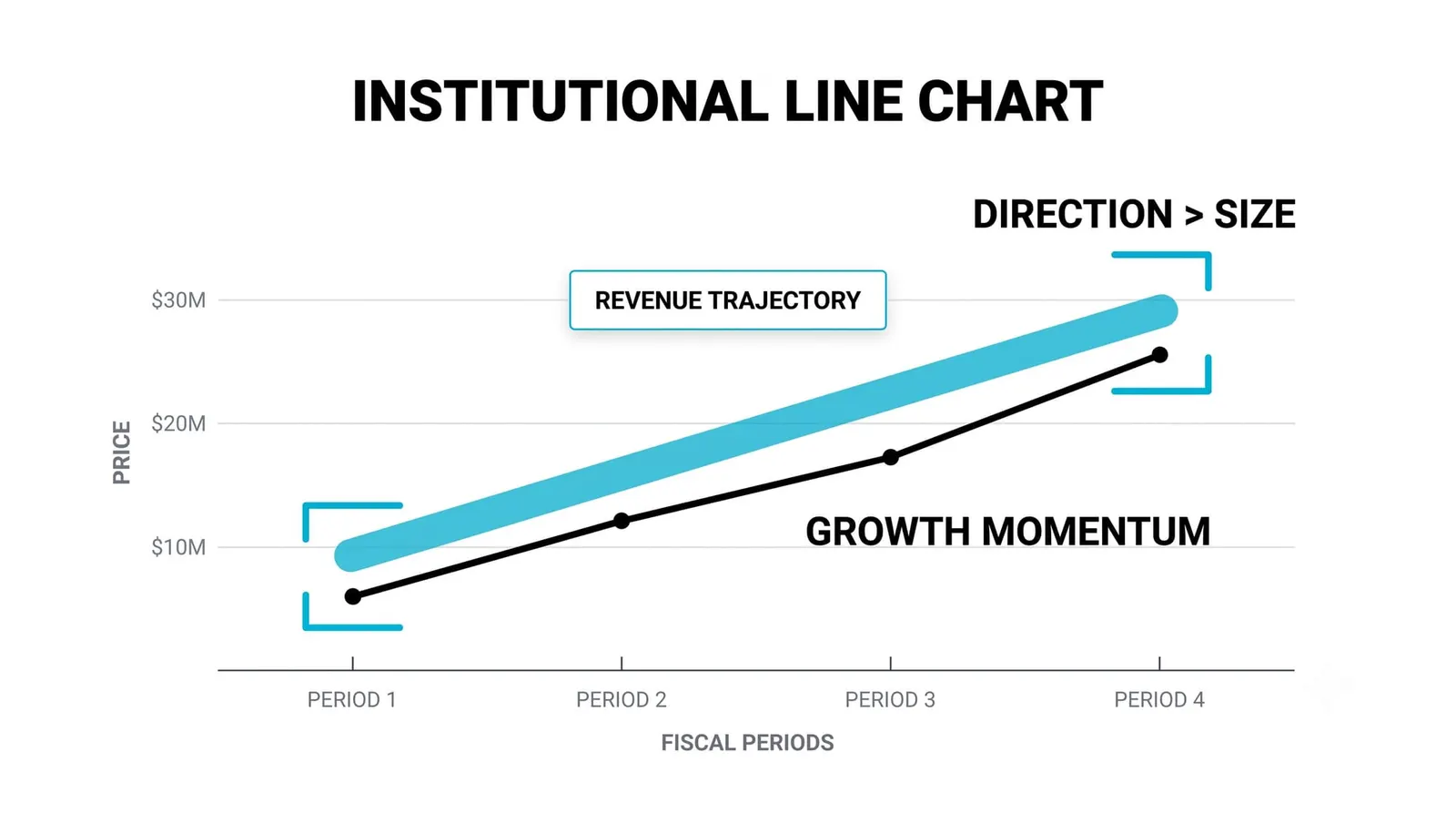
Revenue Growth: Why the Direction Matters More Than the Number
A single growth figure tells you almost nothing on its own. What you want is the trend of the growth rate itself. A company growing at 20 percent a year sounds strong until you learn it grew at 40 percent the year before. The level is high. The direction is down.
Growth comes in three shapes. Accelerating growth means each period's expansion is faster than the last. Steady growth holds roughly the same pace. Decelerating growth means the business still expands, but more slowly each period. Markets react hardest to changes in direction, because prices are built on expectations, and a slowdown breaks expectations even when the absolute number looks fine.
Then ask where the growth came from. Organic growth means the existing business sold more of what it already sells. Bought growth comes from discounting heavily or acquiring other companies and bolting their revenue on. Both raise the top line. Only the first one proves customers want the product at its real price.
So when you see a headline growth number, ask two questions. Is the rate rising or falling? And did the company earn it or purchase it?
Profit Margins: What's Actually Left Over From Each Sale
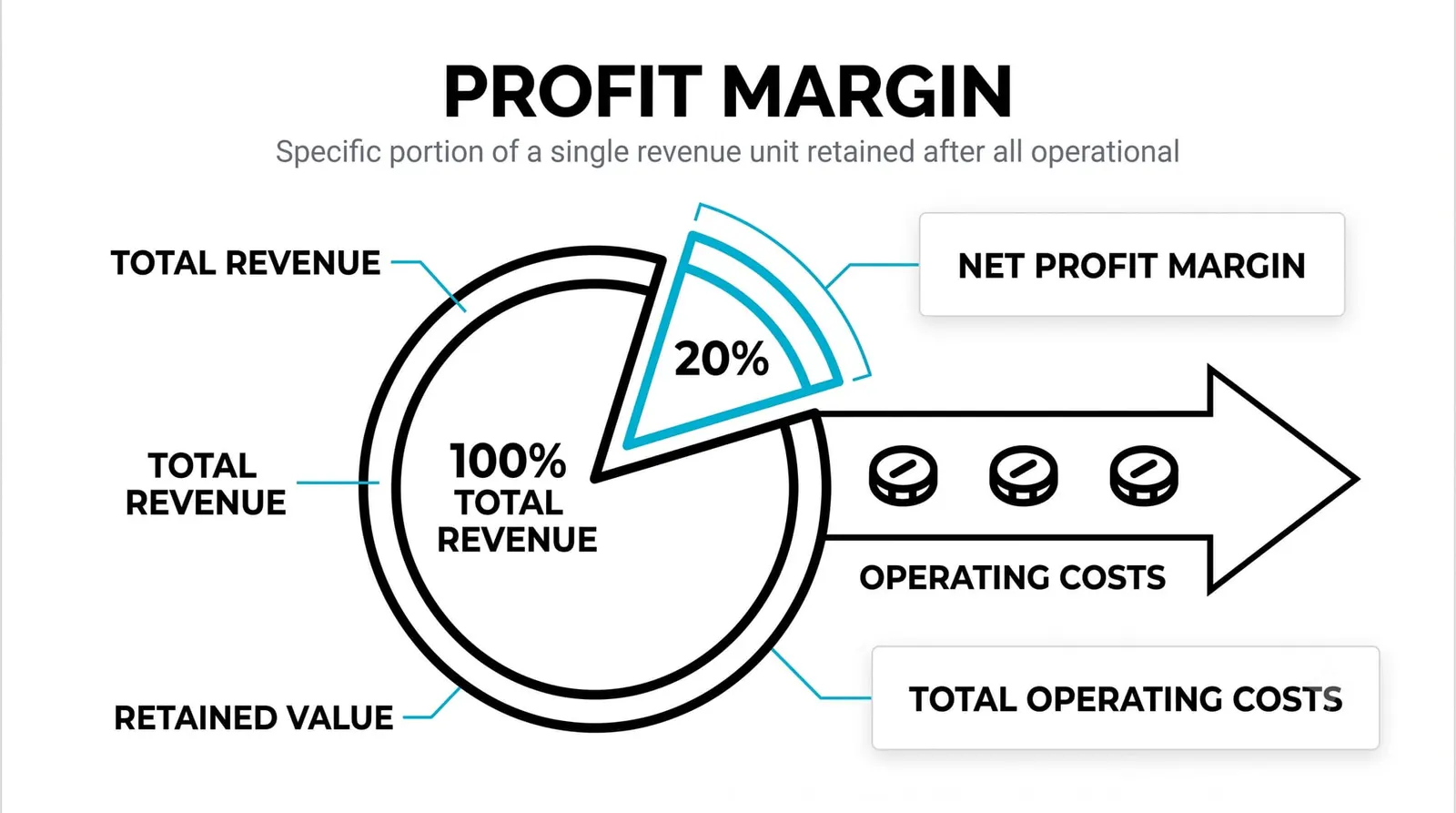
Margins come in three standard layers, each one stripping out more costs. Gross margin is what remains after the direct cost of making the product. Operating margin is what remains after running the business: salaries, rent, marketing. Net margin is what remains after everything, including interest and taxes. That last line is the profit shareholders actually own.
Margins move with scale because of how costs behave. Fixed costs, like a factory lease or a software platform, stay flat whether you sell a little or a lot. Variable costs rise with every unit sold. A business heavy in fixed costs sees margins expand as revenue climbs, because the same overhead gets spread across more sales. The reverse is also true: when revenue falls, those fixed costs crush margins fast.
A margin is also pricing power made visible. A company that holds its gross margin steady while raising prices has customers who accept the increase. A company that watches gross margin erode is competing on price, and that is a treadmill nobody wins for long.
Earlier in this cluster you worked through earnings per share, which is the net line divided across shares. Margins are the machinery underneath that number. Later in this level, the income statement lesson will walk the full report line by line; for now, treat margins as the three checkpoints along it.
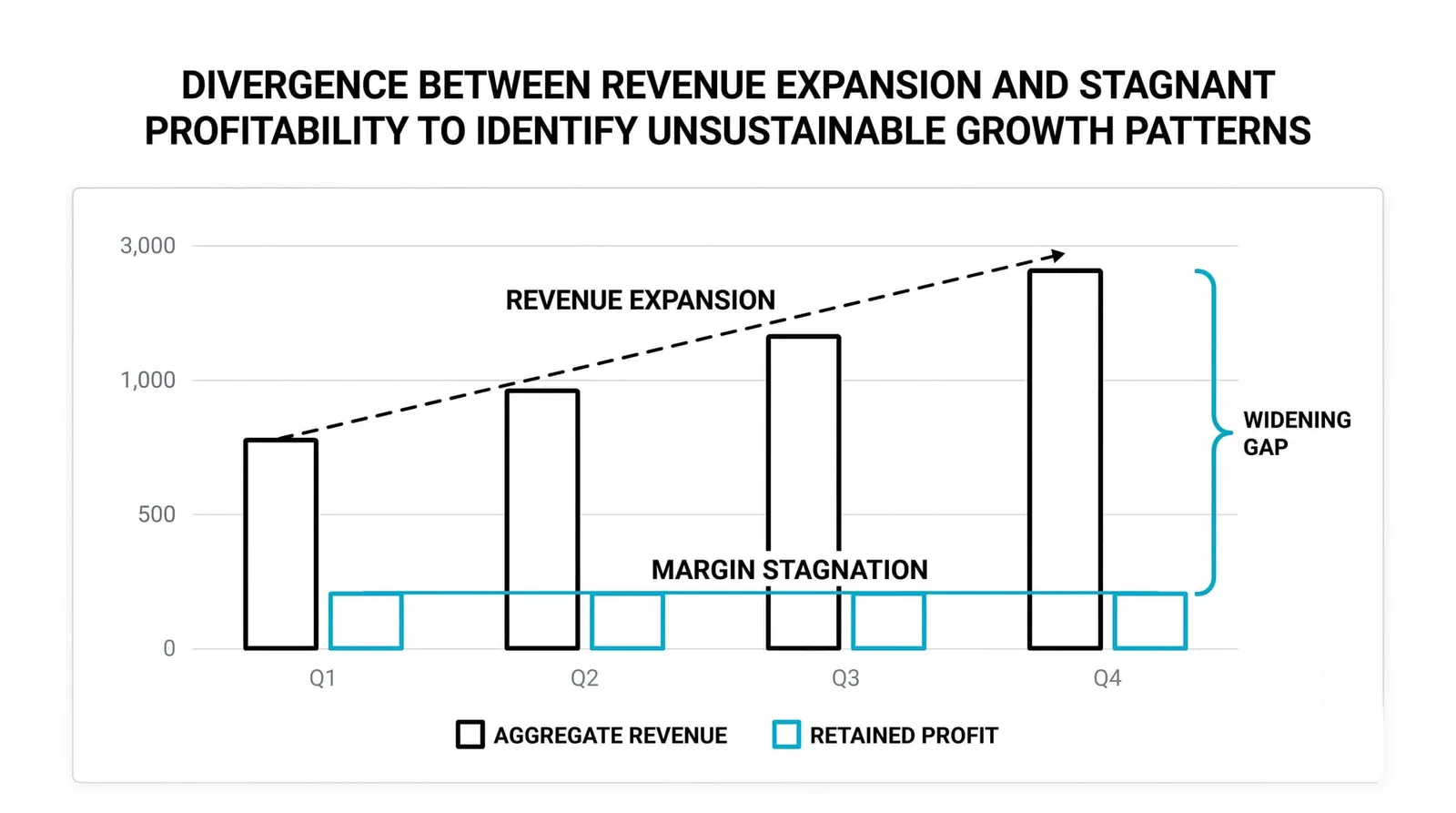
Growth Without Margin: Why Fast Isn't Always Healthy
Revenue can be bought. Spend enough on advertising, subsidies, and discounts, and the top line will rise. The question is whether any of it stays. A company selling a product for less than it costs to deliver is not growing a business. It is renting one.
Watch what sits underneath the fast top line. If customers arrive through promotions and leave when the promotion ends, the growth is a revolving door. Churn like that hides well during the expansion phase because new customers mask the departing ones. It surfaces the moment the spending slows.
Markets tolerate unprofitable growth only while money is cheap. When interest rates rise, profits promised far in the future get discounted harder, and investors stop paying for stories. The same company, with the same revenue growth, can be celebrated in one rate environment and punished in the next. This is a structural feature of how valuation works, not a forecast about any current market.
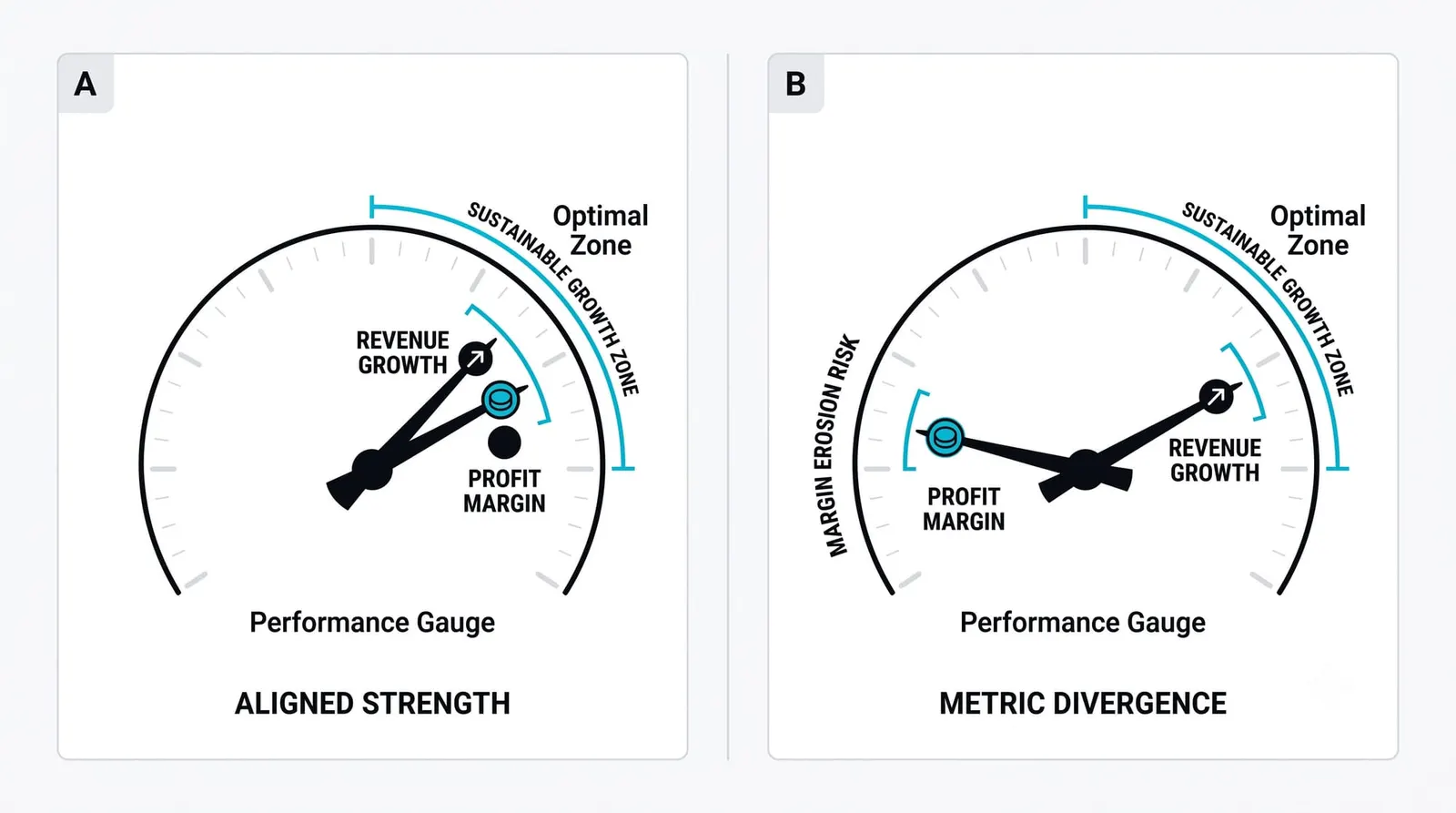
Reading Both Together for a Fuller Picture
Put the two dials side by side and you get four combinations, each with its own meaning for the next few quarters.
Growing revenue with rising margins is the healthiest quadrant. The business is scaling and keeping more of each sale. Fixed costs are spreading out, pricing is holding, and the next few quarters usually bring more of the same unless something external shifts.
Growing revenue with falling margins is the warning quadrant. The company is buying its expansion. Sometimes that is a deliberate land grab with a credible path to profitability. Often it is the first sign of competitive pressure. Expect management to talk about investment, and watch whether margins stabilize within a few quarters.
Shrinking revenue with rising margins is the harvest quadrant. The company is cutting costs, exiting weak segments, or raising prices on a smaller customer base. Profit can improve for a while, but a shrinking top line eventually caps how far margins can go. This pattern often precedes a turnaround attempt or a slow decline.
Shrinking revenue with falling margins is the distress quadrant. Costs are sticky on the way down, so profit falls faster than revenue. The next few quarters are usually about survival: restructuring, asset sales, or worse.
Two Years, One Business
Here is a hypothetical company with round numbers. Year one: revenue of 10 million, net margin of 8 percent, so profit is 0.8 million. Year two: revenue of 16 million, net margin of 4 percent, so profit is 0.64 million.
Walk the arithmetic. Revenue rose from 10 to 16 million, a gain of 60 percent. That is the number the press release leads with. But profit fell from 0.8 million to 0.64 million, a drop of a fifth. The company grew fast and ended up poorer. Every extra dollar of revenue cost more than a dollar to generate, and the old revenue became less profitable too.
Now picture the other three quadrants with the same starting point. Revenue up and margins up might look like revenue of 14 million at a 10 percent margin, profit of 1.4 million: healthy scaling. Revenue down and margins up might be revenue of 8 million at a 12 percent margin, profit of 0.96 million: smaller but more profitable, a deliberate trim. Revenue down and margins down might be revenue of 8 million at a 5 percent margin, profit of 0.4 million: a business in trouble from both ends.
Same company, same two years, four very different stories. The top line alone could not tell you which one you were reading.
| Combination | What it signals | What usually happens next |
|---|---|---|
| Revenue up, margins up | Healthy scaling, pricing power intact | Profit compounds faster than revenue |
| Revenue up, margins down | Growth bought with spending or discounts | Pressure to prove margins can recover |
| Revenue down, margins up | Cost cutting or pruning weak segments | Profit holds for a while, then growth questions return |
| Revenue down, margins down | Distress, costs sticky on the way down | Restructuring, asset sales, or decline |
Revenue and Margins, Answered
Which matters more, growth or margins?
Neither matters more in isolation, because each one is uninterpretable without the other. Growth tells you the direction of the business; margins tell you whether the trip is worth taking. If forced to choose one starting point, margins come first, because a profitable small business can become a profitable large one, while an unprofitable large one often just becomes a larger problem.
What is a good profit margin?
There is no universal good number, because margins are built into the structure of each industry. A grocery distributor might run net margins in the low single digits and be excellent. A software company might run net margins above 20 percent and be ordinary for its field. Compare a company's margins to its own history and to its direct competitors, never to a business in a different industry.
Why do fast-growing companies lose money on purpose?
Because they believe spending now buys a position that pays off later. The logic is that capturing customers early, before competitors do, creates a base that can be made profitable once the spending slows. Sometimes that logic is sound and the margins arrive. Sometimes the customers were only ever there for the subsidy. Your job is to tell the two apart, and the margin trend over several quarters is the tool for it.
Can margins be too high?
Yes, in a structural sense. Unusually high margins act like a signal flare to competitors, inviting new entrants who undercut on price. They can also mean the company is underinvesting, starving maintenance, research, or staff to flatter the current year. A margin far above the industry norm deserves the same skeptical questions as a margin far below it.
Next in this level, you will open the income statement itself and walk it line by line, from the top line down to the bottom one. Everything you practiced here with growth rates and margins becomes a reading skill once you can see the full page.