EPS: Why Earnings Per Share Moves Prices
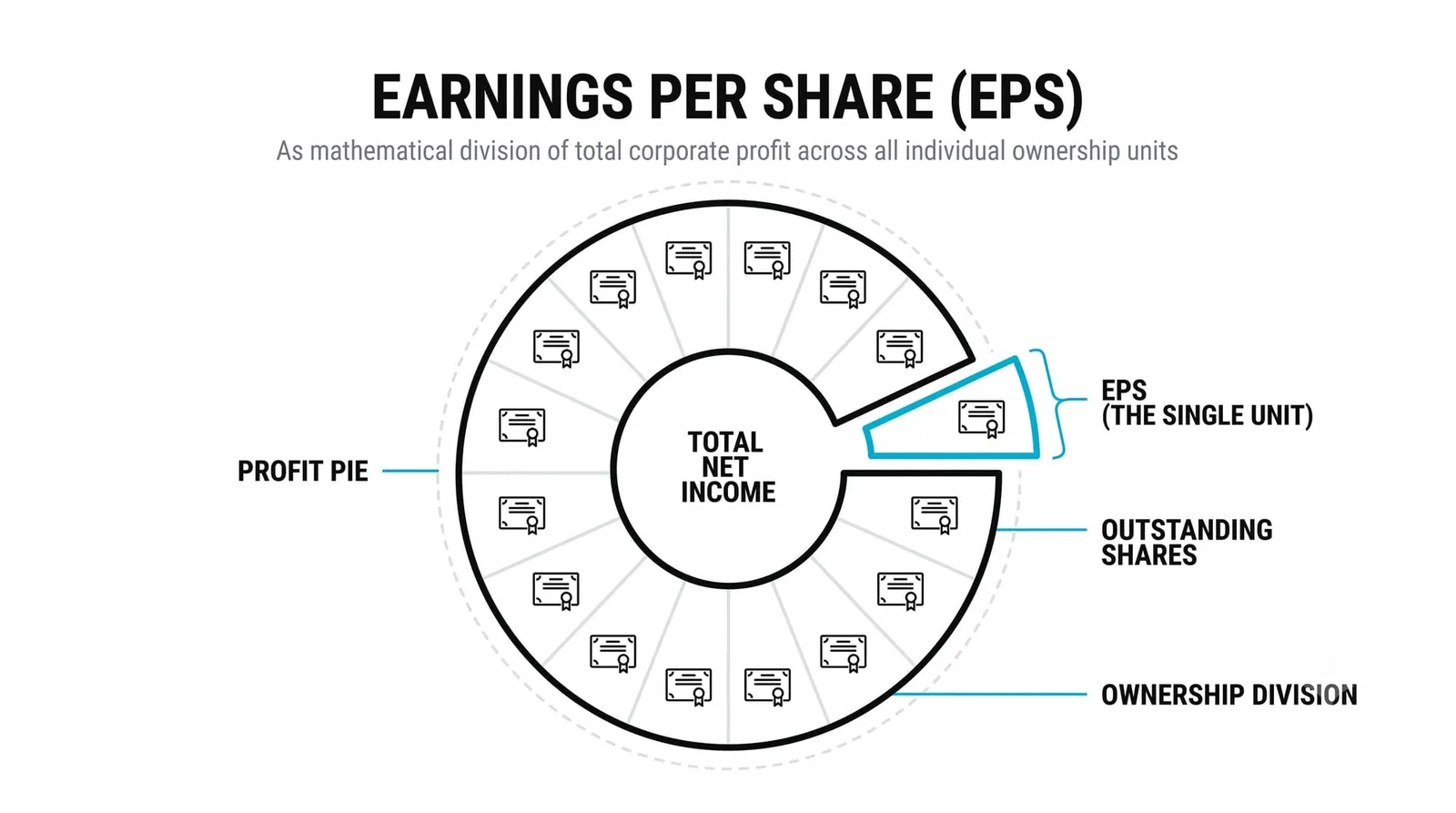
Earnings per share is a company's profit divided by the number of shares outstanding, and it is the single most quoted number in equity markets. It turns a company-sized profit into a share-sized figure you can price, compare, and put in a multiple. Without it, you would be trying to value a billion-dollar business with a number built for the whole firm, not for the slice of it you can actually buy.

Think of EPS as a limited-edition print run: the artwork is the company's profit, and the fewer prints in the edition, the more each copy is worth.
What EPS Actually Measures
EPS takes the profit attributable to shareholders and divides it by the number of shares outstanding. The formula is short. The two inputs deserve attention.
The numerator is a profit figure, and companies report several of them. There is gross profit, operating profit, and net income. The standard choice for EPS is net income, the bottom line, because it is what remains after every cost, tax, and interest payment has been settled. It is the profit that legally belongs to shareholders. Where that bottom line comes from, line by line, is the income statement, which gets its own lesson later in this level.
The denominator is the share count, and it is a moving target. Companies issue new shares to raise money, grant shares to employees, and buy shares back on the open market. The profit may sit still while the share count shifts underneath it. Both halves of the fraction matter.
Why Dividing Profit by Shares Matters
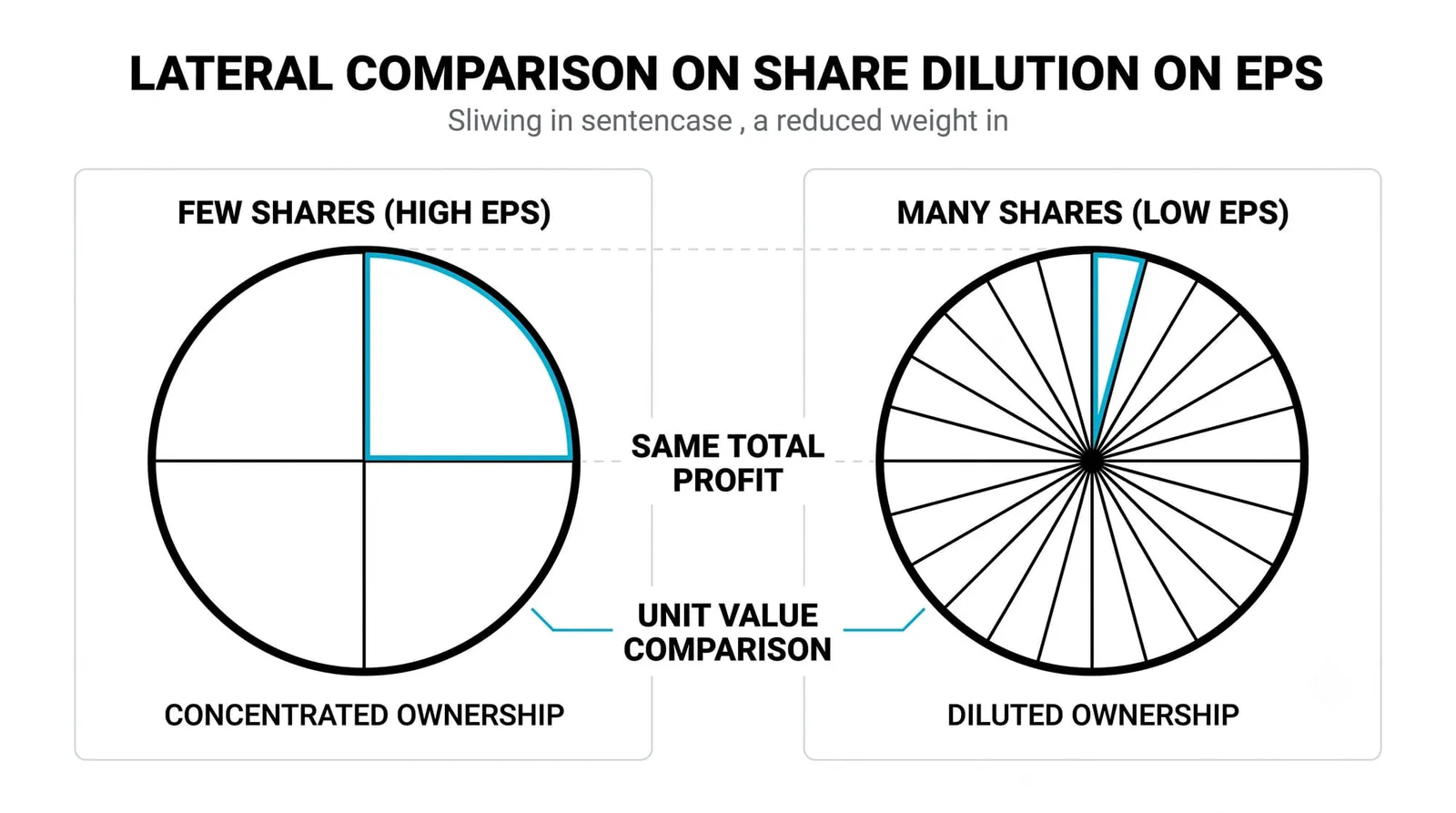
Start with two companies that each earn the same profit in a year. One has a small share count. The other has issued far more shares. Same profit, very different deals. The first company's profit is concentrated into fewer claims; the second's is spread thin. A raw profit figure cannot tell you which is which. EPS can.
The division also makes profits comparable across sizes. A giant firm earning billions and a small firm earning millions cannot be compared on total profit alone. Per share, they can. You can line up two companies of wildly different scale and ask a clean question: how much profit does one share of each actually carry?
That share-sized figure then becomes raw material. Every common valuation multiple starts from a per-share number. The price-to-earnings ratio, which divides the share price by EPS, is the most famous, and it gets its own lesson right after this one. None of that machinery works until profit has been cut down to share size first.
Basic vs Diluted EPS: Why Two Versions Exist
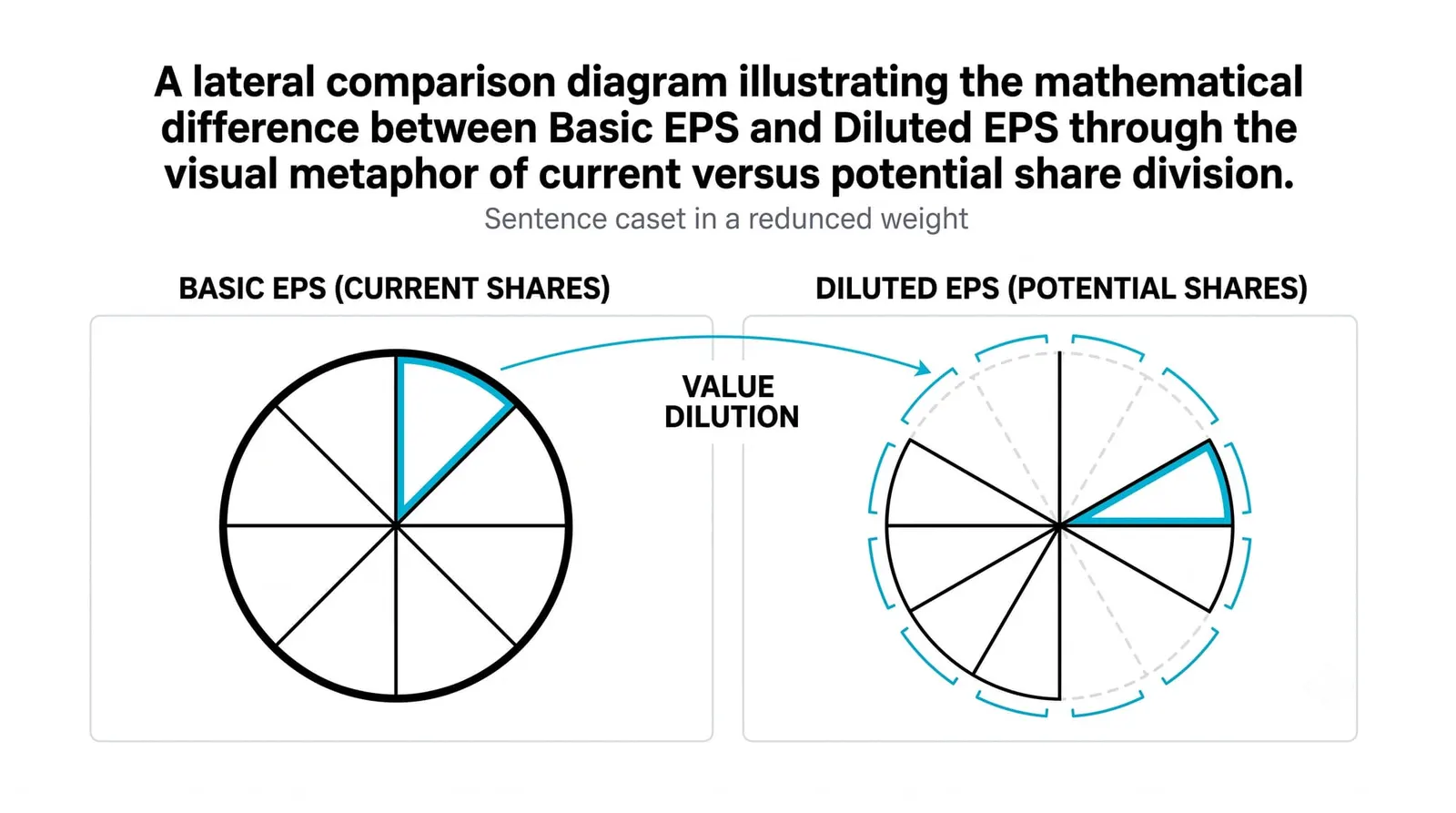
Companies report EPS twice, and the gap between the two numbers tells you something. Basic EPS uses the shares that exist today. Diluted EPS asks a harder question: what happens to the share count if everything that could become a share does become one?
Plenty of instruments sit in that waiting room:
- Stock options granted to employees, which convert into shares when exercised.
- Warrants held by investors, which work similarly.
- Convertible bonds and preferred shares, which can be swapped into common stock under set terms.
Diluted EPS assumes all of these convert. The share count rises, so diluted EPS is almost always lower than basic. Serious readers default to the diluted figure because it prices in the claims that already exist against future profits. A company with a wide gap between basic and diluted is telling you a large pool of potential shares is waiting. That pool will water down your slice if it converts.
Why Stock Prices React So Sharply to EPS
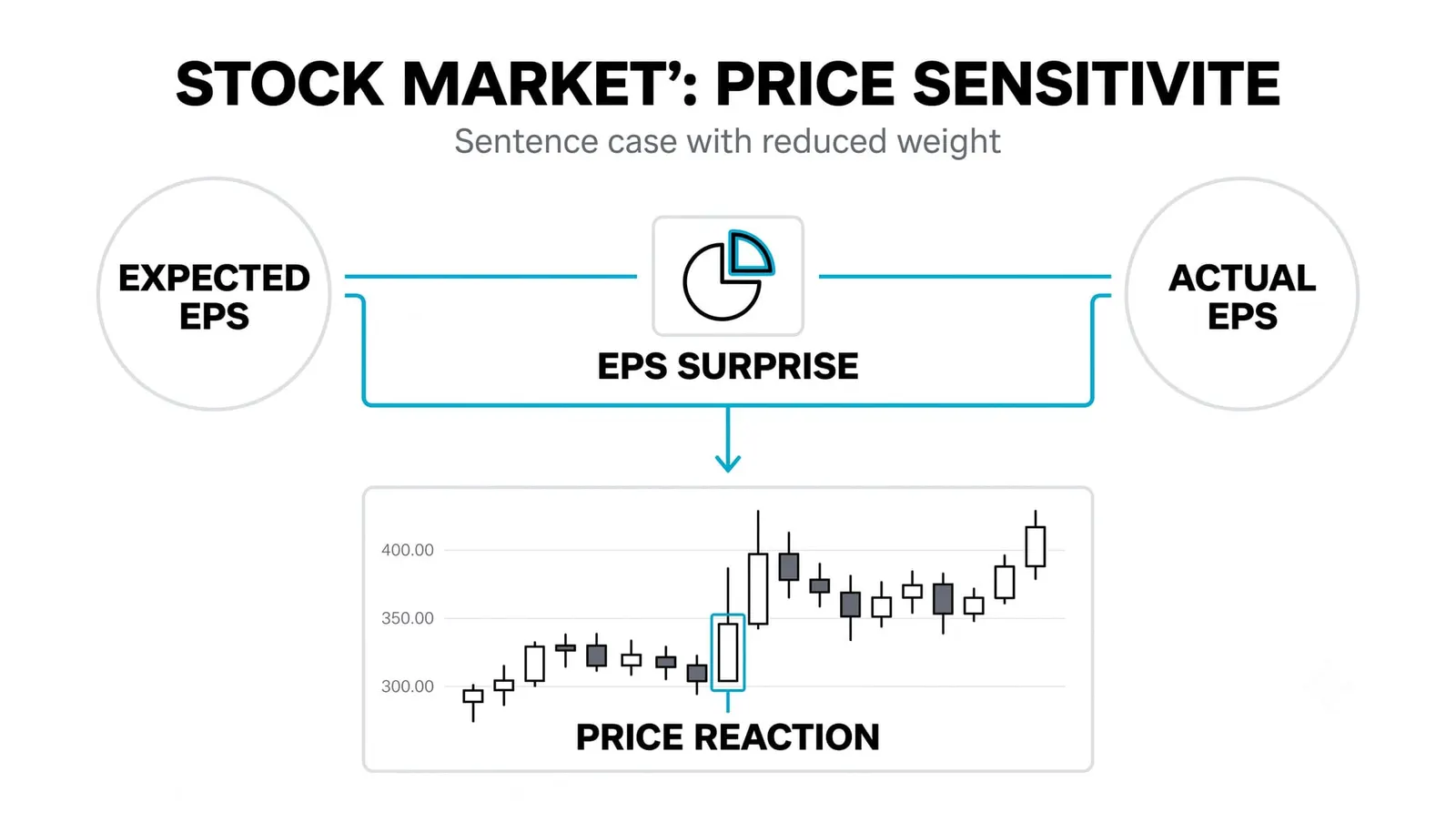
The mechanics here come straight from the data-release lesson, applied to a single stock instead of a currency pair. Prices do not react to the number. They react to the gap between the number and what was expected.
Before a report, analysts publish estimates and the share price drifts toward the consensus. That expectation is already in the price. When the actual EPS prints above it, buyers reprice upward. When it prints below, sellers reprice downward. A company can report a large, healthy profit and still fall hard if the market expected larger. The surprise moves the market, not the level.
Two caveats carry over from the earnings season lesson. First, guidance matters as much as the print: a company can beat on EPS and drop anyway if it lowers its outlook for coming quarters. Second, quality matters. A beat built on one-off gains, cost cuts, or accounting choices is weaker than a beat built on growing sales. Read what produced the number before trusting the number.
One Profit, Two Share Counts
Consider a hypothetical company, all figures invented and round. It earns 100 million in net profit in a year. It has 50 million shares outstanding. EPS is 100 million divided by 50 million, which is 2.00 per share.
Now the company issues 25 million new shares to fund an acquisition. The profit stays at 100 million for the moment. The share count rises to 75 million. EPS falls to 100 million divided by 75 million, roughly 1.33.
Watch what this does to a buyer paying the same share price. Before the issuance, that price bought a claim on 2.00 of annual profit. After it, the same price buys a claim on 1.33. The buyer gets a third less profit per share for identical money. The deal may still work out if the acquisition eventually adds profit, but in the meantime every existing shareholder's slice has shrunk.
The share count is never background noise. A rising EPS can come from growing profit, a shrinking share count, or both. A falling EPS can come from weakening profit, new issuance, or both. Always check which side of the fraction moved.
| Item | What it is | What changes it |
|---|---|---|
| Net profit | What remains of revenue after every cost, tax, and interest payment | Sales, costs, one-off gains and charges |
| Shares outstanding | The count of shares that exist today | New issuance, buybacks, employee grants |
| Basic EPS | Net profit divided by shares outstanding | Either input above |
| Diluted EPS | Net profit divided by shares if every convertible instrument converts | Options, warrants, convertible bonds and preferred shares |
The EPS Report, Answered
Is a higher EPS always better?
No. A higher EPS is only better if the quality behind it holds up. EPS can rise because profit grew, which is healthy, or because the company bought back shares, cut investment, or booked one-time gains, which may not repeat. Compare EPS against revenue growth and against how the figure was produced.
Why do companies buy back shares before earnings?
Buybacks shrink the denominator, so the same profit produces a higher EPS. Some repurchases reflect genuine confidence and spare cash. Others are timed to flatter the per-share number ahead of a report. Either way, a buyback-driven EPS gain is arithmetic, not business growth, and you should separate the two.
What is the difference between EPS and dividends?
EPS measures the profit earned per share; a dividend is the cash actually paid out per share. A company can earn 2.00 per share and pay out 0.50, keeping the rest to reinvest. EPS tells you what was earned. The dividend tells you what was distributed. Many profitable companies pay no dividend at all.
Can EPS be negative?
Yes. When a company posts a net loss, EPS is simply negative, showing the loss per share. Young or struggling companies often report negative EPS for extended periods. In that case the P/E ratio stops working, since dividing a price by a negative number gives you nothing meaningful, and analysts switch to other measures.
EPS gives you profit in a size you can work with. The next lesson takes that figure and pairs it with the share price to build the P/E ratio, where per-share earnings turn into an actual valuation tool.