The P/B Ratio: Price to Book, Explained
The P/B ratio compares a company's market price to its book value, the accounting value of what it owns minus what it owes, and it tells you how much of the price is bricks and how much is belief in what management can build with them. Divide the share price by the book value per share and you have it.
Think of P/B as the price of the bricks; anything above one is the market paying for what someone might do with them.
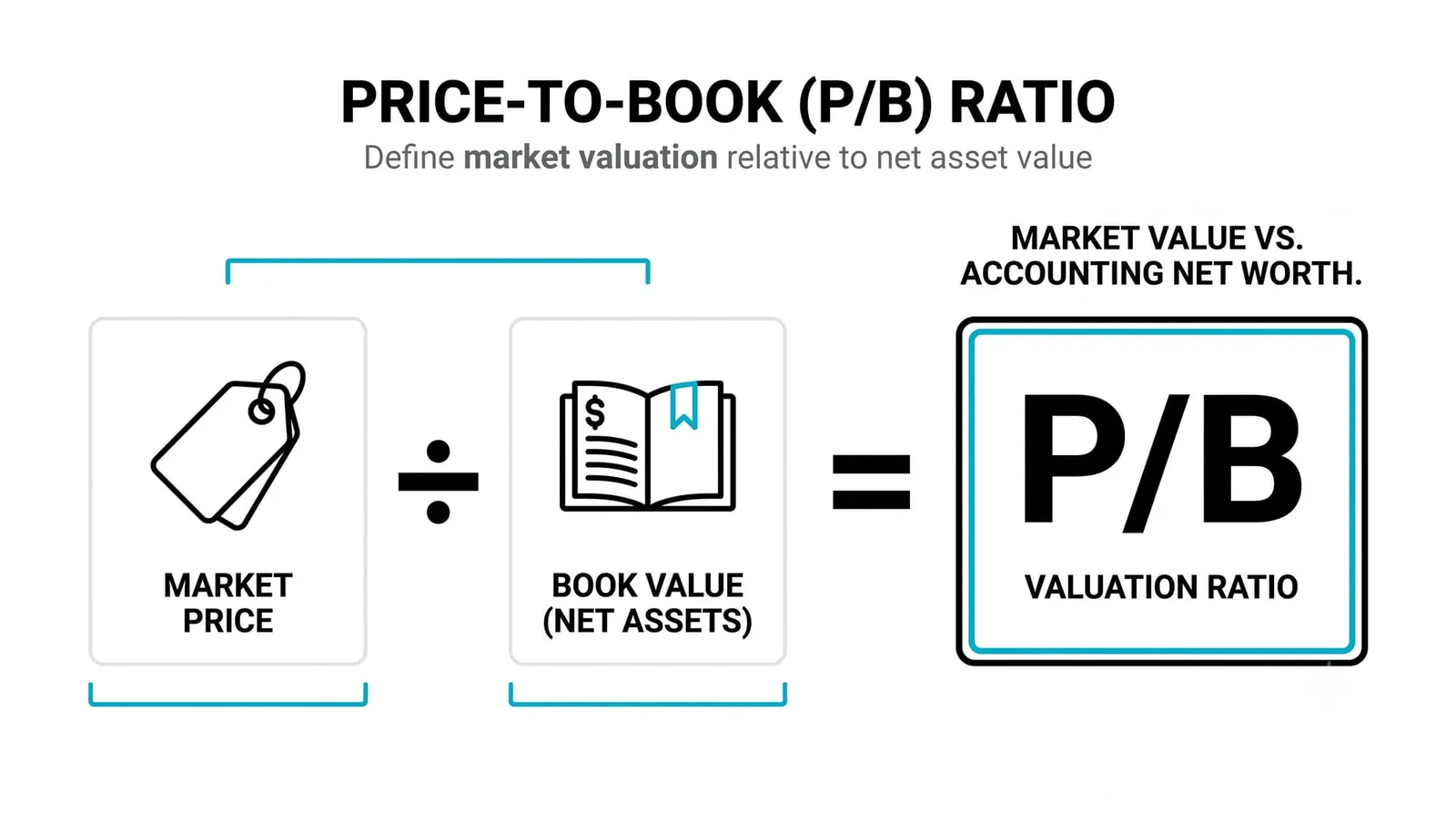
Last lesson covered the P/E ratio, which prices a company against its earnings. P/B prices it against its balance sheet instead. Two lenses, same company, very different questions. The balance sheet itself, where book value lives, gets its own dedicated lesson later in this level, so here we take just enough of it to make the ratio work.
What Book Value Actually Is
Book value is total assets minus total liabilities, taken straight from the balance sheet. Everything the company owns, minus everything it owes. Accountants also call it shareholders' equity, because in theory it is what would be left for owners if the company sold everything and paid every debt.
To use it in the ratio, you divide by the share count. Book value of 200 million across 100 million shares gives a book value per share of 2.00. That per-share figure is what you compare against the market price.
Understand what this number is: an accounting construction. Assets sit on the books largely at historical cost, meaning what the company paid for them, sometimes adjusted downward for depreciation. A building bought decades ago may be carried far below what it would sell for today. A machine bought last year may be carried above what anyone would pay for it now.
Book value is a record of the past, kept under accounting rules. Treat it as a starting point, never as a precise measure of what the assets are worth today.
Why Book Value Isn't the Same as Market Value
The ledger records what was paid. The market prices what the assets can earn. Those two figures diverge constantly, and the gap is where the P/B ratio gets its meaning.
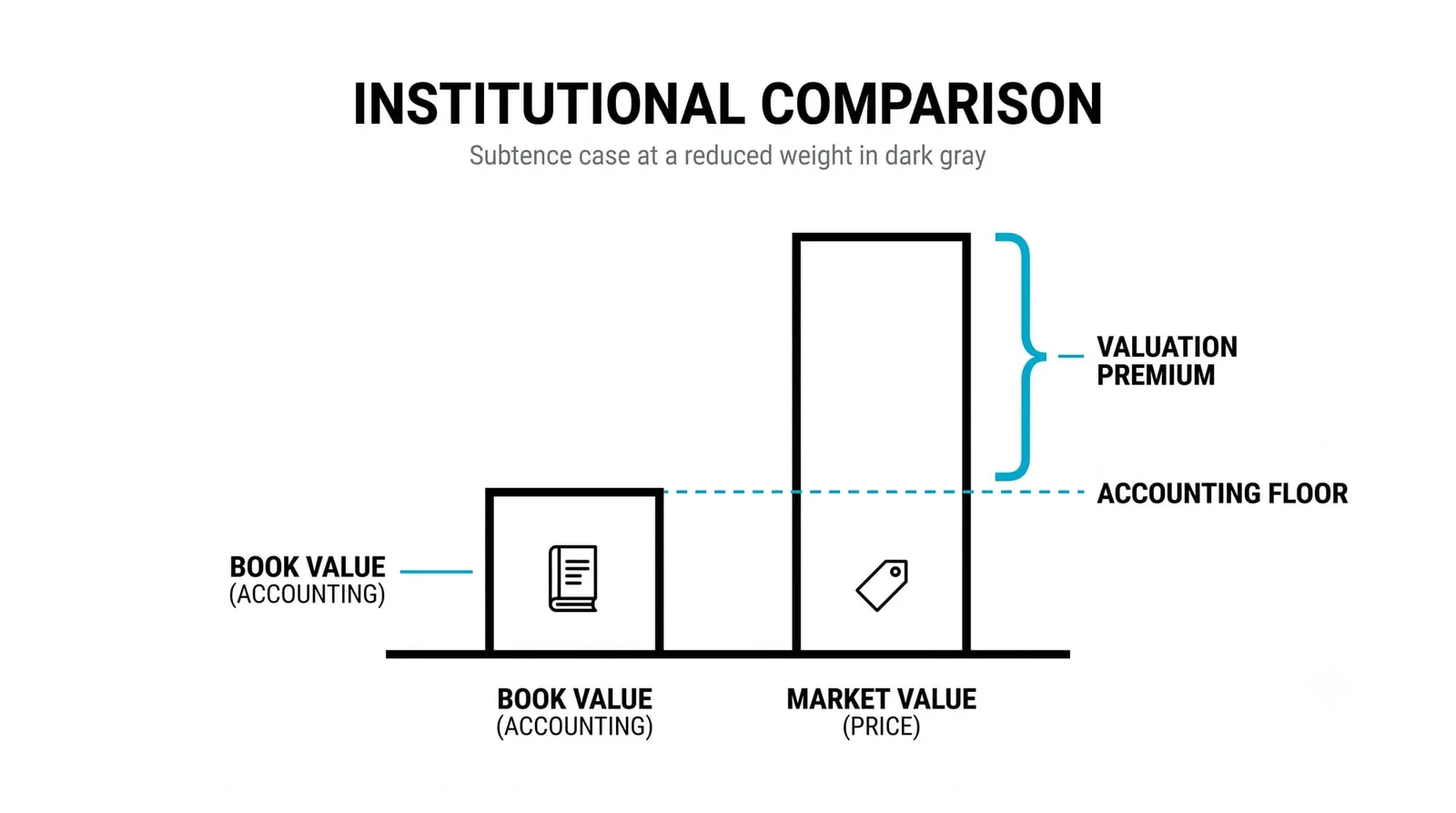
Some of the most valuable things a company owns never appear on its balance sheet at all. A brand built over decades, internally developed software, a trained sales force, a loyal customer base: accounting rules generally keep these off the books or value them at a fraction of their real worth. The money spent building them was expensed as it went out the door, so the value created by that spending is invisible in book value.
This cuts both ways. A company can also carry assets at values the market no longer believes. Loans that will not be repaid, inventory nobody wants, goodwill from an acquisition that went badly. The books say one thing; informed buyers say another.
So when you see a high P/B, you are often seeing the market price in assets the accountants never counted. When you see a low one, you may be seeing the market discount assets the accountants counted too generously.
High P/B vs Low P/B: What Each Might Signal
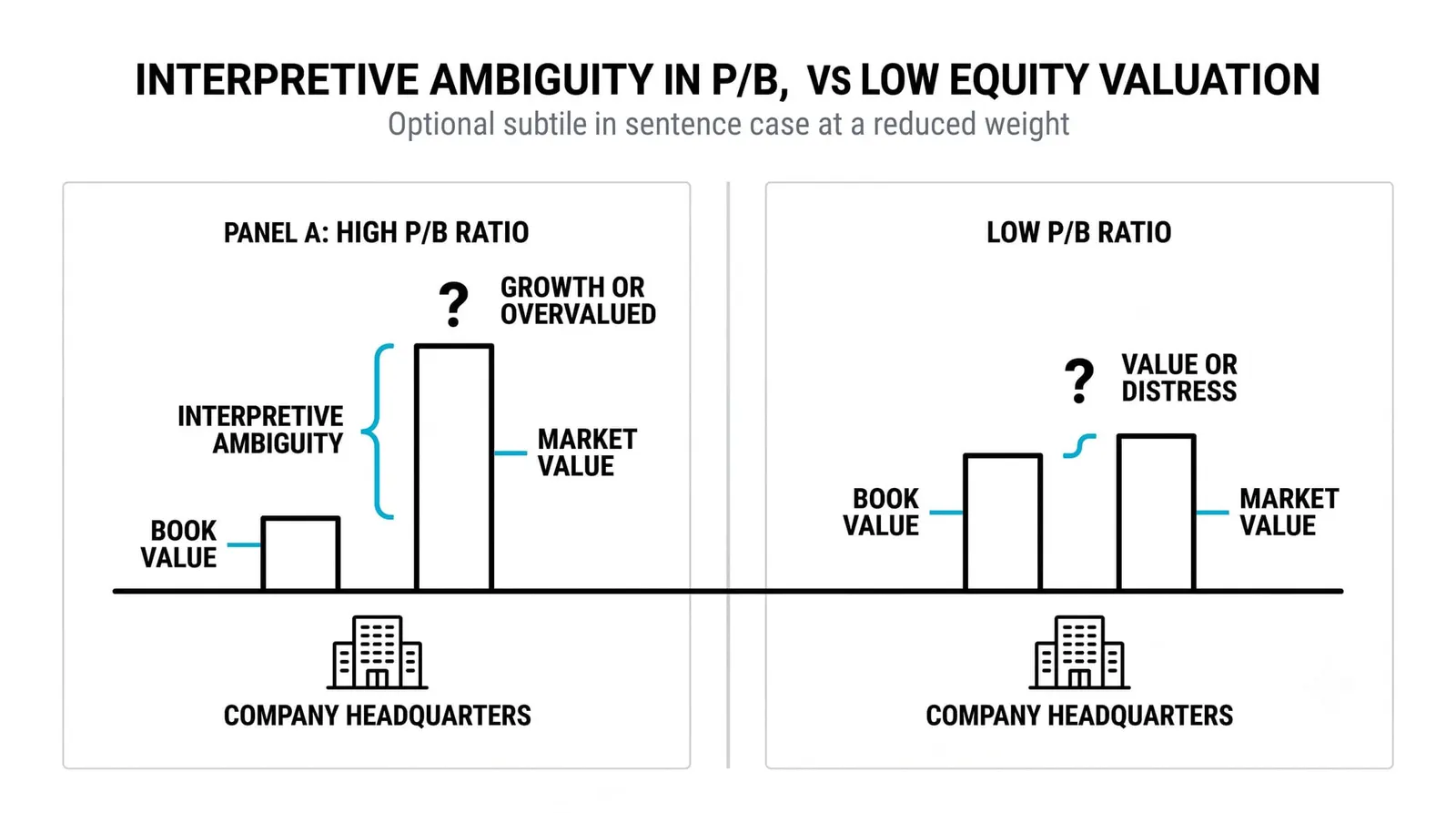
A P/B below 1 carries two opposite interpretations, and your job is to decide which one applies. It can signal deep value: the market has overreacted, and the assets are worth more than the price. It can also signal distress: the assets are impaired, the business is shrinking, and book value itself is about to be written down. Cheap and broken can look identical on a single number.
A high P/B usually means the market believes management earns strong returns on the equity entrusted to it. A company that consistently turns each unit of book value into large profits deserves to trade above book. But a high multiple can also reflect pure optimism, a story with little underneath it. Belief in returns and belief in nothing much produce the same number.
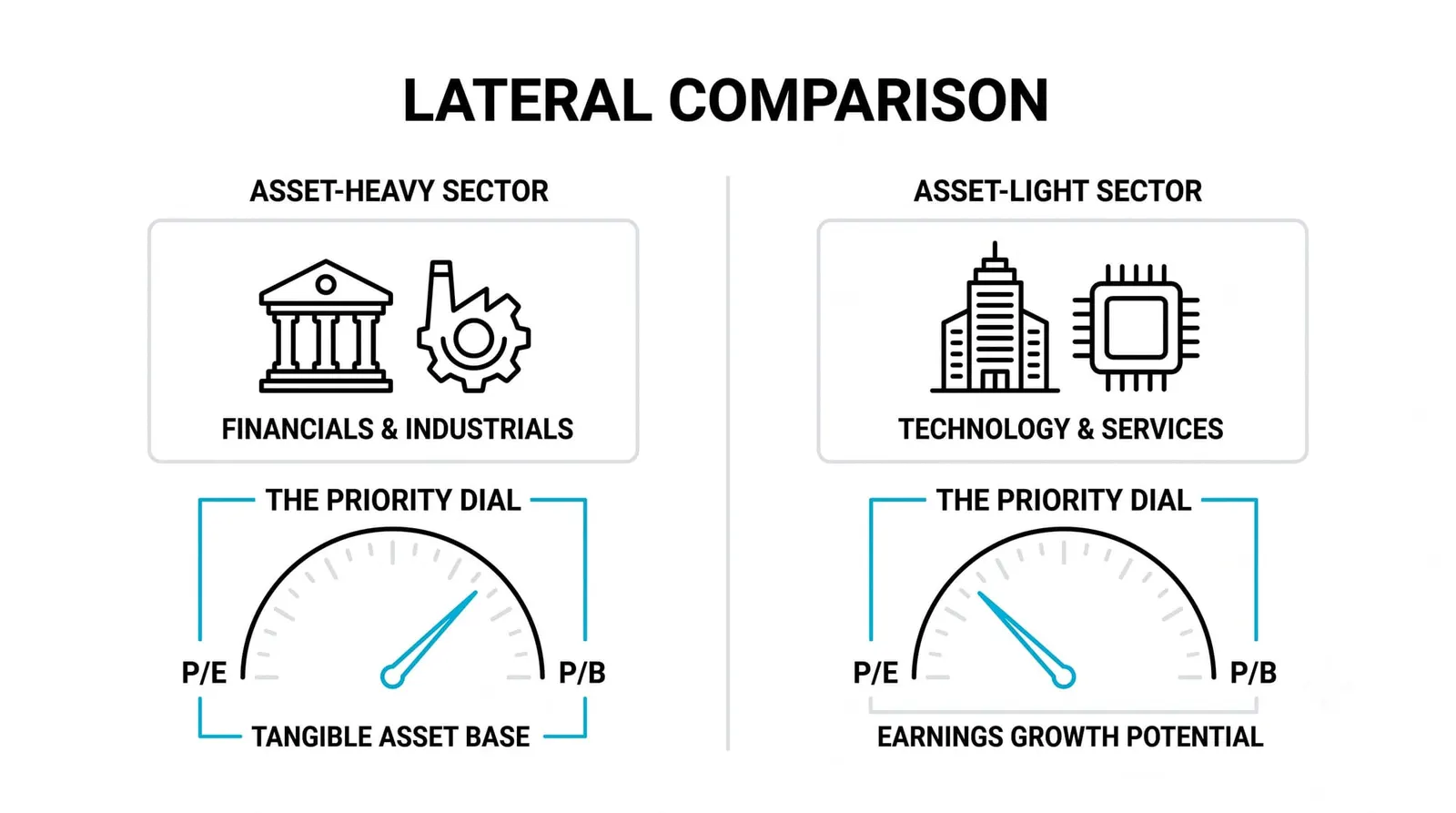
Context matters more than the level. Asset-heavy businesses, like manufacturers, utilities, and banks, carry big tangible balance sheets and often trade at modest P/B multiples. Asset-light businesses, like software and consulting firms, have small book values by design and routinely trade at high multiples. Comparing a software company's P/B to a bank's P/B tells you almost nothing. Compare within industries, and compare a company against its own history.
Where P/B Fits Best Compared to P/E
P/B earns its keep where the balance sheet is the business. Banks and insurers are the classic case. A bank's assets are largely loans and securities; its liabilities are largely deposits and borrowings. The spread between what those assets earn and what those liabilities cost is the entire business model. Book value is a meaningful anchor there, and P/B has long been a standard way to compare one bank against another.
Capital-intensive industries with tangible balance sheets also suit the ratio. Think of businesses built on property, plants, equipment, or commodity inventories. When earnings swing wildly through a cycle, P/E can flip from tiny to enormous and back, while book value moves slowly and gives you something stable to measure against.
Where does P/B go nearly useless? Anywhere the real assets walk out the door every evening. A software firm or a services firm keeps its value in code, relationships, and people, none of which sits properly on the balance sheet. Book value there is a small, arbitrary residue. For those companies, earnings-based and cash-flow-based measures do the heavy lifting, and P/B is noise.
One Balance Sheet, Two Prices
Here is a purely hypothetical company with round numbers, built only to show the mechanics. It holds 500 million in assets and owes 300 million in liabilities. Book value is 200 million. With 100 million shares outstanding, book value per share is 2.00.
| Item | What it is | What it tells you |
|---|---|---|
| Book value | Assets of 500 million minus liabilities of 300 million = 200 million | The accounting value of what owners would keep after debts are paid |
| Book value per share | 200 million divided by 100 million shares = 2.00 | The per-share anchor you compare against the market price |
| Market price | Whatever buyers and sellers agree on, say 3.00 or 1.50 in our two cases | What the market currently thinks the whole business is worth |
| P/B ratio | Price divided by book value per share | How much of the price is bricks and how much is belief |
Case one: the shares trade at 3.00. P/B is 3.00 divided by 2.00, which is 1.5. The market pays a 50 percent premium over book. Read that as a vote of confidence: investors believe management can generate returns on those assets well above what the raw numbers suggest. If the company has a history of strong profitability, that premium may be earned. If it does not, the premium is hope.
Case two: the shares trade at 1.50. P/B is 1.50 divided by 2.00, which is 0.75. The market prices the whole company at a quarter below its accounting value. Two stories fit. In the bargain story, the assets are sound, fear is overdone, and a patient buyer gets a dollar of book value for 75 cents. In the warning story, the 500 million in assets is overstated, write-downs are coming, and book value is falling toward the price rather than the price rising toward book.
The ratio cannot choose between those stories. It can only tell you that the market is skeptical, and hand you the question to investigate next.
The P/B Ratio, Answered
Is a P/B below 1 always cheap?
No. A P/B below 1 means the market doubts the book value, the management, or the future of the business. Sometimes that doubt is wrong and the stock is genuinely cheap. Sometimes the assets are impaired and book value is about to shrink. The number flags a situation worth investigating; it never settles one.
Why do banks often trade near book value?
Because a bank's balance sheet largely is the business. Its assets and liabilities are financial instruments with observable values, so book value is a closer approximation of real worth than it is for most companies. When a bank trades well above book, the market is crediting its profitability and franchise. When it trades well below, the market suspects the loan book.
Can book value be wrong?
Yes, in both directions. Assets carried at historical cost can be worth far more than the books show, like long-held real estate. They can also be worth far less, like bad loans, stale inventory, or goodwill from failed acquisitions. Book value follows accounting rules, and accounting rules record the past rather than appraise the present.
Which investors rely on P/B the most?
Value investors and analysts of financial companies lean on it hardest. Anyone hunting for assets priced below their accounting worth starts with screens built on low P/B, and anyone comparing banks or insurers uses it as a standard yardstick. Growth investors, by contrast, often ignore it entirely, because the companies they buy rarely have meaningful book values.
Next in this level, the balance sheet gets its own full lesson. Once you can read assets, liabilities, and equity line by line, book value stops being a single number you trust and becomes something you can audit for yourself.