How Price Respects and Breaks Structure
Price respects structure when the marked levels hold: tests stop at or near them and turn away, and the closes stay on the same side. Price breaks structure when a close travels beyond the marked extreme and stays there. The difference between those two behaviors is what this entire framework exists to trade.

Think of a border checkpoint: traffic slows, papers get checked, most cars turn back, until the day the gate itself is moved. Levels work the same way. The earlier lessons built the labeled levels, the marking rules made them precise, and the break lesson defined the event that changes them. This closing lesson watches price live at those levels, because respect and break are not two separate ideas. They are one relationship seen from both sides.
What Respect Looks Like
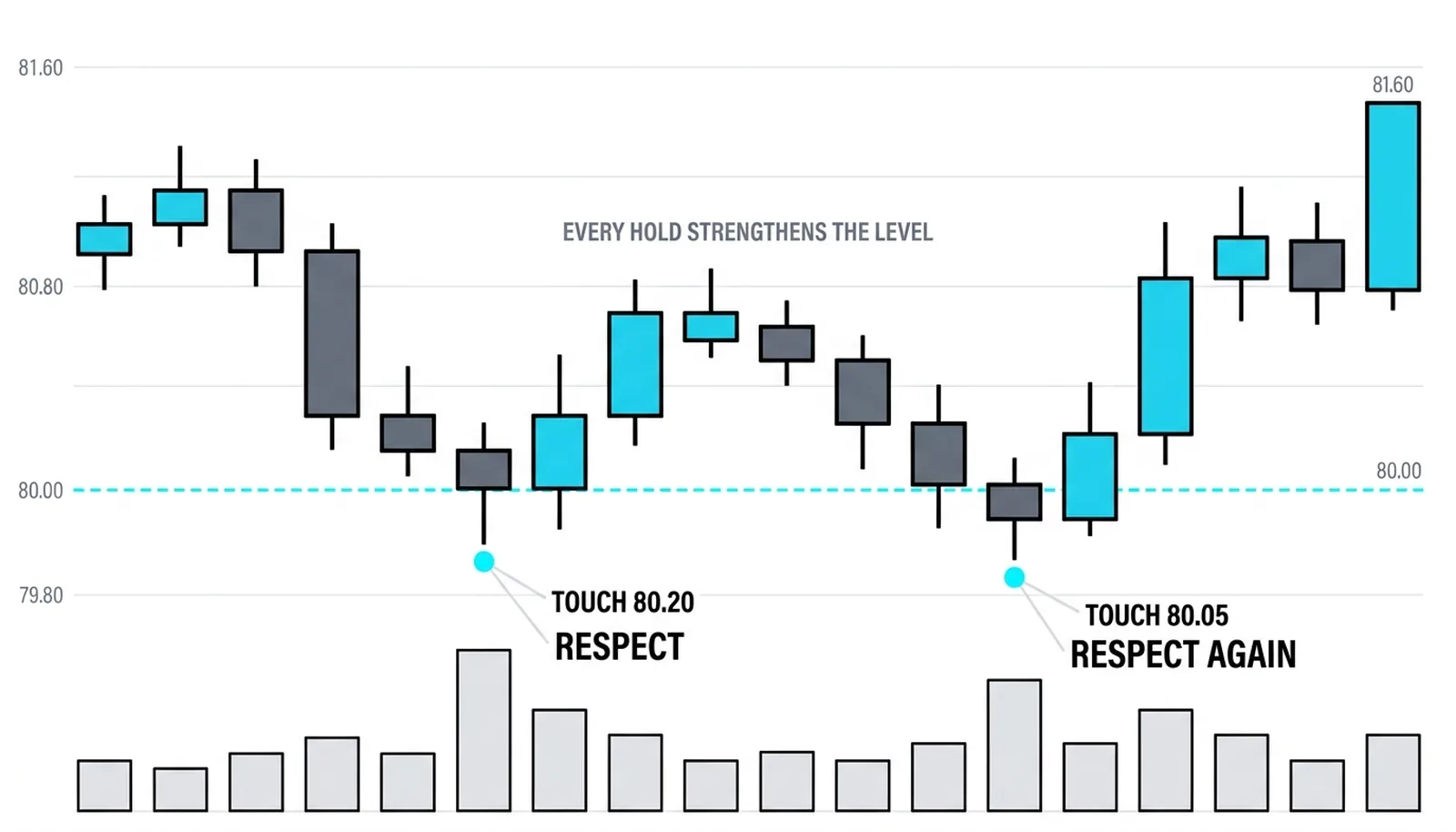
Respect has a recognizable shape. Price approaches the level, probes past it or into it, and closes back inside. The wick is the failed test. The close is the proof.
The rejection candle is the unit of respect. A long lower wick at support means sellers pushed price through the zone and buyers pushed it back before the close. That single bar records an attempted break and its failure.
Every held test strengthens the level's reputation. Each time price touches a level and reverses, more participants notice it, more orders cluster there, and more traders plan their entries and exits around it. The level becomes self-reinforcing, which is exactly why so many eyes are on it.
Respect is a pattern of behavior across repeated visits: approaches that slow, probes that fail, closes that stay inside.
A probe is cheap. Anyone can push price through a level for a few minutes. Holding the other side through a close is the expensive part, and that is what respect measures.
What a Break Requires
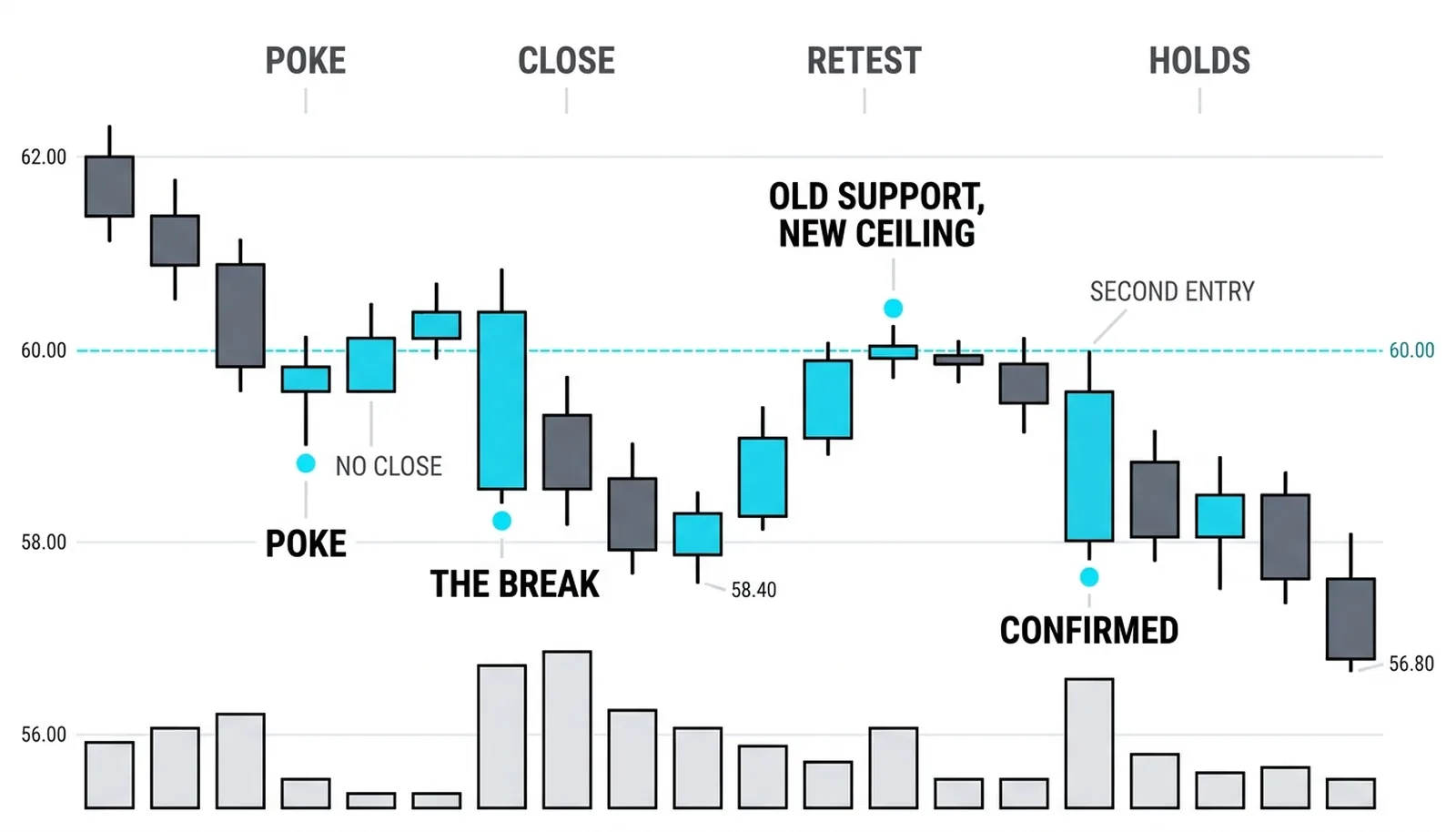
A break demands more than a poke. It requires a close beyond the level, then acceptance on the other side. A wick through the level that retracts is a failed test, not a break.
Between respect and break sits a sequence of escalating evidence:
- The poke. Price trades beyond the level intrabar and comes back. This is nothing. It happens constantly.
- The close. A bar closes beyond the level. This is the break itself, the first hard fact.
- The retest. Price returns to the broken level, which is now expected to flip sides and act as the opposite kind of level. Old support should behave as resistance; old resistance should behave as support.
- The failed retest. Price cannot close back inside. This is the confirmation that makes the break real.
The tape-reading framework describes the same event in time as the second entry: the first attempt at a move fails or gets tested, and the second look at the same level is where the proof is strongest. The price action canon teaches waiting for that second look rather than chasing the first push.
The failed retest is the market answering twice. The close beyond the level was the first answer. The retest refusing to reclaim the level is the second, and two answers carry more weight than one.
Now the other outcome. If the retest closes back inside the old range, the break is void. Price poked out, closed out, and then walked back in. The level's reputation comes back stronger than before, because it survived a close beyond it and still held the crowd's loyalty.
That voiding matters for discipline. A break is never final at the moment it prints. It is a claim, and the retest is where the claim gets graded.
Trading the Sequence
Each phase of the sequence has its own trade, its own stop, and its own logic.
In the respect phase, the trade is the fade. Price approaches the level, the probe fails, the close stays inside. The entry takes the turn at the level, and the stop sits just beyond it, at the price where the respect story is proven wrong. Risk is small because the invalidation point is close.
After a real break, the trade is the retest. The old level should now act from the opposite side. The entry joins the new direction when the retest fails to take price back, and the stop sits beyond the retest's extreme, because that is the exact price at which the flip story is proven wrong.
Here is the honest accounting. Most tests hold. Most pokes fail. Even genuine breaks get retested. That means the cheapest risk and the strongest proof meet at the same place: the retest. The fade offers the earliest entry but the least confirmation. The break close offers confirmation but a wide stop. The retest offers a tight stop against a level that has already been tested twice.
Nothing at a level is ever certain. A level is a hypothesis, and the market grades it one test at a time. The disciplined trader holds opinions loosely at the exact tick and lets the closes do the deciding. That single habit separates structured trading from predicting.
The Tests at 80.00
A hypothetical illustration with round numbers. Support stands at a prior swing low of 80.00.
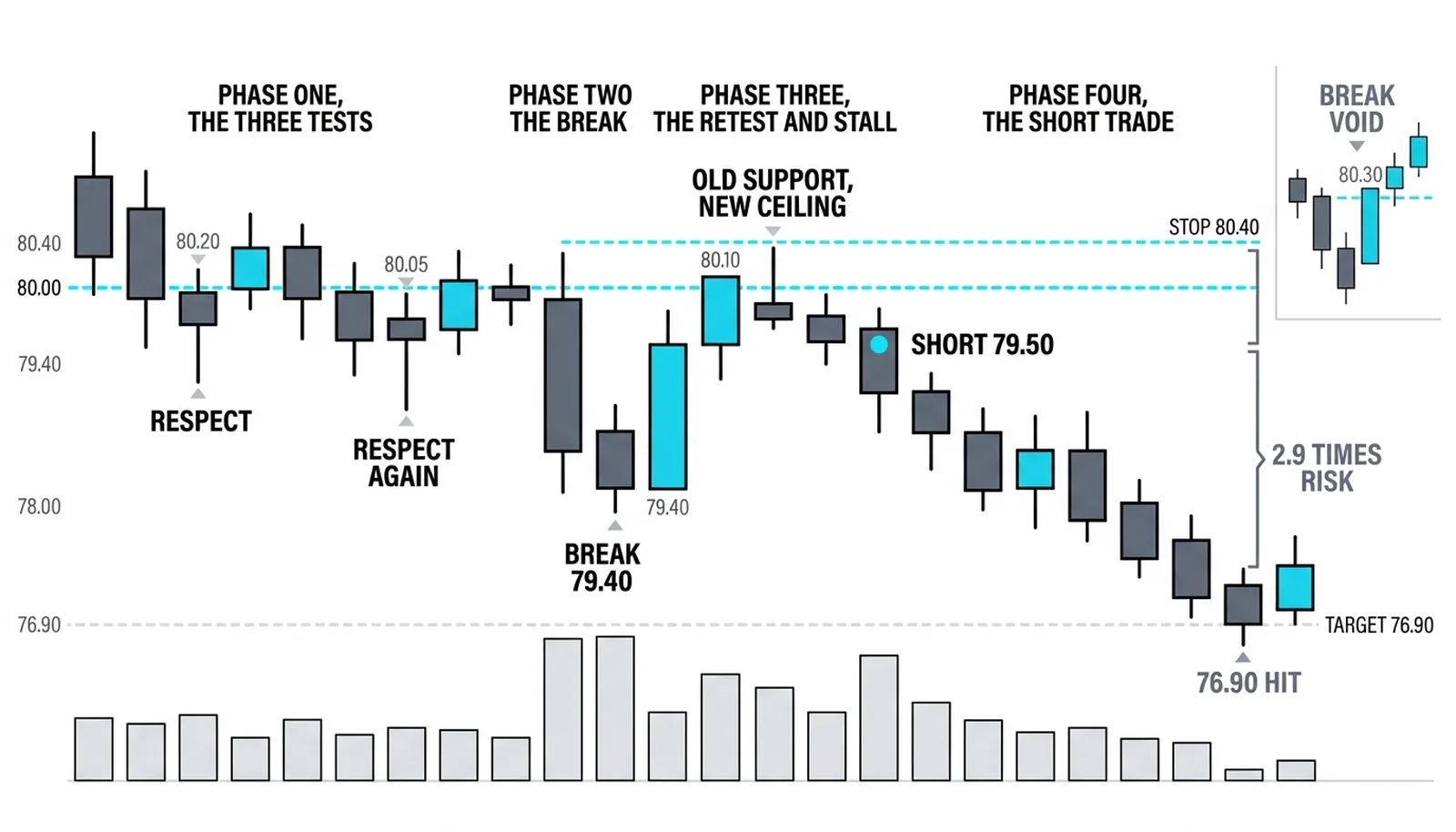
The first decline touches 80.20 and closes back above. Respect. The second decline touches 80.05 and closes above. Respect again, and the level's reputation grows with each hold.
The third decline closes at 79.40, below the level. That is a break. Price then rallies back to 80.10, stalls under the old support, and rolls over. The short triggers at 79.50 as the retest's low gives way. The stop sits at 80.40, above the retest high, risking 0.90. The target is the next structure below at 76.90, a gain of 2.60, roughly 2.9 times the risk.
The failed version: the retest instead closes at 80.30, back above the old level. The break is void. The short stands down, and the level is stronger for having survived the test.
| Event | Price | The Read | The Response |
|---|---|---|---|
| First test | Touch 80.20, close above | Respect, probe failed | Fade valid, stop beyond 80.00 |
| Second test | Touch 80.05, close above | Respect again, reputation grows | Fade still valid, crowd watching |
| Third decline | Close 79.40 | Break, close beyond the level | No chase, wait for the retest |
| Retest | Rally to 80.10, stalls | Old support acts as resistance | Short at 79.50, stop 80.40, target 76.90 |
Structure Respect and Break Questions, Answered
What does it mean for price to respect structure?
Price respects structure when tests of a marked level stop at or near it and close back inside. The wick records the failed probe, the close records the hold, and each successful test adds to the level's reputation.
What counts as a break of structure?
A break is a close beyond the marked extreme, followed by acceptance on the other side. An intrabar poke that retracts is a failed test, not a break, no matter how dramatic it looked in the moment.
Why does the retest matter?
The retest is where the broken level must prove it has flipped sides, and where the market answers a second time. A retest that fails to reclaim the level confirms the break and offers the tightest stop in the whole sequence.
What if the retest closes back inside?
The break is void. Price reclaimed the level through a close, the flip story is dead, and any trade built on the break should stand down. The level emerges stronger, because it survived a close beyond it and still held.
With respect and break defined from both sides, the market structure section is complete. The framework now has its levels, its marking rules, its break event, and the live behavior that ties them together. The next section moves from reading single structures to reading sequences of them, where swings chain into trends and ranges, and the states of the market become tradable territory.