Break of Structure: the Trend's Proof
A break of structure is the moment price travels beyond the most recent swing high in an uptrend, or below the most recent swing low in a downtrend, the trend spending fresh evidence that it still controls the move. It is not a pattern, an indicator reading, or a prediction. It is a recorded event: the market went past the last place where the losing side had won, and it stayed there long enough to count.

In the previous lesson you learned to label the swing sequence, the series of higher highs and higher lows, or lower highs and lower lows, that gives a trend its readable shape. This lesson covers the event that extends that sequence. A label names what happened; a break of structure is what happens next, the moment a labeled level stops being a question and becomes proof. Think of a high-jump bar: it is raised only after the last height is cleared, and once a height is cleared it is never attempted again, it becomes the minimum. A cleared swing high works the same way. The market does not owe you a retest of it, but it can never un-clear it.
What Counts as a Break
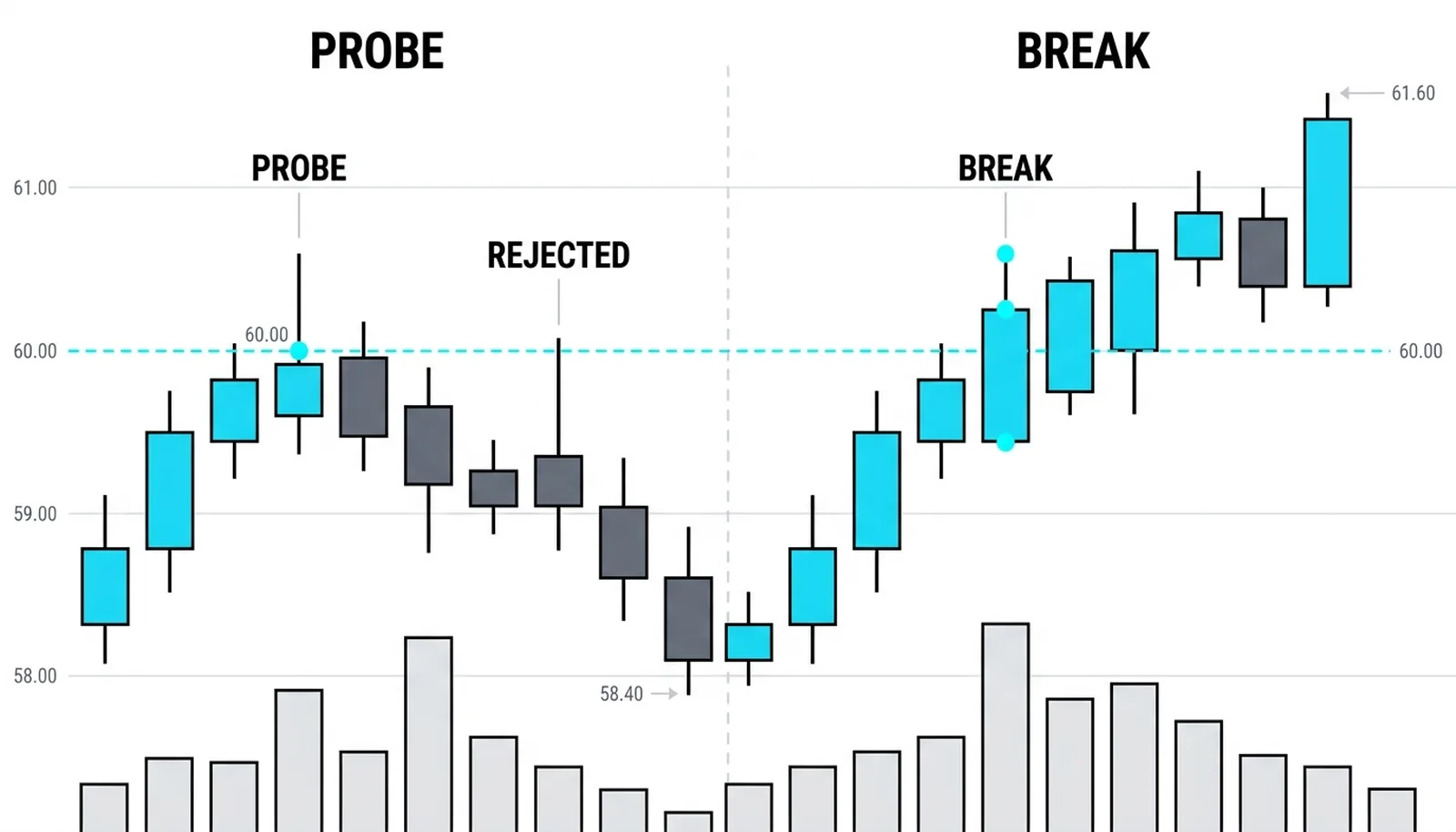
The close matters, not the poke. Price trading one tick beyond the swing high and falling straight back is a probe. A bar closing beyond that high is acceptance. The difference between the two is the difference between a test and a break, and most of the money lost on this concept is lost by traders who cannot tell them apart in real time.
A wick through the level tells you someone tried. A close through the level tells you the try succeeded, at least for that bar. Intraday spikes through swing highs happen constantly, often on thin volume, often engineered to trigger resting stops. The close is the market's signature on the move. Until you have it, you have an attempt, not an event.
Here is the discipline that keeps the term meaningful: only the most recent labeled swing counts. Any line on a chart can be broken. An old high from three months ago, a round number, a trendline drawn last week, all of these can be crossed and none of them is a break of structure. The break of structure is tied to the labeled sequence, and the tie is the definition. Restricting the term to the freshest swing point is what keeps the event rare enough to mean something.
The mirror holds in a downtrend. Each close below the most recent swing low confirms the sellers still control the move, and the broken low becomes the new overhead reference. Everything in this lesson reads identically upside down.
What the Break Proves
In an uptrend, the break proves that buyers just paid through the last price where sellers had won. The swing high was the record of a seller victory, the exact spot where supply last overwhelmed demand. A close above it rewrites that record. The level stops being resistance the market is fighting and becomes a reference the market left behind, the cleared height becoming the new minimum.
The price action canon treats the series of higher highs as a trend in motion, each break of the prior swing high being the event that keeps the definition alive. Without the next break, the sequence stalls and the label "uptrend" starts to age. This is why every impulse leg of a trend ends at a break of structure: the leg is the travel, the break is the arrival stamp. No stamp, no confirmed leg.
Notice what the break does not prove. It does not prove the trend will continue. It proves control right now, at the moment of the close. Control is rented, never owned, and the market can hand it back within a session. Read the break as evidence about the present, not as a forecast of what must follow.
Trading the Break
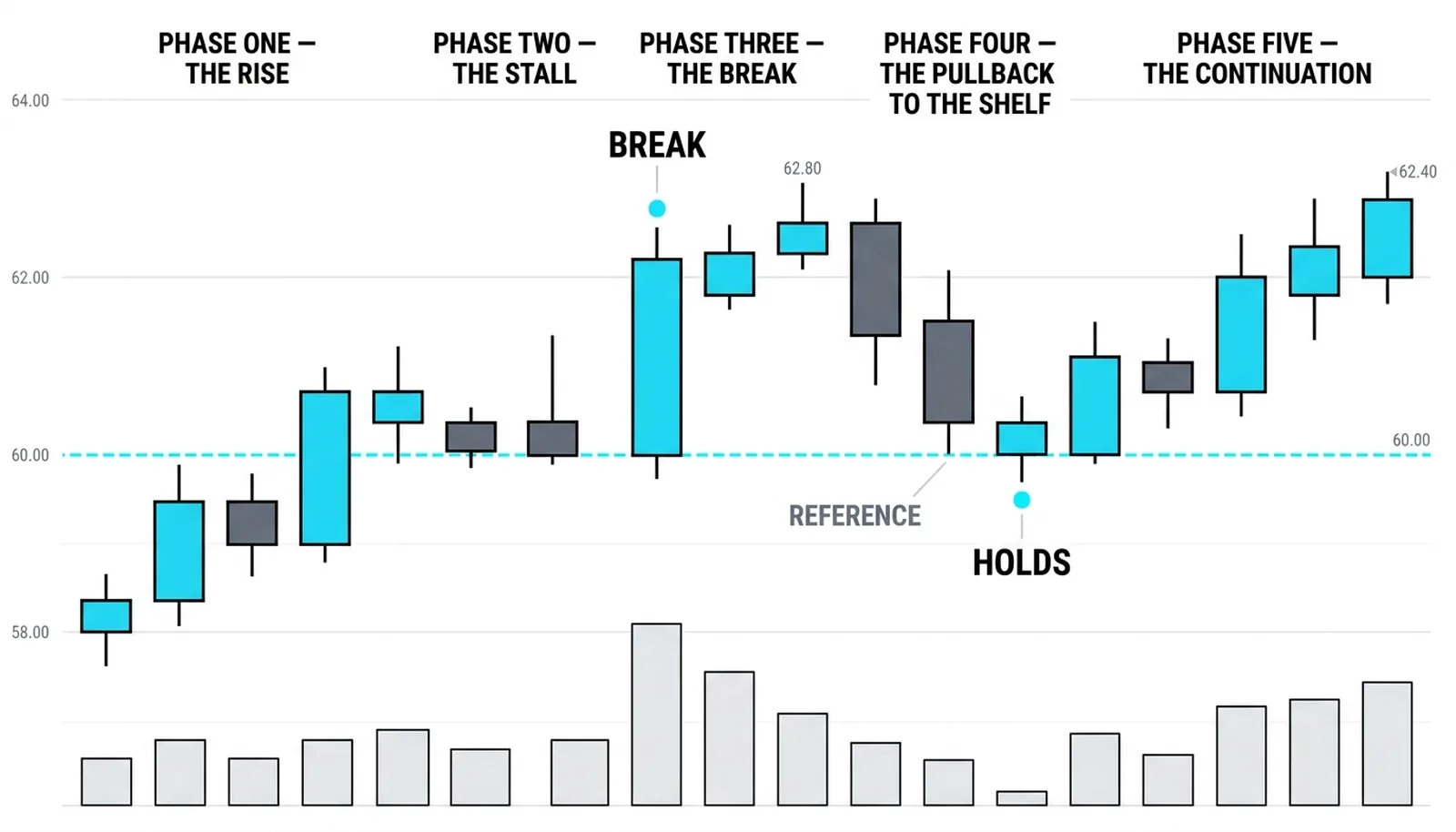
There are two honest ways to enter, and each charges a different price. The breakout entry takes the close beyond the swing point. It is fast, it never misses the move, and it pays for that certainty with a worse fill and a wider stop, because the nearest sensible invalidation sits far below, back under the consolidation the price just escaped.
The retest entry waits. After the break, price often returns to the broken level, which now acts as a reference shelf, and the trader takes the turn off it. This entry is later and sometimes never comes, but when it does the fill is better and the stop is tighter. The stop belongs below the retest low, or below the last higher low, never inside the noise of the pullback itself. A stop parked in the middle of ordinary fluctuation is a donation.
Invalidation is the part traders skip. A close back below the broken swing high suspends the proof, because the acceptance was withdrawn. One wick back under the level is noise; a close back under it is the market retracting its signature. When that happens, the trade thesis is gone even if your stop has not been hit, and the disciplined exit is the close, not the stop.
Now the honesty. Breaks fail often. Most are tested at least once, and some are outright traps built on exactly the enthusiasm the breakout invites. The break is evidence, never a promise. The useful reframe is that a failed break is itself information: it is frequently the first entry in the case for the other side, and building that case is the subject of the next lesson, the change of character.
The Break at 60.00
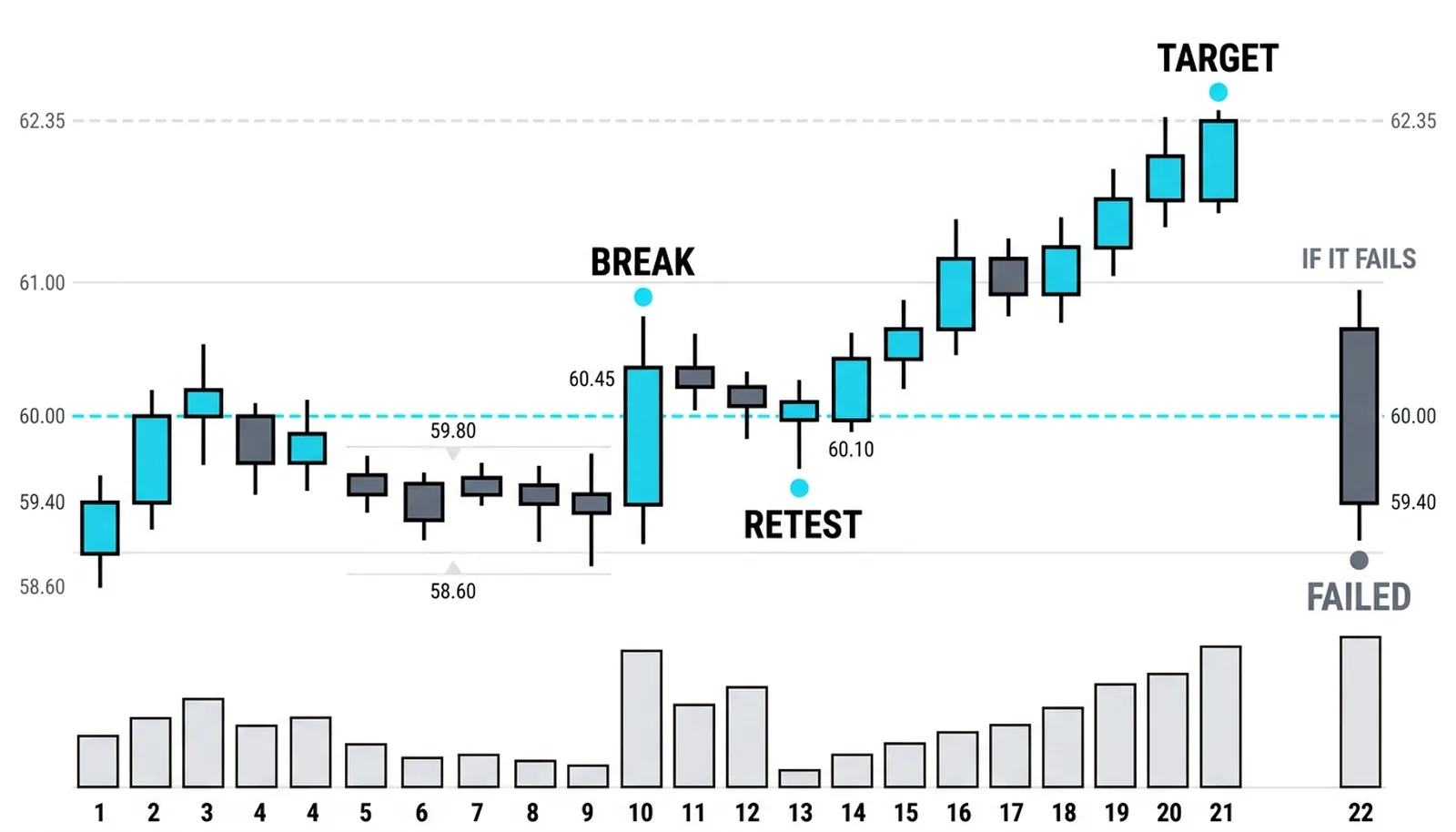
Everything below is a hypothetical illustration with invented round numbers. An uptrend stalls under a swing high at 60.00 and builds a shelf between 58.60 and 59.80 for several sessions. Then a bar closes at 60.45, beyond the 60.00 swing high. That close is a break of structure.
The breakout entry buys the close at 60.45. The stop has to sit far below the shelf, say under 58.60, which makes this a wide, expensive trade. The trader paid for certainty with room.
The patient version waits. Over the next sessions price pulls back to 60.10, holds above the broken high, and turns. The long triggers at 60.15 as buyers defend the reference. The stop sits at 59.50, below the pullback low, risking 0.65. The target is the next resistance at 62.35, a gain of 2.20, roughly 3.4 times the risk.
The failed version: two sessions after the break, price closes back at 59.40, below the broken high. The acceptance is withdrawn, the proof is suspended, and the position exits on that close regardless of where the stop sat.
| Event | Price | The Read | The Action |
|---|---|---|---|
| Close beyond the swing high | 60.45 | Acceptance, break of structure confirmed | Breakout entry fills, or retest watch begins |
| Pullback holds above the broken high | 60.10 | Broken resistance acting as a reference shelf | Retest long triggers at 60.15 |
| Target reached at next resistance | 62.35 | Leg extended, 2.20 gained against 0.65 risked | Exit or trail, sequence still intact |
| Close back below the broken high | 59.40 | Acceptance withdrawn, proof suspended | Exit on the close, do not wait for the stop |
Break of Structure Questions, Answered
What is a break of structure?
A break of structure is a close beyond the most recent labeled swing high in an uptrend, or below the most recent labeled swing low in a downtrend. It is the event that extends the labeled sequence and confirms the side in control still holds control.
Is a break of structure the same as a breakout?
No. A breakout is any move through any level: an old high, a round number, a trendline. A break of structure is a breakout tied specifically to the most recent labeled swing, and that tie is what gives it meaning. Every break of structure is a breakout; very few breakouts are breaks of structure.
Should you enter on the break or wait for the retest?
Both are valid, and they charge different prices. The breakout entry is fast and never misses the move but pays with a worse fill and a wider stop. The retest entry is cheaper with a tighter stop but sometimes never triggers. Choose based on which cost you absorb better, not on which feels braver.
What invalidates a break of structure?
A close back beyond the broken level. In an uptrend, a close back below the broken swing high withdraws the acceptance and suspends the proof, even if your stop has not been hit. The thesis dies on that close; the exit belongs there, not at the stop.
Next in Level 9: the change of character, the mirror event that fires when the sequence fails to extend, and the earliest warning that control is changing hands.