Ranging vs Trending Market Structure
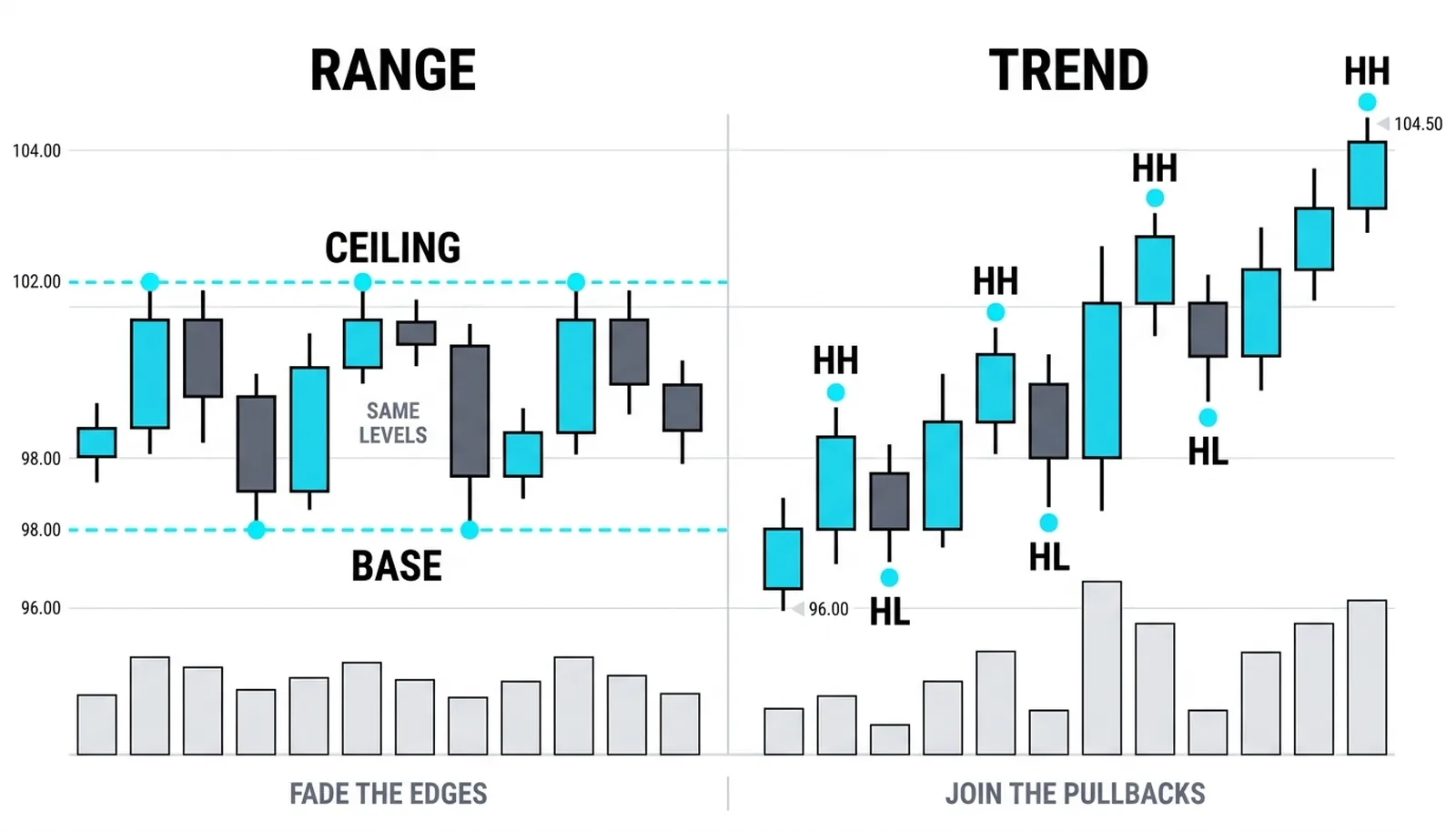
Ranging structure is a labeled sequence whose swing highs and swing lows keep arriving at roughly the same levels, the market rotating between two prices without going anywhere. Trending structure is the opposite: highs and lows progress in one direction, and the market actually travels. Which state you are in decides which trades are allowed. That single decision, state first, trade second, filters out more losing trades than any indicator ever will.

Think of a tennis rally: the ball crosses the same stretch of court again and again between two lines, endless motion and no journey, until one shot lands clean past the line and ends the point. A range is the rally. A trend is what happens after the winning shot. The framework lesson introduced the three states and the impulse lesson named the two speeds, so this lesson pits the two labeled states against each other directly. Most trading mistakes are state mistakes. A fade attempted in a trend. A breakout chased in a range. Same tools, wrong state.
The Two States, One Toolkit
Start with what you already do: label swing highs and swing lows. In a ranging market, the highs cluster near one level and the lows cluster near another. In a trending market, the highs and lows step in one direction, higher highs with higher lows, or lower highs with lower lows. The labels are identical. The pattern they form is not.
Kam Dhadwar's auction market theory supplies the mechanism underneath the labels. A balanced market is efficient: the dual auction rotates and finds opposite responses at the same prices, sellers appearing at the top, buyers at the bottom. That is exactly what a range is, rotation between a defended ceiling and a defended base. An imbalanced market is inefficient, one side absent, and that is a trend.
Now the permissions. In the range, each test of the ceiling is a candidate fade and each test of the base is a candidate bounce, because most tests of the walls fail. That failure rate is precisely why the range persists; if the walls kept breaking, there would be no range to label. In the trend, higher highs and higher lows arrive together, and every correction is a candidate entry in the trend's direction rather than a candidate reversal.
Same toolkit. Same labeled swings. Opposite permissions. The state ends the only way it can end: a close beyond the wall, the range's own version of the break of structure the earlier lessons already trade. Acceptance beyond the wall means balance is being rebuilt somewhere else, at new prices, and the old rotation is finished.
Trading the Range
The range trade is the fade. Short near the ceiling, at the top of the rotation. Buy near the base, at the bottom. You are betting that the wall holds one more time, and the history of the rotation is your evidence.
The stop goes beyond the wall, with a buffer. If the wall fails, the trade has failed by definition, so the stop belongs where the idea is proven wrong, not where the loss feels comfortable. A stop tucked just past the swing high gets clipped by the ordinary noise of a test; a stop placed with a buffer beyond the level survives the noise and dies only when the wall actually gives way.
The target sits at the far wall. The rotation's own history says the move should run out there, because that is where it ran out every previous time. Do not get greedy in the middle and do not get greedy at the end. The range pays the trader who respects its geometry and punishes the one who holds a ceiling short hoping for a breakdown that the state has not announced.
Here is the honesty, stated plainly. Most tests of the walls fail, which makes the fade the statistically honest trade. But every range breaks eventually. The first close beyond a wall voids every fade instantly. And the poke beyond the wall that closes back inside is the market's oldest trap, the move that triggers breakout entries and stops out fades in the same minute. So the state is re-read on closes, never on pokes. A wick through the ceiling is a test. A close through the ceiling is a decision.
- Fade the edges: short near the ceiling, buy near the base.
- Stop beyond the wall, with a buffer for test noise.
- Target the far wall, where the rotation's history says moves expire.
- Re-read the state on closes only; pokes are tests, not answers.
- After a real break, the next trade is a different trade with different rules.
Trading the Trend and Reading the Flip
In the trend, the permissions invert. You do not fade the highs in an uptrend; you join the corrections. Each pullback toward a prior swing region is a candidate entry in the trend's direction, because the sequence of higher highs and higher lows says the market is traveling, and traveling markets resume more often than they reverse.
The price action canon frames the test simply: in a healthy trend, the highs and the lows move together. Higher highs with higher lows, both halves of the sequence agreeing. When one half stops cooperating, when the highs keep printing but the lows stop rising, or the reverse, the trend's internal agreement is cracking, and the trader tightens standards before the chart announces anything.
The flip from range to trend, or trend to range, is declared the same way every state change in this framework is declared: by a close. For the range, the close beyond the wall ends it. For the trend, the close through the prior swing, the lower low in an uptrend, ends it. Nothing else counts. Intrabar drama, long wicks, fast spikes, all of it is noise until a bar closes somewhere it should not close.
What matters is that the trade after a real break is a different trade. The range fade is dead; the breakout-and-pullback logic from the structure lessons takes over. The trader who keeps fading the old ceiling after acceptance beyond it is trading a state that no longer exists. State first, trade second, and re-read the state on every close near a wall.
The Range at 60.00 and 64.00
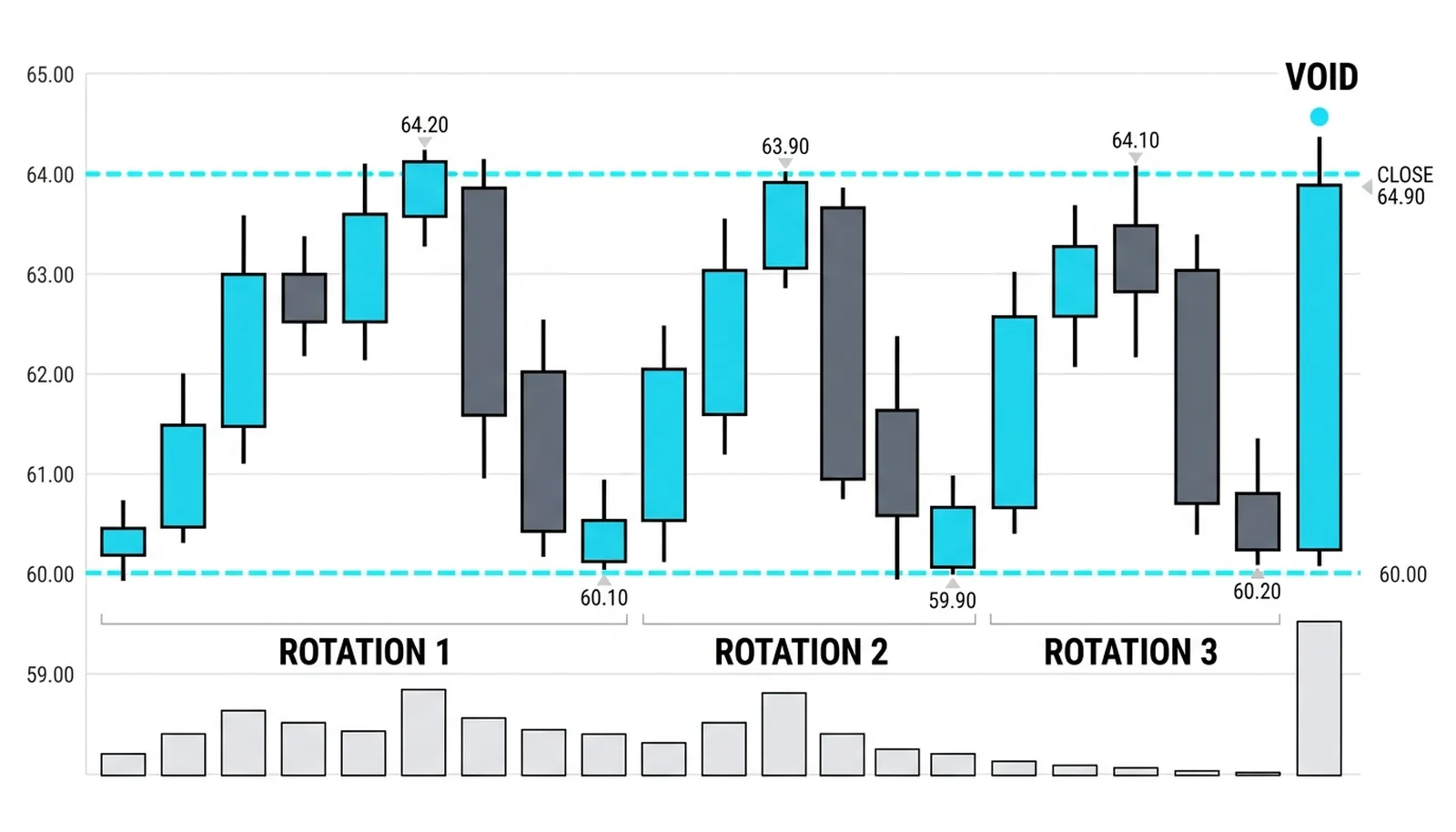
A hypothetical example, with invented round numbers. A market rotates between a defended ceiling near 64.00 and a defended base near 60.00. Across three full rotations it prints swing highs of 64.20, 63.90 and 64.10, and swing lows of 60.10, 59.90 and 60.20. The highs cluster. The lows cluster. Nothing progresses. This is ranging structure, and the fade is the permitted trade.
| Rotation | Swing High | Swing Low | What It Confirmed |
|---|---|---|---|
| First | 64.20 | 60.10 | Ceiling and base both defended once |
| Second | 63.90 | 59.90 | Walls hold; clustering tightens the levels |
| Third | 64.10 | 60.20 | Rotation intact; fade remains the honest trade |
| Break | Close at 64.90 | — | Range void; state must be re-read |
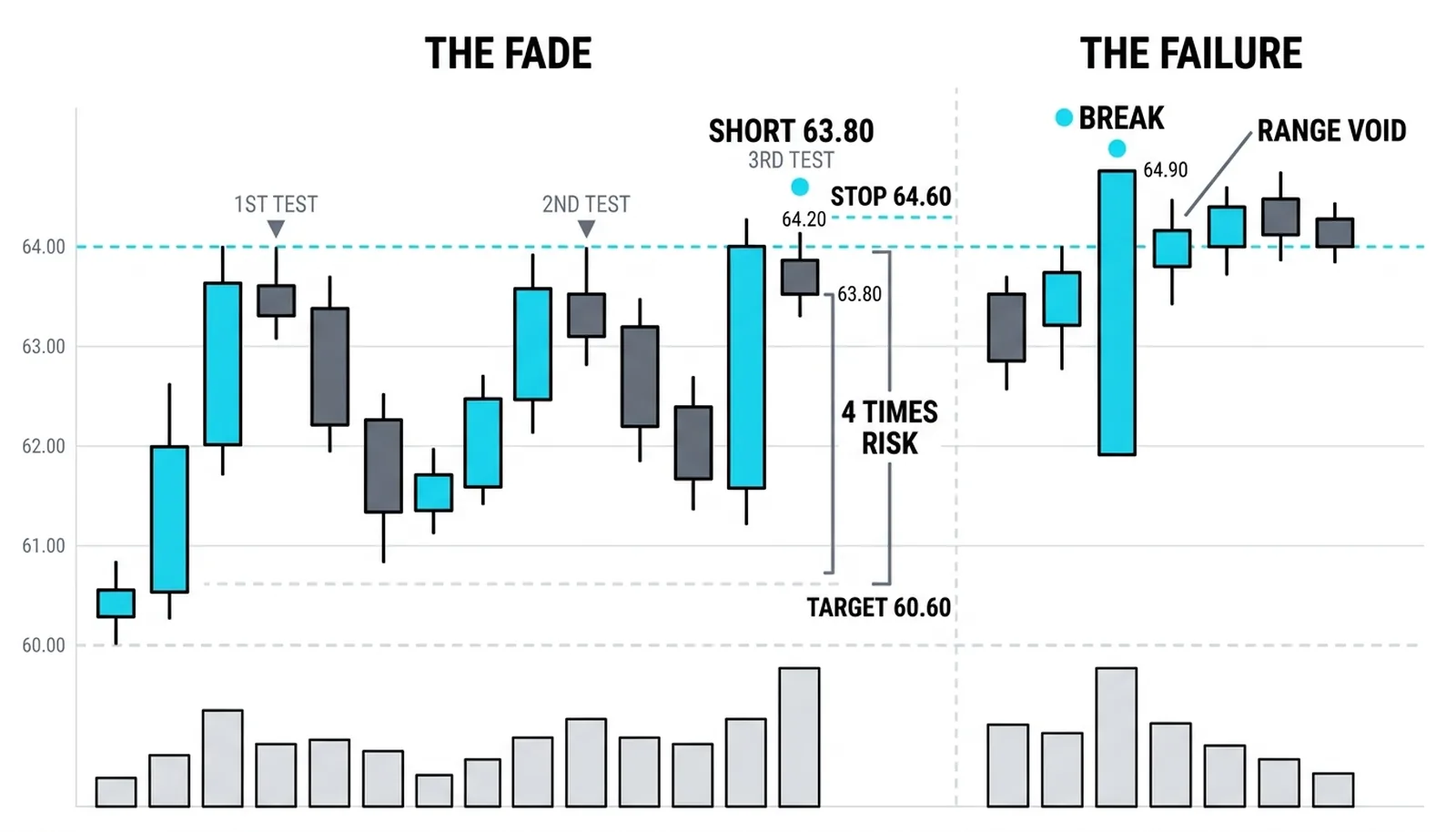
The trade: on the third test of the ceiling, price rejects near the top of the rotation and the trader shorts at 63.80. The stop sits at 64.60, beyond the wall with a buffer above the 64.20 high, risking 0.80. The target is the far wall region at 60.60, where the rotation's history says the down-leg should run out. The market rotates down and fills the target. Gain: 3.20, roughly four times the risk. That asymmetry is what makes fading a wall with a tight invalidation worthwhile, even though individual fades lose regularly.
Now the failed version. On the next approach, a bar closes at 64.90, beyond the ceiling. The range is void on that close. The short exits, no negotiation, no waiting to see if it comes back. The poke that closes back inside would have been a trap, but a close at 64.90 is acceptance, and acceptance means balance is being rebuilt somewhere above. The state gets re-read from scratch before any new trade is allowed. The trader who shorted the old ceiling again after that close is not trading a range; that trader is arguing with a trend.
Ranging and Trending Questions, Answered
What is ranging structure in trading?
Ranging structure is a labeled sequence whose swing highs cluster near one level and whose swing lows cluster near another, the market rotating between two prices without traveling. In auction terms it is balance: an efficient market where the rotation keeps finding sellers at the ceiling and buyers at the base.
What is trending structure?
Trending structure is a labeled sequence whose highs and lows progress in one direction, higher highs with higher lows in an uptrend, lower highs with lower lows in a downtrend. It is imbalance: one side of the market is effectively absent, so price travels until it finds the other side again.
How do you know if a market is ranging or trending?
Label the swing highs and swing lows and look at where they arrive. Clustered highs and clustered lows mean ranging; progressing highs and lows mean trending. The same toolkit answers both questions, which is why the state read comes before any trade decision.
What ends a trading range?
A close beyond one of the walls ends a range. A poke through the wall that closes back inside is a trap, not an ending. Acceptance beyond the wall means balance is being rebuilt at new prices, the fade is void, and the next trade belongs to the breakout framework, not the range framework.
With both states and the permissions they grant now in place, the framework is complete: label the swings, read the state, take only the trade the state allows. The lessons ahead put that complete structure to work, combining it with the volume and indicator layers already built into full trade plans.