Trading Inside Price Channels
Price channels are two parallel lines that frame a trend, and they turn a vague sense of direction into concrete boundaries: where pullbacks tend to end, where extensions tend to stall, and where the trend's pace has changed. If you can already draw a trendline, you are one step away from a channel. That one step adds a lot of information.

Think of a train running between two rails: the rails do not move the train, but everything the train does happens between them. Price behaves the same way inside a well-drawn channel. It travels, pauses, and reverses within boundaries you marked before it got there.
One note before we start. A flat, horizontal channel is a different animal, and this site covers it separately in the lesson on rectangles. This post is about the parallel rising and falling channels: how to draw the second line, when to ride and when to fade, what slope changes mean, and the throw-over.
From Trendline to Channel
Draw the trendline first. In an uptrend, that means connecting the rising lows. In a downtrend, connect the falling highs. Get that line right before you add anything, because the channel is only as honest as its first rail.
Then copy that line and slide the copy, keeping it exactly parallel, over to the opposite side of price. Anchor it through the first obvious extreme on that side. In an uptrend, that is the first clear swing high. In a downtrend, the first clear swing low.
Now the test. A channel is only honest if the parallel line actually contains price. If you draw the upper rail through one high and price immediately slices through it on the next push, your line is wrong, not the market. Redraw it. A channel that needs constant adjustment after the fact is not a channel; it is a wish.
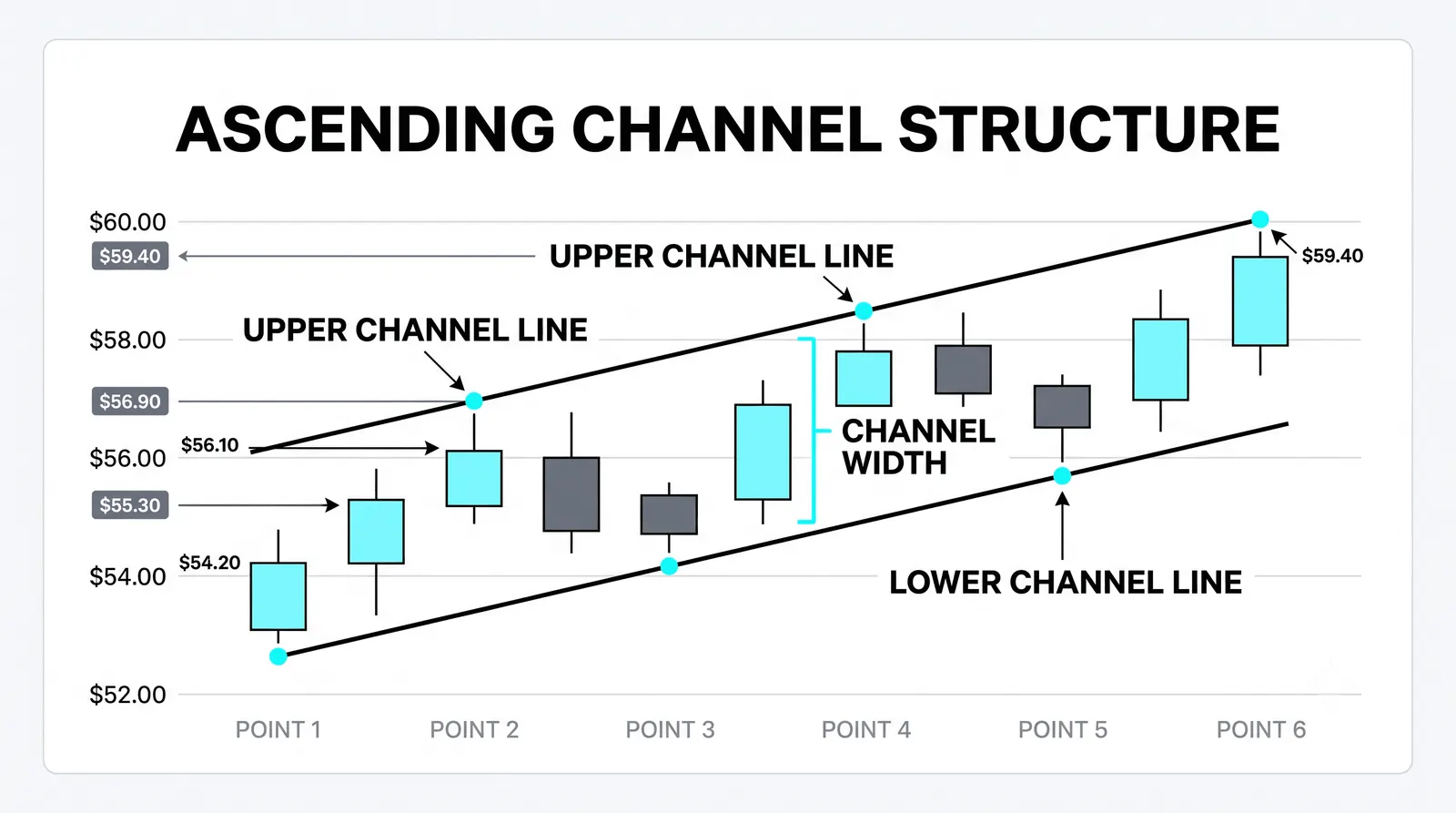
Two touches on each side is a working channel. Three touches on the trendline side plus respect for the parallel rail is a strong one. The more times price has honored both rails, the more weight the boundaries carry.
What the Channel Slope Tells You
An ascending channel means buyers are setting the pace. Each pullback finds demand at a higher level than the last, and each push reaches a bit further. A descending channel means sellers are in control, with rallies dying at lower and lower levels.
The steepness of the slope is the trend's speed. A gentle ascending channel is a slow, orderly advance. A steep one is a fast trend, and fast trends burn fuel quickly. Steep channels break more often than shallow ones, and they break harder.
Watch for the slope itself to change. A channel that flattens is a trend losing pace, even while price is still rising. The highs still come, but they arrive slower and closer together. That deceleration often shows up in the channel's shape before it shows up anywhere else. When you see the rails bending toward horizontal, tighten your expectations and your stops.
Riding the Channel
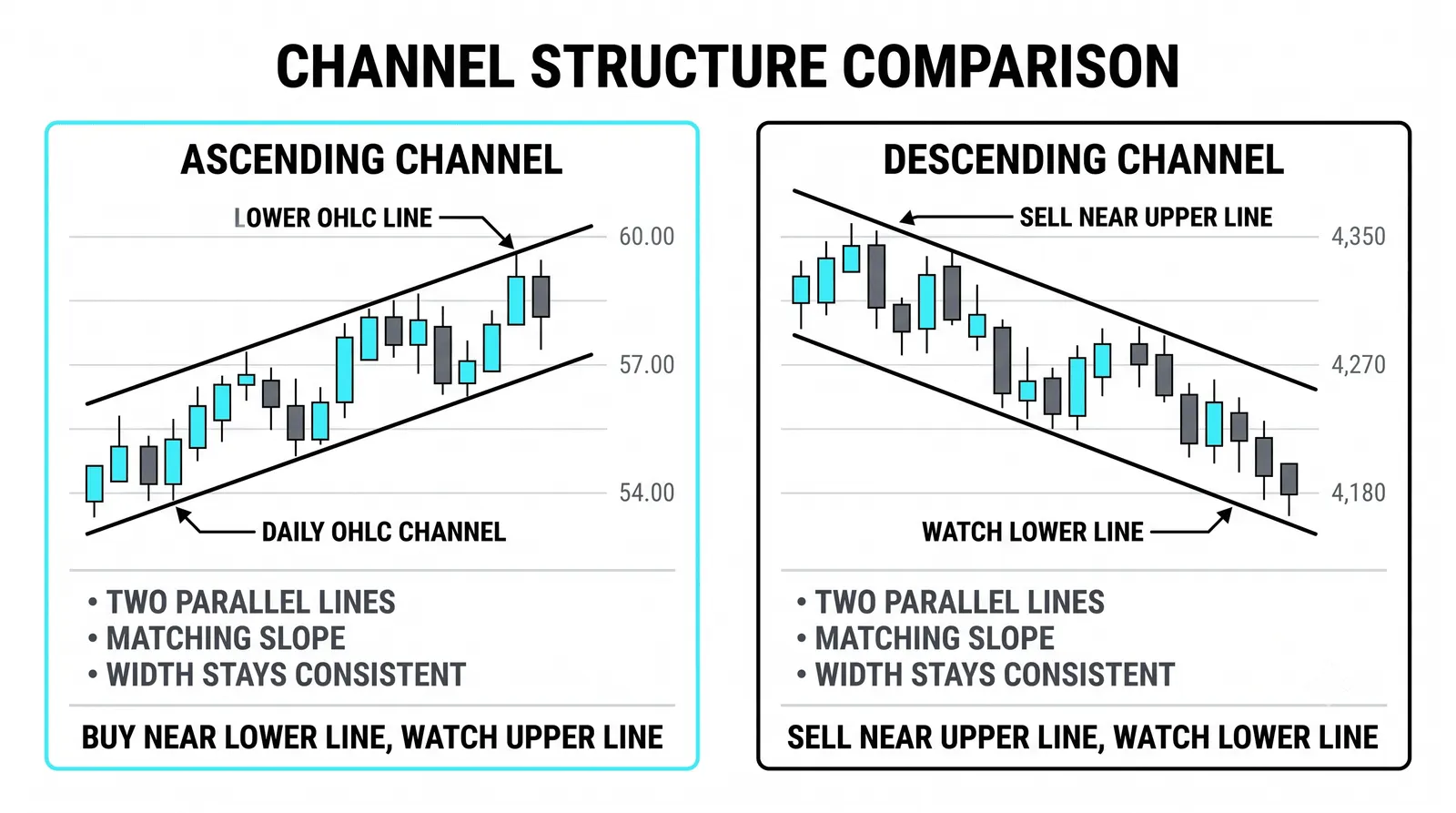
In an ascending channel, the disciplined trade is buying near the lower rail, not chasing near the upper one. This sounds obvious and is violated constantly. Price near the upper rail feels strong and safe. It is actually the worst entry the channel offers, because your risk runs all the way back down to the bottom rail while your remaining upside is a few ticks.
The mechanics are simple. Wait for the pullback to reach the lower rail. Look for price to hold there: a rejection wick, a bullish engulfing candle, a tight consolidation that refuses to break the line. Enter on that evidence, not before it.
Stops go below the rail, with a small buffer for noise. If price closes decisively under the lower rail, the channel idea is wrong and the trade should already be out. Targets sit at or just before the upper rail. "Just before" matters, because price often stalls a little short of the line, and the trader holding out for the exact touch watches a good trade round-trip.
The risk-reward here is built into the structure. You risk the width of a small buffer below the rail to make most of the channel's width. That is why patient channel traders can be wrong often and still come out ahead.
Fading the Rails and the Throw-Over
In wide, mature channels, some traders fade the edges instead of riding the trend. They short near the upper rail of an ascending channel or buy near the lower rail of a descending one, aiming only for a trip back toward the middle. This can work, but understand what you are doing: trading against the trend's direction with the trend's boundary as your backstop. Keep targets modest and stops tight. Fading is a scalper's game, not an investor's.
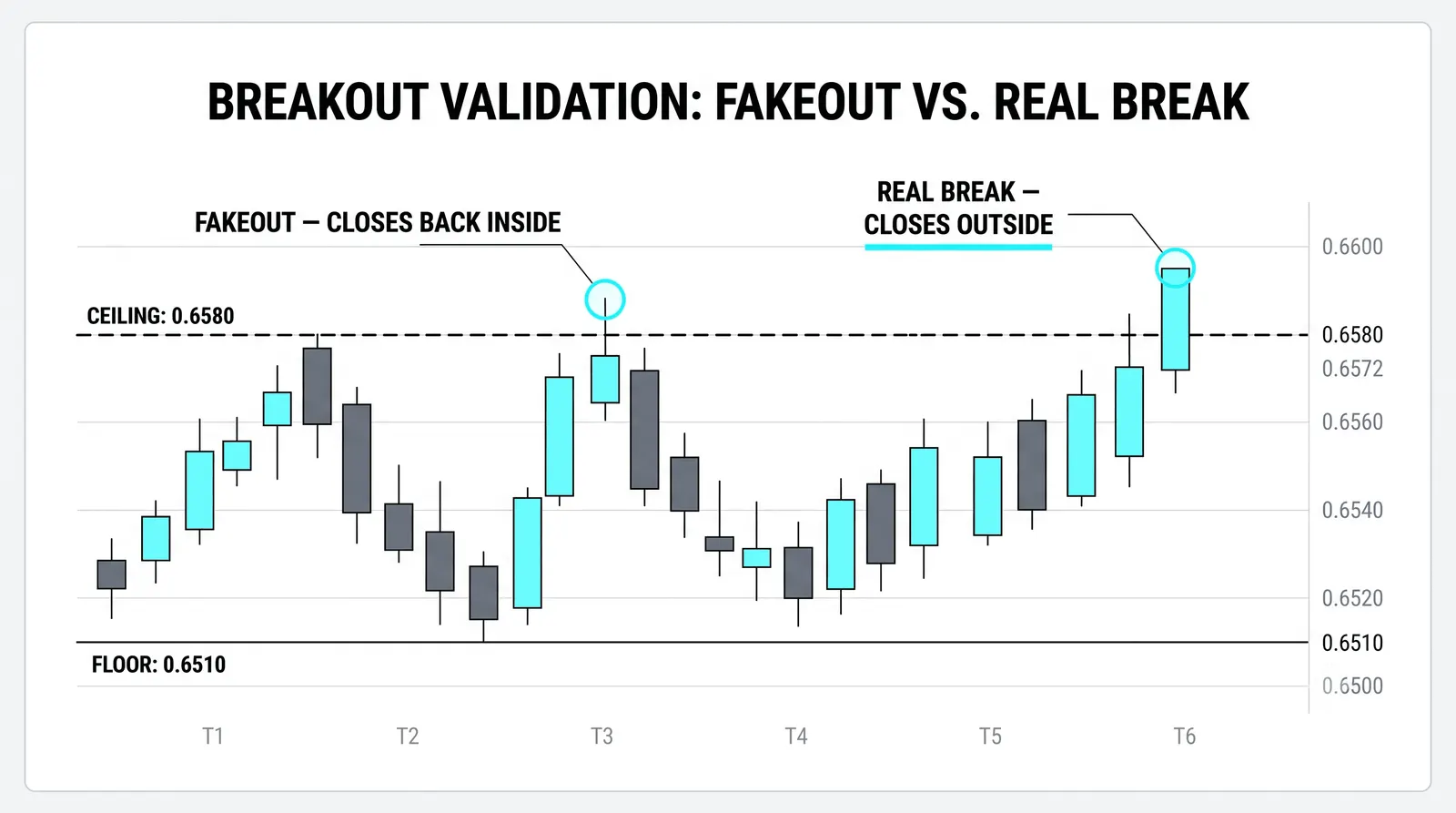
Then there is the throw-over. A throw-over is price pushing through the upper rail of an ascending channel and stalling out there. It looks like acceleration. It is usually exhaustion.
The strongest-looking move is often the last one. Late buyers see the breakout above the rail and pile in, and that final burst of demand is exactly what exhausts the move. When price throws over the upper rail and then falls back inside the channel, treat it as a warning that the trend is spent, not that it has found a new gear. Many sharp reversals begin with a throw-over and a fast return through the channel's middle.
One Channel, One Ride
Here is a hypothetical walkthrough with round numbers. A stock makes pullback lows at 30, then 34, then 38. You draw the lower rail through those three points. It rises four points per swing, cleanly.
The first obvious high printed at 36, back when the low was 30. You copy the lower rail, slide the copy up through 36, and that becomes your upper rail. The channel's width is 6 points.
Price keeps working. It prints a high near 40, right on the upper rail, and pulls back. Later it prints a high near 44, again on the rail. Both rails have now been respected multiple times. The channel is honest.
The next pullback develops. You project the lower rail forward, and it sits near 42 when price arrives. Price dips to 42, prints a strong rejection candle, and holds. You go long at 42.50.
Your stop goes under the rail with a buffer, at 41.50. That is 1 point of risk. Your target sits just before the projected upper rail, around 48. That is 5.5 points of potential reward against 1 point of risk. You did not need a prediction. You needed the rails.
Price climbs and reaches 47.80 before stalling. You exit near your target. Later, the stock rolls over and closes at 40.50, decisively under the lower rail. That close is the channel telling you it has failed. Anyone still holding longs on channel logic has no reason left to hold.
The Three Channel Types at a Glance
| Channel type | What the slope says | Natural side | Main risk |
|---|---|---|---|
| Ascending | Buyers set the pace; higher lows and higher highs | Long near the lower rail | Chasing near the upper rail; a close below the lower rail ends the idea |
| Descending | Sellers set the pace; lower highs and lower lows | Short near the upper rail | Buying the lower rail too early; a close above the upper rail ends the idea |
| Horizontal | Neither side controls pace; a range, not a trend | Either edge, faded back toward the middle | Breakouts from ranges can run fast and far against a fade |
Questions About Price Channels
Does the second line have to touch exactly two highs?
No. One clear anchor point is enough to place the parallel line, and what matters after that is whether price respects it. A rail drawn through one obvious high that then contains the next two pushes is doing its job. Forcing the line through two exact touches often means tilting it off parallel, which breaks the whole construction.
What is a channel throw-over and why does it matter?
A throw-over is price pushing through the outer rail and stalling instead of accelerating. It matters because it marks exhaustion: the final burst of late demand that empties the tank. When price falls back inside the channel after a throw-over, the odds of a full reversal rise sharply, and holding trend-side positions gets dangerous.
Should I trade the rails or the middle?
Trade the rails. The middle of a channel offers the worst of both sides: no boundary nearby to define your risk, and no edge in either direction. The rails give you a line to enter against, a place for your stop, and a clear condition that proves you wrong. The middle gives you hope.
When is a channel better than a trendline alone?
A channel is better whenever you need targets as well as entries. A lone trendline tells you where pullbacks should end, but says nothing about how far the next push should go. The parallel rail answers that, and it also warns you, through slope changes and throw-overs, when the trend's character is shifting.
Once channels feel mechanical, the next skill is reading what happens at the moment they fail. A broken rail is also new information about who has taken control. The lessons on breakouts and failed structures pick up exactly where this one ends.