Pitchfork and Median Line Analysis
The pitchfork is a drawing tool that builds three parallel lines out of three market pivots, and its center line, the median line, is the part traders actually watch, because price treats it like a destination it keeps coming back to. The full name is the Andrews pitchfork, after Alan Andrews, who taught the method in the 1960s and 70s. Most charting platforms include it as a standard tool.

The idea is simple. Markets swing, and swings have a center of gravity. The pitchfork draws that center as a line, then wraps a boundary on each side. Once it is drawn, you stop guessing where price "should" go and start watching how it behaves around the fork.
The median line acts like a magnet for price; not magic, just the average path of the swing the fork was built on.
Building the Fork
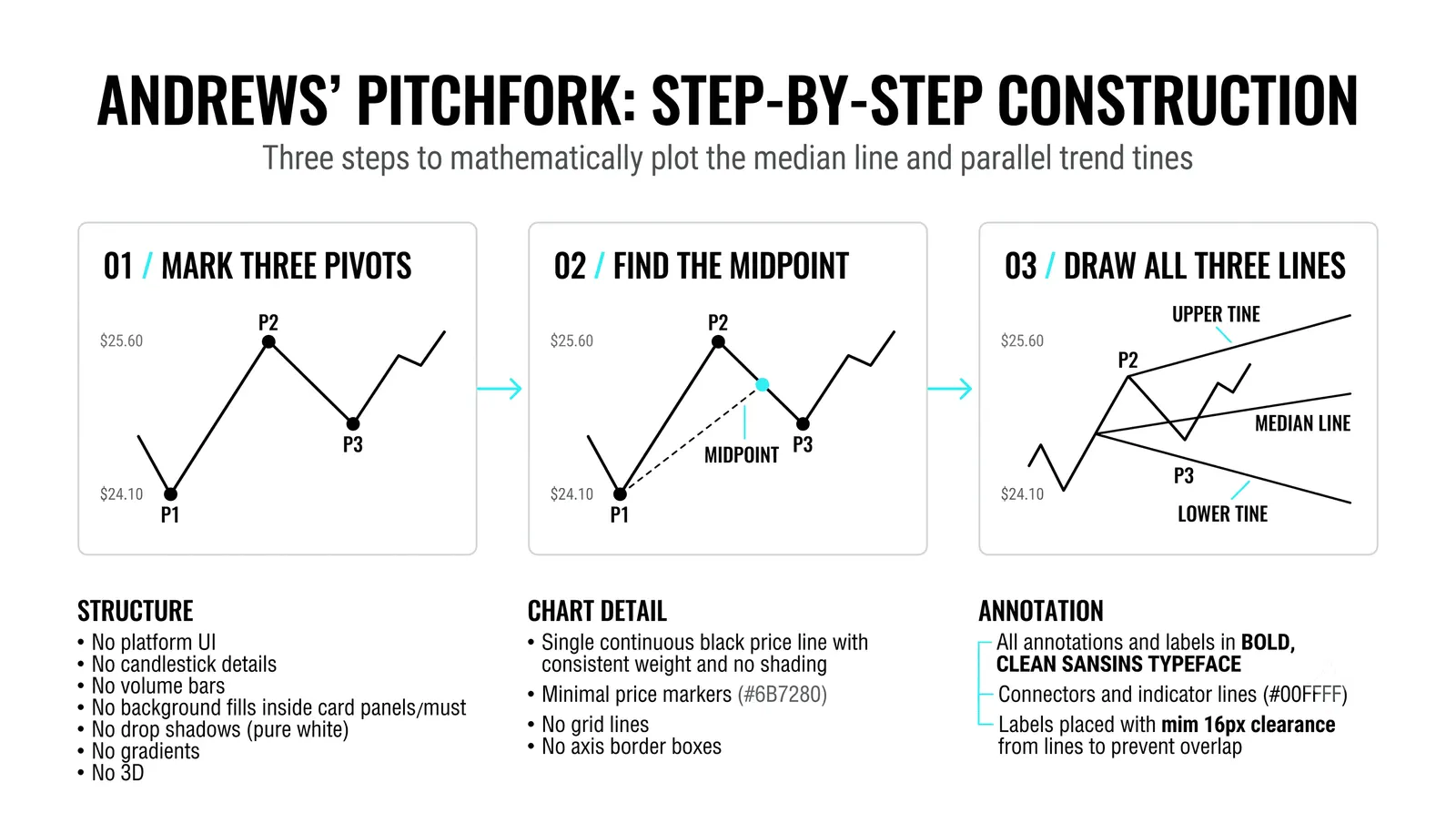
You need three alternating pivots. For a bullish fork, pick a major low, then the high that follows it, then the next low. Those three points define the swing you are measuring.
The geometry works like this. The two outer lines, the prongs, run parallel to each other, one starting from the second pivot and one from the third. The median line starts at the first pivot and runs through the midpoint of the other two. Most platforms do the math for you once you click the three points.
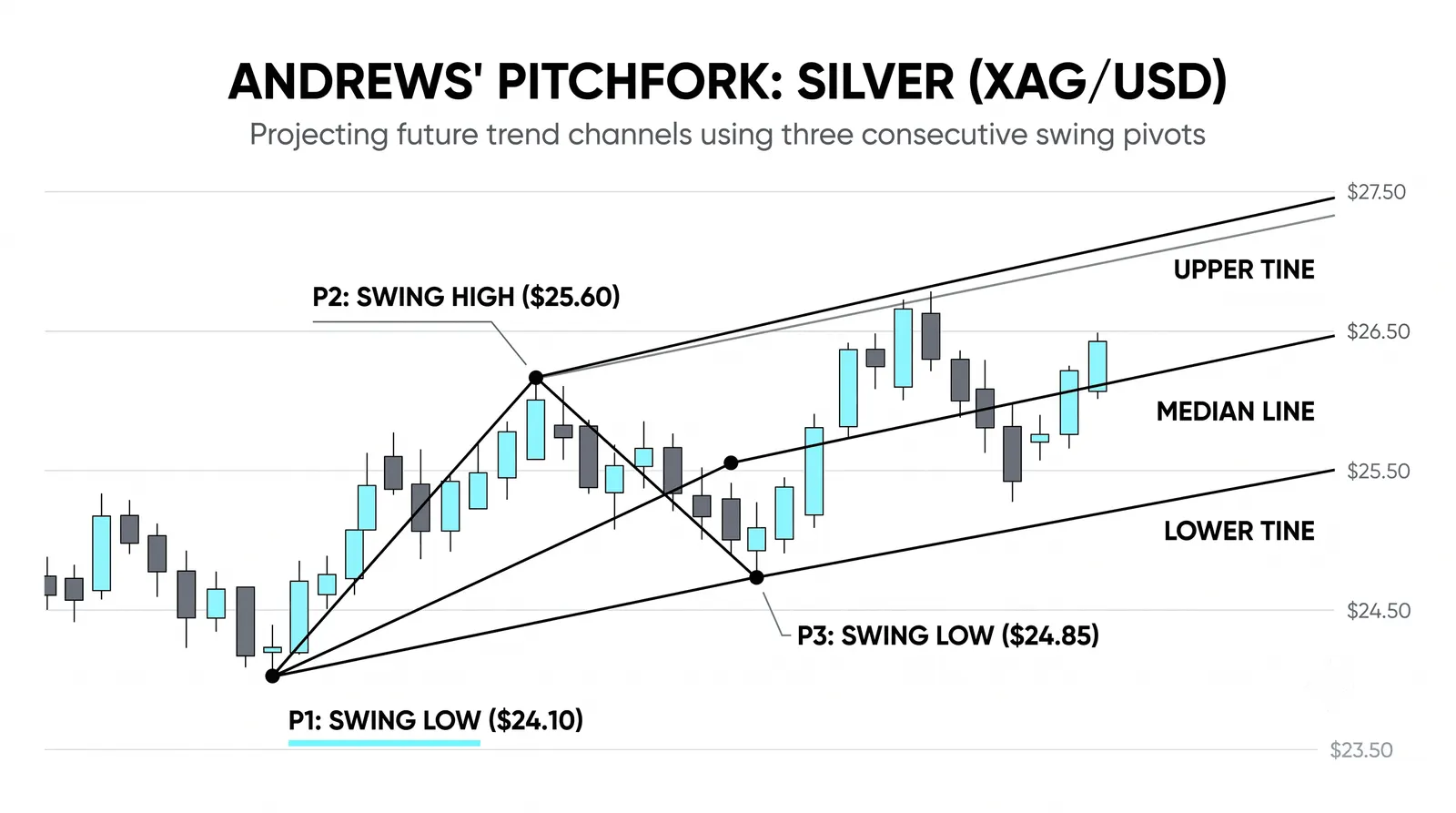
For a bearish fork, flip the sequence: a major high, the low that follows, then the next high. Same construction, mirrored.
Pivot selection is where the skill lives. Choose obvious, structural pivots, the ones anyone looking at the chart would circle. If you have to hunt for your three points, the fork will not mean much. A fork drawn on noise produces noise.
What Each Line Is For
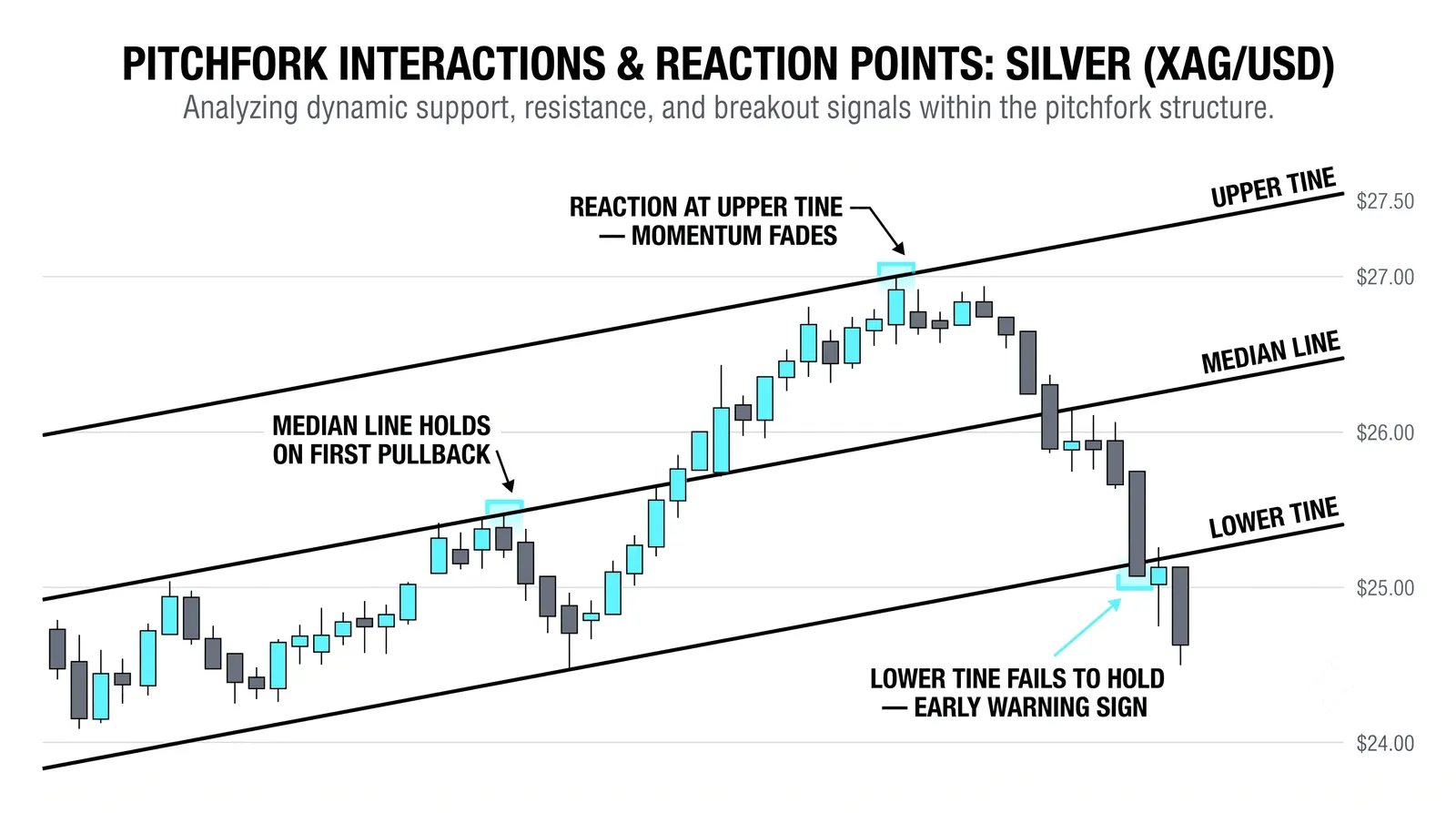
The outer prongs mark the boundaries of the swing's spread. Think of them as the edges of the path price has been traveling. Touches of a prong often produce reactions, especially the first touch after the fork is drawn.
The median line is the balance path. It splits the swing in half. When price is above it, the swing's buyers hold the advantage. Below it, sellers do.
Two objectives follow from this. Price reaching the median line is the first objective, the minimum expectation once a valid fork is in place. Price reaching the far prong is the extension, the fuller version of the move. Andrews himself claimed price reaches the median line roughly 80 percent of the time. Treat that number as folklore, not a statistic, but the tendency is real enough to build a framework around.
Why the Median Line Gets Respected
The median line is the center of the move that created the fork. It is not an arbitrary diagonal. It is the average trajectory of a swing the market actually printed, projected forward.
When price reverses at the median, the market is saying the original swing's balance still holds. The same forces that built the first leg are still in charge. That is useful information, and it costs you nothing to observe.
When price slices through the median with authority, a strong close well beyond it, the message changes. The balance has shifted. The old swing no longer describes the market, and the fork loses its claim on your attention.
This is why the median line matters more than the prongs. The prongs mark edges. The median marks control.
Reading the First Test
A fork earns trust at its first test. Until price interacts with one of its lines, the drawing is a hypothesis.
A clean reversal at the median line confirms the fork. Price traveled to the center of the swing, found the balance point, and responded. You now have evidence the fork describes something real, and future touches deserve respect.
A slide straight through the median, with no pause and no reaction, demotes the fork to a failed drawing. Do not argue with it. Do not redraw it five times until it fits. A fork that price ignores is telling you the swing you measured is no longer the swing that matters.
Failed forks are not wasted work; they carry information about momentum. A market that ignores its own median line is a market being driven by something stronger than the prior swing.
Three Pivots, One Fork
Here is a hypothetical example with round numbers. A stock makes a major low at 50. It rallies to a high at 60. It pulls back and prints a higher low at 53. Those are your three pivots.
The midpoint between 60 and 53 is 56.50. So the median line starts at 50 and runs through 56.50, projecting upward and to the right. The upper prong starts at 60, the lower prong at 53, both parallel to the median.
Now price climbs from 53. It rises and stalls right around 56.50, sitting on the median line. That stall is the first test, and the hesitation confirms the fork is live. The market noticed the line.
Then price breaks above 56.50 and holds. That break says buyers have absorbed the balance point, and the fork's next objective is the upper prong. Price travels up toward that prong, which now serves as the extension target and a logical place to expect supply.
Each event told you something specific. The stall at 56.50 confirmed the median line was respected. The break above it confirmed the balance had tipped to buyers. The run to the upper prong confirmed the swing's full range was in play. One drawing, three pieces of information.
Where the Fork Fits With Other Tools
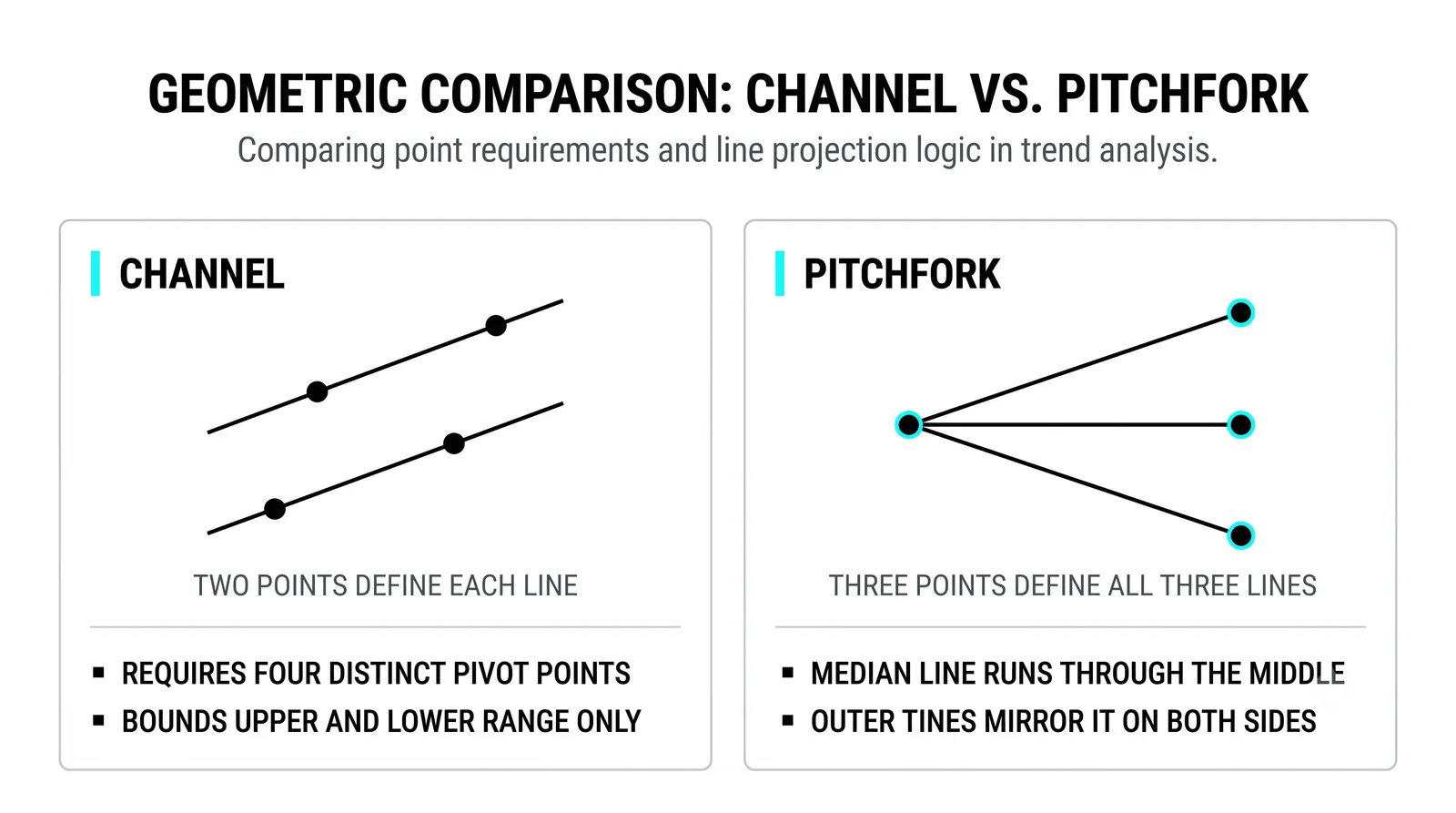
A pitchfork is a channel drawn from pivots instead of from two extremes. A standard channel needs a trendline and a parallel copy. A fork derives everything from three structural points, which makes it less subjective once you agree on the pivots.
It pairs naturally with what you already use. When a median line lands on a horizontal support or resistance level, that confluence carries more weight than either line alone. When a prong lines up with a trendline you have already drawn, the zone deserves attention.
Use the fork on the same timeframes where you already read structure. If you read swings on the daily chart, draw forks on the daily chart. Dropping a fork onto a timeframe where you have no structural context just adds lines to a chart you do not understand.
One caution. The fork is a framework for reading behavior, not a prediction machine. It tells you where reactions are likely and what those reactions mean. It does not owe you a reversal at any line, and no line on a chart guarantees anything about your P&L.
Common Questions About the Pitchfork
Who invented the pitchfork, and does the name matter?
Dr. Alan Andrews developed and taught the method, building on earlier median-line work by Roger Babson. The name matters only for finding the tool in your platform's menu. The trading value is in the geometry, not the history.
What if price never reaches the median line?
That outcome is meaningful, not broken. If price turns before reaching the median, the move is weaker than the swing that built the fork, which often warns of a deeper reversal coming. Andrews treated a missed median as a signal in itself, and it is worth logging in your journal.
Can I use a pitchfork on lower timeframes?
Yes, the construction works on any timeframe, but reliability drops as the pivots get smaller. A fork built on five-minute noise fails far more often than one built on daily swings. If you trade lower timeframes, anchor your forks to pivots that are obvious on a higher timeframe first.
What makes a fork failed versus working?
The first test decides it. A clear reaction at the median line or a prong means the fork is working. A decisive slice through the median with no reaction means it has failed, and the honest response is to delete it and reassess the structure rather than redraw until the chart agrees with you.
From here, the natural next step is practicing pivot selection on historical charts. Scroll back, mark three pivots, draw the fork, then scroll forward one bar at a time and grade how price treated the median line. Twenty repetitions of that exercise will teach you more than any description of the tool, including this one.