Options Greeks: Delta, Theta, Gamma, Vega
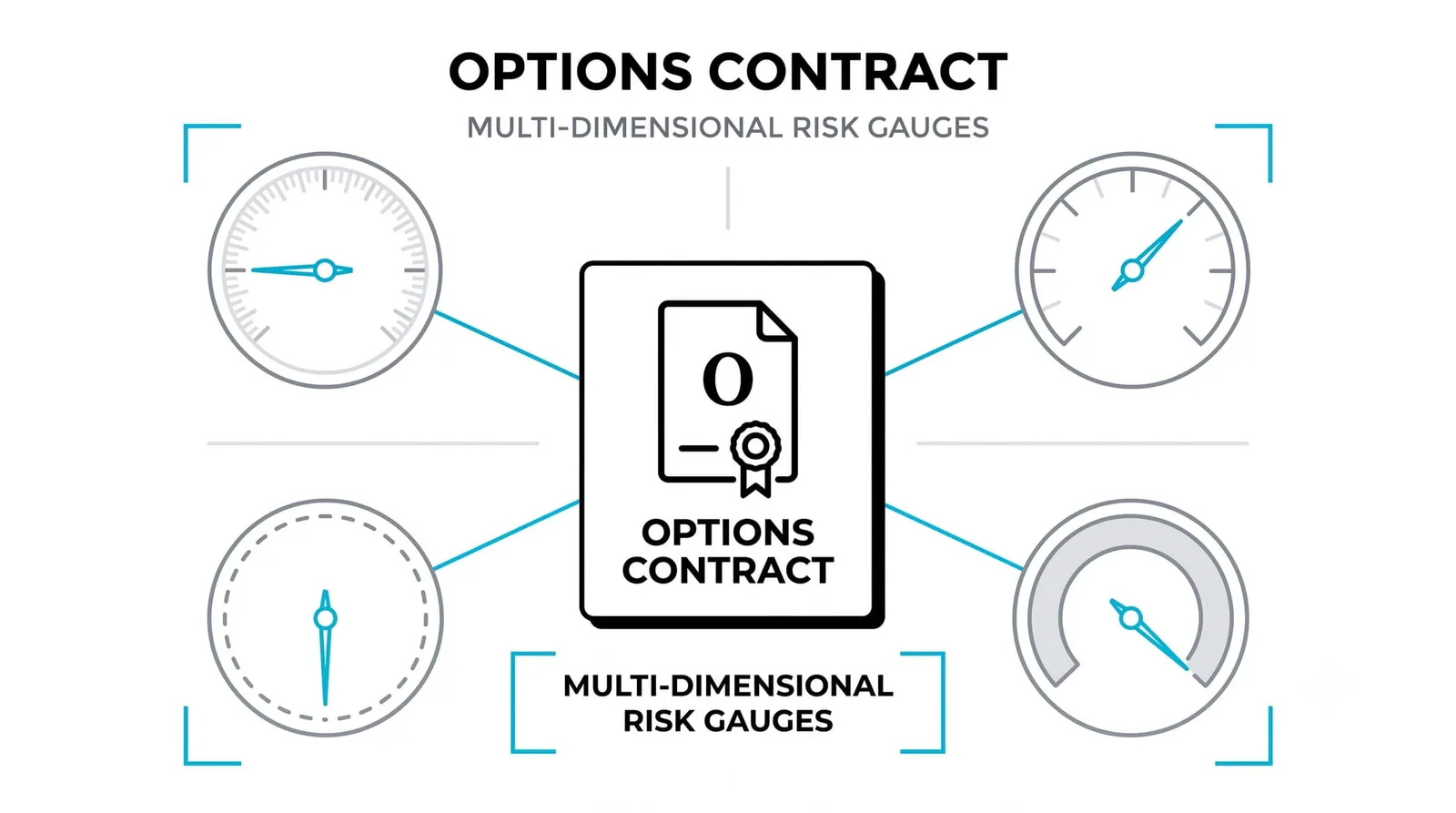
The options greeks are the sensitivity measures behind an option's price: delta for the underlying's direction, theta for time decay, gamma for how delta itself shifts, and vega for volatility. If you trade options without watching them, you are trading an instrument whose price moves for reasons you are not tracking.

Earlier in this program we covered what options are and how calls and puts work mechanically. This lesson is about the risk dials behind the price. Think of each greek as one lever behind the option's price: pull one and the price moves in a way the others cannot explain. A stock going up can lift your call while falling volatility drags it back down, and the greeks tell you which force won and by how much.
Delta: Direction Sensitivity
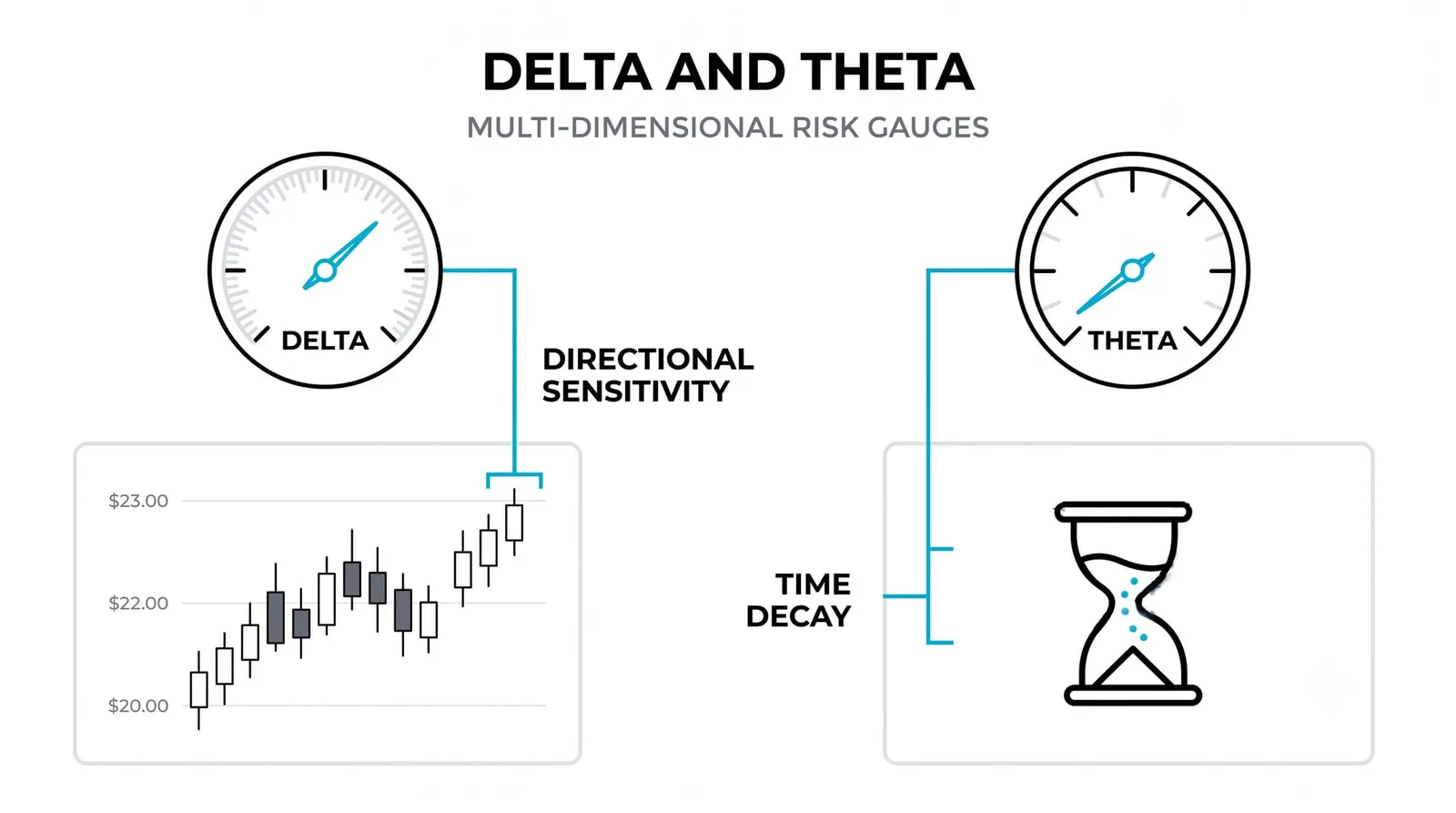
Delta answers the most basic question: if the underlying moves one point, how much does the option price move? A call with a delta of 0.50 gains roughly half a point when the stock rises one point. A put with a delta of -0.40 gains roughly 0.40 when the stock falls one point, because the negative sign marks the inverse relationship.
Call deltas run from 0 to 1. Put deltas run from 0 to -1. A far out-of-the-money call might sit at 0.10, barely responding to the stock. A deep in-the-money call approaches 1.00 and starts behaving like the stock itself. At-the-money options cluster near 0.50 or -0.50.
Traders also use delta as a rough probability shorthand. A delta of 0.30 is often read as "the market prices about a 30% chance this option finishes in the money." Treat this as an approximation, not a measurement. It comes from a pricing model built on assumptions about how prices move, and real markets violate those assumptions regularly. Use it as a quick feel for how far out-of-the-money you are, nothing more.
One practical consequence: if you buy a cheap far out-of-the-money call because it costs only a few cents, delta tells you why it is cheap. A delta of 0.05 means a one-point rally in the stock earns you five cents on the option. The stock can move in your favor and you can still lose money.
Theta: The Clock Eating the Premium
Theta measures how much value an option loses each day purely from time passing, everything else held constant. An option is a wasting asset. Every day that passes leaves less time for the move you need, and the price reflects that shrinking window.
Decay is not linear. An option with ninety days left loses value slowly. The same option in its final two weeks bleeds much faster, and in the last few days theta becomes savage. This is why experienced traders say time decay accelerates into expiry. The premium you paid is melting, and the melt speeds up as the clock runs down.
This creates the fundamental divide in options trading. Buyers fight theta. Every day you hold a long option, you pay a toll, and the underlying must move enough to cover it. Sellers collect theta. When you sell an option, that daily decay lands in your pocket as long as the market stays quiet enough. Neither side is automatically right. Buyers get leveraged upside; sellers get a steady drip of income with the risk of a large loss. Know which side of the clock you are on before you enter.
One quirk worth knowing: decay does not pause for weekends and holidays. Pricing models account for non-trading days, so theta often shows up heavier around a Friday close or before a holiday, as the market prices in dead time in advance.
Gamma: Why Delta Will Not Sit Still
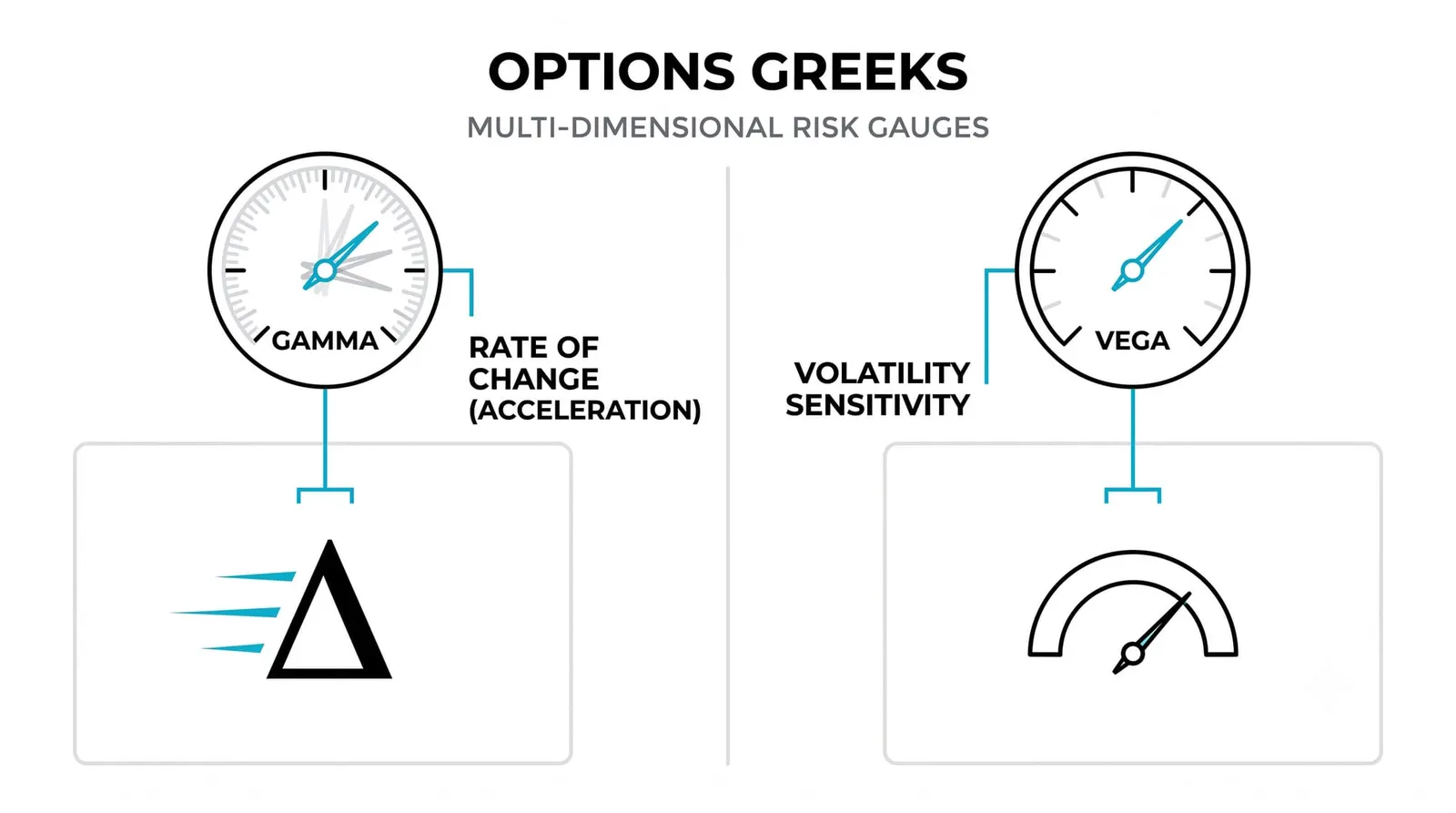
Delta is not fixed, and gamma measures how fast it changes. If your call has a delta of 0.50 and a gamma of 0.06, a one-point rise in the stock pushes delta to roughly 0.56. The option becomes more sensitive to the next move. Gamma is the rate of change of delta, the second layer of the machine.
Gamma is highest for at-the-money options near expiry and lowest for deep in-the-money or far out-of-the-money options. A deep in-the-money call already has a delta near 1.00, so there is little room for it to change. An at-the-money option in its final week can swing from a delta of 0.30 to 0.70 on a modest move in the stock.
This is why big moves surprise option holders in both directions. A long call with high gamma accelerates: each point the stock rises, the option responds more aggressively than the point before. The same math works against you on the way down, and it works violently against option sellers, whose losses can compound faster than a simple directional read would suggest.
Practical takeaway: the closer you are to expiry and the closer the strike is to the current price, the more unstable your position's behavior becomes. New traders often learn this by watching an option's gains double in an hour and not understanding why. Gamma is why.
Vega: The Volatility Dial
Vega measures how much the option price changes for each one-point move in implied volatility. A vega of 0.10 means a one-point rise in implied volatility adds about ten cents to the option's price, and a one-point fall removes it. We covered implied volatility and the VIX earlier this level; vega is where that concept becomes a precise number attached to your position.
Every option you buy carries vega exposure whether you intended it or not. When you purchase a call, you are long direction and long volatility at the same time. If implied volatility collapses after you enter, you can be right on direction and still lose money, because the volatility component of the price shrank underneath you.
The classic trap is event risk. Before an earnings report or a major data release, implied volatility inflates because nobody knows the outcome. Option prices fatten. The moment the news lands, uncertainty resolves, and implied volatility drops hard. Traders call this the volatility crush. A trader who bought calls before the event can watch the stock jump and the option barely move, because vega losses ate the delta gains.
Sellers face the mirror image. They benefit from the post-event collapse in volatility, which is exactly why selling options around events is popular and exactly why it carries tail risk when the move is larger than anyone priced in.
One Option, Four Dials
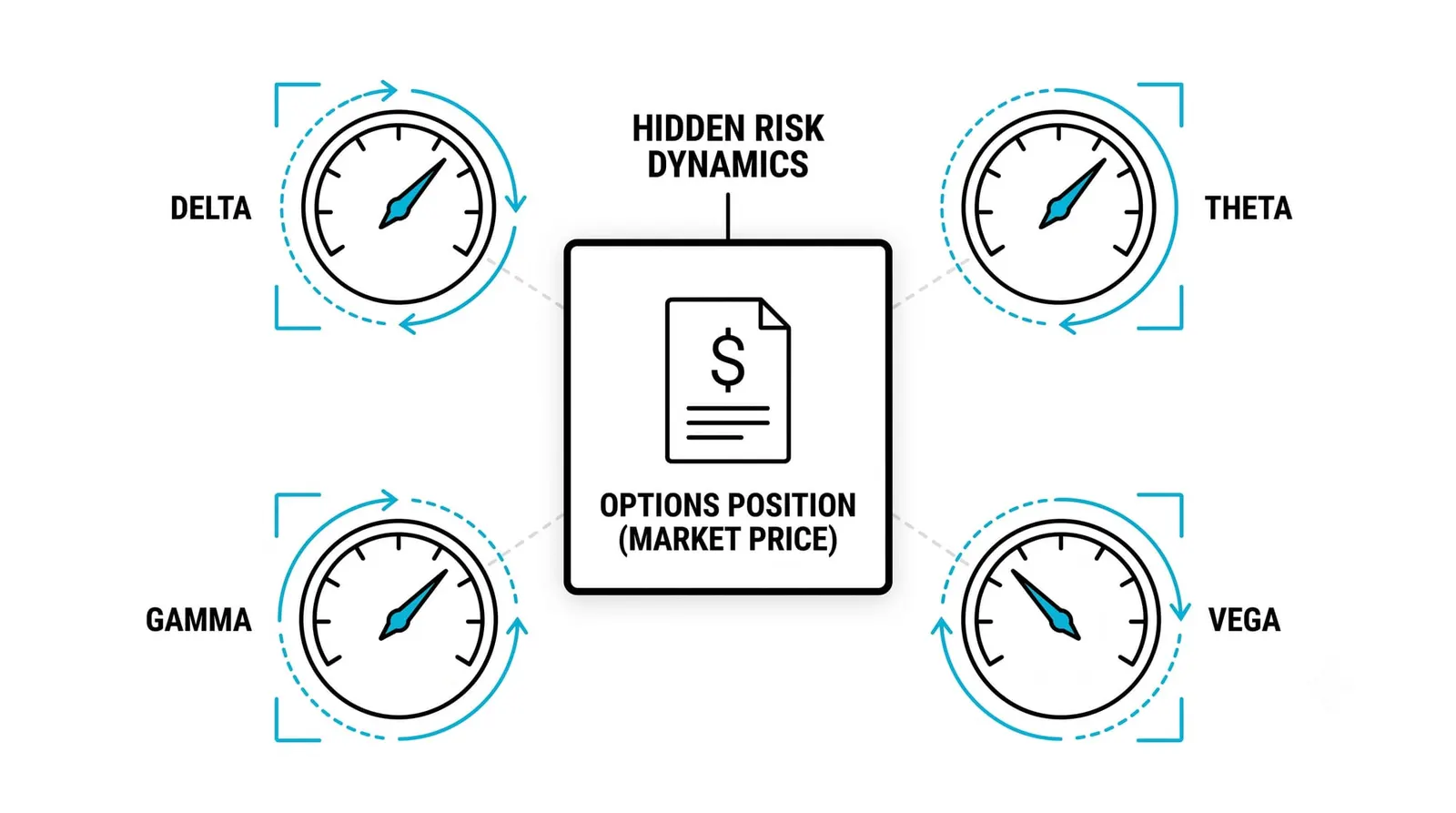
Here is a fully hypothetical illustration with round numbers. A stock trades at 100. You buy a call with a strike of 100, thirty days to expiry, priced at 3.00. Its greeks: delta 0.50, theta -0.05 per day, gamma 0.06, vega 0.10.
One week passes. The stock rises 2 points to 102. Implied volatility falls 2 points. Now separate the forces:
- Delta: the first point of the rally adds about 0.50. Gamma lifts delta as the stock rises, so the second point adds roughly 0.56 plus a bit more. Total directional gain: about 1.10. The option's price pushes toward 4.10 on direction alone.
- Theta: seven days at 0.05 per day removes 0.35. That is the toll for holding the position through the week.
- Vega: implied volatility fell 2 points. At 0.10 per point, that subtracts 0.20.
- Gamma: it does not add money directly. It explains why the delta contribution was 1.10 rather than the flat 1.00 you would get from a frozen delta of 0.50.
Net result: the option sits near 3.55, up from 3.00. You were right on direction, the stock moved a full 2 percent, and you kept only about half the directional gain because time and volatility worked against you. That is the greeks in one trade: four forces, three visible in the final price, one explaining the shape of the move.
| Greek | What it measures | Who it rewards |
|---|---|---|
| Delta | Price change per one-point move in the underlying | Traders correct on direction |
| Theta | Price lost per day from time decay | Option sellers |
| Gamma | How fast delta itself changes | Option buyers during large moves |
| Vega | Price change per one-point move in implied volatility | Buyers when volatility rises, sellers when it falls |
Options Greeks, Answered
Which greek matters most for beginners?
Delta, because direction is the first thing every option trade depends on. Understand how much exposure you actually have per contract before you worry about the finer dials. Theta should be a close second, since it quietly decides whether your timing window is realistic.
Why does theta accelerate near expiry?
Because an option's remaining value is increasingly made of time, and there is less of it left to lose each day. With ninety days out, one day passing removes a tiny fraction of the total window. With five days left, one day removes a fifth of it. The same calendar day takes a bigger bite.
Can vega hurt you after earnings?
Yes, and it is one of the most common ways new option traders lose money while being right. Implied volatility typically deflates sharply once the announcement resolves the uncertainty, so the volatility component of your option's price collapses even if the stock moves your way. The move has to be large enough to outrun the crush.
What does a delta of 0.30 actually mean?
It means the option gains or loses about thirty cents for each one-point move in the underlying, and it loosely suggests the market prices around a 30% chance of finishing in the money. Both readings are approximations from a model. Use them for orientation, not precision.
Once these four dials feel familiar, the natural next step is position-level thinking: how the greeks add up across multiple contracts and spreads, and how a portfolio of options can be long direction while short volatility, or the reverse. That is where single-leg literacy turns into actual risk management.