News Trading: Protocols Around Releases
News trading is the practice of making decisions around scheduled economic releases, and news trading protocols are the fixed routines a trader follows through those moments: what to do before the number prints, what to do during the spike, and what to do once the first move settles. These routines exist for one reason. Split-second decisions made under adrenaline are where accounts get broken, so the decisions get made in advance, at a desk, with a calm head.

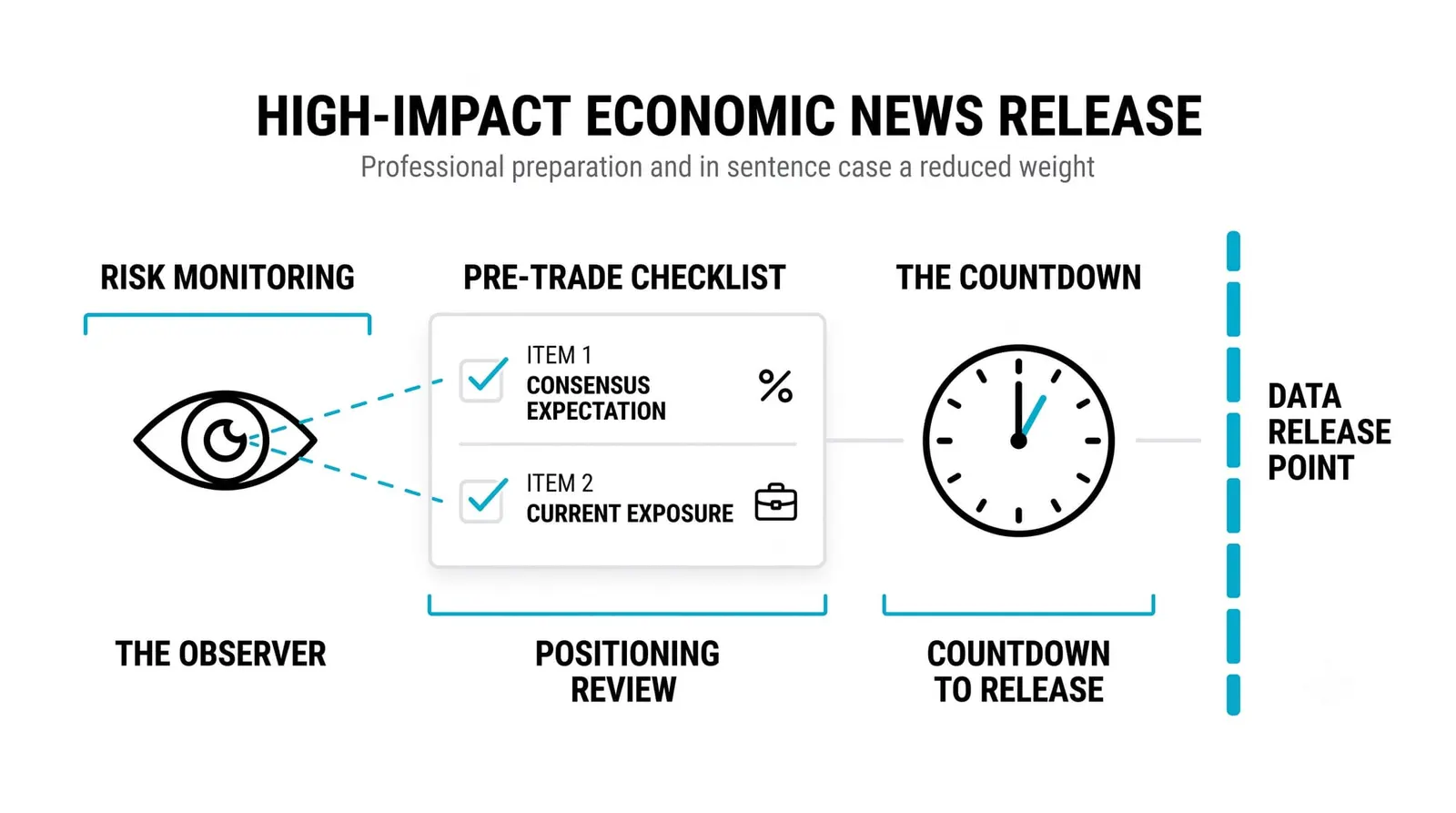
Trading a live release without a protocol is diving into water you have never checked the depth of; the protocol is checking first, in daylight, without pressure. The previous lesson covered the expectation-versus-surprise mechanics behind why prices jump on releases, so this one stays on the practical side: the routine itself. If you studied the earnings season lesson earlier in this level, you already know this discipline. A scheduled event is a scheduled event, whether it is a central bank statement or a quarterly report, and the calendar discipline transfers directly.
Pre-News Positioning: Getting Ready Before the Release
Every protocol starts hours before the number, not seconds before it. Three facts must be written down: the exact release time in your timezone, the consensus forecast, and your current exposure to anything the release can move. If you cannot state all three without looking, you are not ready to be in the market when the number lands.
Then comes the decision, and it must be made before the adrenaline arrives. You have three honest choices: hold your position through the release, reduce it, or stand aside entirely. Each is defensible. What is not defensible is deciding at the moment of the spike, because that decision will be made by fear or greed, not by analysis.
Orders and invalidation levels get set in this window too. Your stop goes where your idea is proven wrong, sized for the wider spreads you know are coming. Your entry orders, if you plan to trade the aftermath, are placed at levels you chose while the chart was quiet. Nothing about the live moment should require improvisation.
A useful habit is writing the plan in one or two plain sentences. "I am flat into the CPI print. I will look for a long only if the spike fades back through the pre-release level and spreads normalize." That sentence is the protocol. When the screen starts moving fast, you follow the sentence.
Trading the Spike: What Happens in the First Moments
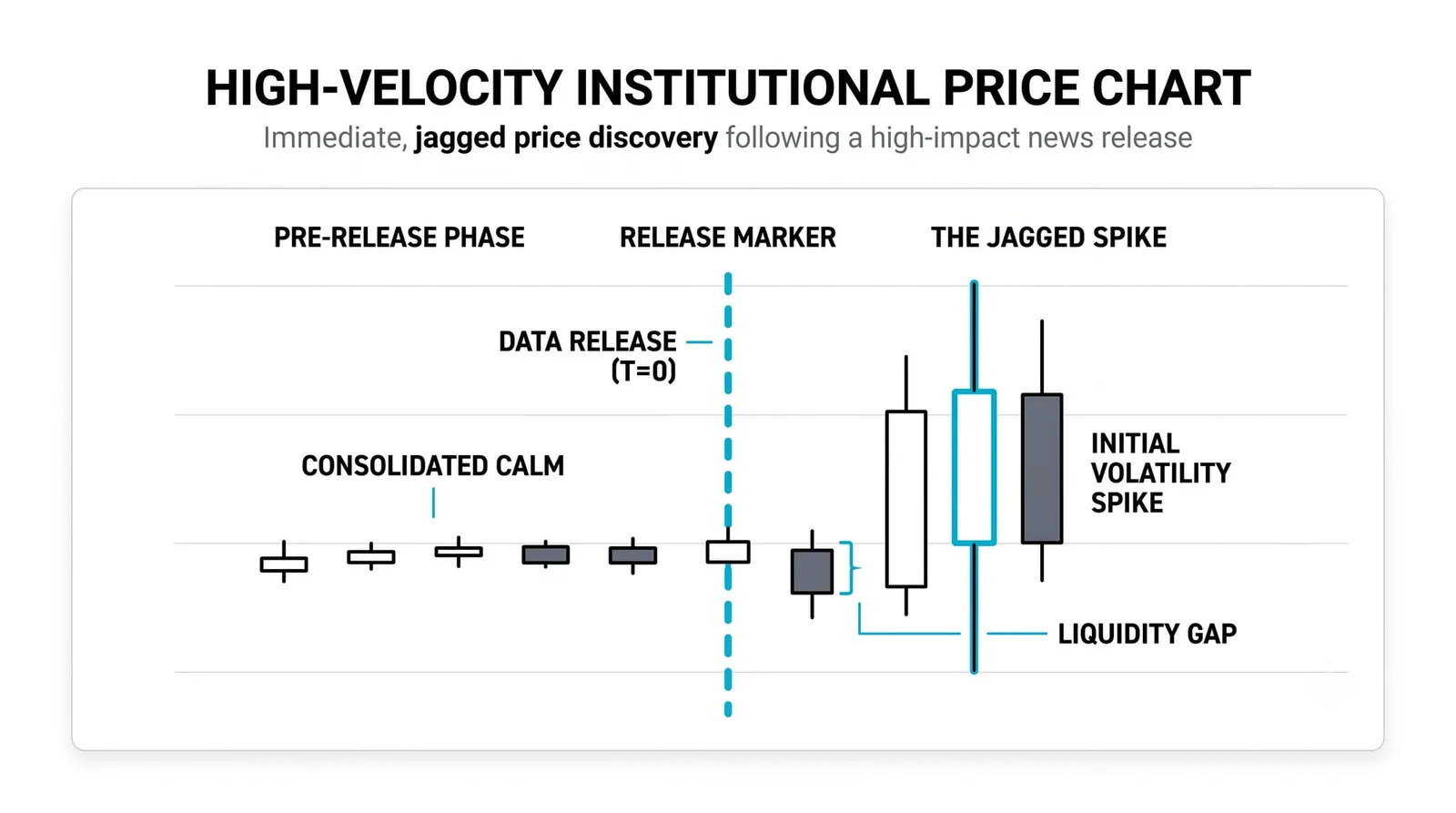
The seconds after a major release are the most distorted market conditions a retail trader will ever face. Spreads widen dramatically because liquidity providers pull their quotes or reprice them defensively. The depth of the order book thins. Machines react in milliseconds, long before any human has read the headline, let alone the details.
Slippage is the gap between the price you asked for and the price you actually got filled at. In quiet markets it is often negligible. In the first seconds of a release it can be severe, because the price you clicked on may no longer exist by the time your order reaches the market.
A market order in those first seconds is a lottery ticket. You are agreeing to pay whatever the thinnest, most panicked version of the market demands, with a spread several times its normal width and no reliable picture of where the real price is. Some traders get lucky fills. Luck is not a protocol.
The blunt version: the first move belongs to the machines and the market makers, and you are not faster than either. Accepting that is the foundation of every sensible routine around releases.
The Post-Spike Fade: When the First Move Reverses
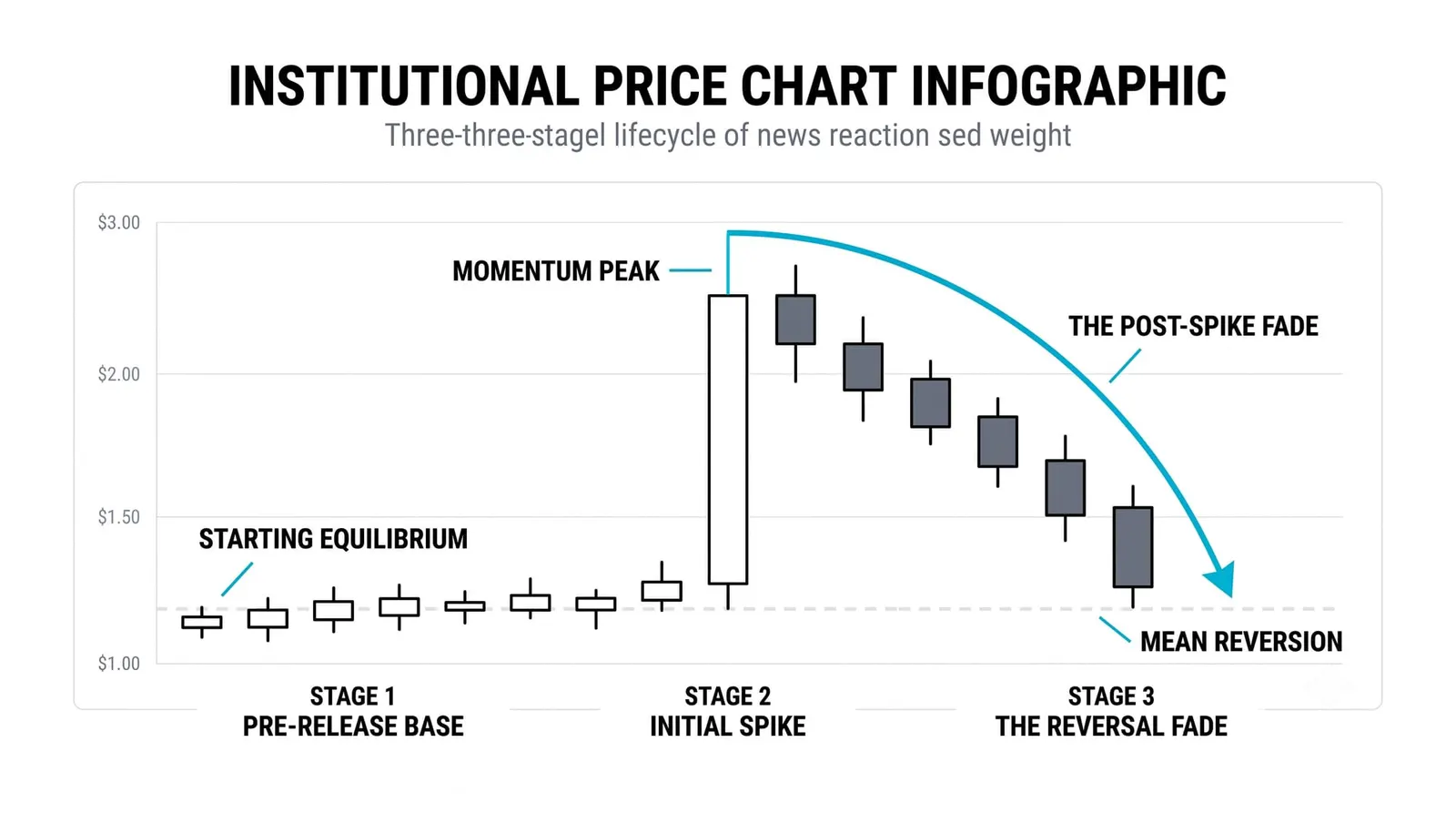
Initial spikes overextend for mechanical reasons, not always informational ones. Thin liquidity means a modest wave of orders pushes price further than it would on a normal day. Stops get triggered in clusters, adding fuel. Then liquidity returns, the forced flows finish, and price often retraces a meaningful part of the move.
The trap is chasing the spike. A trader sees a 60-pip move, fears missing the rest, and buys the top of a move that was partly an artifact of thin books. When the fade comes, that trader is immediately underwater on a position entered at the worst available price with the widest spread of the day.
The disciplined alternative is waiting for the second move. Let the spike happen. Let the fade happen. Watch where price settles once spreads normalize and real two-way flow returns. That settled level, and how price behaves around it, carries far more information than the first violent minute. Many experienced traders treat the first move as noise and the second move as signal.
This patience has a cost. Sometimes the spike never fades and the market runs without you. A protocol accepts that trade. Missing a move is a tuition fee you pay occasionally; chasing spikes is a tuition fee you pay repeatedly.
Straddle Setups: Preparing for Either Direction
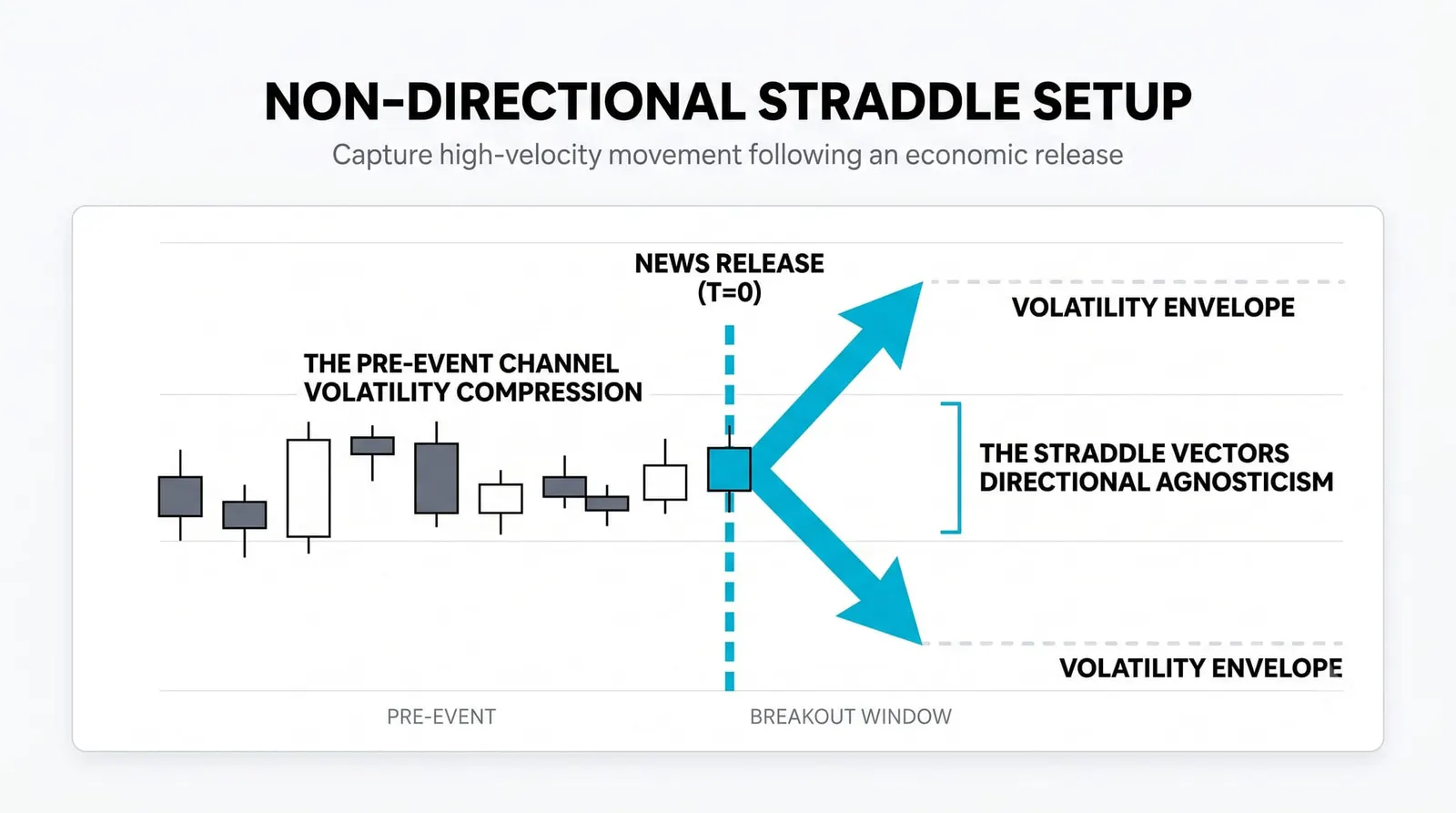
A straddle approach means placing orders on both sides of the current price before the release, so that whichever direction the market breaks, one order catches it. In practice this usually means a buy stop above price and a sell stop below it, set just before the number, with the expectation that the release will trigger one side.
The idea sounds clean, and the risk is equally clear: the whipsaw. A release can spike up, trigger your buy, reverse, trigger your sell, and then settle near where it started. Both orders filled, both positions stopped, and the market went nowhere. Whipsawed straddles are one of the most common ways new traders donate money to a news event.
Because of that, a straddle demands stricter invalidation than almost any other setup. Stops must be predefined and honored without negotiation. The distance of the orders from price must account for the spread widening, or the spread alone can trigger entries. And the trader must accept that a large share of straddles will lose small amounts, with the approach depending on the occasions when a clean directional move follows through.
Straddles also conflict with the patience principle from the previous section. One philosophy says catch the first move, the other says wait for the second. A protocol must choose which school it belongs to. Mixing them mid-release is improvisation at the worst possible moment.
One Release, One Protocol
Consider a purely hypothetical illustration with round numbers. A trader faces a central bank rate decision on a currency pair. Her protocol: any pre-news position is cut to half size, no market orders for two minutes after the release, and entries only on a retest of the pre-release level after spreads normalize.
The release hits. The pair spikes 80 pips in two minutes. Spreads triple from 1 pip to 3 pips. Over the next half hour, the move fades 40 pips back toward the pre-release level.
- What the protocol cost her: she held no position into the release, so she captured none of the 80-pip spike. A trader who guessed the direction correctly with a full position made money she did not.
- What the protocol saved her: she avoided the 3-pip spread and the slippage of the first two minutes, she never chased the top of the spike, and she was not holding a position that gave back 40 pips of paper profit in the fade.
- What the protocol gave her: after spreads returned to 1 pip, price retested the pre-release level and held. She entered there, at a price she chose calmly, with a tight invalidation just beyond the level.
On this single release, the aggressive trader who guessed right beat her. Across a year of releases, where guesses split roughly in half and the losing guesses hit at wide spreads with slippage, the arithmetic favors the protocol. The routine is not designed to win one event. It is designed to survive all of them.
The Four Phases, at a Glance
| Phase | What it is | Main risk |
|---|---|---|
| Pre-news positioning | Deciding in advance whether to hold, reduce, or stand aside, with orders and invalidation set before the release | Deciding under adrenaline instead of in advance |
| The spike | The violent first move in the seconds after the number, driven by thin liquidity and machines | Wide spreads and slippage turning any fill into a lottery |
| The post-spike fade | The partial reversal once liquidity returns and the initial overextension unwinds | Chasing the spike and getting caught by the reversal |
| The straddle approach | Orders placed on both sides of price before the release to catch the break in either direction | Whipsaw: both sides triggered on a release that goes nowhere |
News Trading, Answered
Should you hold a position through a news release?
It depends on whether the position was built to survive it. If your stop is sized for normal conditions, a release can blow through it with slippage far beyond your planned risk. Holding through news is a deliberate choice that belongs in the pre-release plan, with reduced size and wider invalidation. Holding by default, because you did not check the calendar, is the version that breaks accounts.
Why do spreads widen during news?
Spreads widen because liquidity providers face one-sided, unpredictable order flow and protect themselves by quoting wider or pulling quotes entirely. Market makers earn the spread in exchange for standing on both sides of the market; when a release makes that dangerous, they charge more for the service or step back. The wide spread is the price of immediacy at the worst possible moment to need it.
What is slippage?
Slippage is the difference between the price you requested and the price your order was actually filled at. It happens because prices move between the moment you send an order and the moment it executes, and it grows worse when liquidity is thin. During major releases, slippage of several pips beyond your intended price is common, and stop orders are not immune to it.
Is straddle trading around news profitable?
It can be, but the structure has a built-in leak: whipsaw releases hit both sides and produce two losses on an event that went nowhere. Profitability depends on strict invalidation, realistic order placement that accounts for spread widening, and enough follow-through moves to outweigh the frequent small losses. It is a demanding approach, not a shortcut around the discipline every other protocol requires.
Whatever routine you settle on, the next step is testing it against the calendar. Take the next major scheduled release, write your protocol before it, and watch the event without trading it. Watch the spread, the spike, and the fade, and grade your written plan against what actually happened. That rehearsal, repeated a few times, teaches more than any single live trade will.