Mean Reversion to VWAP: Fading Back to Value
Mean reversion to VWAP means selling price stretched far above the session's volume-weighted average, or buying it stretched below, with the average itself as the destination. The logic is simple: when price runs further than participation justified, it tends to return to the level where most of the day's volume actually traded. The fade is a bet on rotation, and it lives or dies on whether the day is rotating.

Think of a lighthouse. Ships range miles in every direction through the night, but they steer by the fixed beam, and VWAP is the fixed beam price steers by during the day. The earlier block taught what VWAP is, how price orbits it intraday, and how the standard deviation bands frame stretch. This lesson applies the reversion trade to that map. Nothing here re-teaches construction. This is about execution.
Anatomy of a Healthy Fade
A good fade has four parts, in order. Skip one and the trade loses its reason to exist.
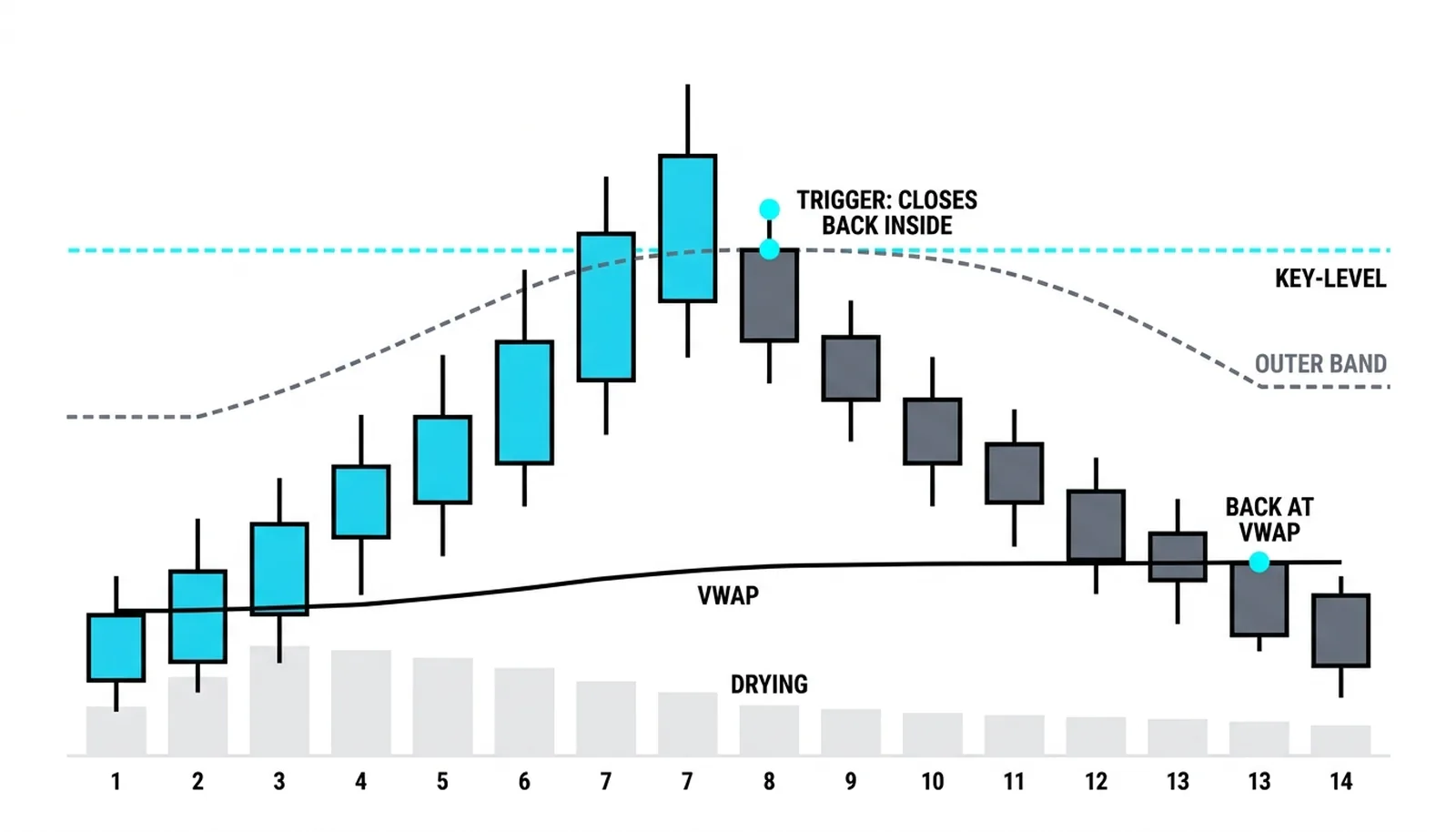
The stretch. Price reaches beyond the upper band region, far enough that late longs bought badly. Stretch alone is not a signal. It is the setup for a signal. Plenty of stretched moves keep going, which is why the next two parts exist.
The drying. Volume on the approach thins because nobody urgent is left to pay up. The anchored VWAP method frames this as the move losing its fuel. Watch the volume bars as price pushes higher. Each new high on less participation than the last is the auction running out of buyers, not finding new ones.
The trigger. A failure to extend. Either a bar prints a new extreme but closes back inside, or price hits the outer band and rejects hard. This is evidence the auction stalled. Without the trigger, the stretch and the drying are just an opinion. With it, they become a trade.
The target ladder. First the one-deviation line, then VWAP itself, taken in parts. Expecting the fade to sail through the average on the first push misreads the trade. The average is where the day's business happened, and price often stalls there, bounces there, or chops around it. Take the first portion at the inner band, take the second at the average, and let anything beyond that be a bonus you did not plan on.
The sequence, condensed:
- Stretch: price beyond the band, late buyers trapped.
- Drying: volume falls on each push, urgency gone.
- Trigger: a bar fails to extend and closes back inside.
- Ladder: partial at one deviation, rest at VWAP.
Anchored VWAP from an event works the same way for multi-day fades. Anchor to the earnings gap or the news bar, and the line becomes the argument. The fade is the walk back to it, just on a slower clock.
When the Fade Is Void
Two conditions kill this trade. Both are common. Both are identifiable in real time if you are willing to look.
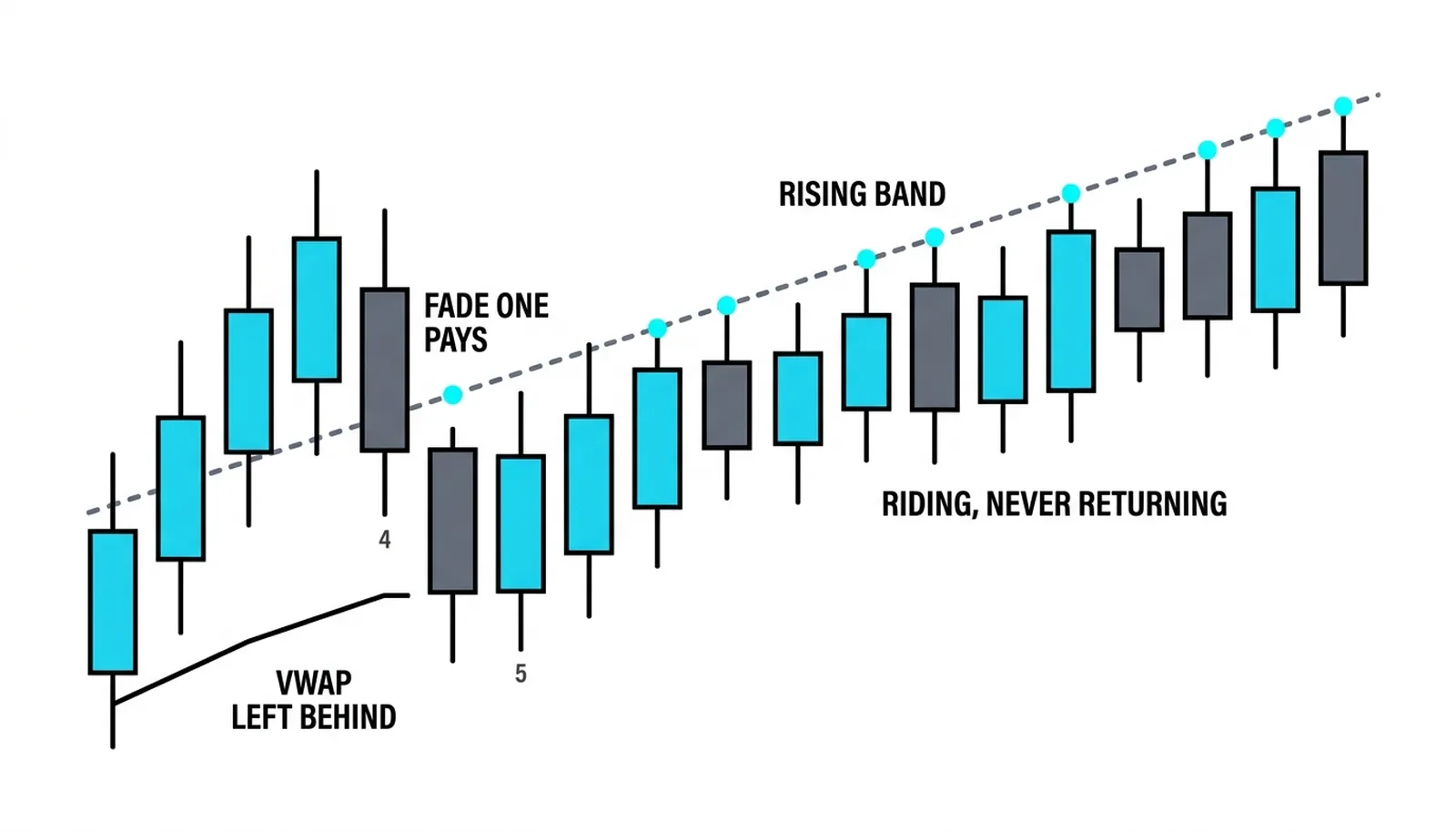
The band walk. When price stops returning and instead walks along or above the outer band bar after bar, the day has switched from rotation to trend. The fade becomes a short sale into a one-sided auction. This is the exact trade the band-walk lesson warned about. The rule is blunt: the fade is only ever taken while price is still returning. One touch of the band that rejects is a fade candidate. Five bars riding the band is a trend, and fading a trend because it "looks stretched" is how accounts shrink.
News repricing. When a genuine headline moved value itself, the old average is where price sits for the wrong reason. The move was not stretch. It was a new price discovered on information. Fading information is how small losses become qualifications. Ask one question before any fade: did something change what this thing is worth today? If yes, the bands describe a different world than the one you are trading in.
Reading the Return
The trip back to VWAP tells you who is in control. A slow, grinding return on modest volume says the stretch was exhaustion and the day is balanced. Sellers are not aggressive; buyers simply ran out. Expect the average to hold as a pivot and the session to chop around it.
A fast return on expanding volume says something else. The stretch was wrong rather than merely tired, and trapped longs are now selling to get out. That kind of return often overshoots, punching through the average before stabilizing. This is why the ladder exists. The character of the return decides whether the second target is the end of the trade or the middle of it.
Watch what price does at the average itself. Acceptance there, with volume drying and price holding, closes the reversion story. A slice through on heavy volume reopens it in the other direction. The fade ends at the line; what happens after the line is a different trade with a different thesis.
The Morning Stretch
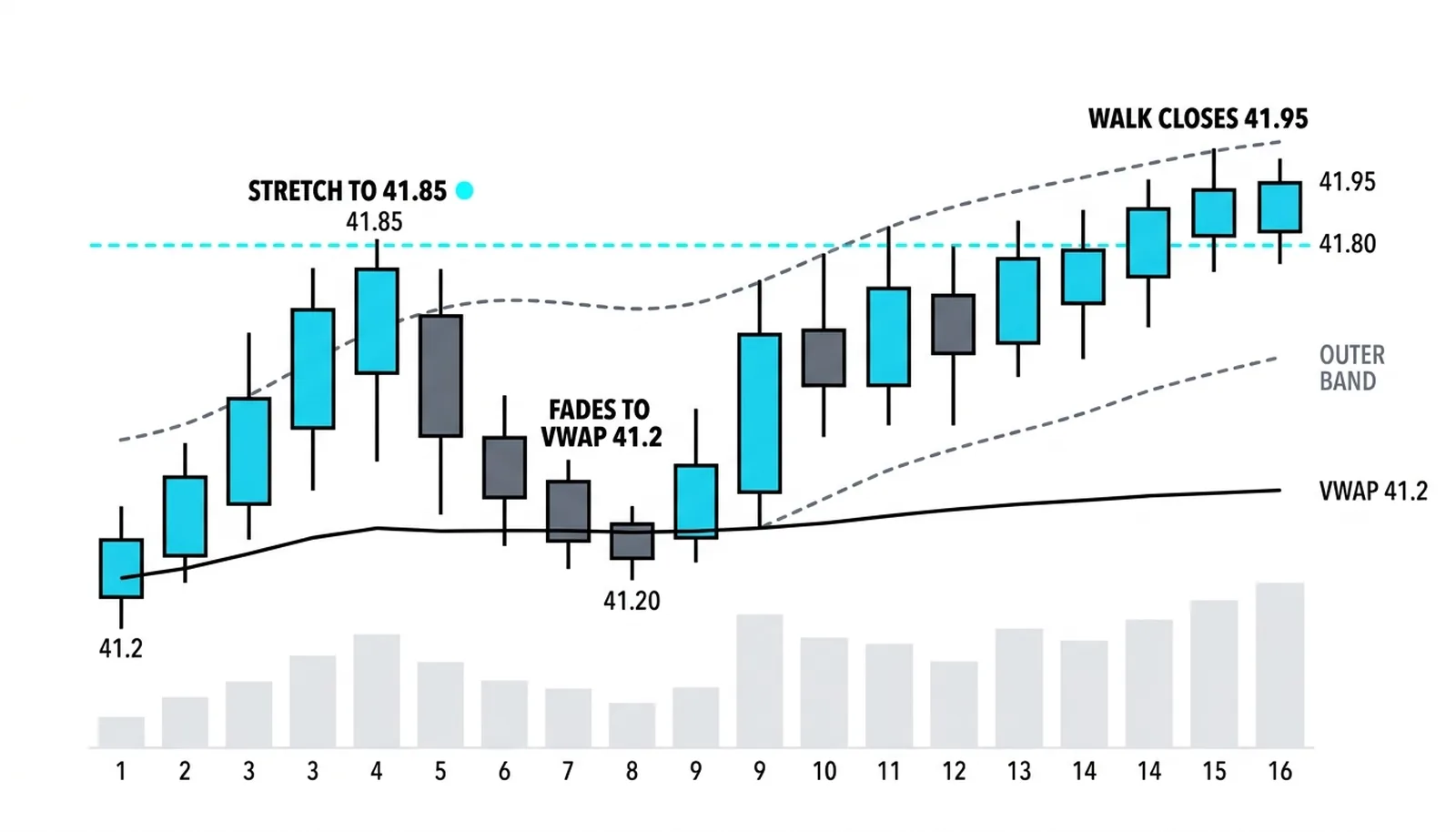
A hypothetical session, all numbers invented for illustration. VWAP sits at 41.20. One standard deviation is near 0.30, so the inner band runs around 41.50, and two deviations near 0.60 puts the outer band around 41.80.
Late morning, price pushes to 41.85. Volume dries on each advance: the push from 41.60 to 41.70 traded heavy, the push from 41.70 to 41.80 noticeably less, the final poke to 41.85 less again. Then the trigger bar prints. It spikes to 41.90, fails, and closes at 41.70, back inside the outer band.
The fade enters near 41.65 on the close of that bar. First target is the one-deviation line at 41.50, where a first portion comes off. Second target is VWAP at 41.20, reached by early afternoon, where the rest exits. The return was orderly, moderate volume, no panic. Textbook rotation.
Now the contrast. In the afternoon, price retests 41.80. This time volume rises on each push and the bars close at their highs, riding the outer band. No fade is taken. The drying never appeared, the trigger never printed, and the day had shifted into trend mode. The close prints 41.95. The morning rules applied in the afternoon would have produced a loss against a one-sided auction.
| Stretch signal | Healthy fade read | Void read | Action |
|---|---|---|---|
| Volume on the push | Thinning on each advance | Rising on each advance | Fade only when drying is clear |
| Bar at the extreme | New high, close back inside | Closes at highs beyond the band | Wait for the trigger bar |
| Behavior at the band | Rejection, price returns | Walks the band bar after bar | No fade during a band walk |
| Cause of the move | No news, pure extension | Headline repriced value | Never fade new information |
VWAP Fades, Answered
How far from VWAP should you fade?
Far enough that late participants are trapped, which in practice means at or beyond the one-deviation band, with the cleanest fades starting near two. Inside one deviation, price is still in normal rotation and the fade has no edge.
When is fading VWAP wrong?
Fading is wrong when the day is trending or when news moved value itself. A band walk and a genuine headline both void the setup, because in both cases price is not stretched away from the day's consensus; the consensus moved.
Where should a VWAP fade target?
First the one-deviation line, then VWAP itself, taken in parts. The average is where the day's volume traded, so expect price to stall or chop there rather than pass cleanly through on the first touch.
What confirms a VWAP fade?
A trigger bar: a new extreme that fails and closes back inside, or a hard rejection at the outer band, ideally after volume thinned on the approach. Stretch plus drying plus failure to extend is the full confirmation; any two of three is a wait.
The next lesson takes the same reversion logic off the time-based average and onto the volume profile itself, where the point of control and the value area give you fixed prices to fade toward instead of a moving line.