Intraday VWAP Trading: How Price Behaves
Intraday VWAP trading is the craft of reading how price behaves around the session's volume-weighted line, because VWAP acts as the day's pivot of value. In a balanced session, price orbits it. In a strong session, price rides above it. The character of each approach, whether the line is respected or swept aside, tells you which kind of day you are in, and that read is worth more than any single touch.

Think of a carousel at the fair: the painted figures circle a fixed center pole all day, sometimes hugging it close and sometimes swinging wide, and the pole never moves. Price does the same around VWAP. The previous lesson built VWAP as the session's value reference, the average price weighted by where volume actually traded. This lesson owns what happens next: the behavior around that reference from open to close. Volume price analysis has long argued that volume and price together tell the real story of a session, and VWAP is where that argument becomes visible on an intraday chart. The line is not a signal by itself. The reaction at the line is the signal.
The Balanced Day and the Orbit
On a balanced day, price rotates above and below VWAP with roughly equal time on each side. Neither buyers nor sellers can hold control, so value keeps reasserting itself. Extensions away from the line stall, and price drifts back. This is the session where VWAP earns its reputation.
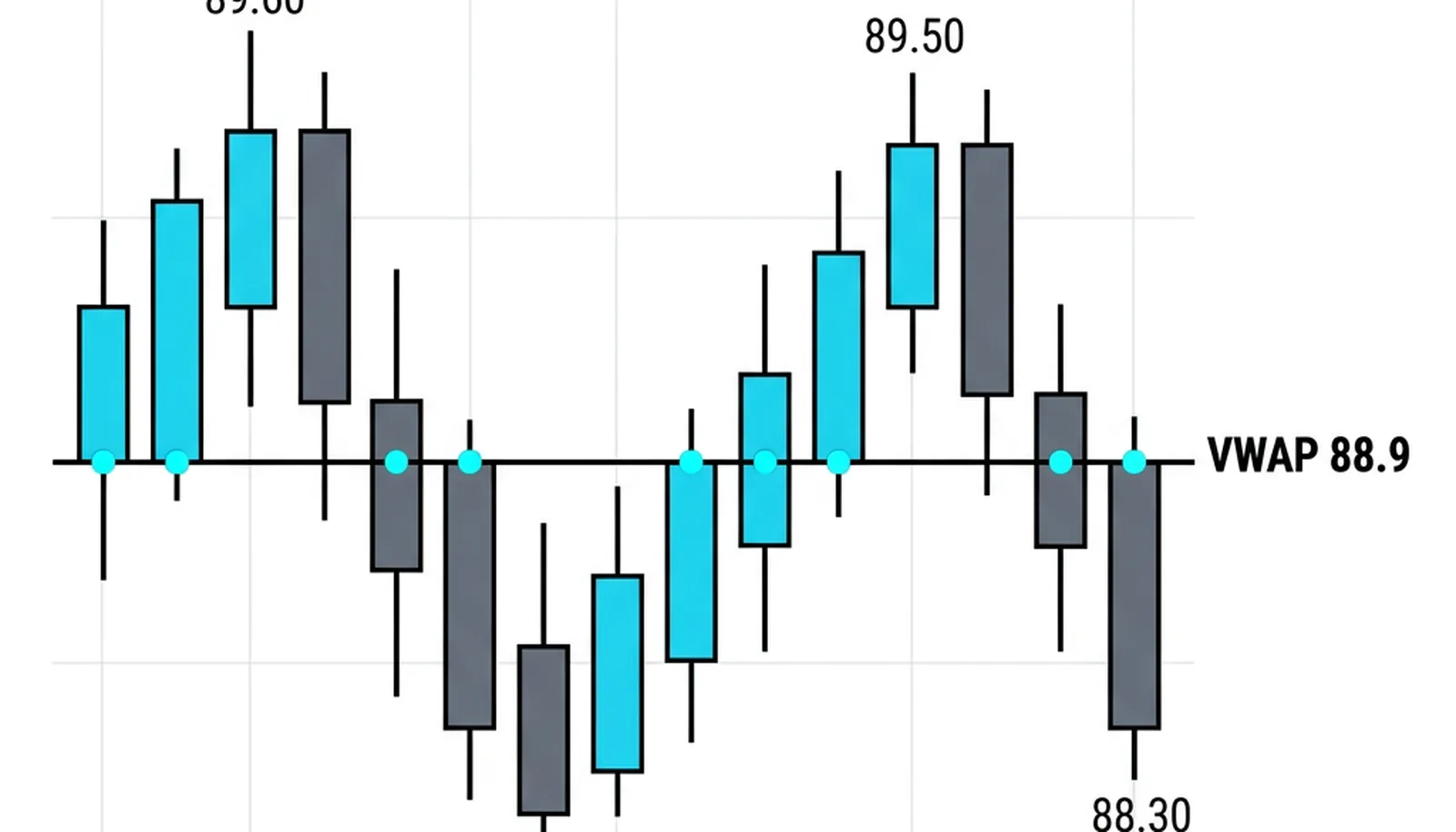
The trade in a balanced day is the fade. When price stretches well above the line and momentum dries up, you sell the extension back toward value. When it dips below and sellers cannot press, you buy the dip back toward the line. You are betting that the rotation continues, and on a balanced day that bet has the odds.
Two things confirm you are in this kind of session. First, each return to VWAP produces a bounce in the opposite direction of the approach, so the line keeps getting respected from both sides. Second, the extremes of the day form early and hold, with price spending the middle hours inside the morning's range. When those two conditions show up together, fading extensions is the plan and chasing breakouts is the mistake.
Most traders get hurt here by doing the opposite. They buy the push above VWAP expecting a trend, and the rotation sells them back down. The balanced day punishes breakout logic and rewards patience at the extremes.
The Trend Day and the Guard Rail
On a trend day, price holds one side of VWAP all session. Every pullback into the line gets bought in an uptrend, or sold in a downtrend, and the line changes character. It stops being a center of rotation and starts acting like a guard rail on a mountain road: price leans on it, bounces off it, and keeps moving in one direction.
The read that matters is the first real test. If price pulls back to VWAP, holds it, and makes a new high, the trend day is confirmed and the line becomes your reference for entries. You buy the touches with a stop just through the line, because a genuine trend day should not give VWAP back. If the line fails and price accepts below it, the trend thesis is dead and you stand down or flip.
There is a stronger version of this session, the open drive. Price leaves VWAP in the first hour and never meaningfully returns. Pullbacks are shallow, the line chases from below, and waiting for a touch means watching the whole move pass. The correct read on an open drive is patience in a different form: either you are already in from the open, or you accept that the clean entries are gone and you do not chase. Forcing a trade late in a one-way session is how good analysis turns into bad fills.
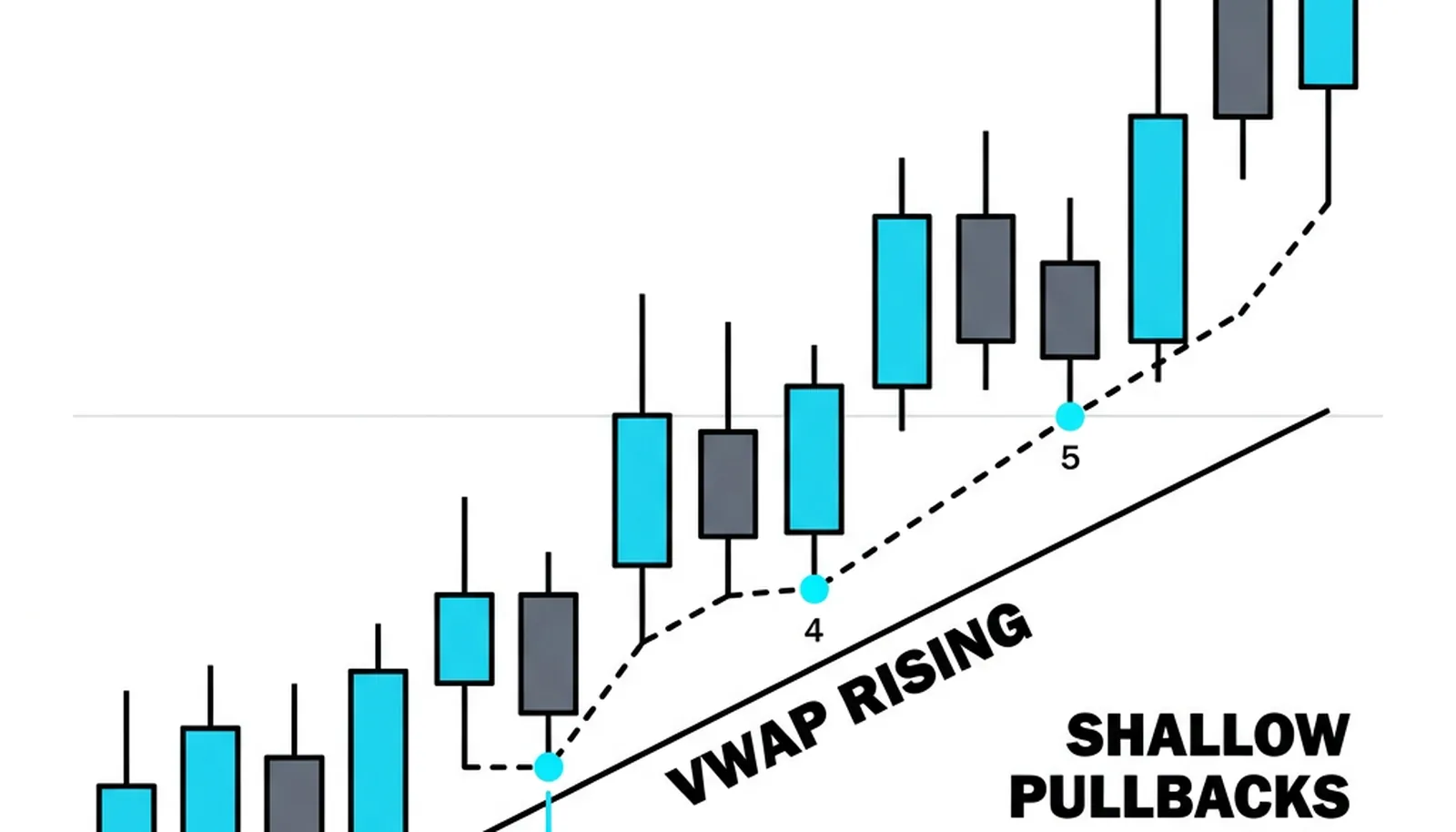
One caution applies to everything in this section. VWAP is not a magic support. In a strong trend, the line gets sliced during fast moves and the trend continues anyway. The trade is the reaction around the line, the hold or the failure, never the touch itself. A touch with no response is information, not an entry.
Touches Wear Out
Not every touch of VWAP deserves your money. The first and second touches of the session are the tradable ones, because the line still carries information and the market has not yet decided what kind of day it is. By the fourth or fifth touch, the line is worn out. Price is chopping through it from both sides, nobody respects it, and trading the touches becomes coin-flip territory.
The logic is simple. A level that keeps getting tested and keeps holding is being defended. A level that gets crossed repeatedly in both directions is being ignored. When you see price slicing back and forth through VWAP in the afternoon, the honest read is that the session has no directional sponsor, and the right position is often no position.
The late-day break is the exception that deserves attention. Sometimes a session holds VWAP all afternoon, then loses the line in the final hour on expanding volume. That is a different animal from the worn-out chop. The expanding volume says real money is moving, and the day's story flips late. A trader who was long above a respected VWAP at 2:45 pm and is still long through a high-volume break at 3:15 pm is holding a trade whose premise just died.
That raises the second caution. The last hour is a different market. Closing auctions, fund rebalancing, and de-grossing distort VWAP behavior after 3:00 pm, and a morning lesson does not automatically survive into the close. Tighten your expectations as the session ages. Reads that were reliable at 10:30 am get noisier each hour, and the final thirty minutes answer to flows that have nothing to do with the day's earlier structure.
One Day at 88.90
Here is a hypothetical session, all numbers invented and round. A stock opens at 88.40. Buyers work it higher through the morning, and by midday VWAP has climbed to 88.90. That rising line is the first fact: value is migrating upward, so the session leans bullish.
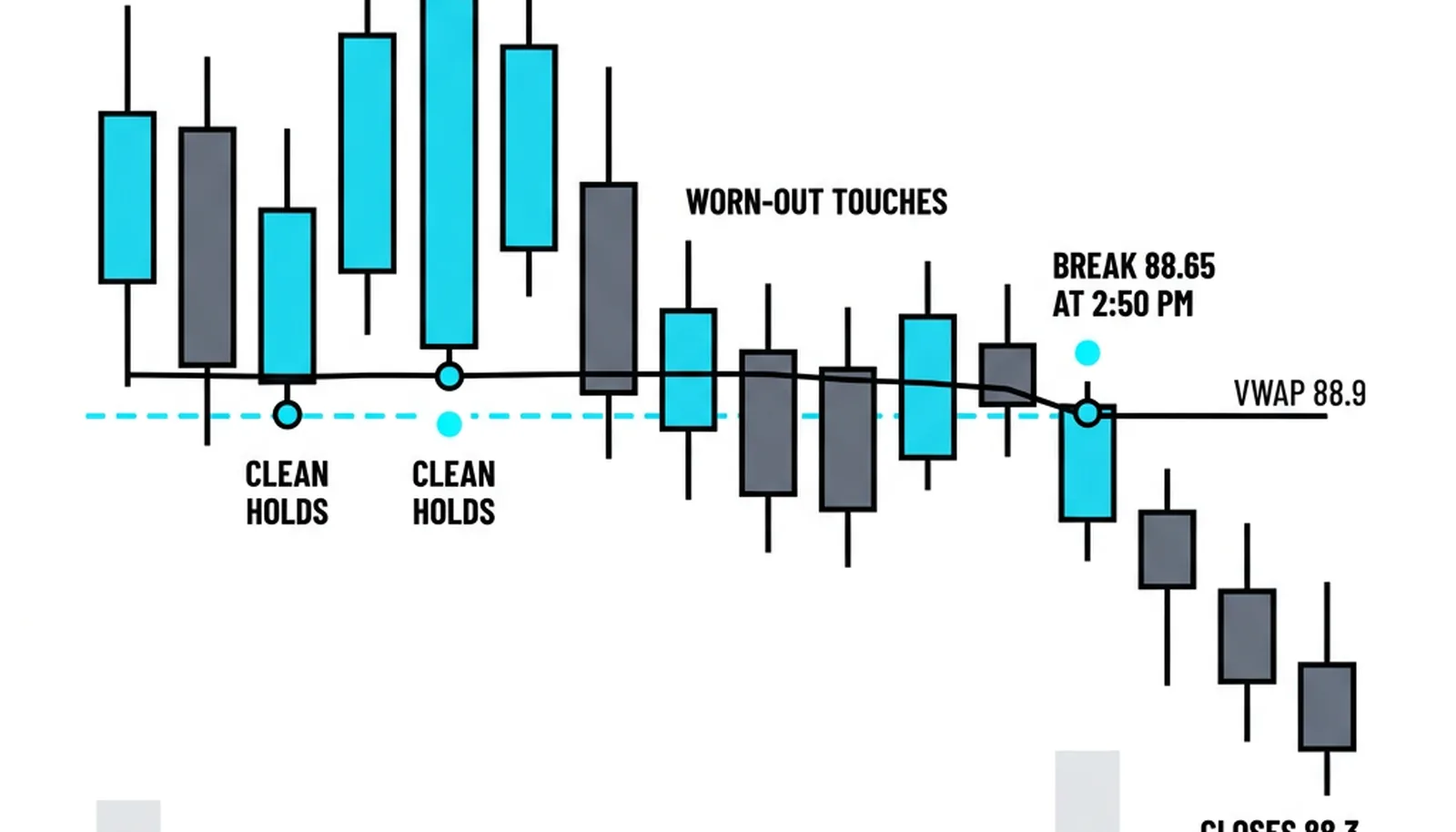
At 10:30, price pulls back and tags VWAP from above at 88.90. It holds, and buyers step in. That first touch is the cleanest trade of the day, a pullback to a rising line in a young trend. Price rotates up to 89.35.
At 12:40, price tags VWAP again near 89.00 and holds a second time. This touch is still tradable, though the reward is thinner because the move is now mature. Price pushes on to 89.60 by mid-afternoon. A third and fourth approach in the early afternoon get choppy, with price crossing the line both ways. Those touches are the worn-out kind, and trading them is guessing.
At 2:50 pm, the line breaks at 88.65 on expanding volume. This is the first genuine failure of the day, and it changes everything. The trend thesis that worked at 10:30 is finished. Price closes at 88.30, below the open and well below VWAP. The close says the late sellers won the session, and anyone still holding longs from the morning touches was holding them on a read that expired hours earlier.
| Time of Day | VWAP Behavior | The Read | The Trap |
|---|---|---|---|
| 10:30 am | First tag from above, holds at 88.90 | Clean trend-day entry, buy the hold | Skipping the stop because the line "should" hold |
| 12:40 pm | Second tag near 89.00, holds again | Still tradable, smaller size, mature move | Expecting the same reward as the first touch |
| Early afternoon | Repeated crossings both directions | Line is worn out, stand aside | Fading every touch in the chop |
| 2:50 pm to close | Break at 88.65 on expanding volume | Trend thesis dead, exit or flip | Holding longs into the close on a broken premise |
Intraday VWAP Trading, Answered
What is intraday VWAP trading?
It is the practice of reading how price behaves around the session's volume-weighted average price, using the line as the day's reference for value. You trade the reactions at the line, the holds, the failures, and the rotations, rather than the line itself.
Should you buy every touch of VWAP?
No. The first and second touches of a session carry the most information and offer the best trades. By the fourth or fifth touch the line is worn out, price is chopping through it, and the touches have stopped meaning anything.
Why does price keep returning to VWAP?
Because VWAP marks where the day's volume actually traded, so it represents the price the session's participants collectively accepted as fair. In balanced sessions, moves away from that consensus attract the opposite side, and price rotates back. In trend sessions, one side is strong enough to keep price away from the line all day.
Does VWAP work in the last hour of the day?
Less reliably. Closing auctions, rebalancing flows, and de-grossing distort behavior after 3:00 pm, so reads that worked in the morning degrade as the session ages. A late-day break of VWAP on expanding volume is meaningful, but routine touches in the final hour deserve extra skepticism.
The next lesson in this block stretches the same line across a longer horizon: weekly and monthly VWAP, and what changes when the reference outlives the session.