Mean Reversion Setups: Entry, Stop, Target
Mean reversion trading reduces to three decisions wired together: an entry trigger that demands evidence the stretch has failed, a stop placed where the reversion thesis is genuinely dead rather than merely annoyed, and a target at value itself. The stop is the controversial one. Quantitative backtesting practice puts the problem honestly: stopping out contradicts the very assumption that price returns, because a cheaper price is supposedly a better price. This lesson resolves that tension into working mechanics.

Think of the stop as a circuit breaker, fitted calmly long before any fault, silent through ordinary surges, and tripping only when something is truly wrong. The earlier lessons in this block covered why price reverts and where the destinations sit, the session average and the value area. This one assembles the trade.
Entries That Demand Evidence
Two honest entry styles exist, and each charges a different fee.
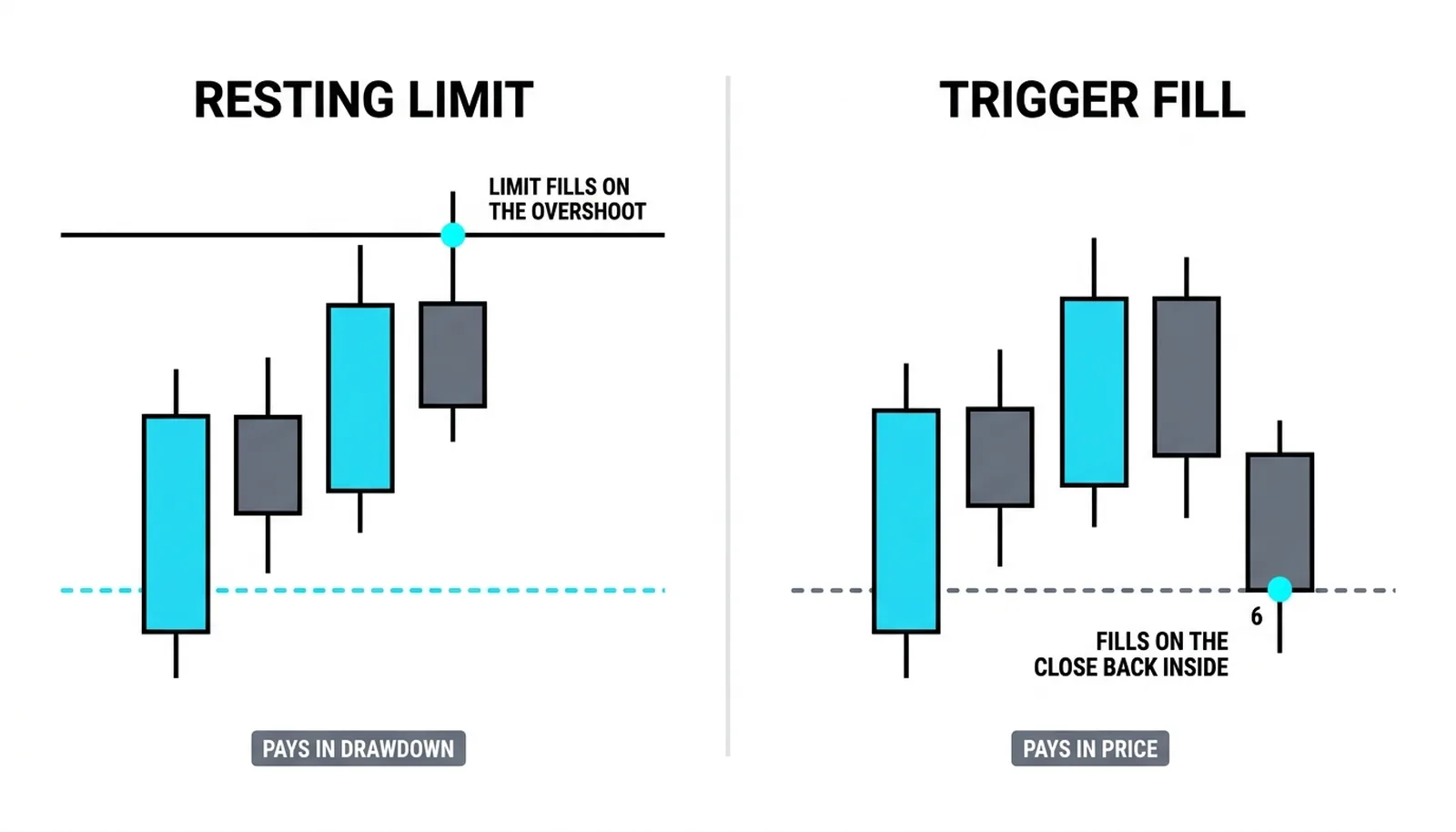
The trigger entry waits for the failed extension. Price pushes to a new extreme, then closes back inside the prior range, or auctions beyond a value boundary and gets rejected. You enter on that failure, not before. The cost is a few points versus the absolute extreme. The benefit is that you skip the falling knife entirely, because you only act once the stretch has demonstrably stalled.
The limit entry rests at the outer band or just beyond value, waiting to be filled. It gets you in fast markets without staring at the screen, and it often fills at better prices than any trigger would. Its cost is structural: a resting limit keeps filling as price overshoots, so you can hold a position that is already underwater while the stretch continues. That is the design, and it demands smaller size and a wider stop to match.
Neither style is morally superior. The trigger pays in price, the limit pays in drawdown. Pick the fee you can actually tolerate, because the one you cannot tolerate is the one you will abandon mid-trade.
Targets and the Time Stop
The mean itself is the first and honest target. Scale there, or just in front of it, because price often stalls a tick shy of the level everyone is watching.
The far side of value is a bonus reserved for strong conditions, when the fade has momentum behind it and the tape carries through the mean. Expecting every fade to blast through value on the first push misreads the trade. Reversion means return to value, not a guaranteed trip to the opposite extreme.
Then there is the exit nobody plans: the time stop. If the trade has not worked within roughly the horizon the reversion speed justified, the thesis is stale. A fade that was supposed to resolve in an hour and has done nothing for three is telling you the condition changed. Exit without ceremony. Time is a cost, and a flat trade that should have worked is information.
The Stop Problem
State the paradox plainly. If you believe price reverts, then a wider loss always looks like a better entry, and a stopped-out trade always looks like one that would have worked. Followed honestly, that logic ends at the flash crash of May 6, 2010, when broken liquidity printed absurd prices and stop orders on real companies filled at fractions of a dollar. Quantitative backtesting practice cites that day when arguing stops must exist as disaster insurance even for reversion strategies, because the one time the mean does not come back, the unhedged fade is fatal.
The resolution is two stops doing two jobs.
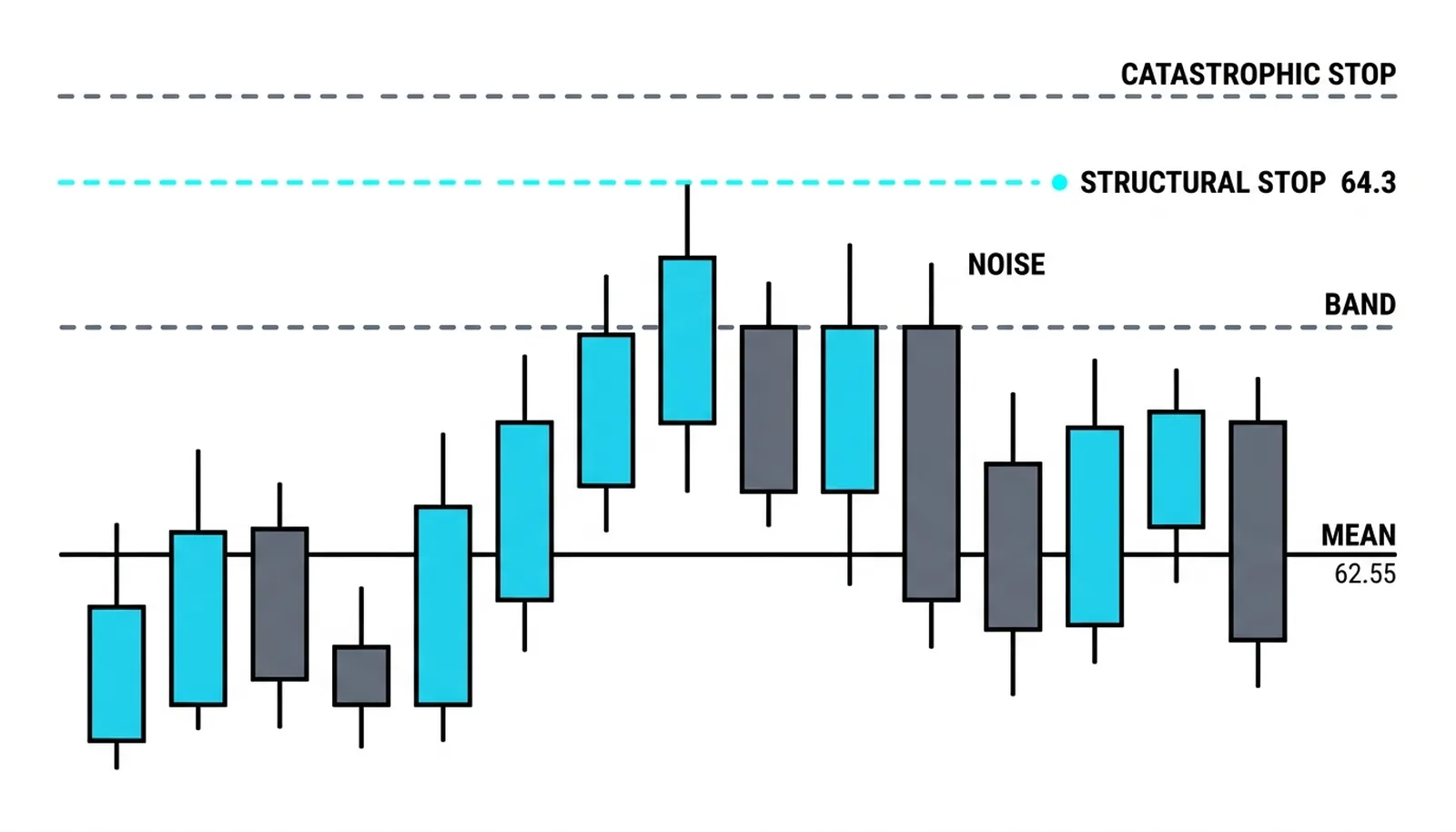
- The structural stop sits beyond the stretch extreme and its noise, at the price where the reversion story is actually wrong. Size the position so that getting there hurts once, a planned, survivable loss.
- The catastrophic stop never moves. It exists for the day markets break, the flash-crash scenario, and it sits far enough away that normal volatility can never touch it.
Stops parked at obvious round numbers sit exactly where everyone else's sit, which is precisely why they fill worst. Clusters get run. Place the structural stop beyond the noise, not on the nearest round figure, and let size, not stop tightness, control the risk.
The Fade at 63.80
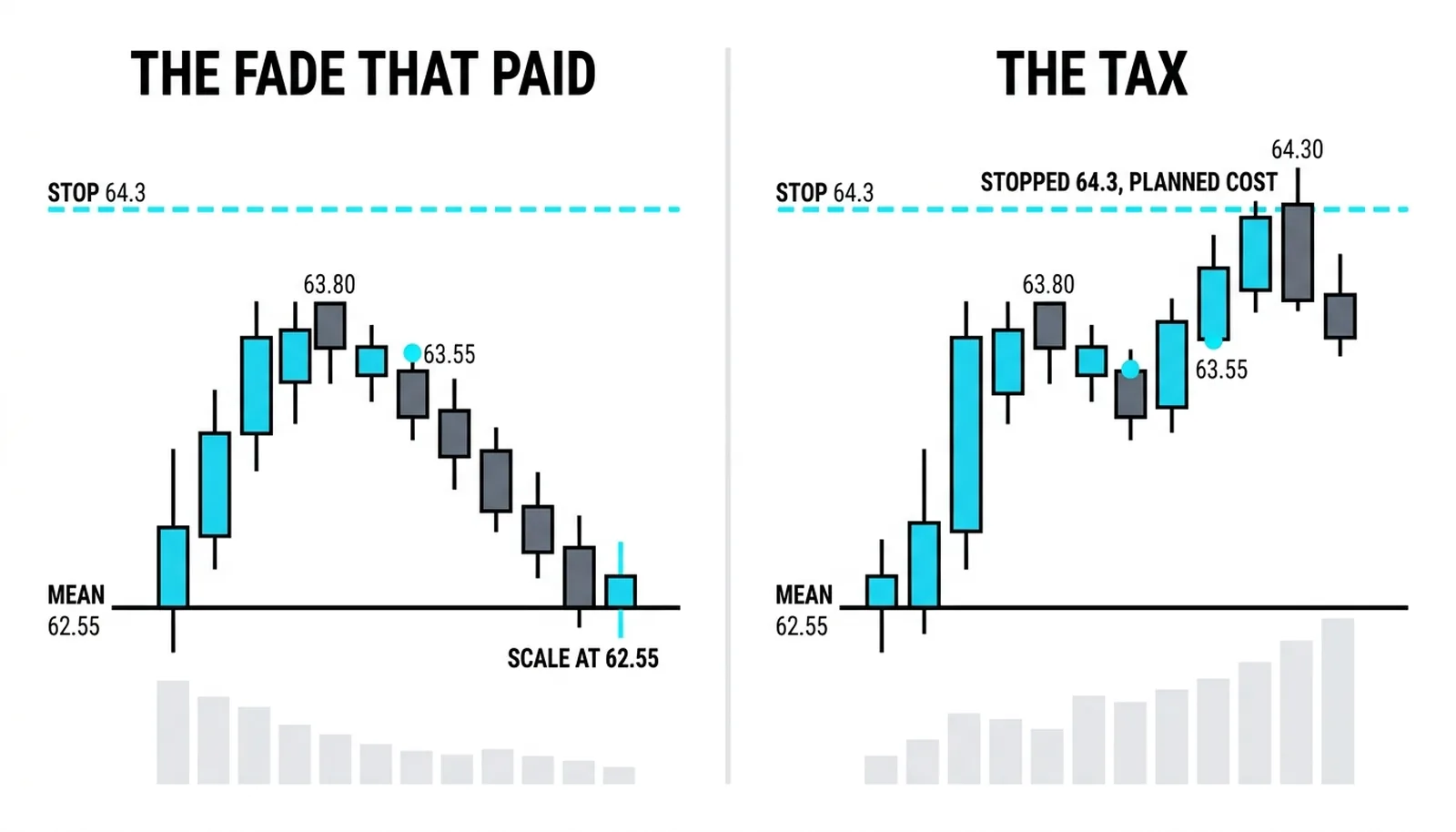
A hypothetical illustration, round numbers throughout. A mean sits at 62.55 with one deviation measured at 0.35. Price stretches to 63.80, spikes an extreme at 63.90, and closes back at 63.60. That close back inside is the failed extension.
The trigger entry fills at 63.55 on the close of the trigger bar. The structural stop goes at 64.30, beyond the 63.90 extreme plus its noise, far enough that ordinary chop cannot reach it. The catastrophic stop rests untouched at 64.85, insurance against a broken day.
Price reverts. The first scale comes off at 62.95, just in front of the one-deviation line at 62.90, banking the easy part. The remainder exits at 62.70 as price approaches the 62.55 mean, because front-running the level beats hoping for the last nickel.
Now the contrast case. Two weeks later, the same setup appears, same entry at 63.55. But this time the day is building volume above the extreme rather than rejecting it. Price grinds through 63.90 and the structural stop fills at 64.30 for the planned one-time hurt. That loss is the business paying its tax. The trader who moves the stop on a day like that converts a planned cost into an open-ended one, and the volume said the stretch had sponsorship all along.
| Component | The rule | The common mistake | The fix |
|---|---|---|---|
| Entry | Wait for the failed extension, or rest a limit beyond value | Catching the stretch mid-flight with no evidence | Demand a close back inside, or accept the limit entry's drawdown cost with smaller size |
| Structural stop | Beyond the extreme and its noise, where the thesis is dead | Parking it on a round number in the cluster | Place it past the noise and control risk with position size instead |
| Target | Scale at or just before the mean | Demanding the far side of value on every fade | Bank the mean first; treat the far side as a strong-day bonus |
| Time stop | Exit when the justified horizon expires | Holding a stale fade and hoping | Define the reversion speed before entry and leave when it lapses |
Mean Reversion Setups, Answered
Where should a mean reversion stop go?
Beyond the stretch extreme and its noise, at the price where the reversion story is genuinely wrong. Then add a second, unmoving catastrophic stop for the day liquidity breaks. Avoid round numbers, because clusters of stops at obvious levels fill worst.
Why do my stops get hit before the reversion?
Almost always because they sit inside normal noise, usually at obvious prices everyone else picked. The fix is a wider structural stop combined with smaller size, so the same risk in currency buys enough room for the stretch to finish stretching.
Where do you take profit on a mean reversion trade?
At or just in front of the mean: VWAP, the point of control, or the value area edge, whichever the fade targeted. Scale there first, and only hold for the far side of value when conditions are clearly strong.
What is a time stop?
An exit triggered by the clock rather than by price. If the reversion has not happened within the horizon its typical speed justified, the thesis is stale and you leave, win, lose, or flat.
With entries, targets, and stops wired together, the mean reversion block is complete. The next step is the skill that decides whether any of this applies at all: telling mean-reverting conditions from trending ones before the trade, not after the stop.