Market Cycles — the Four Phases
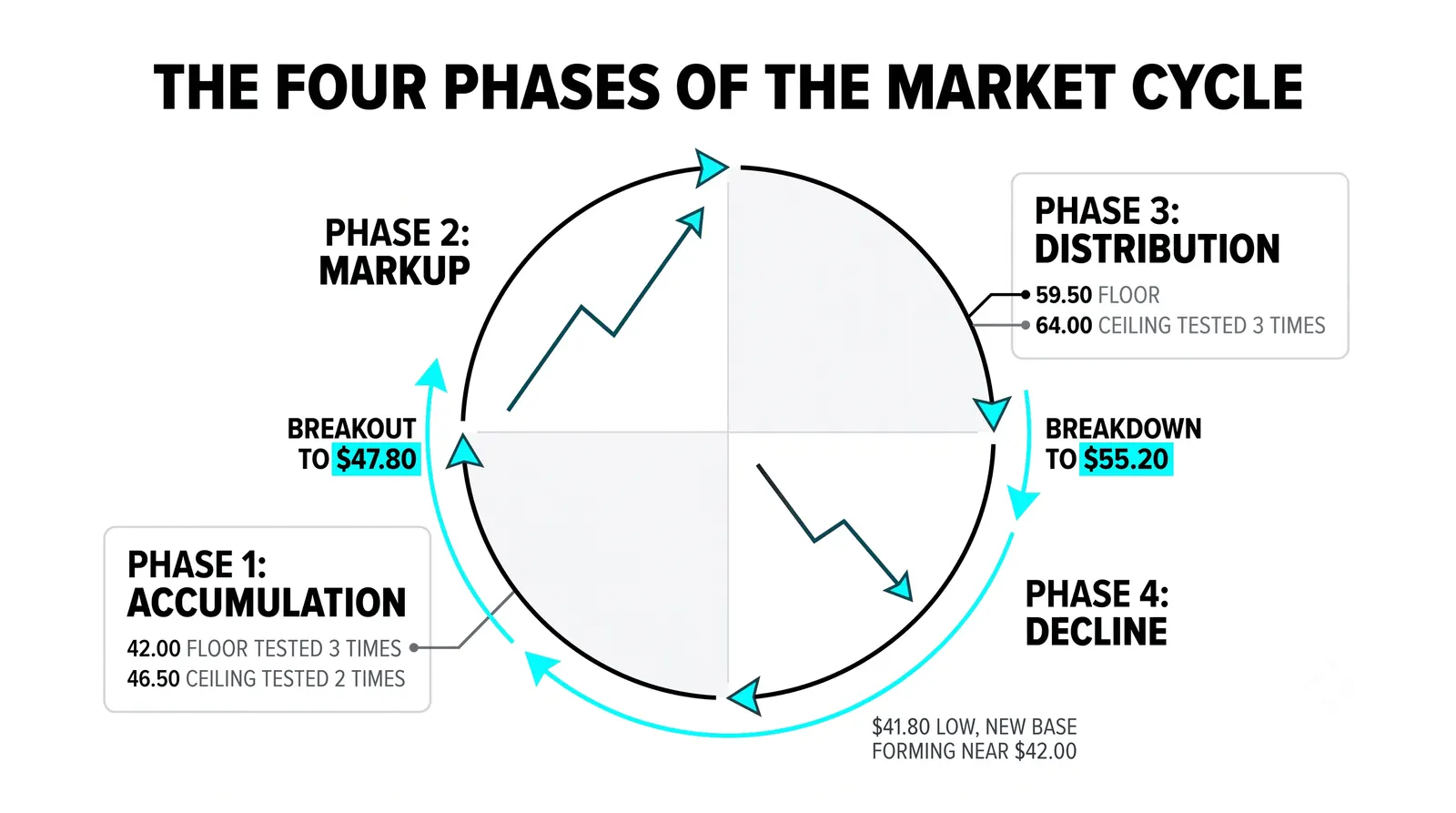
Market cycles are the repeating four-phase pattern that price moves through: accumulation, markup, distribution, and markdown. Each phase is defined by where informed money is building or unwinding positions relative to everyone else. Once you can label the phase you are in, most chart behavior stops looking random.

Think of it like farming. Informed money plants in spring, the crowd arrives for the scenery in summer, and the harvest happens while they are still admiring the view.
This post walks through each phase, then runs one stock through the whole loop with round numbers.
Accumulation: The Quiet Range After a Decline
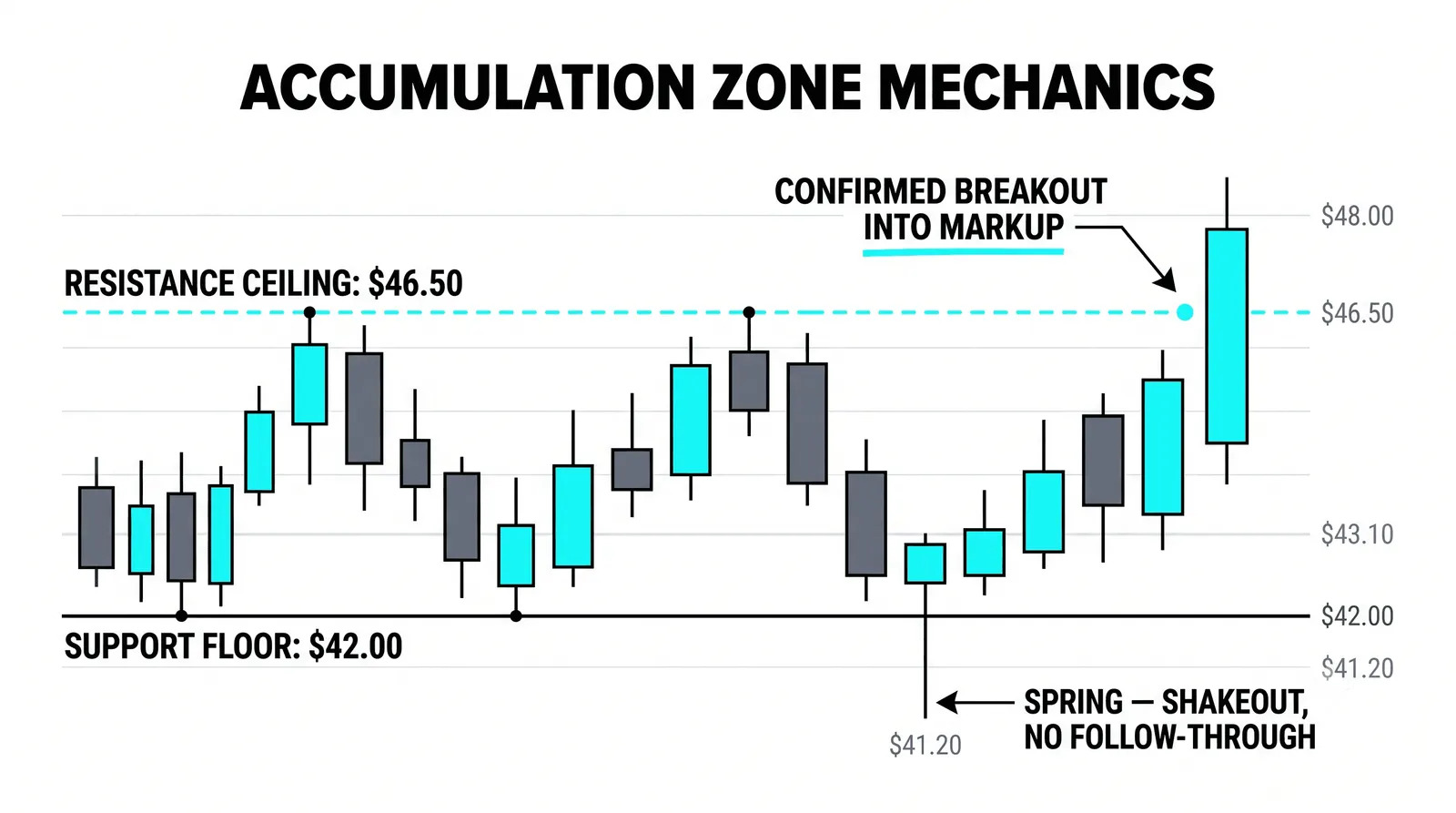
Accumulation is a sideways range that forms after a meaningful decline. Price stops falling, but it does not rally either. It chops sideways, often for weeks or months.
Volatility dries up. The swings get smaller. Volume often thins out compared to the panic selling that came before.
The news is still terrible. Headlines talk about the decline, the broken sector, the reasons the stock deserved to fall. Retail traders who survived the drop are exhausted. Most have sworn off the name entirely.
That is exactly when informed money buys. They buy into weakness, patiently, inside the range. They absorb supply from sellers who are giving up. They do not chase price up, because chasing would raise their own cost.
The key behavior: every dip toward the bottom of the range gets bought, and the buying is quiet. No excitement. No headlines. Just a floor that keeps holding.
Markup: The Advance Everyone Joins Late
Markup begins when accumulation is finished and price breaks out of the range. The informed money has its position. Now price is free to rise because the available supply at low prices is gone.
The advance has a recognizable rhythm. Price pushes higher, pulls back, and the pullback gets bought. Each dip finds buyers faster than the last. Higher highs, higher lows.
The crowd joins late. Early in the markup, most retail traders do not believe the rally. They call it a dead-cat bounce. By the middle, they start to notice. By the end, they are buying aggressively, often right before the phase ends.
News improves during markup, but notice the order of events. Price usually turns first. The good news arrives afterward and reads like an explanation.
Your job in markup is simple: respect the trend, buy the dips that hold structure, and do not confuse a normal pullback with the end of the move.
Distribution: The Loud Range After an Advance
Distribution is a sideways range that forms after a meaningful advance. Structurally it looks like accumulation flipped upside down, but the emotional tone is completely different.
Now the news is great. Earnings beat. Analysts upgrade. Everyone who bought during markup feels smart, and new buyers keep arriving because the story sounds wonderful.
Informed money sells into that strength. They need buyers, and the euphoric crowd provides them. Every push toward the top of the range meets supply. Rallies fail at roughly the same level, over and over.
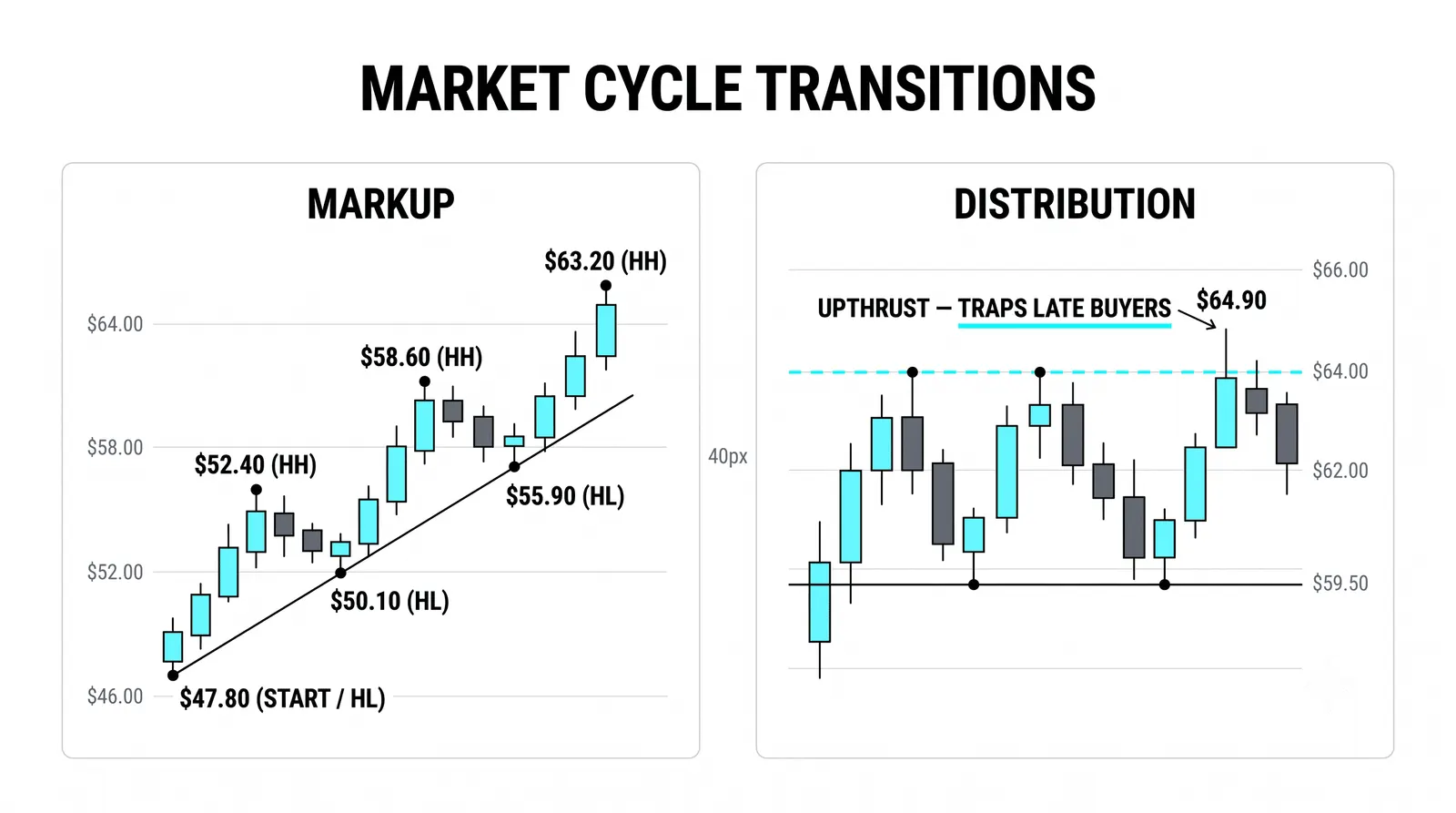
Volatility often picks up compared to the smooth markup. Swings get wider and sharper. That is large positions changing hands.
The crowd reads each dip as a buying opportunity, because buying dips worked all through markup. That habit is exactly what lets informed sellers exit at good prices.
Markdown: The Decline Nobody Believes
Markdown begins when distribution is complete and price breaks below the range. The informed sellers are out. There is no one left to support price at those levels.
The crowd holds and hopes. They bought near the top, so they are underwater quickly. Instead of selling, they wait for the price to "come back." Rallies happen, but each one fails lower than the last.
Lower highs, lower lows. Dips do not get bought anymore. They get sold.
Bad news arrives during markdown, just as good news arrived during markup. Again, the news mostly justifies what price already started doing.
Eventually the decline exhausts itself, sellers run out, and the whole thing sets up for accumulation again. The loop repeats.
What Actually Drives the Cycle
Positioning drives the cycle, not calendars. There is no schedule that says a stock must rally in a certain month or fall in a certain quarter.
Phases end when the side that needed to act is done acting. Accumulation ends when informed buyers have filled their positions. Distribution ends when informed sellers have unloaded theirs. The breakout or breakdown is the signal that the work is finished.
This is why cycles vary so much in length. A large position takes time to build without moving price against yourself. Sometimes that takes weeks. Sometimes it takes a year.
News plays a supporting role. It mostly arrives to justify the phase already underway. Good news during distribution keeps retail buying so sellers can exit. Bad news during accumulation keeps retail selling so buyers can accumulate.
Once you see this, you stop trading headlines and start reading the auction underneath them.
Why Ranges Are Ambiguous in Real Time
Accumulation and distribution look identical while they are happening. Both are sideways ranges. Both have a floor and a ceiling. Both frustrate breakout traders who get chopped up inside them.
You cannot tell them apart by staring at the range itself. The tell is where the range came from.
A range that forms after a long decline is a candidate for accumulation. A range that forms after a long advance is a candidate for distribution. Context before the range matters more than anything inside it.
Secondary clues help. Quiet, low-volume ranges with bad news lean toward accumulation. Wide, volatile ranges with great news lean toward distribution. But these are hints, not proof.
Proof only comes at resolution. The breakout or breakdown confirms which side won. Until then, treat the range as undecided and size your conviction accordingly.
One Stock Through the Whole Loop
Here is a hypothetical example with round numbers, purely for illustration.
Accumulation: After falling from higher levels, the stock ranges between 90 and 100 for months. News is bleak. Informed money is quietly buying near 90 to 93 from discouraged sellers. The crowd has given up on the name.
Markup: Price breaks above 100 and runs to 140. Pullbacks to 110 and 125 get bought quickly. Early in the move, retail calls it a trap. By 135, they are piling in. Informed holders simply hold and let the trend work.
Distribution: Price stalls and ranges between 130 and 150. Headlines are glowing. Every push toward 150 meets selling. Informed money is unloading to enthusiastic late buyers who think each dip is a gift.
Markdown: Price breaks below 130 and slides to 95. Rallies to 120 and 110 fail. The crowd holds and hopes the whole way down, anchored to the 150 they saw. Sellers who exited in distribution watch from safety.
Four phases. Same stock. The only thing that changed was who held the shares and at what price.
How to Position Your Reading
You will not always label the phase correctly. Nobody does. The goal is to ask better questions, not to be certain.
- How long has this range run? A range of a few weeks after a two-year advance is probably a pause, not full distribution. Time matters.
- What preceded it? A range after a decline and a range after an advance are different animals, even if they look the same on screen.
- Who has already bought? If everyone you know owns the stock and loves it, ask who is left to buy. If everyone hates it, ask who is left to sell.
- What is the news doing relative to price? Great news with a stalling price is a warning. Terrible news with a price that refuses to fall is a clue.
- Which boundary breaks? Let the resolution confirm your read instead of front-running it with full size.
These questions will not make you right every time. They will keep you from being confidently wrong at the worst moments.
The Cycle at a Glance
| Phase | Who Is Buying | Who Is Selling | Crowd Emotion |
|---|---|---|---|
| Accumulation | Informed money, quietly | Capitulating retail | Despair, boredom |
| Markup | Trend followers, then late retail | Early doubters exiting too soon | Skepticism turning to greed |
| Distribution | Euphoric late buyers | Informed money, into strength | Confidence, excitement |
| Markdown | Bottom-fishers catching falling prices | Trapped holders finally giving up | Hope turning to fear |
Market Cycles: Your Questions, Answered
How long does a full cycle take?
There is no fixed length. A full cycle can take months on a small stock or years on a major index. The duration depends on how long informed money needs to build and unwind positions, not on any calendar. Expect variation and let the structure, not the clock, tell you where you are.
Can a cycle skip a phase?
Rarely, and usually only in appearance. A strong markup can blow through what looked like distribution and keep going, which means the range was a re-accumulation, not a top. The four phases still describe the logic; real charts just relabel ranges after the fact. Stay flexible with your labels.
Do cycles work on all timeframes?
Yes. The same four phases appear on a five-minute chart, a daily chart, and a monthly chart. A daily accumulation range might contain dozens of smaller intraday cycles inside it. This is why multi-timeframe reading matters: the phase on your trading timeframe sits inside a larger phase that can help or hurt you, which is the core of multi-timeframe analysis.
What ends a cycle?
A completed markdown that exhausts its sellers ends the cycle and opens the door to the next accumulation. In practical terms, the cycle ends when the last forced sellers are out and price stops making lower lows. From there, the loop starts again with quiet, boring, hated sideways action.
Start labeling phases on charts you already know. Pick ten past moves, mark the four phases, and note what the news sounded like in each one. That habit builds the pattern recognition this entire framework depends on, and it prepares you for the next step: timing entries inside the phase you have identified.